
Right now I’m reading two books that wouldn’t seem to have much to do with each other. One is a book on writing, especially on writing fiction, by Stephen King. The other is on trinitarian theology, by Robert Jenson. (I highly recommend both, even if you don’t fashion yourself a writer or theologian, though Jenson’s most recent work might be an easier starting place.)
I’m also trying to write about the church’s doctrine of the Trinity. When you talk about the Trinity, you walk through a minefield. With every description, you risk heresy. If you’ve ever heard the Trinity compared to H2O (ice, water, steam) or to a man in three different roles (father, husband, son) or to a three-leaf clover, it was a bad description. It bordered on heresy if it didn’t go the whole way there. Even better analogies, like a three-note chord, still have problems. Every analogy falls short. This brief, funny video shows the problem.
Scripture shows us God as Father, Son and Spirit relating to one another, but it doesn’t explain this trinitarian relationship in the fashion we would like. Some people note that the word “Trinity” isn’t used in the Bible, nor is the doctrine spelled out. Some even suggest that the Church may have invented the concept of “Trinity.” They don’t find the word or a clear description in the Bible. It must not be real. This treats the problem as if only what’s defined is real.
Others start from the opposite end: Everything that’s real can be defined. So they labor to fill in the descriptive holes left by the biblical narrative, explaining what we mean when we say “Trinity.” The best attempts have led to major theological statements, with words like homoousios. The worst attempts have led to heresies.
Robert Jenson says that even with our best attempts, we’ve created a problem by separating trinitarian theology from the biblical narrative. Even our less-than-heretical attempts to describe the Trinity do damage as they move from depiction to description.
Our analytical, bullet-pointing, PowerPointing Western minds love description. We like to understand just how everything works. And so, in any of our -ologies, we assume a sort of science, in which all can be explained. But if we can move out of the world of -ology, we can see that bare description doesn’t always enhance understanding.
Depiction Trumps Description
This is where Stephen King comes in. He says, “One of the cardinal rules of good fiction is never tell us a thing if you can show us, instead.”
You’ve seen this. In the world of narrative, depiction can do much more than description. You’ll understand a person better by living with them through the narrative than you will through reading a character description. Moreover, that character description can’t explain everything. Personality is more complex than description can contain.
If this is true for mere humans, how much more must it be true for the Triune God? Words will fail to fully describe.
Theology in Liturgy and Scripture
This is where I love the way the Eastern Church has done theology. Jaroslav Pelikan describes it this way:
To grasp the Eastern understanding of the church and of its doctrine, “one has to return from the school-room to the worshiping Church and perhaps to change the school-dialect of theology for the pictorial and metaphorical language of Scripture.”
The church’s liturgies and biblical accounts do theology in a different way than our textbook theology. In fact, Jenson notes, “What kept the apologists religiously trinitarian was not their theology but their church’s liturgical life.”
In the church’s liturgies we baptize in the name of Father, Son and Holy Spirit and we sing “Glory be to the Father and to the Son and to the Holy Spirit.” We give trinitarian benedictions like the great one from 2 Corinthians: “The grace of the Lord Jesus Christ and the love of God and the fellowship of the Holy Spirit be with you.” And we have icons like this brilliant one from Andrei Rublev, which depicts the Trinity at table, in relation to one another.
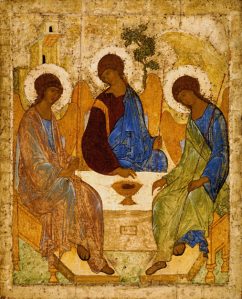
Perhaps in our theology, we should take Stephen King’s advice. “Never tell us a thing if you can show it instead.” The next time someone asks you to explain the Trinity, instead of turning to examples of H2O or three-leaf clovers or musical chords, turn instead to Jesus’ baptism in Matthew 3 and Paul’s benediction in 2 Corinthians 13 and Rublev’s icon.
I said this before in relation to preaching, and so now I say it more broadly for theological discussion: better to tell the story than to talk about the story.
Did you enjoy this? Click here to receive new posts in your inbox.
 You may notice that the Old Testament spells out
  teddy ray