
In the coming years, the church must find a way to maximize its resources. The United Methodist Church serves as an excellent experimental lab, with thousands of ongoing experiments running in different local churches and Annual Conferences. What can we learn from those experiments? I wrote part I of this series on pastoral tenure and transition. The next two parts will focus on church growth and church planting.
Two charts that should change how we think about church growth
I’m going to share two charts with you that should make us reconsider how we typically think about church growth.
These are based on my research of the United Methodist Church in Kentucky. This is obviously a limited data set. One denomination, one state.[note]Not even a full state. Just my conference. A handful of our counties are in another conference.[/note] Nevertheless, it gives us over 800 churches in 105 counties, so there’s a lot to work with here. I suspect that it would hold true if we went beyond my denomination and state.[note]Preliminary research on the North Carolina Conference of the UMC shows similar results.[/note]
An easy first question: Is there a relationship between the number of churches in a county and the percentage of that county’s population in worship?
If you said yes, you were right. More churches = more people in worship. The chart below plots each county based on its number of UMC churches per capita and the average percentage of the population in worship attendance at UMC churches.
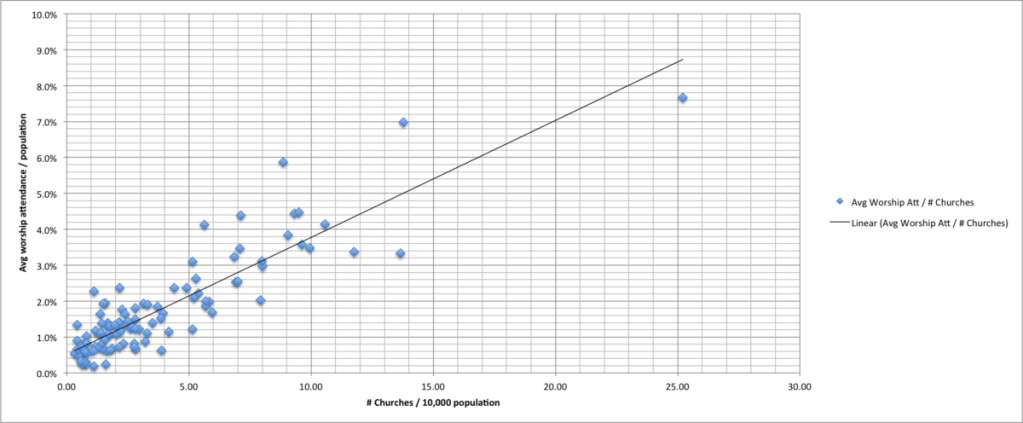 Look at that beautiful direct relationship. More churches = more people in worship.
For people who like math and statistics, the correlation here is 0.884.
If you’re unfamiliar with correlations, they show you how closely related two variables are.
A 1 signifies a perfect positive relationship. Things with high positive correlations: ice cream sales vs. the outdoor temperature, your waist size vs. the amount of junk food you eat.
A -1 signifies a perfect negative relationship. Things with high negative correlations: hot chocolate sales vs. the outdoor temperature, your waist size vs. the amount you exercise.
A 0 signifies no relationship. Things with a near-0 correlation: the temperature outside vs. the amount of money in your bank account.
So a 0.884 correlation suggests a strong relationship between these two things.[note]There’s an important reminder in statistics: correlation does not imply causation. The number of people who drowned by falling into a swimming-pool correlates with the number of films Nicolas Cage appeared in during the year. Nevertheless, I think we have reason to believe that some causation is happening here. A few people might argue that the number of people in worship is causing the number of churches in that county. I don’t think that argument would find much support.[/note] I took this data to a team of MBA students at UK to be sure I hadn’t mishandled my data or misunderstood my results. They came back to me amazed that the data showed such a strong one-variable relationship.[note]For statistical analysis nerds, there’s much more here to discuss re: regression analyses. A regression analysis using county size and churches per capita shows a p-value of 4.4*10^-37 for churches per capita. A regression analysis using county size and average church size shows a p-value of .97 for average church size. I’m happy to continue the conversation and get your help and input for any next steps of study. Email me.[/note]
Let’s ask a next question. Is there a relationship between the size of churches in a county and the percentage of the population in worship?
This seems as intuitive as the first question. Bigger churches should equal more people in worship.
If you said yes… you were wrong. Bigger churches = nothing as far as total reach. The chart below plots each county based on the average size of its UMC churches and the percentage of the population in worship attendance.
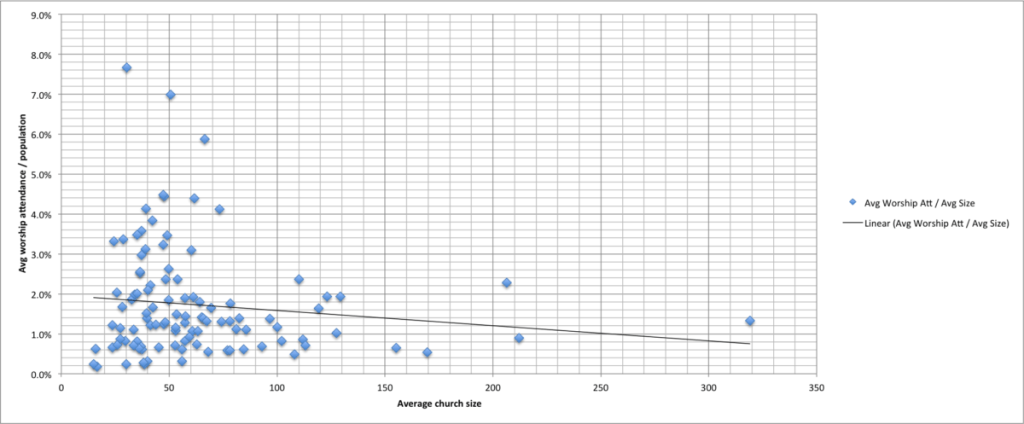 No relationship. The correlation is -0.12. This doesn’t change significantly even if we separate our counties by size. Even among our large counties––where churches are likely to grow larger––the number of churches per capita relates to how many people we’re reaching, the average size of the churches in that county does not.
More churches, more people
Tell me the number of UMC churches in your county, and I can tell you with decent accuracy what percentage of the county you’re reaching. Tell me the average size of UMC churches in your county, and I can tell you… nothing.
More churches = more people. Bigger churches = no difference.
In the data points above, you might see that the UMC has nearly 8% of one county in worship each Sunday. That’s Cumberland County. That county doesn’t have a single church with more than 100 people in attendance. But it has 17 of them![note]Some people will argue that Cumberland County is an outlier. Except that it’s not. Remove it, and the correlation doesn’t change. It is not an exception to the rule. It’s an extreme data point that proves the rule.[/note] For comparisons’ sake, that’s four more UMC churches than Fayette County has, even though Fayette is 46x larger.
If the Church really believes in reaching more people, it should be locked-in focused on starting more churches. Instead, we seem much more focused on growing churches. We celebrate church growth more than anything. Which people do we put in the spotlight? The ones who grow big churches! “The next speaker grew his[note]Let’s face it, it’s almost always “his.” I don’t celebrate that.[/note] church to ___ thousand in just ___ years!” The not-so-subtle suggestion: we all want to be like that guy and grow massive churches. Or at least grow larger than we are. Because we’ve all been convinced, if not consciously then subconsciously, that bigger churches are better.
We reveal that disposition when we refer to the church down the street as competition instead of as an ally. We reveal it when we say [insert your city name] has enough churches already, or when we advocate for church mergers. (“Do we really need one more church down the street? Why not combine into one bigger church?”)
About those mergers
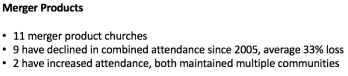 When we look at our merger products, we see more evidence that our bigger is better thinking is flawed. Analysis of Kentucky’s merger product churches over the past decade shows them as the single worst-performing category of churches we found. We had eleven merger product churches. Nine declined in their combined attendance and averaged a 33% loss. Five of them were among our top 20 attendance decreases across the conference during this period. (A category of churches that makes up only 1.4% of the Conference represented 25% of our churches with worst worship attendance losses.)
Two of those merger products actually grew. Those two exceptions are telling. One maintained separate geographic locations. The other maintained worship services in different languages. Neither merger included getting all the people under one roof.
Why we prefer bigger, why we need more
Bigger affords more. Specifically, it affords pastors a bigger pulpit, paycheck, parsonage and pension. (I’ve heard about the 4 P’s more than a few times. So long as they’re prized, our decisions will be based more on pastor preferences than kingdom impact.) So there’s a baked-in incentive for pastors to favor bigger rather than more. If you send people out to start something new, it means that your pulpit will stay smaller. And probably the paycheck and pension, since people will take their money with them. One church of 400 can pay a pastor much more than five churches of 100 can each pay their pastor. But we reach more people the second way.
Bigger affords more, but bigger doesn’t reach more. More reaches more. How can we flip the script in the church to start celebrating more churches more than we celebrate bigger churches?
This post deals with our why. Why plant churches? Because we reach more people. The why isn’t enough, though. How do we plant churches effectively? Next week’s post [now available] will suggest that we already know… but often ignore it. To be sure you don’t miss it, JOIN my e-mail update list.

 teddy ray