Reading the Bible with Christ as Our Lens

I’m regretting a near-omission in my last post. (It was quite long already.) I want to address that and then follow with a more detailed post about biblical interpretation.

In my previous post on Adam Hamilton’s method of reading the Bible, I focused on the interpretive rubric he proposes: love, mercy, and compassion. I relegated to a couple of brief footnotes any discussion of his appeal to Christ as interpretive lens. Because of the significant place that takes in Hamilton’s proposal, I should say more about this––both in praise and critique.

I write this in response to some specific statements by Hamilton, but my interest isn’t so much to criticize him.[note]Adam is a quite prominent public theologian, at least in the UMC. Public debate and discourse are important and helpful and don’t have to reflect any animosity between the persons involved. I have no animosity toward Adam. I disagree with some of his ideas. I worry that our society has come to such a point of confusion about the difference between love and affirmation that we believe any criticism of someone’s position is an attack on that person. If you see anything here that reads as ad hominem and not critical engagement, I’d be happy to know and correct it.[/note] I think he represents a common approach to Scripture, one that’s convincing on the surface and well-intentioned but on closer inspection inadequate. What I’m looking to do here is to propose a better way of reading Scripture for all of us.

Christological Reading

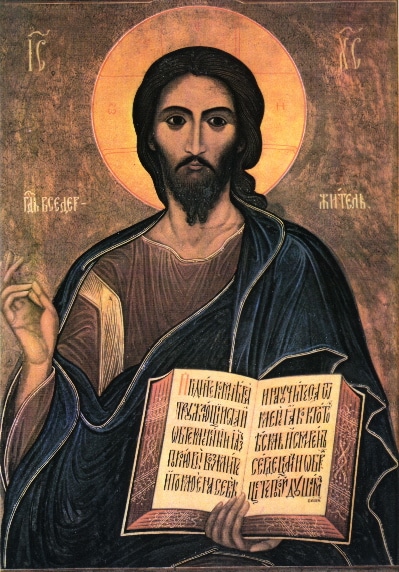
After his appeal to love, mercy, and compassion, Hamilton says, “Most importantly as Christians, we are to read all of Scripture through the lens of Jesus Christ, his life, teachings, ministry, death, and resurrection. He is the only unmitigated Word of God.”

Reading all of Scripture through the lens of Jesus Christ — YES!

We believe that all of Scripture is directed to Christ, the Word of God. He is, as Robert Jenson says it, “God’s agenda in Scripture.” [note]In Canon and Creed, p. 82[/note] I love the way The Jesus Storybook Bible represents this: “Every story whispers his name.”

I didn’t give this much time in the previous article and instead jumped to a discussion of canonical reading. I did that because I believe Hamilton’s version of christological reading is insufficient and one-sided. It appears to give permission to dismiss certain biblical texts if they don’t align with one’s perception of Christ.

Look at this penetrating description from Jenson for a better way:

“[We must teach] with the ancient church, that when God revealed himself to old Israel’s lawgivers, prophets, and sages, it was ‘in the person’ of that same Christ that he was present to them. The indeed singular revelation in Christ includes his presence in the Old Testament: the Word that ‘was in the beginning’ and is incarnate as Jesus (John 1:1-14) is the very Word that ‘came to’ the prophets (e.g., Ezek. 1:3), is offered back to God in the Psalms, and moves Israel’s history (Isa. 55:11). If Christ interpreted the old Scripture ‘with authority,’ as if he were the author, it was because, in the final ontological analysis, that is what he is.

Robert W. Jenson, Canon and Creed, p. 22, emphasis mine.

The kind of christological reading Jenson describes is not one that uses Jesus to judge which portions of Scripture are divine revelation. Instead, it expects to find him in all of Scripture. He is the Word come to the prophets of the Old Testament and proclaimed by the apostles of the New Testament.

So the only proper christological reading of the Bible is a canonical reading. To understand who Christ is, we must consider all of Scripture. And to understand any Scripture, we must consider it in light of Christ, its author. Do you see how this is different from using Jesus to determine which portions of the Bible are divine revelation?

A simple example:

Jesus says, “Do not judge, or you too will be judged.” [note]Matthew 7:1[/note] Later, Paul writes about a man in the church committing sexual immorality: “I have already passed judgment in the name of our Lord Jesus on the one who has been doing this.” [note]1 Corinthians 5:3[/note] If we don’t accept all of the Bible as divine revelation, we’re likely to dismiss Paul’s words as merely human. We might even scoff at Paul’s inadequate understanding of his Lord, who taught us not to judge.

If we read the Bible christologically and canonically, we’ll instead ask how the mind and will of God are expressed in both statements. That’s harder work than choosing one passage and dismissing another. And I don’t suggest that it will lead us all to the same conclusions. But it will lead us to better conclusions than assuming we can dismiss any portion of Scripture as less than divine revelation.

I write this to prevent any over-corrections or misunderstandings from my previous post, which nearly neglected christological reading. Christ and canon are both essential sources for biblical interpretation. But there are two more. I’ll discuss them in the next post: Essential Sources for Biblical Interpretation: A new quadrilateral?”

The Church, simul justus et peccator

The United Methodist Church is in the middle of a theological crisis. Some will call this a crisis regarding human sexuality, others will say the crisis centers on justice or biblical authority or Christian orthodoxy.

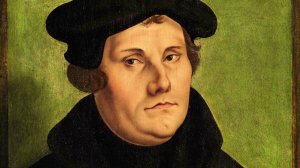
Many have gone to John Wesley for help in resolving these crises, as we would expect. But I wonder if we could use some outside help in this instance. I’ll suggest here that Martin Luther may offer a different view of our impasse.

Simul justus et peccator

One of Luther’s most famous phrases is simul justus et peccator. With it, Luther claimed that a Christian is at once both righteous and a sinner. We are sinners, and we are saints. For the one who imagines himself only a saint, Luther’s claim instills humility. For the one who imagines himself only a sinner, Luther’s claim offers hope.

We hear a similar notion in Solzhenitsyn’s most famous quote:

“If only there were evil people somewhere insidiously committing evil deeds, and it were necessary only to separate them from the rest of us and destroy them. But the line dividing good and evil cuts through the heart of every human being.” [note]From The Gulag Archipelago, 1918-1956[/note]

Luther and Solzhenitsyn remind us that evil is not simply something out there. Look inside each of us and we will find it.

Luther emphasized this well in another of his famous phrases: “Sin boldly!”

What can he mean by “sin boldly”? Shall we go on sinning so that grace may increase? By no means![note]This is from Romans 6:1-2[/note] To understand, we should look at the context for that exhortation –– a letter to his friend Philip Melanchthon:

“If you are a preacher of mercy, do not preach an imaginary but the true mercy. If the mercy is true, you must therefore bear the true, not an imaginary sin. God does not save those who are only imaginary sinners. Be a sinner, and let your sins be strong [i.e. sin boldly], but let your trust in Christ be stronger, and rejoice in Christ who is the victor over sin, death, and the world […] Do you think such an exalted Lamb paid merely a small price with a meager sacrifice for our sins? Pray hard for you are quite a sinner.”[note]emphasis mine[/note]

Luther’s “sin boldly” makes more sense to me when I see it in this context. This isn’t to encourage a friend into sin––”Go do what you please! God will forgive you.” This is to make Luther’s friend acknowledge his true state as a sinner. Don’t treat your sinfulness as imaginary, as something insignificant, as a few minor mistakes. You’ve heard those kinds of “confessions”––”I’m sure I’ve done some things wrong”; “Mistakes were made”; “I’m only human.” Instead, “sin boldly” tells us to recognize our true nature: “You are quite a sinner!”

The one who lets his sins be strong (i.e. sins boldly) is the one who can cry out with the Apostle Paul, “What a wretched man I am! Who will rescue me from this body that is subject to death?” [note]Romans 7:24[/note] He is also the one who can then join Paul in the exclamation, “Thanks be to God, who delivers me through Jesus Christ our Lord!” [note]Romans 7:25[/note]

Luther calls every Christian to humility––to recognize our own sinfulness.
And Luther calls every Christian to wonder and gratitude––to recognize God’s undeserved gift of life and salvation through Jesus Christ our Lord.

Humility in conflict

How rarely we “sin boldly” in the church today! It seems we recognize others’ sinfulness quite easily but consider our sins much less significant––much closer to the imaginary variety. Michael Gerson named a similar phenomenon in American politics.

This is unsurprising in American politics. It should not be the norm for the Church.

Would a view of ourselves as simul justus et peccator give us the humility to engage each other with less hostility and more grace? Would Solzhenitsyn’s distinction about the line dividing good and evil slow us from tossing pejorative grenades across our supposed lines of division?

“If only there were evil people somewhere insidiously committing evil deeds,” Solzhenitsyn writes. But we have found those evil people! We accuse the other side of racism, bigotry, white nationalism, homophobia, fundamentalism, heartlessness, and injustice. Or we claim based on one issue that an entire group must have no interest in holiness, biblical authority, or following Jesus. These false lines we draw see only justus in ourselves, only peccator in the other.

I wonder if Luther’s simul justus et peccator might give us the humility to handle these conflicts differently. Might it prompt more repentance and less accusation? Might it prompt us to deal gently with those going astray, since we know ourselves to be sinners, too?

The church as simul justus et peccator

When Luther spoke of us as simul justus et peccator, he spoke of us as individual Christians. In each of our bodies, we are at once sinner and saint. I want to suggest that simul justus et peccator may have a broader application––not only to our bodies, but to our Body.

Is it fitting to say that the Church, the very Body of Christ, is at once a sinful and a holy Body? Is it right that we should call this Body “quite a sinner”?

This does not seem fitting of the true Church––the one that is truly Christ’s Body. Because in Christ is no sin. And no one who lives in him keeps on sinning.[note]1 John 3:5-6[/note] I believe this. It’s the great doctrine of Wesleyan holiness, which has transformed my life. In the true Church, the true Body of Christ, there is no sin.

Wesley describes it this way:

“If the Church, as to the very essence of it, is a body of believers, no man that is not a Christian believer can be a member of it. If this whole body be animated by one spirit, and endued with one faith, and one hope of their calling; then he who has not that spirit, and faith, and hope, is no member of this body. It follows, that not only no common swearer, no Sabbath-breaker, no drunkard, no whoremonger, no thief, no liar, none that lives in any outward sin, but none that is under the power of anger or pride, no lover of the world, in a word, none that is dead to God, can be a member of his Church.” [note]In Sermon 74, “Of the Church” [/note]

With Wesley I affirm that Christ’s invisible Church is holy, pure, and set apart from sinners.[note]Hebrews 7:26[/note] We are these because Christ is these and we are his Body.

But are any of our visible churches without thieves or liars? Are any without people under the power of anger or pride? No! The church remains full of sinners. As a Body, we are full of sin. So we confess each week, “We have failed to be an obedient church.”

The church, in all of its visible forms, is simul justus et peccator.

And the line dividing good and evil does not cut between one faction and another, between one congregation and another. It cuts through the heart of every body that calls itself church.

Orthodoxy

We need to make an important distinction about orthodoxy before we carry the analogy from Luther too far. When Luther spoke of people as simul justus et peccator, he was not referring to all people. This was a designation for confessing Christians.[note]I’m indebted to Dr. Steve O’Malley for this point.[/note] They had been baptized into the Church under the Apostles’ Creed as the common confession of faith. They confessed God as Father, Christ as Lord, the resurrection of the body, and the life everlasting. The sinners Luther referred to were made righteous by living by this faith. Righteousness is not our own, it comes only by faith.

I want to suggest that the visible church is a Body both sinful and righteous. But it is only righteous by faith in Christ. A church that does not confess and mean the historic creeds of the Church as the historic Church confessed and meant them is no church at all. At least, it is not a Christian church. All faith outside of these affirmations is, by definition, heterodox––or heresy. If this sounds like an exclusionary statement, that’s because it is. All real things have bounds,[note]I originally had “All things but God have bounds,” but even an omnipotent, omniscient, omnipresent God has definition. God is everywhere, but God is not everything, and everything is not God. (i.e. We are not pantheists.)[/note] and the bounds of Christian orthodoxy were constituted long ago in these universal confessions.

There are some who call themselves United Methodists who reject the Christian faith articulated by the Church’s early ecumenical councils. We have some among us[note]Please do not confuse my “some” to suggest that all, or even most, of any particular faction fit these descriptions[/note] who scoff at the notion of Christ’s real, historical, bodily resurrection, some who believe the Bible is a mere human work with no ultimate authority, and some who honestly have no interest in following the way of Jesus if it should lead them somewhere different than where they would like to go. What I’ve written above is not about those people. They are not those whom Luther referred to as simul justus et peccator. A Body that does not confess the Christ of faith is not the Body of Christ.

Debates about orthodoxy have become common in our current crisis. Should we extend it beyond our definition above? Some have called the “traditional” position on human sexuality the orthodox position. I reject that here. I think orthodoxy is best left to refer to conciliar orthodoxy. James K. A. Smith articulates this well: “The word [orthodox] is reserved to define and delineate those affirmations that are at the very heart of Christian faith—and God knows they are scandalous enough in a secular age. Perhaps we need to introduce another adjective––’traditional’––to describe these historic views and positions on matters of morality. ” [note]From this blog post, which is worth reading in full.[/note]

What do we do with a sinful Church?

And so we have a body––the very Body of Christ––at once righteous and sinful. We’re uncomfortable with the church as simul justus et peccator. And we should be. God has set in our hearts a different image of the Church––as a bride making herself ready for the wedding of the Lamb,[note]Revelation 19:7[/note] preparing as one to be beautifully dressed for her husband.[note]Revelation 21:2[/note]

Our disagreements about what we call sin are presenting themselves as a theological crisis in our church. Underneath them is another tension: What do we do with a sinful Church?

Who will rescue us from this body that is subject to death?


This post attempts to establish some foundations. In a post to follow, I’ll focus on another aspect of Luther’s theology––the theology of the cross––along with implications for the United Methodist Church and for those who might consider leaving.

Like it? Or just want to discuss it more? I’d be honored if you’d share it. Click here to share on Facebook. Click here to share on Twitter.

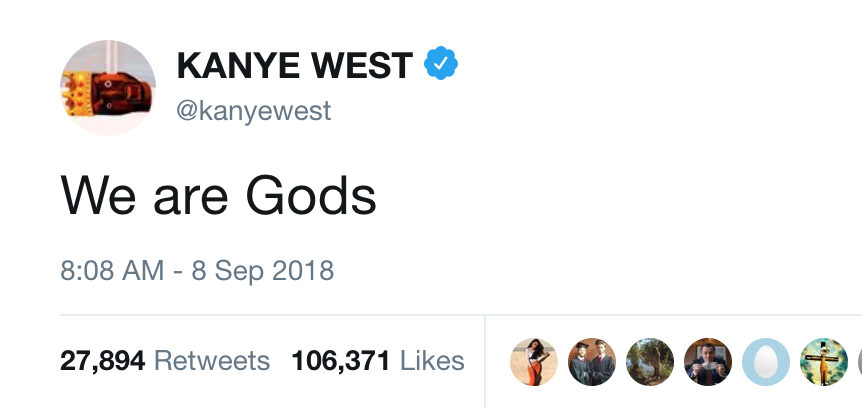
“We are gods.” What if Kanye is right?


Kanye West tweeted something that many of Christianity’s greatest theologians would agree with…


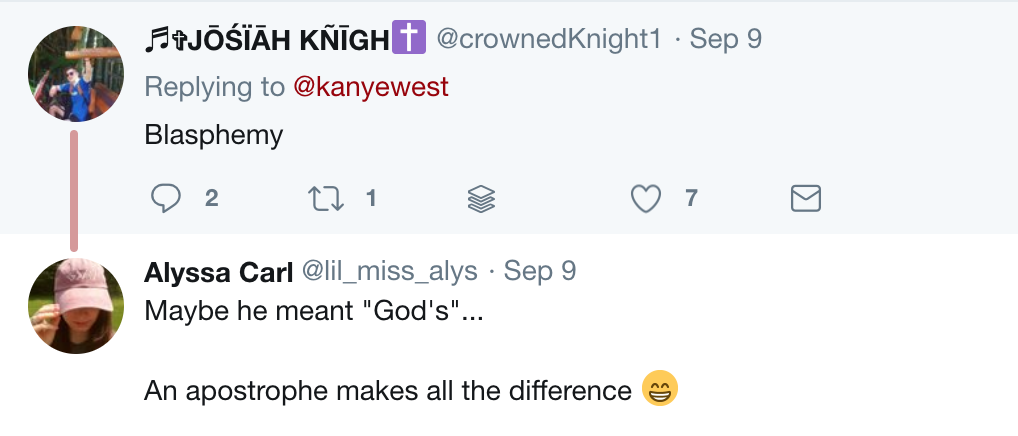
And Christian–or at least theistic–tweeters rebuked him…


To be clear, I doubt Kanye intended what those Christian theologians intended when they said the same. But what if his words were actually orthodox Christian belief?[note]Best to make that “g” lower case[/note] It’s a belief that we’ve mostly lost along the way, and as a result, we’ve lost a lot of the richness and depth of Christian experience. Let’s take a quick look at our relationship to God, as depicted in the Bible and the early church.

Sharing in the Life of the Father

Jesus tells a parable many refer to as the Parable of the Prodigal Son.[note]Find it in Luke 15:11-32[/note] A son asks his father for his inheritance, then leaves his father’s house and squanders it all. He ends up so destitute that he longs to eat even pig slop. Finally, he returns to his father, hoping to receive a position as a servant in his house. The father receives him back, but as his son, not a servant. And the father throws a feast. His son has returned—kill the fattened calf!

The story closes with the father consoling his other son, who refuses to come in to the feast. The older son is upset—how could his father have a feast for the one who squandered his inheritance when this obedient son has never even had a young goat for a party with his friends? The father responds, “You are always with me, and everything I have is yours.”[note]Do you recognize that? It sounds a lot like when Jesus says, “All that belongs to the Father is mine.”[/note]

Neither son has understood his real inheritance. It’s not what they can receive from their father to enjoy on their own. The inheritance begins now—it’s sharing at the feast of the father! Everything he has is theirs! Now!

This makes me wonder if I usually look for God’s “blessings” in the wrong places. I look for how God is benefiting me, making my life better, providing the right opportunities. These “blessings” are about what I can receive from God to enrich my own life. Like the brothers in that parable, I may misunderstand the real inheritance when I watch for these as God’s blessings.

What a wonder! God invites us to participate in the divine life as his children. He invites us to his table. He invites us to share everything he has.

An important distinction: the inheritance isn’t just to take what the Father gives, but to share what the Father has.

If our real inheritance is to share what our Father has, it means we can share in God’s perfect love and holiness and joy and peace. We share in God’s divine nature.

Union with God?

This is where some theologians have talked about a sort of union with God that would sound unthinkable to many Christians. One of the greatest early Church Fathers wrote, “If the Word became a man, it was so men may become gods.”[note]From Irenaeus in the preface of Book V in Against Heresies. To be sure, this is the universal use of “men,” males and females are included equally in it.[/note]

Did you gasp reading that? We might be quick to respond, “There is no God but one!” We are creatures, not the Creator.[note]The difference between God (Father, Son, and Spirit) and humanity is that the Father eternally begets the Son and brings forth the Spirit from his very own substance. But God created humanity in time from nothing. We retain our human nature, even if we might be called “gods” or “one with God” as we participate in the divine nature.[/note]

That will never change. Those theologians would certainly agree. But we can become so united to God that we share God’s will and thoughts and actions. We can be so united to God that we become holy as God is holy. One New Testament letter refers to this as “participating in the divine nature” (2 Peter 1:4).

In Mere Christianity, C. S. Lewis comments on it like this:

The command Be ye perfect is not idealistic gas. Nor is it a command to do the impossible. He is going to make us into creatures that can obey that command. He said (in the Bible) that we were “gods”[note]A note: God really does call people “gods” in the Bible. You can see this in Psalm 82, and then as Jesus refers to it in John 10:34-35.[/note] and He is going to make good His words.[note]On page 205 of the 2001 HarperCollins edition.[/note]

Notice how much more this is than the standard ways we think of life with God. Some people talk about “inviting God into your life” or a “God-shaped hole” that reveals our need for God. But God’s invitation goes infinitely beyond his entering into our small lives or filling some particular hole or desire in our lives. Instead, God’s invitation is that we would come into his divine life. This doesn’t so much fill a particular hole as it consumes the whole of us. It consumes the whole of us to the point that we would be called fully God’s, and by being God’s, we would actually be called <gasp> “gods.”

An early Christian theologian named Augustine famously wrote of God, “You have formed us for yourself, and our hearts are restless till they find rest in you.”[note]From the first paragraph of Book I in The Confessions.[/note] He didn’t say our hearts are restless until they find a place for God, as if we should have God take a seat at our table. Instead, our hearts are restless until they find rest in God, until we are seated at the very table of God.

The problem when we decide to have life our way isn’t just that it’s sin—some sort of disobedience to our Father. The greater tragedy is that while we indulge our small desires, it’s as if we’ve chosen pig slop when we could instead be feasting at the table of God.

What if Kanye is right?