
I can still remember my parents reading to me from a children’s Bible before I was old enough to read. (For some reason, it’s the Tower of Babel story that sticks out in my head.) And I can remember kneeling on the floor with them and praying before bedtime. I don’t know just how routine these activities were, but they happened often enough to burn into my brain as some of my earliest childhood memories. Of all the gifts my parents have given me, the best and most important has been the foundation and example in the faith that they gave me. The best children’s ministry in town is in your living room. I hope this week’s posts might inspire parents and church leaders toward the same focus.
As part of our Family Worship, we are teaching our kids a catechism. I promised I’d explain why.
1. Bible stories are not enough.
Yes, I said it. For all of us – and even more for children – I believe that we cannot depend on Bible stories alone for an understanding of Christian faith. Since the early days of the Christian movement, we have had canon and creed (i.e. the Bible and various creeds or rules of faith). I’ll write something more in-depth on this topic in the future. For now, let me explain particularly with children in mind…
A catechism gives our kids a lens for looking at the Bible. It gives them the big picture – as brilliant theologians for thousands of years have understood it – and helps them to see where the big ideas show up in the individual stories. So when Adam and Eve hide from God, I ask my kids if God could still see them, and they say yes. When I ask why, they say, “Because God is everywhere!”
By teaching your kids basic theology, you’re enabling them to read Scripture in a better, deeper way. Walk through a garden with a trained gardener and you’ll see the difference in how you each look at it. The same is true for Scripture.
This certainly isn’t to say that children can’t learn theology by reading the Bible. That’s called learning inductively (from particular stories to general theology). It’s great and important! A catechism helps them to apply deductive learning (from general to particular) to the stories, as well. The Bible stories give them the trees; the catechism gives them the forest.
2. A catechism is great devotional material.
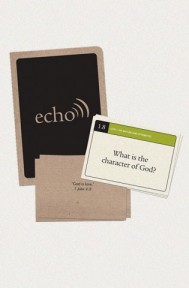
Sometimes I’ll lay in bed with one of my kids and ask, “Who made you?” They answer, “God!” I ask, “And what’s the character of God?” They answer, “God is love!” And then we talk about how God made them and how much God loves them.
As we get a little more sophisticated, I can ask, “Was mankind created good?” And my daughter will answer, “They were; God created mankind in his own image, male and female he created them.” When I ask her what that image of God included, she says, “Being like God in true righteousness and holiness.” Then we talk about how God created her GOOD (as opposed to any other messages the world may try to give her)! And that God created her to be righteous and holy. Big words at this point, but ones that I want to help her understand and live. Those two questions should be fodder for talks for a number of years.
3. A catechism is theology and Scripture my kids will have memorized for the rest of their lives.
Do you have the pledge of allegiance memorized? Could you imagine forgetting it? My guess is that you have it engrained permanently. We think the same will happen with this catechism. It’s being implanted in our kids’ minds and hearts. What better to have implanted?
This again shows why Bible stories aren’t enough. At the end of the day, I would rather my kids remember “the Lord is compassionate and gracious, slow to anger, abounding in love,” than the story of Jonah and the big fish. And by memorizing the catechism, they are primarily memorizing Scripture. The quote I just gave is Psalm 103:8.
Spend some time searching and you should find a variety of catechisms out there. Two friends and I updated and revised an old catechism for use in our families and church, and it was recently published by Asbury Seedbed as Echo: A Catechism for Discipleship in the Ancient Christian Tradition. It has 98 questions and answers, in addition to The Apostles’ Creed, the Ten Commandments, and the Lord’s Prayer. I’m obviously partial to it, but there are many options out there.
What thoughts or questions do you have about using a catechism to teach the faith?
 (good for 1-4 year-olds) and
  (good for 3-7 year-olds). If they were a bit older, I’d probably use
  . And by age 9 or 10, I’d consider just reading the Bible itself. We look for Bibles that attempt to tell the Scripture story in a straight-forward manner to familiarize children with the stories and characters (as The Beginner’s Bible does), or Bibles that interpret stories in light of our faith (as The Jesus Storybook Bible does – interpreting every story in light of Christ’s saving work). Beware of the several children’s Bibles out there that attempt to turn the Bible into a set of fables — teaching children simply to be good, moral people.
