Evangelical Activism (pt. II): The dangers of good activism

In an earlier post, I suggested that the pro-life cause may have been the most galvanizing political issue since slavery for American evangelicals.

A note: I’m neither endorsing this as clearly appropriate (many other issues are serious and could have been galvanizing––especially regarding civil rights), nor would I call it inappropriate (the numbers are tragic). I’m simply naming that this has been a galvanizing issue, whether you agree that it should have been or not.

For evangelicalism as a whole, I’d like to suggest that religious affiliation led the way to political affiliation. But somewhere along the way, I wonder if the political cart got ahead of the religious horse.

How evangelicals became Republicans

In 1976, Democrat Jimmy Carter became the first “born again” evangelical to become president. Newsweek declared it “The Year of the Evangelical.”
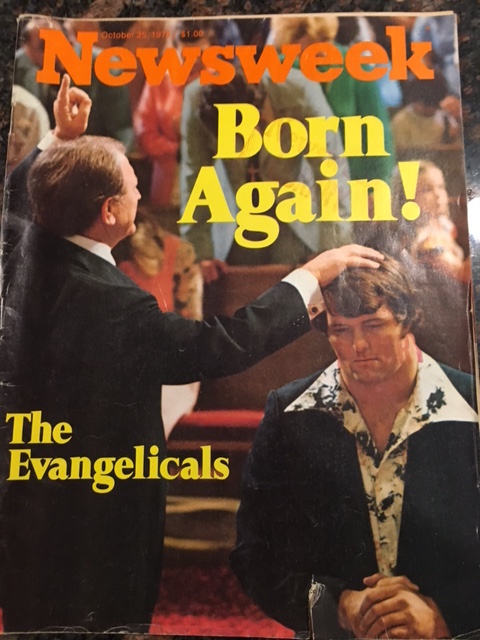
To be sure you caught that… The first “born again” evangelical to be elected President of the United States… was a Democrat. Less than a half-century ago, evangelical did not mean Republican. In fact, the election of a Democrat[note]this particular Democrat––not that all evangelicals were Democrats[/note] to the presidency spurred Newsweek to deem it “The Year of the Evangelical.”

And then in 1980, the Republican Party added anti-abortion planks to its platform. They have continued as the anti-abortion / pro-life party to this day.

By 1992, white evangelicals leaning Republican outnumbered Democrats 2 to 1. By 2014, white evangelicals leaning Republican outnumbered Democrats 7 to 2.
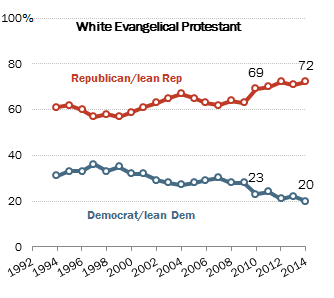
picture from Pew Research Center

In April 2018, a Public Religion Research Institute survey showed white evangelical support for President Trump at an all-time high: 75% compared to general population favorability of 42%.

For many people, evangelical and Republican have become one and the same.

It was not this way in 1976 when Jimmy Carter was the first evangelical elected to the presidency. But as anti-abortion / pro-life policy made the Republican platform, evangelicals flocked to, and took up leadership in, the GOP.

The dangers of good activism 

If we think we may be among those who would have flocked to the Liberty Party in the 1800s because of its anti-slavery platform (see that earlier post), I don’t think we can blame evangelicals for doing the same because of the GOP’s anti-abortion platform.[note]To be sure, there are other ways to advocate for the lives of unborn children. Especially by offering hospitality and the option to adopt to pregnant women unprepared for a baby. I’ve watched several pro-life advocates (some whom I’m related to) make serious personal sacrifices to do exactly this. And they have also advocated for changes in public policy. The two don’t have to go together, but they’re not mutually exclusive, either.[/note]

But over time, that good activism has led many evangelicals to be more Republican than evangelical. This large voting bloc came to the political party primarily because of one issue. They saw anyone who was anti-abortion as ally and all others as foes.

An interesting thing tends to happen over time with allies and foes. Our allies begin to look like heroes to us. We’re so committed to them on the one issue that we begin to see all of their battles as ours. And our foes begin to look like villains to us. We’re so opposed to them on the one issue that we begin to see every battle as a battle against them.

So today white evangelicals are the demographic group most likely to support refugee bans and deportation of immigrants living in the U.S. illegally.[note]Yes, I know even the terminology for this group of people has become a political debate. Here I use the terminology used by pollsters in the linked poll.[/note] They have more positive views toward guns than the general public. And they’re the group least concerned about environmental protection. All of these stances have some kind of reasonable case associated with them (some of them, in my humble opinion, a very weak case). But the case for each is mainly a Republican case. We can’t argue that Christian faith obviously leads us to any of these stances. In fact, on the surface at least, Christian faith would lead us in the opposite directions.

It is not because of biblical arguments that white evangelicals have become the single demographic group most likely to say the U.S. has no responsibility to accept refugees. Not when the Bible persistently advocates for special care for the foreigner, the fatherless, and the widow. (See Deuteronomy 10:18; 14:29; 16:11, 14; 24:17, 19-21; 26:12-13; 27:19; Psalm 94:6; 146:9; Jeremiah 7:6; 22:3; Ezekiel 22:7; Zechariah 7:10; Malachi 3:5)[note]One well-meaning evangelical recently asked, “But are there any examples in the Bible of a group of foreigners who are growing in numbers and could take over the country?” He wasn’t encouraged when the only example I could think of came from Exodus 1: ” ‘Look,’ [Pharaoh] said to his people, ‘the Israelites have become far too numerous for us. Come, we must deal shrewdly with them or they will become even more numerous and, if war breaks out, will join our enemies, fight against us and leave the country.’ So they put slave masters over them to oppress them with forced labor.”[/note]

I expect this century’s general evangelical disregard, or even hostility, toward those who are not American citizens to look as bad for the Christian cause in the future as the American church’s failure in the last century to speak and act with one voice against lynching and segregation.

Religion led many evangelicals to the Republican Party over the last fifty years because of abortion policy and its wider attitudes toward abortion (as something to lament rather than openly celebrate). But once they got there, the political cart of the full Republican platform got ahead of the religious horse that brought many evangelicals here. White evangelicals, as a voting bloc, seem now more inclined to support and oppose issues based on partisan divides than based on an examination of Scripture and the Christian tradition.

The threat of religious idolatry

Is it possible that political partisanship is one of today’s most threatening idols? Someone’s political party identification is now far more reliable than their religious identification for predicting their stance on issues as wide-ranging as abortion, the environment, or immigration. Their political party identification seems more reliable than their faith for determining when a politician’s misdeeds are cause for moral outrage and when they’re an occasion for understanding and forgiveness.

This is not only a problem among white evangelical Republicans, but also among many Christian Democrats who insist their faith has led them to their political stances. When one politician talks with messianic overtones, the partisan Christian responds, “We already have a savior!” Yet when they hear similar statements from their own preferred party, they respond with silence or celebration.

Christians of all stripes, it SHOULD NOT BE THIS WAY! This is not far from idolatry, if it isn’t idolatry, properly defined. Neither of America’s political parties derives its standards from the Christian faith. Both parties include people of virtue and both include people whose behaviors should be cause for moral outrage. If we find ourselves always morally outraged by one side’s policies or people and always defending the other, it may be a signal that our politics have become our gods.

It may have begun with good activism. It’s threatening to become idolatry.

Agree? Strongly disagree and want to discuss it more? “I don’t agree with all of this, but it raises some interesting points…”? Share it using the social media links here. Or send me an email for follow-up discussion. Or if you haven’t already, click here to subscribe for more. Thank you!


The Lectionary and the UMC: The subjects of our verbs

Another version – from “Ungodly Evangelicals”

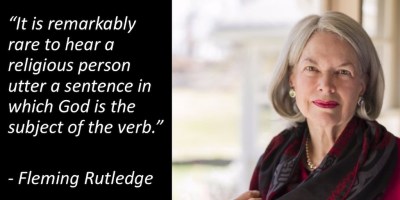
“When I have taught homiletics (preaching),” writes Fleming Rutledge, “I have always put a lot of emphasis on subjects and verbs. It’s remarkable how infrequently many of today’s preachers make God the subject of active verbs. Usually it’s the human being who is given the verbs.” [note]If you have not read everything Fleming Rutledge has ever written, your life is incomplete.[/note]

In a longer paper, Rutledge discusses our love for the “triumph of the human spirit” story. She’s worth quoting at length:

“Our addiction to our own supposed powers leads us perpetually to sentimentalize and romanticize human possibility rather than acknowledge our desperate predicament. This tendency, in turn, subtly or not so subtly encourages the making of sentences which have human capacity as their subject and God as their object. Thus we have the current enthusiasm for ‘spiritual journeys,’ with the human religious search as the controlling metaphor.”

Because of Fleming Rutledge, I’ve begun to pay more attention to my grammar––especially in preaching and church leadership, but also in everyday life. How often is God the subject of my verbs?

When God is the subject

I’ve also begun to pay more attention to the subjects and verbs in the Bible. My general finding: When God is the subject of the verbs, things tend to go well. When people become the subjects of the verbs, things often go awry. Which can lead back to God being the subject of some rather unpleasant verbs…

A warning in the book of Deuteronomy illustrates well. As the people move into the promised land, they risk convincing themselves that they did it all. I’ve highlighted several key subjects so we can see the movement:

When you have eaten and are satisfied, praise the LORD your God for the good land he has given you. Be careful that you do not forget the LORD your God, failing to observe his commands, his laws and his decrees that I am giving you this day. Otherwise, when you eat and are satisfied, when you build fine houses and settle down, and when your herds and flocks grow large and your silver and gold increase and all you have is multiplied,  then your heart will become proud and you will forget the LORD your God, who brought you out of Egypt, out of the land of slavery.  He led you through the vast and dreadful wilderness, that thirsty and waterless land, with its venomous snakes and scorpions. He brought you water out of hard rock. He gave you manna to eat in the wilderness, something your ancestors had never known, to humble and test you so that in the end it might go well with you.  You may say to yourself, “My power and the strength of my hands have produced this wealth for me.” But remember the LORD your God, for it is he who gives you the ability to produce wealth, and so confirms his covenant, which he swore to your ancestors, as it is today.[note]Deut 8:10-18[/note]

The Bible story is not a “triumph of the human spirit” story. It’s a triumph of God story. God is the main character. The main plotline is about God creating, God rescuing, God redeeming, God restoring, God with us.

People are the supporting cast. Our story, apart from God, highlights the weakness of the human spirit and the evil inclinations of the human heart. Only because of God’s active role in this narrative can we celebrate triumphant and good people.

“Why have you not built me a house of cedar?”

This week the lectionary brings us to 2 Samuel 7 where David considers building a temple for Yahweh.

Is it an act of genuine piety? David sees the contradiction between his royal palace and the place of the ark of God––literally “in the midst of curtains.” He wants to give Yahweh a more fitting dwelling place.

Or is it about self-serving legitimation? A grand temple validates the king. It’s a mark of his success. (Does this have similarities to church building programs?) In some ways, it makes the god a patron of the king.

Walter Brueggemann calls temple building “undoubtedly a mixed act of genuine piety and self-serving legitimation.” [note]In his outstanding Interpretation commentary.[/note] Isn’t this how it is with so many of our decisions, especially as Christians and church leaders? Advancement and self-preservation––of both individuals and institutions––can have motives that are at once noble and self-serving. To the extent that it may be difficult to discern which is which.

Whether David’s motives are pure or impure (or more likely, an indivisible mix of the two), Yahweh changes the subjects of the verbs. Look at these subjects:

“This is what Yahweh says: ‘Are you the one to build me a house to dwell in?’ “

Subject: David.
Object: House (temple).
Recipient: Yahweh

And then the reversal:

I have not dwelt in a house from the day I brought the Israelites up out of Egypt to this day. I have been moving from place to place with a tent as my dwelling. Wherever I have moved with all the Israelites, did I ever say to any of their rulers whom I commanded to shepherd my people Israel, ‘Why have you not built me a house of cedar?‘ “

From here through verse 16, Yahweh is the subject of 23 active verbs, as I count them.

He’s the subject of past-tense verbs: “took you from the pasture.”

He’s the subject of future-tense verbs: “I will make your name great.”

He’s the subject of the great promise that extends far beyond David’s small vision of a temple: “Yahweh declares to you that Yahweh himself will establish a house for you.”

Subject: Yahweh.
Object: House (dynasty).
Recipient: David.

The Bible story is also not a story of people doing good things for God. It’s the story of God continually sustaining his sometimes anxious, sometimes self-serving, sometimes faithful people by giving them far more than they have envisioned. Ultimately, God has given us his Son, the offspring of David, whose kingdom never ends.

Regarding human plans that didn’t begin with God, he asks, “When did I ask you to do this for me?

God does tell his people to do things for him. Principally, he tells us to trust and obey. Outside of trust and obedience, Yahweh is the subject of most of the good verbs in the Bible. The difference between Noah building an ark and the people building a tower at Babel––one is an act of human trust and obedience, the other an act of human will.

The lectionary and the UMC

A favorite phrase of United Methodist leaders today is “non-anxious presence.” In a time of anxiety, our Bishops are urging us to “project a non-anxious presence.”

This amidst much (legitimate) concern about the state of the United Methodist Church. It’s difficult to speak of “death tsunamis” and potential schism with a non-anxious presence.

I don’t expect we’ll become non-anxious through reading the right leadership book or mustering up enough confidence. I don’t expect the newly released report of the Commission on a Way Forward to reduce anxieties. From the beginning, many have viewed the task of the Commission as impossible––so far as the task is to maintain the unity of the UMC.

I expect the only legitimate way to cultivate (not just project) a non-anxious presence is to make God the subject of more of our verbs. I want to resolve as a leader in the church to spend less time prognosticating and more time asking what faithfulness to God means in my life and the life of my congregation today. I want to resolve as a leader in the church to spend less time wringing my hands about the future and more time in prayer, in gratitude for what God has done, and in sure and certain hope that God will sustain his church.

Does this mean that God will sustain the United Methodist Church in unity? We don’t have that promise. Nor can we fixate on making it happen ourselves. In our efforts to save our denomination, perhaps we have romanticized human possibility rather than acknowledging our desperate predicament. Perhaps we have made ourselves the subjects of too many of our verbs.**

Perhaps, like David, our determination to do something for God (with all the mixed motives that surely entails) has veiled our eyes to the larger designs of God. Perhaps we’ve sought to preserve and build an institution at the expense of celebrating the greater promise of God––his Son, Immanuel, God with us, as the one whose kingdom will last forever. If that kingdom is our end, we have no need for anxiety.

Fleming Rutledge writes, “The biblical story has God as its unfailing subject. God is not for us to find; God has found us, and keeps on finding us, and will chase us down even in Sheol (Psalm 139:8).” I don’t know the future of the United Methodist Church as a denomination. But I believe wherever it is we end up––each of our churches and members and clergy––God will be there already, with us, seeking us out, chasing us down… even in Sheol.

Like it? Or just want to discuss it more? I’d be honored if you’d share it –– use the social media links at left. Or send me an email for follow-up discussion. Or if you haven’t already, click here to subscribe for more. Thank you!

** To be clear: I don’t mean to negate good and faithful work done by many of our leaders, and particularly the Commission on a Way Forward. I trust many of them are asking questions that acknowledge our desperate predicament and God’s action as our only true hope. And I’m thankful for them. I write this more as admonition for myself and others like me than for those who already have God as the subject of their verbs.


The Lectionary and the UMC: Avoiding Uzzah

[When you’re done, see my newest post: “The Lectionary and the UMC: The subjects of our verbs.”]

Throughout the history of God’s people, religious renewals have followed a similar pattern. You’ll be unsurprised to know these renewals didn’t begin with a change to policy or structure or a 55-45 vote. Here’s how William J. Abraham describes the Lutheran and Wesleyan renewals, among others:

“They took to immersion in the scriptures, to study of the tradition, to intentional participation in the sacramental life of the church, to prayer, and to extended conversation with their friends.” [note]In his brilliant Waking from Doctrinal Amnesia, p. 91[/note]

As the United Methodist Church faces a time of crisis, I’m convinced that renewal will not come through a vote at our General Conference or the next great policy proposal (not that these are entirely insignificant). It will come the way renewal comes, when we immerse ourselves in the scriptures and prayer and the church’s tradition and sacraments––and when we have extended conversation with each other concerning these practices and shaped by them.

To be sure, we can’t undertake these practices for the sake of proving ourselves correct. We do it to seek a word from God. Or perhaps better, to stop making ourselves the subjects of all our verbs and instead to say, “Speak, Lord, for your servants are listening.”

Whether you are United Methodist or not, might we ask how God speaks to us––not just as individuals, but as communities of people, even denominations––through his scriptures? What if we immersed ourselves in the scriptures according to our own lectionary? Does God have a word we can hear together here?

Avoiding Uzzah

The Old Testament lectionary passage for this week (2 Samuel 6:1-5, 12b-19) is as remarkable for what it leaves out as for what it contains. The passage narrates the arrival of the ark of God in Jerusalem. It leaves out Uzzah’s sudden death.

Verses 6-7, missing from our prescribed lectionary reading:

“When they came to the threshing floor of Nakon, Uzzah reached out and took hold of the ark of God, because the oxen stumbled. Yahweh’s anger burned against Uzzah because of his irreverent act; therefore God struck him down, and he died there beside the ark of God.”

The lectionary frequently leaves out portions of passages. Sometimes that’s for the sake of brevity, other times for the sake of focus on one particular aspect of the passage. In this case, though, I suspect it’s to avoid having to deal with what happened to Uzzah. This makes sense to me. I’d probably prefer to avoid it. But an honest immersion in the scriptures doesn’t let us off that easily.

Why are we uncomfortable with the Uzzah passage? It seems like the wrong answer to a common question: “Would a loving God really do that?” How could a loving and compassionate God strike someone down? And for this?

Richard Dawkins loves texts like this. He uses them as basis for a central claim in The God Delusion: “The God of the Old Testament is arguably the most unpleasant character in all fiction: jealous and proud of it; a petty, unjust, unforgiving control-freak…” [note]p. 51. That sentence keeps going for quite a while longer.[/note] Uzzah tries to steady the ark on the cart and God strikes him dead. Uzzah’s (ultimate) punishment does not seem to fit his (very minor) crime.

Uzzah’s demise traces back to Numbers 4:15: “After Aaron and his sons have finished covering the holy furnishings and all the holy articles, and when the camp is ready to move, only then are the Kohathites to come and do the carrying. But they must not touch the holy things or they will die. The Kohathites are to carry those things that are in the tent of meeting.”

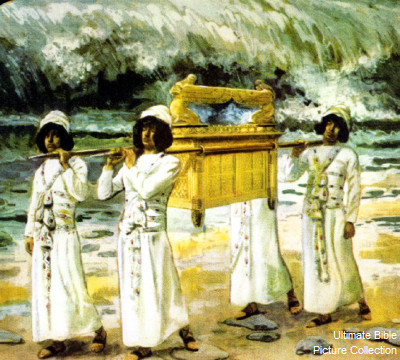
The ark of God––the throne of God on earth among the Israelites––was intended to be carried like this.

Picture courtesy of bibleencyclopedia.com

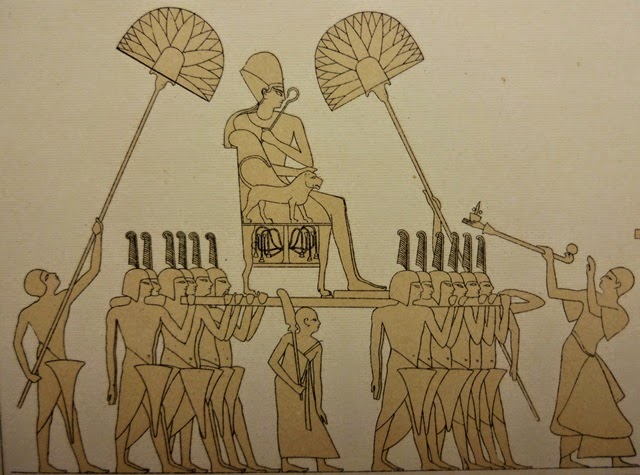
Does that look familiar?

Looks kind of like this.

Picture courtesy of paranormalromantics.blogspot.com

A royal procession for a King.

Instead, the Israelites chose to move the ark of Yahweh as if it were luggage, loaded onto an oxcart.

Courtesy of http://www.sgeorgiastreet.church

Uzzah’s decision to reach out and touch the ark, disregarding God’s command and God’s holiness, was far from the first act of irreverence on the part of the Israelites. But it was the action that resulted in Yahweh’s wrath finally breaking out.

When we ask whether a loving and compassionate God would strike Uzzah dead, our hearts want to say no. But God did strike Uzzah dead, and while our lectionary can avoid it, we cannot.

Essential but not Sufficient

God’s compassion is an essential part of understanding the nature of God. But God’s compassion alone is not sufficient for understanding God. We make a great mistake when we confuse essential for sufficient.

Along with recognizing God’s compassion, we must recognize what the Israelites here ignored: God’s holiness. They had been told to fear Yahweh, to walk in obedience to him and observe his commands and decrees. This, too, was an essential part of their understanding and knowing God. Uzzah’s death was a result of their lack of fear and obedience.

When we avoid Uzzah to focus on a God of compassion, we don’t get a better God, we get a false god––one of our own making.

We could also do the opposite––to fixate on the God who strikes Uzzah dead. This is how Richard Dawkins would prefer it. But that overlooks the God who mercifully returns to be Israel’s God––visible in the ark’s procession to Jerusalem––even after their repeated rejections and rebellions. If we did this, we would likewise be worshiping a god of our own making, one who desires sacrifice, not mercy.

The Lectionary and the UMC

There are two common watchwords right now in the UMC: compassion and orthodoxy. Both are essential to the Christian faith. Neither is sufficient.

Compassion tells us to listen to those on the margins, the minorities, the least of these. Orthodoxy tells us to listen to those who’ve gone before us. Who should we listen to? Both!

Compassion tells us we should give special attention to care for the marginalized and oppressed, whatever the cost. Orthodoxy tells us we should give special attention to reverent obedience to God’s word and the church’s historic teaching, whatever the cost. Which should we tend to? Both!

Compassion tells us we should be wary of injustice. Orthodoxy tells us we should be wary of heresy. Which should we be wary of? Both!

Our problems come when we take either of these not just as essential, but as a sufficient rule for our faith and life, and thereby nullify the other.

If I find myself regularly citing those on the margins, I may need to spend extra time listening to those who’ve gone before us (and not just those who say what I want to hear). If I find myself regularly citing those who’ve gone before us, I may need to spend extra time listening to those on the margins (and not just those who say what I want to hear).

Our church cannot avoid Uzzah. God is a holy God. His eyes are too pure to look on evil; he cannot tolerate wrongdoing.[note]From Hab 1:13[/note] Neither can our church fixate on Uzzah. His death shows us only part of God’s nature. Yahweh is still a compassionate and gracious God, slow to anger, abounding in love.[note]Found throughout the OT. See, e.g. Ps 103:8; Jonah 4:2[/note]

Like it? Or just want to discuss it more? I’d be honored if you’d share it –– use the social media links at left. Or send me an email for follow-up discussion. Or if you haven’t already, click here to subscribe for more. Thank you!
[When you’re done, see my newest post: “The Lectionary and the UMC: The subjects of our verbs.”]