Evangelical Activism (pt. I): From abolition to abortion

What do you think of when you think of evangelicals?

Almost none of us think of the group Donald Dayton describes. He tells of 19th century evangelicals who were “heavily involved in the abolition of slavery, fighting for the poor, and women’s rights.”

“Evangelical revivals called people not only to personal atonement but to putting faith into action. At their ‘altar calls’ people would come to Christ and immediately sign up for the anti-slavery campaign!”[note]That’s Jim Wallis’s summary of Dayton’s book in the foreword to Rediscovering an Evangelical Heritage.[/note]

You probably don’t associate evangelical with these great social justice causes, do you? Of the people I know, those who would identify as strong advocates for social justice would be the least inclined to identify as evangelical. But Dayton paints this picture of activist evangelicalism in Rediscovering an Evangelical Heritage (I highly recommend it).

Above all, he depicts them as devoted abolitionists. Others at the time may have considered them rabid abolitionists –– abolition-at-all-costs abolitionists.[note]Jonathan Blanchard, founder of Wheaton College –– “the Harvard of evangelicalism” –– is a good example of one of those radical abolitionists. He called slave-holding “not a solitary, but a social sin” and would not tolerate advocacy for anything less than quick and total abolition.[/note] They constituted a sizable voting bloc, with heavy support for and leadership in the Liberty Party––a party devoted above all else to abolishing slavery.

How closely aligned were the Liberty Party and evangelicalism? Dayton says “the party functioned almost like an evangelical institution in which antislavery votes served as evidence of sanctified living […] An antislavery ballot provided proof of a person’s unqualified allegiance to God.“[note]pp. 131-132, emphasis mine[/note]

If Dayton’s picture is accurate, those 19th century evangelicals were one-issue voters. I wonder if I would have been (acknowledging the impossibility of that hypothetical). Was this one issue so important that any like-minded politician would be considered an ally and everyone else a foe, regardless of all the rest? Living in the early 19th century, could I have ever voted for a politician who would not advance the cause of abolition?

Another definition of evangelicalism names activism as one of its four distinctive marks.[note]See David W. Bebbington’s The Dominance of Evangelicalism. This activism includes both evangelism and social work. “[S]ocial work that carried over into pressure for reform was equally characteristic for this period,” he writes (p. 38).[/note] Evangelicals are, by nature, activists, pushing for reform. The U.S. has never seen such an important cause for activism as slavery. And so the cause united evangelicals politically like few others could.

Evangelicals and activism today

For the past half-century, the large majority of those who identify as evangelical have again united around one political cause: the cause to abolish abortion.

If you don’t like that statement, stick with me.

[If you have have had an abortion, assisted, or insisted in one, a much better starting place: “A pastor’s note to women who have had abortions––and to those who assisted or insisted.”]

Abortion is a complicated and nuanced issue. Anyone treating it as black-and-white hasn’t had enough honest conversations or sought out enough information.[note]Though we treat it as clear-cut in retrospect, the abolition debate also dealt with many nuances. To the point that Abraham Lincoln’s stance opposed the kind of quick abolition those early evangelicals called for. It could be catastrophic to the lives and futures of many slave-owners and slaves alike. He wrote, “the promulgation of abolition doctrines tends rather to increase than abate its evils.” (see Collected Works of Abraham Lincoln, volume 1, p. 75.) This isn’t to equate the two. After the abolition of slavery, there would now be no nuance in a debate about reinstituting it. If abortion were entirely abolished, we would forever face the complexities that would come with that decision.[/note] Many pro-life evangelicals recognize those nuances and know they require compassion and careful thought. We would benefit from more pro-life evangelicals recognizing these nuances.

The vast majority of those who call themselves evangelical agree on this: The abortion statistics in the U.S. are tragic. Of the more than 600,000 abortions likely to take place in the U.S. this year, less than 8% are likely to be because of rape, incest, or health concerns. Many in the pro-life cause would like to consider how abortion can remain safe and legal in those rare cases.
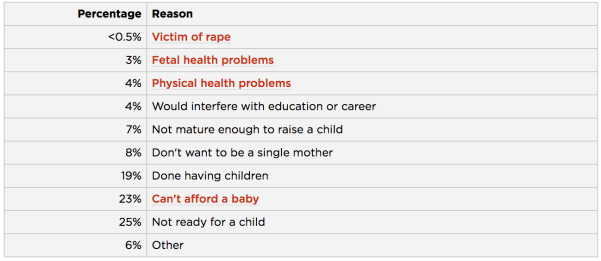
From a 2004 Guttmacher Institute survey, shared on http://abort73.com/abortion_facts/us_abortion_statistics/

For the other cases––whether you agree with them or not, most evangelicals hear “can’t afford a baby” as a reason for abortion the same way abolitionists heard “can’t afford to lose my slaves” as a reason to keep the institution of slavery. It is a significant concern––and at our best, one that we rally to support someone through––but not a reason to take a life.

For American evangelicals, the pro-life cause over the past 50 years may have been the most galvanizing political issue since slavery. (Aside: We have plenty of reason to ask why this would be the case. Why not anti-lynching campaigns or other civil rights causes? That the American Church did not speak with one voice on these issues is a tragic failure.)

Many evangelicals are likely to say they could never cast a vote for someone who will not fight for the ~540,000 unborn children who will be aborted this year when rape, incest, the health of the mother, and other extreme cases, are not at root. Though they see many other tragedies in the world, this is the one that has caught their attention and seems to them the worst.

For all the rhetoric about abortion being legal, healthy, and rare, many are heartbroken and appalled that abortion is currently the leading cause of death in the United States.[note]It just edges out heart disease and cancer. You usually won’t see it listed this way, since most people reporting these statistics don’t consider abortion a “cause of death.”[/note] Abortion in the U.S. is not rare.

So for many evangelicals, I wonder if an anti-abortion vote today would be similar to an anti-slavery vote in the 1800s: evidence of sanctified living, proof of a person’s unqualified allegiance to God, an attempt to set at right the most wrong of all wrongs in our society today.[note]”Most wrong of all wrongs” as they perceive it. I’m not making the absolute claim that abortion is, in fact, the “most wrong of all wrongs” today. But I think we can make a strong case for it.[/note] For many evangelicals, I wonder if the connection between faith and this one issue is just as strong––hard to imagine that any real Christian could support a politician on the other side of this issue. (To be clear: This is not my position. Just as I also don’t hold the position that no real Christian could possibly vote for Trump.)

At a conference earlier this year, I attended several sessions on the state of evangelicalism. At least among this group, there were no #MAGA celebrations going on. These crowds were generally aghast about our President’s contempt toward people who weren’t born in the U.S. or Western Europe. (I think it was the week of his “shithole countries” comment.) But also in every one of those sessions, someone from the audience asked, “But what do we do about abortion?” It wasn’t a rally cry to the GOP. It was a morally conflicted question. These people couldn’t imagine voting for someone whose Supreme Court nominees would uphold more progressive standards regarding abortion––not just preserving the status quo, but likely to advance a more progressive standard––and for decades.[note]For instance, if Antonin Scalia and Anthony Kennedy had been replaced by more progressive judges, the Court would be expected to rule against pro-life pregnancy crisis centers that do not want to be required to post notices about state programs providing free or low-cost abortions.[/note]

The evangelical position here is no deluded extremist position. People like Ross Douthat––a columnist for the New York Times, a #NeverTrumper and ongoing Trump critic… hardly a FOX News contributor––have called for “judicial action, not restraint [in] Overturning our inhumane abortion settlement.” I don’t know that Douthat could be identified as an evangelical (he’s Roman Catholic), but he names the position held by many evangelicals. They want to see change to how our country views and uses abortion. For many, it’s enough to make any like-minded politician an ally and all others foes.

You may or may not agree with this stance on abortion. You should know it is there. If you disagree because of the nuance and complexity of the situation, that is understandable. Not that we can simply shrug at inhumane practices because they’re nuanced and complex. (See also: current immigration and refugee crises.) If you disagree because you don’t find abortion to be that morally problematic, I admit I don’t understand you at all. I’d love to know more. If you disagree because you say, “But what about [insert other issue]?”… let’s talk about that. Next week.

This is part I. Part II: “How evangelicals became Republicans, and the dangers of good activism” will post next week. To be sure you don’t miss it, click here to subscribe.
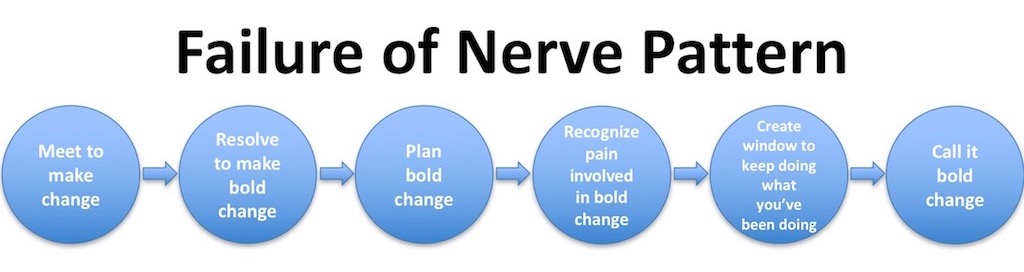
Failure of Nerve

About a decade ago, our church leadership team read Simple Church together. In principle, we all bought into the book’s premise: Identify the few things that matter most; do those things; do only those things.

As we read and worked, our team got excited about the great change that was coming. We could see how this kind of simplicity and focus was going to improve everything. So we identified the few things that mattered most for us––worship, growth in small groups, and service.[note]When I see the hundreds (thousands?) of churches with similar banners, I wonder if they all read Simple Church.[/note] We resolved to focus all of our energy and publicity and resources on those things.

People would get tired of hearing an invitation into our small groups because that invitation would be so constant. Our bulletin would change––rather than thirty announcements to get lost in, there would be only three. Our budget would change––rather than hundreds of line items fracturing our resources, we would focus all of our resources on these few things. We were all excited about it, in principle.

And then we had to start talking about all the other things.

Those items that would no longer be in the announcements. (Remember? We’re simplifying the announcements to talk about small groups ad nauseam.)

Those line items that would no longer be in the budget. (Remember? We’re reallocating our resources to focus them all on worship, grow, and serve. So much extra money for the most important things!)

This was when it all began to fall apart. “But the softball team…!” “But that fellowship dinner…!” As we went down the list of items we would no longer fund in the budget or advertise in the bulletin, it turned out each of them was important to someone. We were supposed to identify the few things that mattered most and do only those things. But everything we were doing mattered.

So what about our exciting new simple church? We decided we could at least organize the announcements according to our new slogan. And we could organize the budget the same way. If it didn’t fit under “worship,” “grow,” or “serve,” it would be an indication that we shouldn’t be doing it.

You know what happened then. We discovered that everything we were doing could be shoehorned into one of those categories. The bulletin announcements remained the same, but they had new headings. Same for the budget line items. We resolved to tweak some of those items––ask how the softball team could be a bit more of a spiritual growth opportunity, etc.––though I’m not sure how long that resolve lasted.

After several months of reading and planning and excitement, we had a new, Simple Church-approved slogan. And the same church.

Why real change fails

Why did our change effort result in a few months of dreaming, a new slogan, and no real change? For the same reason that most real change fails. Change inherently involves loss. And loss involves pain. And once we finally realize the changes we’re planning will involve pain, we have a failure of nerve and try to minimize the pain.

The best way to minimize the pain:
1 – Tweak the old system (to avoid the pain of real change)
2 – Tell yourselves you’re following the new plan (to avoid the pain of wasted time planning)

A more detailed version of that failure of nerve pattern:


In his book on the same subject[note]My diagram and definition of failure of nerve are my own. I’m not sure whether Edwin Friedman would approve or not.[/note] Edwin Friedman says it like this:

“[W]hat is clear about pain universally is this: To the extent that we are motivated to get on with life, we seem to be able to tolerate more pain; in other words, our threshold seems to increase. Conversely, to the extent that we are unmotivated to get out of our chair, our threshold seems to go down.”[note]in A Failure of Nerve, p. 93[/note]

Unless we’re motivated enough, we will not make fundamental change.[note]Ironically, Friedman talks about being unmotivated to get out of our chair while much of the United Methodist Church is relying on a process that requires us to make our most important decisions while we sit in the same chair for 8 hours.[/note] We’ll make tweaks and call it change. And sadly, stagnant and declining organizations usually don’t get motivated enough until crisis. And they don’t usually realize they’re in crisis until too late.

The first post I ever wrote here was about an experience like this. The Bishop had called for a task force to reconsider how we were funding our campus ministries. They consumed 8% of the Conference budget at the time. They were under fire for producing too little return on the Conference’s significant investment. Not that they were all failing. There were many good stories and important ministries happening. But there were others that couldn’t name more than ten students involved in their ministries. Since those ministries were receiving $70,000 from the Conference, they were good candidates for the “most expensive small group” award.[note]Thanks to Adam Sparks for this excellent award title.[/note]

Nevertheless, many leaders were unprepared to face our realities and endure the pain of fundamental change. Instead, our Conference passed a tweak to the system. I didn’t yet have the language for this, but now I can name it as a failure of nerve. We knew we needed to make a change (lots of talk around the Conference about under-performance and major investment; the Bishop had called for a task force!) But we weren’t willing to do it. Those leaders didn’t yet realize their crisis.

A few years later, the campus ministries lost their Conference funding. That task force had been the last chance at preserving their funding.

(A point of celebration: that new funding crisis forced our campus ministries to “get out of their chairs.” Some that were struggling before are thriving now.)

Who will hold the line?

Is fundamental change needed where you are? If so, are you willing to pay the price? There will be loss––and pain.

For any group to pay that price, it will require a bold leader who is prepared to hold the line when others start saying, “But what about [insert pain point]??”

What does that bold leader look like? Especially in church world, they often look like a jerk. I wonder if this is why we so rarely do it. Edwin Friedman describes them this way: “Anyone who wishes to advance our species or an institution must possess those qualities which those who have little sense of self will perceive as narcissistic. All this besides the fact that ‘arrogant,’ ‘headstrong,’ ‘narcissistic,’ and ‘cold’ will be the terms used against any person who tries to be more himself or herself.”[note]p. 190[/note]

Arrogant, headstrong, narcissistic, and cold… Church world rejects these (perceived) characteristics perhaps more than any other world. Do we have room for leaders who are willing to hold the line? Or will we reject them as cold, arrogant, and lacking compassion?

I wonder if the church’s penchant for compassion may lead us to a more regular failure of nerve than most others. Of course, this is often only a perceived compassion, more properly called a desire to keep everyone happy, which is often at its heart narcissistic.

A vote in favor of Methodist itineracy, or When the circuit rider dismounted…

Many advocates for itineracy in the United Methodist Church have contended that itineracy is at the heart of Methodism and a vital part of our ministry.

I’ve advocated in many places for the importance of the local pastor. Some have taken my advocacy as a disregard for itineracy. On the contrary, I would argue that itinerant ministry played a vitally important role in the history of Methodism and could continue to play that role now.

In 21st century Methodism, the ideal of itineracy has not been tried and found wanting. It has been found difficult; and left untried.[note]with apologies to G.K. Chesterton[/note]

Real Itineracy and the Dismounting of the Circuit Rider

Long ago, our circuit riders dismounted. We now operate with stationed pastors who get shuffled around from time to time. This may be a continued acknowledgment of episcopal authority––the Bishop decides when and where someone goes. It has little to do with itineracy as the early Methodists understood it. If anything, our current practice of “itineracy” is likely to have an effect opposite that of real itineracy as the early Methodists practiced it.

Look at this description from Frederick Norwood’s The Story of American Methodism:

“What they meant by itineracy was that plan of appointments by which ministers were kept moving twice-over. In the first place, each man had his appointment for a strictly limited time [at first quarterly, then annually with an absolute 2-year limit, then 3- and 4-year limits in the later 19th century]. In the second place, every preacher kept on the move on his circuit, and this was true even of ministers appointed to city stations, for they had several outpoints […] In this way, some preachers were appointed to circuits in which they preached perhaps four times (once each quarter) in each of many preaching points, and then went off to the annual conference for appointment to a different circuit. Four powerful sermons, ringing the changes from conviction of sin all the way to perfect love, would take care of an entire year’s preaching!”[note]p. 137[/note]

Itinerant preachers moved twice-over. (1) Their appointments to circuits had strict limits. Those who stayed at the same appointment for a second year were criticized for staying too long. (2) Even within those circuits, they were constantly moving. They might preach somewhere four times in a year!

Were these itinerant ministers the ones conducting weddings and funerals for all of their people?

No!

Were they the ones convening weekly leadership meetings, hiring staff, visiting the sick? In other words, were they the “pastor in charge”?

No!

Would they have even known most of their people’s names?

I wonder.

The itinerant minister functioned much more like an evangelist. “Four powerful sermons, ringing the changes from conviction of sin all the way to perfect love…” The itinerant minister provided little to no pastoral care, little church management, rare “vision-casting” leadership, if at all––and the “vision” would usually be a vision of the kingdom of God, not a committee-created 2020 “vision” for the church.

The Congenial Combination in Early Methodism

So what about all the rest? Who would conduct weddings and funerals? Who would meet with the leaders of a congregation and visit their sick? Who were the “pastors in charge”? The located leaders. These were the often overlooked backbone of the early Methodist movement. The traveling evangelists could bring their four powerful sermons, then move on. A local church would not rise and fall on that kind of occasional leadership. Instead, the ongoing leadership of a congregation came from people who were not under threat of being moved at the next annual conference.

The traveling preacher and the local pastor made for a great team. The one serving an apostolic role––constantly on the move and proclaiming the gospel––the other a priestly role––living among the people and shepherding them. “Only when the circuit rider dismounted and settled in the community where the local preacher lived did the problem arise […] of what his role should be,” explains Norwood, “especially in a community accustomed to a congenial combination of the two.”

Today’s Methodism has lost that congenial combination. We have no traveling preachers. We have lost what was best and most important about that role––its evangelistic nature and focus.

We have only local pastors. Yet we warn local pastors and their congregations that we’re likely to uproot them and move them to a different congregation from time to time. With that, we have lost what was best and most important about that role, too––its constancy with the people.

Why did we abandon the true itinerant ministry? Mainly because we found it difficult. Even in American Methodism’s earliest days, the bishops lamented that “an embarrassingly large number of traveling preachers located.” [note]Norwood, 135[/note] The pilgrim life is hard. It’s best cut out for the young and the single. (It was when circuit riders married that they tended to locate.) How many of our “itinerant” ministers today would truly be able and willing to travel like those early Methodist preachers? The car is much easier on the body than a horse. Still, we would likely lose most. Perhaps we would replace them, though, with those truly called to a ministry of itinerant evangelism.

And how many more great pastoral leaders for the church might we gain if we did away with the threat to move them to a different town and congregation? Likely many. Though what we call “itineracy” today is hardly circuit riding, its constant threat of displacement is still difficult both for those with families and for those whose vision of ministry includes a long journey with a particular community.

The Unnatural New Creation of Modern Methodism: The Ad Interim Pastor

Our circuit riders dismounted long ago. When they did, we abolished both the itinerant ministry and the located pastoral ministry. Instead we settled for a new, unnatural and biblically unprecedented form: the ad interim pastor, where the interim may be one year or twenty––hold your breath at each annual conference cycle. It is now the ad interim pastor who conducts most weddings and funerals, convenes most leadership meetings, hires most staff, and sometimes visits in the hospitals, too. Many in the UMC will contend that we should train laity to do some of these things––at least the visitation. To what degree will depend on which ad interim pastor is serving a congregation at the moment. That wasn’t a question in early Methodism. When the circuit riders dismounted, the lines between these roles blurred.

What if we tried itineracy again? What if we tried having located pastors in charge again? Even one of these moves could reap great rewards. The two together could be a piece of returning to the roots of the Methodist movement.


If you found this interesting or helpful, I’d love the chance to share more. Click here to subscribe.