Pastoral Tenure and Transition: How to NOT squander church resources (pt. I)

Only God is infinite. The rest of us deal in finite resources.

The money available to us is finite. The time available to us, at least on this old earth, is finite. Will we use them well, or will we squander them?

I referenced Moneyball in the previous post. In the based-on-a-true-story book and movie, the Oakland A’s are using a limited budget and trying to compete with the Yankees. (Only God is infinite. But the Yankees’ resources seem close.)

How does a team like the A’s with a $41 million payroll beat the Yankees with their $125+ million payroll? They figure out how to maximize their resources. While most baseball teams are relying on “medieval” thinking––doing it because they think it should work, because it’s the way they’ve always done it, etc.––the A’s rigorously study what makes a difference and follow the results to new ways of operating, unusual or uncomfortable as they sometimes are.

Maximizing the church’s resources

In the coming years, the church must find ways to maximize its resources. This is especially important because our battle is especially important. Our competition isn’t the Yankees. Contrary to popular belief, our competition isn’t the mega-church down the street, the Baptists, the Roman Catholics, etc. Our competition is sin, injustice, and heresy.

These are relentless opponents. But our infinite God has given us all that we need for the battle. Now the question: Will we steward it well, or will we squander it?

In the previous post, I wrote about a group that spent $15 million on church planting over the last decade with almost nothing to show for it today. That was a tragic loss of resources. I’m not quite ready to call it squandering. Perhaps that group was neither reckless nor foolish. Perhaps they were careful, thoughtful… and unlucky. Perhaps they were just doing the best they could. They didn’t know any better They provided, if nothing else, a very expensive set of experiments in church planting.

What would be reckless and foolish is if we didn’t learn enough from that expensive set of experiments before running off to try more.

I want to suggest here that the United Methodist Church is an excellent experimental lab. With the level of autonomy each Annual Conference and local church has, we’re simultaneously running thousands of experiments. We have enough history that it’s time to study those experiments more closely and let the results guide us. If we don’t do that, we’re liable to squander our resources––usually out of a desire to keep doing things the way we want to do them.

Three areas where the results should challenge what we’re doing

Tenure and Transition

In an earlier post, I shared several studies related to pastoral tenure and transition. These studies showed what every study I’ve seen shows: churches do much better with long pastoral tenures and few pastoral transitions.[note]Some people may suggest the causal relationship actually runs the other way. Though there must be at least some truth to this, our study showed how even successful long-term pastorates suffered losses in their early years.[/note] When I sent results of one of these studies to a friend, he asked, “Do we even need to keep running more studies?” We know by now. My plea to leaders across the UMC: do what you can to increase pastoral tenures and reduce transitions.
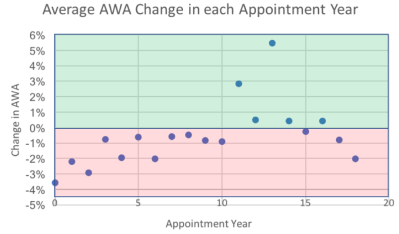
While many said it sounded like a good idea, there were also several who corrected me about our problem. The problem wasn’t too many transitions. The problem was that “we don’t do transitions well.”

Do you see what that suggestion affords? A chance to keep making moves as often as we want to, but with more conversation along the way about how to do it “well.”

The problem: We have nothing more than anecdotes about how to do transition “well.” We do, however, have clear evidence that we should try to create fewer occasions of pastoral transition. One retired United Methodist Bishop cited this as the single biggest problem in our denomination. “We have to get our heads out of the sand,” he said. I thought he must have switched topics to our bigger denominational controversies. “No,” he said, “about pastoral transitions.”

We shouldn’t be too surprised that the frequent shuffling of pastors is harmful to ministry. The practice works against basic biology. Harvard professor Robert Putnam writes,  “[F]or people as for plants, frequent repotting disrupts root systems. It takes time for a mobile individual to put down new roots […] frequent movers have weaker community ties.”[note]In Bowling Alone: The Collapse and Revival of American Community  (New York: Simon & Schuster, 2000), 205.[/note] That makes frequent moving harmful for pastors and for churches trying to minister to their communities.

I went to a cooking class a few years ago where the chef talked to us about how amateur cooks feel a need to constantly move the meat around on the grill top. He talked about all the reasons that was unnecessary and could be harmful to the final product. “For some reason, you feel the need to keep moving that meat around. Maybe you need to feel like you’re doing something. You have to stop! Put it there, and then LEAVE IT THE HELL ALONE!” Though I’m not sure that’s quite the way we’d say it to Bishops and Cabinets around the denomination, the chef’s admonition seems fitting, in principle.

We have enough evidence to make this change. Can a pastoral transition be beneficial to a church? Of course! But it will be the rare exception to the rule.[note]In our study, 70% of churches declined after a transition, including 90% of churches that had previously experienced 10% growth or more.[/note] If a Conference’s median pastoral tenure is falling, rather than rising, we have reason to ask whether they’re squandering one of their most important resources. A change to lengthen pastoral tenures––I’ve suggested a target average of 10 years––would involve a change to many standard practices and cultural norms. It wouldn’t be easy. But it’s needed. I’ve provided some practical suggestions about how we could do this in the recommendations section of the bigger research study.

I’ll share pt. II next week. It’s on church planting and includes some research that may confirm or contradict how you think church planting works. JOIN my e-mail update list to be sure you see it.


“If 50 times you don’t succeed…”: Intuition in Strategic Planning

Theatrical release poster, found on Wikimedia. Qualifies as fair use.

Last year, I attended a conference where a leadership group shared about the massive failure of their church planting strategy over the past decade. Massive, in their case, was around $15 million spent with almost nothing to show for it.

This was at a conference about using statistical data to measure our outcomes. (A friend called it “nerd camp.”) It was refreshing to hear a group of leaders admit to their past mistakes –– well, the mistakes of the previous regime, but still…

Then the presentation shifted to their new plan. They talked about the millions of dollars they were planning to invest in new efforts. Fresh Expressions. Closing dozens of churches to create “vital mergers.” They spoke with assurance and excitement about the great things that were about to happen in their conference because of this grand new strategy. Most people in the room –– composed mainly of Conference leadership from across the United Methodist Church –– seemed inspired and excited by this bold new vision.

One question gnawed at me: A decade ago, couldn’t that previous team that blew $15 million have stood on stage somewhere and talked about their bold and exciting new vision to plant churches?

In fact, that leadership team a decade ago probably did just that. They probably shared their vision with leaders from other areas who walked away inspired and wishing that their leaders could dream such big dreams and cast such big visions.

So what made this new 2017 leadership team so confident that they would fare better? We were at a conference about using statistics, so perhaps they had better data. Their presentation revealed nothing of the sort. They used the statistics to prove what an epic failure the previous strategy had been. What did they use to prove that their new strategy would be an epic success? A charismatic presentation.

This was a group that believed in themselves. They believed in their intuition. They believed they had a better vision than the last group, a better plan than the last group (in UMC world, it all begins with a good Ministry Action Plan [MAP]), and better systems for implementation than the last group.

So a question I’ve begun asking in leadership rooms: “What if the people who were doing this eight years ago were just as smart and talented and driven as we are?”

And a statement I’ve begun making: “Until our track record improves, I refuse to trust our intuition.” (Another leader tells me I’m giving him a complex. He doesn’t trust anything he thinks anymore. I make no apologies.)

This presents an internal conflict for most leaders: We love our intuition. We believe in ourselves. We believe in our ideas. We believe we know what we’re doing.

So we spend $15 million on a big new strategy that we’re sure will work. Because we’ve read books about it and heard people talk about it at conferences. Because we’ve had long meetings (8 hours!) where we developed exciting mission statements and MAPs. Because we’ve heard ourselves casting that compelling vision, and it sounds pretty good.

When these strategies fail, it should be cause for us to question our intuition. We rarely do. Instead, we assume that the problem was that group’s intuition or talent or drive. With hindsight, we say, “They should have known.” Or, “They didn’t execute properly.”

And then we say to ourselves, “We’ll get it right this time.”

And then we give a new presentation about the exciting thing we’re about to do.

Something besides intuition

One of my favorite movies in the past decade was Moneyball. It showed its viewers just how silly some of our intuitive reasoning can be.

In Moneyball, we see baseball scouts evaluating players based on how attractive their girlfriends are, how their swings look, and what kind of confidence they project in the locker room. They prefer players who get to first base with a hit and dismiss those who get walked a lot. The based-on-a-true-story plotline is built on this line in the movie: “There is an epidemic failure within the game to understand what is really happening. And this leads people who run Major League Baseball teams to misjudge their players and mismanage their teams […] Baseball thinking is medieval. They are asking all the wrong questions.”

In Moneyball, the answer was to properly identify which results mattered and then to meticulously analyze what was enabling those results. They did not rely on their intuition. They relied on the cold, hard analysis. They did strange things like trading their only first baseman, trading away players everyone thought were stars for players no one had heard of. The person making all the trades didn’t even watch the games.

If my experience at the “nerd camp” conference was any indication, most of us would like to stick with the medieval thinking. We’re reluctant to do hard analysis and then go where it leads us. Why? Because it challenges our conventional wisdom. It limits our options and takes away our own decision-making control. It may not let us do what we want to do.

Most of our decision-making is comfortably intuition-based. Planning is easy –– and rather exhilarating sometimes. Just crafting that beautiful plan makes us feel like we accomplished it.

A brilliant man named Lovett Weems said at that conference: “If you have a proven track record, the path to success is simple:

Plan It –> Implement It –> Celebrate Your Success

“If you don’t have a proven track record, that strategy makes no sense.”[note] My best memory of his exact quote.[/note]

In the next post, I’ll ask about some areas where it might be time to stop trusting our intuition and try a Moneyball strategy instead. Namely, church planting, pastoral transitions, and our process for developing strategy in general.

Until then, how’s your track record? If it’s good, keep on doing what you’re doing. If you’re meeting because things haven’t been going too well, ask yourself, “What if the last group working on this was just as smart, talented, and driven as us?”

To be sure you get that next post, click here to subscribe.


How much before you’re rich?

This recent article detailed the budget of a couple with annual income of $500,000. That couple is “only” investing into their 401(k)s for retirement, only giving 3.6% of income to charity (5.7% of post-tax income), and has only $7,300 left at the end for savings. The article describes them as feeling “average.”

If you have a household income of, say $100k, you’re likely to be incredulous at this. You think you’d surely be able to give more, save more, and have more left over if you could only have that kind of income. You likely will look at many of this couple’s expenses as lavish and unnecessary. (“Three vacations!” “BMW…”)

But be aware that someone with household income of, say $50k, would be equally incredulous at a $100k household with similar numbers. Same for the $25k household looking at the $50k. Probably same for the couple featured here if they came across a couple making $2 million who thought they were just average…

Anecdotal observation: People at almost all income levels think they’re at the just-barely-making-it point. We tend to compare up rather than down. That gives us justifications for why we don’t give more and why we don’t save more and why if we could just make as much as [whomever we’re comparing to], we’d be fine. Those justifications don’t do anything good for our hearts, our relationships (which easily turn resentful), or our generosity (which I’d suggest has a reciprocal relationship with our hearts).

If you wait to give generously until you’re finally at that position in life where someone else is, it’s not likely to come. Whenever you get there, the goalposts will have moved. Same for saving. Same for gratitude. Simplicity[note]In this instance, I use “simplicity” in a loose way––for anyone who lives happily within their means[/note], generosity, and gratitude have more to do with the state of our heart than our annual income. Yet we tend to look to a bigger income as the solution.