
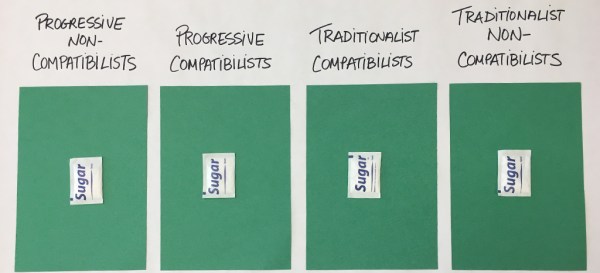
Most people now think some sort of divide in the UMC is inevitable. Tom Berlin shared this helpful illustration about our differences––attributed to Tom Lambrecht. It shows two groups who are “non-compatible” with the other’s stance on same-sex marriage. Their positions are so opposed that they cannot find any covenant both sides would agree to and keep.
Chris Ritter improved on that illustration in a recent post to show the relative size of each group.
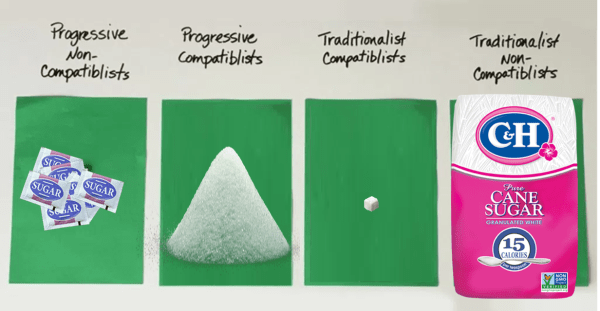
First, let’s ask whether Ritter and Berlin are right––these groups can’t all remain united. I think they are. Mainly because I’ve interacted with non-compatibilists on both sides. I know the pastors and church members who will leave any Church communion that endorses same-sex marriage, on paper or in practice, nearby or afar (i.e. what happens in California affects Kentucky). And I know the pastors and church members who will leave any communion that prevents them from endorsing same-sex marriage.
Unless I’m wrong about this, our Commission on a Way Forward will not find a way to keep us all united. Some divide must occur.
The question: where and how do we draw the lines?
The illustration above helps us see our current crisis. However, I think it leads us to the wrong conclusions when we start talking about drawing lines. We assume that if we’re headed toward inevitable schism, the line must cut according to these divisions––we’re going to divide over same-sex marriage.
I want to suggest a different way of looking at our current situation, not according to same-sex marriage (alone) but according to covenant.
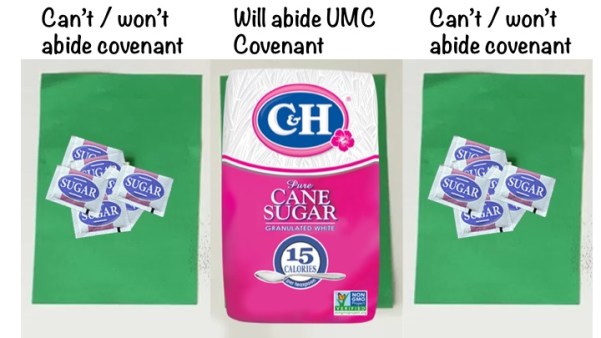 “Covenant” in the UMC may sound like a shibboleth for conservative / traditionalist right now. Especially given the name and emphasis of the Wesleyan Covenant Association (WCA). But note that there are sugar packets on both sides here.
This is where some “conservative / traditionalist” repentance is in order. I offer this as someone who tends to identify more closely with the UMC’s “conservative” crowd. I hosted Bill Arnold’s guest post about the initial WCA meeting. I teach and affirm the UMC’s current positions on human sexuality. So I offer this critique of the UMC’s more conservative wing from the inside:
- Traditionalists have gotten serious about human sexuality far too late, and still leave some question about whether we’re concerned about human sexuality or only gay sex.[1] Many of our churches have allowed unmarried, sexually active heterosexuals to become members, leaders and staff members while denying the same to sexually active homosexuals, or in some cases, even celibate homosexuals![2] This reveals an incomplete and incoherent (or merely homophobic) theology of human sexuality. We must develop and practice a more robust theology of human sexuality.
- We have gotten serious about covenant far too late, and in an incomplete way. Some progressives have asked me why covenant-keeping has become so important to conservatives now, when they’ve never seen outrage about our several churches and pastors who practice re-baptism, “remembrance of baptism” by full immersion, or infant dedications with believer’s baptism. All of these are flagrant violations of our covenant.[3] If we’re going to get upset about flagrant covenant-breaking, it has to be about all flagrant covenant-breaking.
- We have suggested that traditionalists “believe the Bible” and progressives don’t. That’s unfair. I’ve been on the other side of that argument with Calvinists, believer’s baptism folks, and people who won’t ordain women. (“You let women preach? Oh, my church follows the Bible…”) We have to engage in more serious conversations about exegesis, not straw man take-downs.
- Some of us have withheld our apportionments as a sign of protest. That’s not the way to protest.
Our tendency is to acknowledge our “small” faults, but then to point out how much more the other side is at fault. I’ve never had a conflict move toward resolution by trying to point out that the other person was 80% of the problem. I don’t know the percentages here, but there’s enough blame to go around. No need to identify who’s more at fault.
Getting serious about covenant
With all of that, I want to suggest that it’s time for us all to repent, forgive, and get serious about our UMC covenant––all of it.
We need to offer full forgiveness to all who have broken that covenant in the past.
We need to ask which churches and pastors will find it impossible to abide our covenant going forward.
We need to offer them a gracious, graceful exit. This is not far different from what Bill Arnold and David Watson were proposing a few years ago (the A&W plan, as it was called). If you must leave, take your property and your pension with you. Some of our general boards and agencies may even find a way to continue to work in partnership with you, should you choose.
The major difference between this suggestion and the A&W plan: it’s not just about same-sex marriage. It’s about the whole covenant. Can you abide, or can you not?
Some of the most likely areas we’ll need to discuss:
-
-
- Baptism practices. Will you need to break covenant to re-baptize someone, to perform an infant dedication, or to recommend believers’ baptism?[4]
- United Methodist doctrine. Contrary to popular opinion, we have a clear set of doctrinal beliefs. Can you affirm and teach Trinitarian faith? The historical, bodily resurrection of Christ? Free grace on offer to all people (i.e. you’re not a Calvinist)? The Bible as the true rule and guide for faith and practice?[5]
- Women in ministry. Can you support full clergy rights for women?[6]
- Same-sex marriage. Will you need to break covenant to perform or live in a same-sex marriage?
- Itineracy. If you vow to go wherever the Bishop may send you, can you keep that vow?
- General Conference. Above all, you’re agreeing to live and minister according to the decisions of our General Conference.
-
These questions do not ask for full agreement, only obedience.
I have friends who believe we should re-think baptism, others who believe we should re-think same-sex marriage. But they’re willing to live within our current UMC covenant. I believe we need to re-think ordination and itineracy. But I’m willing to live within our current covenant.
We need dissenters who will keep dissenting, just as we needed them in the past to advocate women’s ordination until we changed our position. I’m not convinced by the alternative positions on baptism or same-sex marriage. I don’t expect ever to be. But people have historically helped the church re-think important positions by their advocacy.
If we divide (and we almost surely will), I hope we do it based on covenant, not the single issue of same-sex marriage. I hope we give a graceful exit to those who simply can’t abide the covenant. I hope we retain many people who continue to disagree and advocate for change. And I hope we then begin to take our covenant seriously––all of it.
I write about theology, ministry and the UMC, usually about twice a week. Click here to subscribe by email.
[1] Some people have noted that traditionalists aren’t only now trying to maintain biblical faithfulness regarding human sexuality. They talk about an effort in the 60s and 70s to maintain faithfulness regarding premarital sex, adultery, and divorce. “We capitulated to cultural pressures” on those issues, writes one person. That’s a better historical perspective, not that traditionalists are only now getting serious about sexual ethics, but that we’ve capitulated on the rest in many places, making a firm stance against same-sex marriages appear merely homophobic, since it’s no longer paired with a firm stance on the rest.
[2] To be clear, I’m not suggesting that it would be unfaithful to our UMC covenant to admit people as members to the church, even while they’re doing something that we would call wilful sin. (I don’t advocate membership in those cases, but that’s another post for another day…) All I mean to suggest here is that if we’re willing to admit anyone “living in sin” as members, we need to be ready to admit anyone “living in sin.” No way can we exclude a gay or lesbian couple while admitting others.
[3] Several people have asked me if all of these are truly “flagrant violations of covenant.” I admit that I may have gone too far here. Re-baptism is a clear flagrant violation (including by willful ignorance or by any suggestion that the first one didn’t count).
Remembrance by immersion and infant dedication are more gray area. This article from Discipleship Ministries and the sources it cites are probably most helpful regarding infant dedication. If not 100% inappropriate, it’s at least a significant deviation from our sacramental theology (baptism as an act of God; dedication as a human action). For remembrance, This Holy Mystery states, “water may be used symbolically in ways that cannot be interpreted as baptism.” That makes it hard for me to see immersion qualifying. Usually a smaller amount of water is used and it’s not administered by another person. If it looks like a duck, swims like a duck… Many of these “remembrances” seem to me a clever way of getting around our baptismal theology. But this, too, is not black and white.
[4] Why the heavy emphasis on baptism? “That’s not what’s causing our divisions,” some say. But if we say that infidelity to covenant is causing our divisions, then this is a prominent area of covenant infidelity in some areas, and it must be resolved. (Also, some value our sacramental theology as much as our theology of sexuality. We have not come lightly to our positions on the sacraments.)
[5] Several people have suggested that the primary cause of our divide is theological. First, I don’t believe we have one divide, but many. Theology is certainly a cause of division, though I’d caution us not to think of that divide in simplistic “left” and “right” categories. We have many people across the spectrum (and with varying beliefs about same-sex marriage) who can say the full Nicene Creed and mean it. And we have people across the spectrum who cannot. If we attempt to solve our divisions by means of sifting out the heterodox (something that fidelity to covenant does), we will not be chopping off a “liberal” or “conservative” wing or resolving our controversy over same-sex marriage.
[6] For any who think this addition unnecessary, here’s a comment to me from a United Methodist woman: “[O]ne of the things I was worried about before the WCA was that the conservative voices in the UMC particularly here in KY would begin to question women clergy (among other things). Let’s be honest many many [of our] UMCs do not totally support women clergy and in fact if we shine a light bright enough, we find several UMC pastors and maybe even DSs that do not as well. I have also seen and been privy to conversations surrounding Communion as a Sacrament, One Baptism and Calvinistic language among lay persons in leadership and clergy whose primary background is in another denomination. Seriously, we have many Bapti-Methodist churches in [our state] and the SEJ that ignore important aspects of our doctrine and polity as egregiously as those progressive whom they criticize. As I have heard and seen WCA emerge, I’ve been pleased to see that Orthodoxy, Wesleyan theology, and abiding by the BOD in all regards is the focus.” For the record: I don’t know of any DSs who don’t support women clergy, but I found this woman’s testimony helpful for anyone who believes we’re past these concerns.
 teddy ray