
 You’ve probably heard all that you care to hear about polls and favorability ratings. I’m going to share one more set of polls with you, though. About five years ago, a group called Public Policy Polling had done a survey about Aaron Rodgers’s favorability in Wisconsin. He got the highest rating they had ever seen—an 89%.
If you don’t know who Aaron Rodgers is – this may help:

Now you recognize him, right? He’s the discount double-check guy! The commercials were really big at the time. He also plays quarterback for the Green Bay Packers, and they had just won the Super Bowl, so that could have something to do with it, too.
So the polling group decided to do one more poll. They wanted to know if anyone could be more popular across America than Rodgers was in Wisconsin. Did anyone hit 90% favorability? They surveyed 800 Americans, and they found three winners![note]You can see the results at http://www.publicpolicypolling.com/main/2011/11/americans-love-jesus-lincoln-and-themselves.html%5B/note%5D
#2 was Abraham Lincoln. He had a 91% favorability rating. Which makes sense. We all like Honest Abe, right? Or at least 91% of us do. (Who in the world were the 9%?)
Right behind Lincoln was Jesus, with a 90% favorability rating. This is interesting to me. Jesus has been a hotly debated figure through time. He’s been divisive. He told his disciples, “You will be hated by everyone because of me.”[note]Matt 10:22[/note] He said men would turn against their fathers, daughters would turn against their mothers because of him.[note]Matt 10:35[/note] He told his disciples that the world hated him because he testified that its works are evil.[note]John 7:7[/note]
And the divisions didn’t end in the Bible. Some of history’s longest and fiercest debates have been about Jesus—whether he was truly the Son of God, what Jesus would do, what Jesus would approve of… So how could someone so divisive in his time and through history have a 90% favorability rating?
Well, I have a few suggestions. One that I don’t want to make light of: many of us worship him as Savior, God who has taken on flesh and given us his great grace at his expense. We view Christ not just favorably, but with ultimate reverence and devotion. “Favorable” is far too small. We’ll come back around to that.
But I wonder if there’s something else going on here, too. I’ve given you #2 and #3 in favorability in that poll, but I haven’t given you #1 yet.
Number one was… #1. The poll also asked people how favorably they viewed themselves, and 93% gave themselves a positive rating. The most esteemed person in America… is each of us in our own eyes. This isn’t shocking, is it?
I think that also has something to do with why Jesus’ ratings are so high. Several people have suggested that our search for understanding Jesus—the real, historical Jesus—is like looking down to the bottom of a deep well. And from the bottom, we see an image come back to us that we’re sure is Jesus, but it looks a lot like our reflection.[note]This analogy was first used by George Tyrrell in Christianity at the Crossroads, 1909, though it’s most commonly attributed to Albert Schweitzer.[/note]
The Jesus in our minds supports the sort of morality that we support—strict about the things that we’re strict about, lenient and full of grace about the things that we’re lenient about. He probably would vote the way we vote, because the issue that we’re most passionate about is surely the one that he cares most about. For some people that’s war.

For others it’s abortion.

And to be sure, we should look to Jesus and his teaching and example for our moral lives, but we might admit that we rush to him more quickly on some issues than others.
It’s no wonder, then, that we even re-make Jesus physically in our image. Asians have depicted Jesus as Asian.

Africans have depicted him as African.
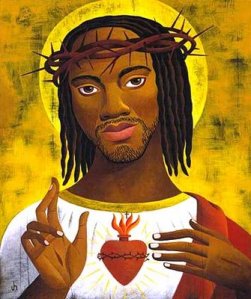
And of course, white Westerners have depicted him as a white Westerner.

Those physical depictions are just small evidence of the bigger ways that we make Jesus look like us. If our calling is to be imitators of God, imitators of Christ, we’ve found that the easier way of coming to look like Christ is when we make him come to look like us.
Some people have seen us paint these false pictures and reacted by running the other way—saying we can’t really know anything about Jesus. A famous Bible scholar named Rudolf Bultmann said it this way: “I do indeed think that we can now know almost nothing concerning the life and personality of Jesus.”[note]from N. T. Wright in Jesus and the Victory of God, 3.[/note]
And then there’s a third group of people—those who say Jesus doesn’t matter. We’re spending too much time on a historical figure who’s irrelevant today. You can see that in this survey of the Church of England that talked about the different reasons people don’t go to church. Why don’t more people go to church?
“Part of the reason is simply a lack of belief that the death of Christ was the turning-point of history… It all seems less and less likely to be true, the more you discover about those maniacs in the first century who were expecting a Messiah and getting ready for the end of the world.”[note]Ysenda Maxtone Graham in The Church Hesitant (1993), p. 129. As found in JVG, xiv.[/note]
According to that survey, our interest in Jesus is pointless. It was created by a few maniacs in the first century. Time to move on.
Whether you fashion Jesus in your own eyes, or as someone who can hardly be known about at all, or as someone irrelevant for us today—the product of a few maniacs from the first century—we can say this: “What you say about Jesus affects your entire worldview. If you see Jesus differently, everything changes. Turn this small rudder, and the whole ship will change [course]. To put it bluntly: what if the maniacs turned out to be right?”[note]JVG, xiv[/note]
In some sense, that’s the question we’ll be asking throughout this series. It becomes two questions: “Who was Jesus?” and “So what?” We ask because the answers to those questions have the potential to change everything—our entire worldview (the way we see), and our entire course (the way we live). We ask because we believe that Jesus looked very different from a lot of our conceptions—and if we really want to know him and imitate him, we need to dispense with the false portraits we’ve sketched in our minds and instead see him as he was. We ask these questions because we disagree with Bultmann when he says we can’t really know anything about Jesus. We believe we can! Because we believe this record we have in Scripture tells us about him, how he lived, what he did and said.
In this first post, especially, we’re going to spend a lot of time on that question, “Who was Jesus?” We’re going to spend a lot of time in his world to see Jesus in his real time and place, and then we’ll come out at the end to ask, “So what?” So we go to Scripture to see Jesus in his time and place.
Jesus’ setting: Renewal movements
Look at the beginning of Jesus’ ministry, as Matthew presents it:
From that time on Jesus began to preach, “Repent, for the kingdom of heaven has come near.”
As Jesus was walking beside the Sea of Galilee, he saw two brothers, Simon called Peter and his brother Andrew. They were casting a net into the lake, for they were fishermen. “Come, follow me,” Jesus said, “and I will send you out to fish for people.” At once they left their nets and followed him.
Going on from there, he saw two other brothers, James son of Zebedee and his brother John. They were in a boat with their father Zebedee, preparing their nets. Jesus called them, and immediately they left the boat and their father and followed him. (Matt 4:17-22)
Something sometimes unnoticed about Jesus throughout the gospels is that he was leading a movement. He went around announcing that something new was happening. He gathered a following of people around him—disciples. Whatever he was doing, he was leading people somewhere; he was starting a movement.
A lot of the images in our heads about Jesus’ time and place are serene, peaceful, Jesus going around and just “loving” people, standing beside some body of water and speaking in ethereal tones: “The kingdom of heaven is like a mustard seed.” That doesn’t give you a real sense of the atmosphere at this time and place in the world. For the Jewish people, recent history involved violence, uprisings, upheavals of government. It involved movements and leaders who would gather people to their cause.
Here’s a sketch of the time leading up to Jesus… About 160 years before he was born, there was a Jewish rebel army that took control of Judea. They’re known as the Maccabees. The Maccabees said that the Jewish people were living in the Promised Land, and God’s people shouldn’t be under foreign rule. So they revolted, and they actually won and took over. After their long time under foreign rule, the Jewish people ruled in the promised land for 100 years. But then the Romans came in and conquered them. That happened about 60 years before Jesus was born.
We have records of some of the abuse these Jewish people suffered during those times. Here’s one instance from the book of 2 Maccabees:
Eleazar, one of the scribes in high position, a man now advanced in age and of noble presence, was being forced to open his mouth to eat swine’s flesh.
[This is, of course, horribly offensive for Jewish people who didn’t eat pork.]
But he, welcoming death with honor rather than life with pollution, went up to the rack of his own accord, spitting out the flesh, as all ought to go who have the courage to refuse things that it is not right to taste, even for the natural love of life. (2 Maccabees 6:18-20)
This is the kind of oppression and suffering that the Jewish people of Jesus’ time would have experienced and talked about. The pagan nations persecuted the Jews back in the days of the Maccabees, and then the Romans took over, and there was this continued foreign military occupation. They imposed weighty taxes, ones that could be crippling for people who lived on the edge of poverty. (A reason tax collectors were thought of so poorly—and why people asked Jesus at one point about whether he supported the imperial tax: “Are you with the empire? Or are you with the Jewish people?” Either answer would get you in trouble with someone.)
So what happens when people are oppressed like this? When their backs are against the wall and they feel like they have no hope? This is when revolutionary movements arise. You get social bandits—“Robin Hood” types who would perform raids to harass the upper classes and provide for the peasants. There’s one occasion where King Herod assembled an army to track down a group of bandits, and they retreated to hide in caves. Look how a historian recorded what Herod did:
“With ropes [Herod] lowered [over the cliffs] the toughest of his men in large baskets until they reached the mouths of the caves; they then slaughtered the brigands and their families, and threw firebrands at those who resisted… Not a one of them voluntarily surrendered and of those brought out forcibly, many preferred death to captivity.”
– Josephus, The Jewish War[note]all of this from “Revolutionary Movements, Jewish” by W. J. Heard and C. A. Evans in Dictionary of New Testament Background[/note]
You had bandit uprisings, and you had the rulers stomping them out. This is how the Romans kept peace. The Pax Romana worked by stomping out any uprisings.
And then after Herod died, some time shortly after Jesus was born, Herod’s son sent armies into Jerusalem and massacred thousands of Jews on pilgrimage to worship there. Because of that, peasant revolts rose up all over the kingdom, a lot of them with leaders that might be referred to as messiahs—promising to overthrow Herod’s dynasty and the Romans’ rule.
This is the kind of political setting that Jesus came into. And that’s only a small taste. It wasn’t getting better. After Jesus, it got much worse, actually.
In all of it, the Jews had this great hope that they wouldn’t live under Rome’s thumb forever. They were God’s special people, and God had made promises to rescue them and make everything right again. Specifically, God would come and establish himself as King over all the earth. He would bring justice and peace and set the world right.[note]adapted from Wright’s Matthew for Everyone, Part One, pp. 28-29.[/note] And a lot of them would look to movements like these as the answer.
So where would their minds go when they heard something like, “the kingdom of heaven has come near”? This was a major political statement. A revolutionary statement. “God is renewing his covenant with Israel, he’s restoring creation, setting Israel free. God is returning to be known as King!” The people would hear those as fighting words. We have to understand this bit of background to understand so much of Jesus’ life.
Mighty in word and deed
So look at the next part of that passage in Matthew now:
Jesus went throughout Galilee, teaching in their synagogues, proclaiming the good news of the kingdom, and healing every disease and sickness among the people. News about him spread all over Syria, and people brought to him all who were ill with various diseases, those suffering severe pain, the demon-possessed, those having seizures, and the paralyzed; and he healed them. Large crowds from Galilee, the Decapolis, Jerusalem, Judea and the region across the Jordan followed him. (Matt 4:23-25)
You can imagine curious people watching from their doors, gathering to hear what he had to say, gossiping about what they had seen, wondering whether what he said was true. You can imagine them bringing people to him on stretchers and seeing them healed—flocking to wherever he was, so they could keep seeing and hearing what he was up to.[note]This idea of Jesus traveling from village to village and teaching might help us see the writing of the gospels differently. With a traveling prophet who is constantly in front of new crowds, how many times would he say some of the things that he said? For his most popular teachings and parables, he probably said them dozens of times, at least. So when you see a teaching in several of the gospels, and perhaps it’s in a different place and worded slightly differently in them, it’s likely that these are each different occasions. And for his followers to later record some of these with accuracy, it probably wouldn’t be that hard. Can’t you imagine them saying, “Oh, it’s the parable of the sower again…”?[/note] [note]Wright describes the scene much like this in Matthew for Everyone.[/note]
He spoke differently from the other teachers of the law, like someone who had authority. He spoke like a prophet! If you don’t think of Jesus as a prophet, it’s interesting to see just how often the New Testament calls him one.
It’s how the crowds view him. When people ask who he is, they say he’s the prophet from Nazareth.[note]Matt 21:11[/note]
It’s how his disciples viewed him. After his death, they tell a stranger (who turns out to be Jesus!) that he was “a prophet, powerful in word and deed” (Luke 24:19).
Jesus even refers to himself as a prophet.[note]e.g. Matt 13:57; Luke 13:13[/note]
And he backs up his prophetic words with his actions—he’s a prophet powerful in word and deed. His only miracle that’s recorded in all four gospels is when he went out in the wilderness and fed people.
Does this remind us of any stories from the Old Testament––God feeding Israelites in the wilderness? That’s what God did during the exodus from Egypt. Jesus’ miracles weren’t just some magic to prove that he was God. If he just wanted to prove he had divine powers, he could have… I don’t know, floated. These were more than signs of miraculous powers, they were announcements—this was about God rescuing his people, a new exodus!
When he healed people, it announced the same. What’s it like when the kingdom of God comes? Faithful people are healed, the curse of disease and decay is broken! And this isn’t just about physical healing. So many of the people who were healed had been ostracized. If you were blind or lame or deaf or dumb, people assumed that somehow sin was involved. You were less of a human—not a full Israelite—because of those physical problems. Jesus healed a woman who had been bleeding for years, which would have made her perpetually unclean. He healed lepers who had to stay away from the rest of society and yell, “Unclean!” as they went by. Those healing miracles were restoring people to community. It wasn’t just physical healing—it was social healing.
For a people who have long been under someone else’s thumb, what good news! This was release to the captives and recovering of sight for the blind. The day had come when God would save his people!
If it were this simple, we would expect Jesus’ favorability rating to blow Aaron Rodgers’s out of the water, wouldn’t we?
Why would people hate Jesus?
But it wasn’t just curious and excited crowds who flocked to hear Jesus. Almost anywhere he went, there was tension. They accused him of being demon-possessed. One crowd took him to throw him off a cliff.[note]Luke 4:29[/note] At least twice, people picked up stones to stone him.[note]John 8:59; 10:31[/note] And it seems that everywhere he went, Jesus was being confronted by the Pharisees and the teachers of the law.
If you have any idea in your head that most of Jesus’ time was peaceful, you’ve been fed a false narrative. This movement he was leading was highly controversial.
N. T. Wright says it this way:
“The fact that he was not arrested sooner was due to his itinerant style, and to his concentration on villages rather than major cities, not to anything bland or unprovocative about the content of his message.”[note]JVG 172[/note]
His message wasn’t some nice, timeless truths for us to live by. It was a passionate and provocative message that people heard and had strong reactions to—some of them reacted by following Jesus, even leaving behind professions and families. Others picked up stones to stone him or tried to throw him off a cliff.
Two reasons that people didn’t like Jesus’ message:
First, he was giving a revolutionary message, and not everyone wanted revolution. Can you imagine some of the Jewish people who were doing okay in this setting? The ones who were okay with things as they were? The worst thing that could happen for them would be to upset the Romans with rumors of another uprising. They would say things like this:
“If we let him go on like this, everyone will believe in him, and then the Romans will come and take away both our temple and our nation.” (John 11:48)
These prophetic announcements about the kingdom of heaven coming near were not good news for the people already in power. Later, when Pontius Pilate asked, “Shall I crucify your king?” the chief priests answered, “We have no king but Caesar” (John 19:15). Don’t mess with Caesar. Times are good. Caesar is Lord.
Second – even if a message of revolution was good news for you, you still may not have liked Jesus. In Jesus’ world, when someone announced the kingdom of God coming, whose side would God be on? Israel’s! And who was God against? Israel’s oppressors—the Romans! But instead, Jesus went around talking about a lot of Israel as outsiders, and others—Gentiles—as those who would receive the kingdom. When he talked about judgment day, it wasn’t all the Jews who were in and all the rest who were out. He kept warning the Jews that they might find themselves on the outside, knocking on a closed door.
N. T. Wright observes about it all:
“Someone who is telling strangely familiar stories and meaning the wrong things by them will land up in trouble. The parable about defilement, about the things which come out of or go into a person, in which the former defile and the latter do not, is a cryptic invitation to abandon one of the most cherished cultural boundary-markers of Israel, a social and religious symbol which people in recent memory had adhered to even when the result was torture and death.”[note]JVG, 179[/note]
Remember those Maccabees who died rather than eating swine flesh? This parable would be a slap in the face to them.
Even with his healings, Jesus didn’t announce the kingdom the way they would expect. Who does the messiah bring healing to? His people, right? But then in maybe the most audacious of all his healings, Jesus healed the servant of a Roman centurion. Here he was providing healing to the enemy––one of the stationed officers of the occupying army. What do you do with this?
Jesus’ miracles weren’t finally the kind of miracles the people were looking for. They weren’t miracles that delivered them from their captivity to the Romans. Instead, his most powerful miracles targeted a different enemy. He drove out demons, forgave people of their sins, and raised people from the dead. Why?? These attacked the real enemy—and it wasn’t Rome. It was the devil. And when Jesus came driving out demons and announcing forgiveness, it was a direct attack on the devil.
When Jesus announced that God’s kingdom was coming, he meant something different from what the people expected. They wanted deliverance from Rome, just as Israel had been delivered from slavery in Egypt. Jesus was announcing a deliverance from the devil, from slavery to sin and death.
This second group didn’t understand Jesus’ revolution message because it wasn’t how revolution messages were supposed to sound. In fact, what he was saying sounded almost opposite a revolution message. He sounded a lot like a prophet from the Old Testament, Micaiah son of Imlah. And you know what he was like…
No? Let me tell you his short story.
Jesus, the new Micaiah
The king of Israel, Ahab, wanted to go to war against another country, to take back some of Israel’s land. This was the promised land—it belonged to Israel—surely God would want them to have it back. (Is this sounding familiar?) So Ahab called together 400 prophets (these were prophets of other gods, not the God of Israel), and they all answered the same way: “Go! Yahweh will give them into your hands.” But another king—the king from Judah—asked, “Isn’t there any prophet of Yahweh around here?” And Ahab said, “Well, there’s one… but I hate him because all of his prophecies are bad. His name is Micaiah son of Imlah.”
So they went and got Micaiah, and the messengers all said, “Look, the other prophets are unanimous on this. They’re all predicting success for the king. Don’t screw this up!” But instead, Micaiah went in and said this:
“I saw all Israel scattered on the hills like sheep without a shepherd, and the Lord said, ‘These people have no master. Let each one go home in peace.’ ” (1 Kgs 22:17)
He was saying, “You think you’re going to victory—that this is how you’ll gain back the promised land—but you’re going to your death.”
And after that, Ahab turned and said, “Didn’t I tell you he only prophesies bad things about me?” So what do you think Ahab did? You already know, don’t you? He ignored the prophecy and went to war. And what happened? You already know, don’t you? They got routed. Ahab was killed. You can imagine the bodies scattered on the hills. Whoever escaped alive saying, “We have no master now, no King”—sheep without a shepherd.
Jesus came like a new version of Micaiah son of Imlah. He came to people who were ready for war, certain that God would give them victory, and he warned them that their way of revolution wasn’t how they would achieve peace. He had compassion on the crowds because they were like sheep without a shepherd.[note]Matt 9:36[/note] As he went into Jerusalem, about to be crucified, he wept and said:
“If you, even you, had only known on this day what would bring you peace—but now it is hidden from your eyes. The days will come upon you when your enemies will build an embankment against you and encircle you and hem you in on every side. They will dash you to the ground, you and the children within your walls. They will not leave one stone on another, because you did not recognize the time of God’s coming to you.” (Luke 19:42-44)
A few decades later, that prophecy came true. The Jewish people went to war against Rome, and the Jewish rebels actually took Jerusalem. They occupied it for a few years, but then the Roman army came back and crushed them. They hemmed them in on every side and slaughtered them and tore down their temple.
So many of those people thought they would bring the kingdom of God by their own revolution. And in the process, they missed the real revolution, the one that came through Christ in an entirely different manner.
So what?
This takes us to that second question—“so what?” This isn’t just about interesting history. For each of us, there’s a personal question: are we willing and ready to see Jesus as a prophet, one who does not look like us and does not affirm each of our agendas, but comes and calls us to his? Are we willing to listen when he says that the way that we’re choosing leads to death, even when we so want it to be the right way?
As the Church, we ask questions about Jesus because he is our founder. For us as the Body of Christ, Jesus is our head. For us as the bride of Christ, Jesus is our bridegroom. So for us especially, who Jesus was has enormous implications for who we are.
The mighty words and deeds that we see in Christ continue. Christ is present today in the world. Where Christ is, the kingdom of God has come—there’s freedom and announcements of good news! And where is Christ present? Most specifically in his Body, the Church!
The Church as the Body of Christ… that’s something interesting to consider when we think of Jesus’ favorability ratings. How do they compare to the Church’s favorability ratings?I’ve looked for statistics, and they’ve been harder to find. Here’s my general experience, though, and I think you’ll agree… the Church’s favorability ratings are not at 90%. I’m not sure they’re as high as 50%. We even have books like They Like Jesus but not the Church. You have in your mind reasons for this, don’t you? Let me suggest two…
First — there’s this important reminder. People wanted to throw Jesus off cliffs and stone him when he walked this earth the first time. He was bad news to the people who wanted to continue saying “Caesar is Lord.” He was bad news for people who were pretty comfortable in Roman culture. Those people—even their religious people—were okay to say, “We have no king but Caesar.” Don’t rock the boat.
For the church to be the Body of Christ in our world today will surely mean that we refuse to say, “Caesar is Lord,” when the rest of our culture wants us to affirm its conventions. We’ve been accused of Marxism for calling for social justice and working for it in our world. We’ve been accused of bigotry for making different claims about sexuality than the world around us. (To be clear, that’s not primarily about debates over homosexuality. Before we can even go near those, we need to acknowledge that our world’s claims and practices about heterosexuality are far different from ours.) If we are like Jesus, it may be that the world will hate us because we continue to testify that its works are evil, that its ways are not Christ’s ways.
I’ll share another brilliant quote from N. T. Wright that captures this:
“If we are announcing the Kingdom in such a way that it simply echoes what certain groups in the world are saying, we have climbed one wrong mountain; if we announce it in such a way that it challenges nobody and nothing in our world, we have climbed another wrong mountain.”[note]in For All God’s Worth, Kindle Locations 1425-1426[/note]
Because of all this, I would be skeptical if the Church ever achieved a 90% favorability rating. If we did, we would probably be a church re-made into a false image of Christ, not the image of a messiah who people wanted to stone and throw off cliffs because he wouldn’t conform to the images they wanted him to fit.
Because of this, our first questions can never be about how to get people to like us. We can’t succumb to the kind of pressures I so often hear in church world—“Don’t you think that will turn people off?” “Don’t you think that’s a little too extreme?” Imagine the people who said the same to Jesus.
But that’s obviously only one reason the Church’s favorability ratings fall short. You know the second one all too well… We’ve had problems not just for being too much like Jesus, but often for how much we’ve failed to be like him. While Jesus healed the sick, we’ve many times been communities that inflict undue harm on people. While Jesus fed the hungry, we’ve too often allowed ourselves to become social clubs who care only for ourselves. While Jesus ate with sinners, we often won’t even consider breaking bread with anyone we disagree with. People we regard as sinners often receive scorn rather than compassion.
Where this is true, we must go back to Jesus for his grace. The Church is the greatest sign and the greatest reality of God’s kingdom come on this earth today. The Church is the greatest sign and the greatest reality of the Body of Christ walking this earth today. Where we have mucked that up, we go to Christ for the grace of his forgiveness. And we go to Christ for the grace of his restoration––that he would restore us to the true embodiment of the kingdom of God come on this earth, the true embodiment of Christ on earth. We rely on the grace of God, knowing that our efforts to “bring the kingdom of God” on our own will be an utter failure, and an affront to our God.
For our world, good news to the poor! Because with God, the church actively works to reduce growing disparity between rich and poor. Good news to the outcast! Because with God, we delight in diversity and difference. Good news for creation, because with God, we care for the integrity of creation.
When the Church has been this good news, much of the world has been able to look on us with favor, even when we look so different from the world. Where our favorability ratings are low because we have failed to announce and live this good news, we can be better. We must be.
The Bible says that Jesus came full of grace and truth. The same one who testified that the world’s deeds were evil was the one who ate with sinners. Our calling is to be the same. Not to be so set on grace that we get soft about truth. Not to be so set on truth that we withhold grace. Full of grace and truth.
——————

 . It’s the most self-helpish book on this list, but I appreciate helpful books. It provides good categories for those who are too slow to say no or too slow to say yes. (Although I fear it may give people too quick an excuse to be selfish and say, “That’s just my boundary.”)
 The Way to Heaven


 It will accomplish much of the same, but in a more narrative format. If non-fiction is easier for you, start with Goheen and Bartholomew. If you’re usually a fiction reader, choose Gladding.


 You can also pick at blind from the Bonhoeffer menu
 and know that you’re getting something great. Discipleship (aka The Cost of Discipleship) is his best. Life Together is maybe the easiest starting point. Even if you don’t have the time or appetite for the whole book, chapter 1 of Discipleship could change your life.

 You could really read anything by Foster. Or choose Dallas Willard, if he suits your taste better. These are the devotional masters of our time. They’ll teach you how to orient your life toward listening to God and hearing from him.

 Again, most any of the popular works by Wright will do. (He also writes scholarly books. You’ll know them by the extensive footnotes and 900-page sizes.) I choose Surprised by Hope as the best starting point for most people. Wright is helping re-orient American Christians to a salvation that means more than heaven.


 Have you ever heard a sermon or Bible study that presents a text in a way that you had never considered? Those sermons and studies have always stood out to me. They force me to think in a different way about the whole biblical narrative and my faith. They make me want to go back to other passages in the Bible and read more deeply, in case what I’ve been seeing from them was too shallow, or perhaps even missed the point entirely.

