Anxiety & Fear, Faithfulness & Delight

Last summer, I went through an exercise to consider life purpose, vision, goals, etc. You might have been part of one of these in the past. Or five. I’d been through several already, but the one last summer proved providential for a few reasons:

1 – Our facilitator focused on holistic questions rather than asking us to think only of our professional environment. He told stories about people whose life situations drastically changed, but whose reason for getting out of bed each day stayed constant.

2 – I had been reading through various catechisms at the time. Long before self-help gurus began asking us to create mission statements, the Church had been talking about our reason for existence. (See my longer, more theologically-detailed reflection on all of this in “Your Personal Mission & Vision: Chosen or Given?”)

3 – The exercise came six months before a pandemic sent our country into our greatest extended time of upheaval since … World War II?

This week, I pulled out my notes from that exercise. I was deep into a moment of “disorientation” as the chart below would call it––counting all the ways that my little world had changed, grieving those changes, and struggling for future direction.

Maybe you’ve experienced some disorientation in the past few weeks, too. For me, this has been like a deep grief, at times without a clear sense of exactly what I’m grieving––just an awareness that things aren’t as they should be, and they’re not likely to be set right soon. It’s an awareness that the future has just changed and a grief for the dreams that died in the process. (A recommendation for those times: Andrew Peterson’s “Is He Worthy?”. Especially good accompanied by a walk and cry through the park in the rain.)

This chart comes from this brief article and the more detailed PowerPoint linked at the bottom of the article. This was a helpful model for identifying some of what I’ve been experiencing. Like the stages of grief, my experience has been that my “stage” can change by the hour. It’s no simple linear progression.

It was at this point of disorientation that I went back to my purpose/vision/goals notes from last summer. Those provided a great middle-of-the-pandemic moment of clarity for me. Nothing from that exercise had changed. Not the purpose. Not the vision. Not the goals. The reason for getting out of bed hadn’t changed one bit.

The context has changed considerably. The future likely has, too. And those will require some serious adapting. But it’s good to be reminded, especially in challenging times, that our purpose is bigger than our context.

Your Purpose: Chosen or Given?

On our own, we might choose a life purpose defined by success. All of us want this––to be successful in one, if not several, areas of life. And if we’re not careful, we might convince ourselves that success is our reason for being.

It’s interesting to hear a number of people we’d call successful talk about how their anxieties and insecurities increased with greater success. The comparisons got worse, not better. The pressure to achieve and advance grew rather than subsiding. Imagine Sisyphus pushing that boulder up the hill and actually making it to the top … only to find a bigger hill ahead. Such seems to be much of our striving for success.

Others choose a more modest goal for our lives: survival. We would all, after all, like to survive. But when survival becomes our reason for being, our lives are governed by fear.

This is where the Church’s historical understanding of our purpose is helpful. It’s based in neither success nor survival, but instead in faithfulness and delight.

Our purpose

The church’s catechisms ask about the chief end of humanity and give one unwavering answer: We exist to glorify God and enjoy him forever. Said a bit differently, we exist to know and love God.

We didn’t choose these reasons for our existence. God did. They’re based in worship and delight, exactly opposite any notions of existence that would lead us to anxiety and fear.

A vision for the future

In a parable, Jesus provides a related vision of the future. To servants who were good stewards of all they received, their master says, “Well done, good and faithful servant! You have been faithful with a few things; I will put you in charge of many things. Come and share your master’s happiness!”[note]Matthew 25:21[/note] 

God’s intended future for us: To hear “well done,” to be given responsibility according to our faithfulness, to share our master’s happiness.

What if we don’t get to choose the purpose of our lives? What if God has already named it for us?

Anxiety & Fear, Faithfulness & Delight

Many people would reject this as God limiting their freedom, but I want to suggest to you that it’s actually the most freeing thing God could do for us. He has freed us from the anxiety that comes from our own striving and the fear that comes from potential failure. Our lives aren’t defined by the things beyond our control.

In a time when you may feel like you have lost a lot of control, what’s your reason for getting up in the morning? I think it’s the same as before. It’s to delight in God and any blessings God has put in your life. It’s to identify the few things God has entrusted you with and to be good and faithful with them.

This is, of course, why having the same life purposes doesn’t mean that we should all live the same lives. We’ve all been entrusted with different things. The good life, for each of us, is to be faithful with those things entrusted to us.

In a time of deep disorientation for many of us, a few important questions:

1 – What have you lost? Most of us have taken some losses in these past few weeks. We might anticipate more to come. It’s okay and good to grieve those.

2 – What are your blessings? Give thanks for them. Delight in them.

3 – What has God entrusted you with? And what does it mean to be faithful with those things? Perhaps our best goals are simply to be faithful with what we’ve been given. We can grieve what we’ve lost and hope for what we don’t have, but we can’t allow these to distract us from faithfulness with what we have now.

All of these would be great points of prayer since ultimately, God doesn’t invite us merely to delight in his gifts, but to delight in him. He doesn’t ask us merely to be faithful with what he gives us, but to share in his very happiness.

These are hard times for most of us. But they don’t strip us of our purpose or our dignity or our reason for getting out of bed each morning. Those are all given by God.

——
Charity, Assumptions, a “Sinful Woman,” and COVID-19

Strange times bring great opportunities for learning.

You’ve probably learned a lot in the past couple of weeks about disease spread and prevention.

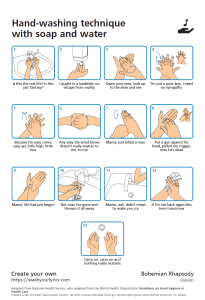
You’ve probably learned how to wash your hands. (We’re all just now learning how to wash our hands. What a wonder! So many songs you can sing while you wash. My kids have chosen “Baby Shark.” Lord, in your mercy …)

We’re learning to stay home when we’re sick. (Just imagine if some of these new habits stick …)

We’re learning new ways to interact. Italians are singing from their windows and terraces. Churches are working out live streaming.

We’re learning to adapt, sometimes with humility. Many church leaders started last week with the bold claim that we never cancel worship services and ended the week … canceling worship services.

It has been a brutal week for anyone responsible for bringing groups of people together in any way.

Many of these pieces of learning we couldn’t avoid. At least not if we wanted to be responsible citizens.

We also have other opportunities for learning––ones that involve others’ decisions instead of our own. Those opportunities begin with choosing charity and curiosity before we choose assumptions and blame.

Let’s be honest about this. In recent times, as a whole, our nation has not done well with charity and curiosity before assumptions and blame.

A comparison to a time long ago: The last time we had such wide-spread concern and significant cancellations was after the 9/11 attacks. Our President’s approval rating then skyrocketed to 92%. Just 10 months earlier, the majority of our nation had voted against him. It’s difficult to imagine any scenario in which a President’s approval rating could hit 92% in today’s atmosphere.[note]That’s not with just this President. It’s with any President you could imagine us having. But also … it’s especially unfathomable with this President.[/note] Many more than 8% of us––on all political sides––default to assumption and blame.

I’ve learned about myself that I tend to misjudge situations that aren’t my own. From the outside, I tend to assume the situation is what I see on the surface. But when I talk to the people involved, without fail, they introduce complexities I hadn’t considered and sometimes entirely change my view of the situation.

A “Sinful Woman”

A good example of charity and assumptions comes from last Sunday’s lectionary gospel text. In John 4, we read about Jesus’ conversation with a Samaritan woman at a well. Jesus has supernatural insight about her life: “You have had five husbands, and the man you now have is not your husband.”

Throughout my life, I’ve had and heard one interpretation of this text––this is a “sinful woman.” She jumps from one man to the next. Five marriages. She hasn’t even bothered to marry the current one. She really should be living differently. How awkward to be confronted on this by someone who claims to be Messiah.

We celebrate Jesus’ charity in choosing to speak with a woman like this.

• She’s a Samaritan. That should be enough to prevent him speaking to her. Jews and Samaritans don’t speak. The resentment runs about as strong as any ethnic resentments you might think of today.

• She’s a woman. That also should be enough to prevent the conversation. Strike two.

• And she’s an adulteress. Major strike three.

No wonder she comes at high noon to the well, a time when she won’t encounter other women. Any good Jewish man, certainly a Jewish Rabbi, would keep his distance. But Jesus doesn’t.

Despite Jesus’ example, I wonder if we’ve been assuming the worst of this woman ever since. We assume she should be living differently, but a woman in this day would have very little choice about a divorce. Why has she had five husbands? It’s likely that leaving these relationships wasn’t her decision––the husbands would have made that call. Or they died. The decision to be with each next man? Maybe a decision for survival, maybe a decision she didn’t control as much as we assume. Whatever it is, the fact that this woman has had five husbands is almost certainly a point of deep shame or sorrow.

We hear this text according to our values and norms and we call this woman a “sinful woman.” But if we hear it according to the values and norms of her culture, we might see her as someone we’d pity, someone who has lived a hard life, someone avoiding the others in her society because of her shame. Could she be a “sinful woman” who has made several bad choices? Yes. But we know far too little to say.

Charity, Assumptions, COVID-19

The current national and global crisis gives us a lot of opportunity to learn about others. With every new conversation I have, I learn about a new complexity someone is dealing with as normal life is disrupted.

I’m especially involved in a lot of conversations with small business owners and pastors. Here are the challenges I’ve watched those groups face over the past week.

Small business owners

The #1 concern from every one I’ve talked to is how to keep the business afloat and also take care of the employees. On Friday, I talked to the owner of a business with 25 employees––a business that I wrongly thought wouldn’t see too much impact. Already, he was agonizing over layoffs. “If I quit paying these people, most of them are in immediate financial trouble. If I keep paying them, I don’t know how long our business can survive.”

Most people have responded with an encouraging amount of charity. Some have responded with shoulds. The businesses should quit being greedy and keep paying their employees. Those have been the exceptions. We’ve seen far more charity than shoulds, at least at this level.

The should chain will keep moving upstream, though. There will be calls for utilities companies, landlords, and banks to provide relief by suspending billing. Ultimately, people will call on the federal government to provide the relief. Every step of the way, the next group called upon will have to balance others’ needs with their own health. The utilities and landlords and banks need to stay afloat, too. And the government can’t print money forever.

If we approach this with charity and curiosity, we can expect that most people are trying to do the right thing––not only for themselves, but for the people they feel some kind of responsibility toward. We’ll be slow with the shoulds and quick to understand the delicate balance people are trying to manage. A group of Lexington small business owners had a conference call with our congressman yesterday. His concern and desire to help were evident. But so were the limits to what he’s likely able to do.

Pastors

Last week many of us agonized over whether to cancel our standard worship services. This week, most of us seem to have accepted that we’ll be cancelling for a while. For some, there was a quick and easy rush to online options. Others went kicking and screaming.

Some of those who went quickly were criticized for giving in to fear, not heeding that passage in Hebrews that tells us to “not give up meeting together.” Some who went kicking and screaming were called selfish––more concerned for themselves than for public health. But I don’t think many of the pastors making these choices were driven by fear or selfishness. Most were making difficult decisions as they tried to manage the balance between being responsible citizens and responsible caretakers.

We believe that the church at worship is the greatest locus of hope in our world. We believe that in the Lord’s Supper we truly encounter Christ, and in that encounter we’re nourished and sustained. We believe that Christ is our hope in times of uncertainty and our solace in times of grief. And we call two things the very Body of Christ in our world––the church[note]Read this as the gathered community of believers, not a building.[/note] and the elements at Eucharist.

So our concern is no mere selfish desire to keep our event going. It’s a concern for the spiritual and emotional care of our people, especially in a time of uncertainty and grief. I’ve talked with several pastors who have a great concern for people’s mental health through this period. Grief + isolation is a dangerous combination. We may be preserving people’s physical health, but we fear the mental health repercussions.

We also believe that bodies matter. We have a responsibility to preserve and protect both our bodies and those around us from unnecessary harm. This is the reason for canceling. We need to. For the sake of our bodies and others’. But it’s also why canceling is so difficult. A move to online worship and prayer gatherings is not the same thing. People continue to gather in the body because it matters.

Charity

I’ve shared above about groups I’m connected to and understand best. I’m blessed by the community around me. It’s an incredibly charitable community. Almost no blame, no shoulds without a lot of preceding charity and curiosity.

But I’ve seen others agonize in the past week about what they should do, and agonize even more because of the assumptions and shoulds they’ve heard from the outside. I’m guessing that many of you, in entirely different ways, are dealing with the same. I can’t imagine what it would be like to make decisions right now about a funeral or a wedding scheduled for May. I can’t imagine the difficulty of conversations about schools and childcare as decision-makers consider the risks posed by canceling and the risks posed by not.

We are likely not near the end of this. That will mean a lot of hard decisions for most people. Be charitable. Be curious. Be quick to listen. It’s a great opportunity to learn more about the people around us and the many important values they’re trying to balance. Their situation may not be what we’ve assumed it to be.

——

Consider a sabbatical … and a related personal update

Many of you who read this blog are in church leadership in some form––whether pastors or involved laity. I want to put something in your mind that you may not have considered, or get you to keep considering it otherwise. Then I’ll share a related personal update.

Sabbatical

Last fall, the Washington Post ran a story about a popular D.C.-area pastor announcing a sabbatical. The headline began with a quote from him: “I feel so distant from God.”

After 30 years in ministry––the past 11 leading a megachurch just outside of D.C.––his church had made a way for him to take 14 weeks off, from New Year’s Day until Easter.

I was glad to see this get such attention. For people in public leadership positions, some significant time out of the spotlight may be one of the best ways to recalibrate and be restored.

To be clear, this isn’t just about pastors. It’s about anyone whose work performance is continually subject to public scrutiny. Church world is my primary world, so that’s the context I’ll use for most of this discussion.

One more clarification: This isn’t about people who work hard. That would include a much broader group … and wouldn’t necessarily include all of the people in public leadership positions. I don’t think it would be bad for anyone who does hard work with long hours to consider this. It’s just beyond my scope here. What I’m referring to here is visibility, spotlight, exposure to broad scrutiny. If that includes you, can I encourage you to consider planning for some kind of sabbatical? If you’re a layperson with influence in your church, could you advocate for something like this for your pastor(s)? (Insert other titles like “board member” and “CEO” or “Executive Director” as they apply here.)

I’ve written more about the need for people to consider sabbaticals in the past. If you want more about the why, read that post. Here, I’ll move on to some questions and practicalities.

I posted something about this recently and got a helpful response:

My quick answers:

Some questions and suggestions:

1 – When should we begin planning or talking about this?

Earlier is better. If someone is taking a high-visibility position, I’d recommend establishing this in a formal contract before they even begin. If they’re already in that position, I’d recommend beginning the conversation now.

By my observation, most sabbaticals happen like the D.C. pastor’s above, as a reaction to crisis. We see that someone isn’t doing well and we offer an emergency sabbatical. Do that if you must, but this usually happens because it was overdue. We could have done it with better planning and less hardship if we had done it proactively, instead.

2 – If I’m the one asking for a sabbatical, can I really do it at the start of a job?

I think you can if you’re talking about taking it several years from now. If you ask for a sabbatical that will take place four to seven years later, you’re naming a commitment to be around a long time and you’re asking for your organization’s commitment to your health.

If you’re going to be around a long time, your long-term health is good for the organization. And a long tenure is good for them, too. Leave sooner than planned for a new opportunity … no sabbatical for you.

(A note for folks in The United Methodist Church: Pastors don’t always have the choice to stick around a long time. The Bishop sends as (s)he chooses. I still think this rule can apply. It should be part of the Bishop’s and Cabinet’s responsibility to protect pastors and churches from constant churn. They should especially protect a church from that churn when the church is taking care of its pastors by offering something like a sabbatical. Also, pastors have more say in whether they move or stay than they often let on.)

3 – What should we plan for?

A sabbatical is not a vacation. In fact, for the circumstances I’m discussing, I don’t think it requires someone to do no work (see the note above––this isn’t about people who work too hard). Someone could use that time for research, writing, learning a new skill, etc. They don’t have to spend the whole time at the beach, in the woods, or on the golf course––though if you choose to offer them a beach house or cabin in the woods for part of that time, that would be a generous offer.

What this requires is total withdrawal from that position of public leadership. For long enough to feel it. I’d recommend at least six weeks. Eight to twelve would be better. Perhaps you could begin planning for a six-week sabbatical at the end of someone’s fourth year in the position. Or a ten-week sabbatical in their seventh year.

To be sure, this is a major investment in your leaders. You still have to pay them for this period, you lose their productivity, and they’ll probably be away long enough that you need to invest extra resources to fill the void. But if someone is in this kind of public leadership position, their health is worth far more to you than the cost of a sabbatical.

One other option… My family took a longer sabbatical back in 2013. We went away for a full year. It was probably the most formative and restorative year of my life. If that’s a possibility for you, I can’t recommend it enough. If you don’t think it’s a possibility for you … don’t write it off too quickly. We didn’t think it was possible for us, either. If you do something like this, the expectations need to change: (1) You shouldn’t expect anyone to hold your job for you. (2) You shouldn’t expect anyone else to pay for it. So if you begin to think in this direction, I’d recommend you start saving and start praying. At least, I needed the prayers to trust that we would be okay on the other side of it.

4 – “But the person I’m thinking about doesn’t work hard enough to merit a sabbatical.”

A few responses:

(a) Another reminder that the sabbatical need I’m talking about isn’t about hard work. It’s about public visibility and scrutiny. (And it sounds like you’re scrutinizing. Which may be warranted.)

(b) I’ve seen a few cases where burnout was the cause for halfhearted work. Or where the gratitude for receiving this unusual benefit translated to harder work. So a sabbatical could actually be an answer to your problems.

(c) If they don’t work very hard, well … you may not miss them very much while they’re gone. That should make it easier.

A related personal update

My related personal update may not surprise you given the above. I mentioned above that our family took a year-long sabbatical in 2013. That was to help with an early-phase church plant in Algete, Spain, a small town just outside of Madrid. We’re planning to return there this summer for another 11 months.

We have another site where we’ll be sharing posts and podcasts about that sabbatical. In the future, I’ll reserve this blog for other things, so if you’d like to receive regular updates about our preparations and time in Spain, you can sign up for them here.

A few things I’ll share here about that upcoming sabbatical and how it relates to the above:

1 – I don’t feel distant from God. And I don’t feel on the brink of burnout. I’m actually doing quite well and loving what I’m doing as much as ever. It will be hard to walk away. So as this relates to rhythms and restoration, it would be much more like preventative maintenance than a rescue plan.

2 – I said above not to expect anyone to hold your job for you if you take a year away. When we left in 2013, it was walking away. And then, by the grace of God, I ended up able to come back to the same church and the part of my job I loved most. This time, the church is holding my spot and providing a one-year interim. That’s far beyond anything I could have asked or expected. It’s a credit to some amazing, generous leaders, well-built systems, and an organization built on trust.

3 – I said above not to expect anyone to pay for it. And we do plan and expect to pay for most of this year away. But our church and several individuals have also already said that they want to support us financially. So we don’t go alone in this way either. Again, a credit to an incredibly generous group of people.

If you’re interested in more about our personal plans, see the Ray Sabbatical site. And if you have questions or feedback on the discussion about sabbatical here, I’d love to hear from you.