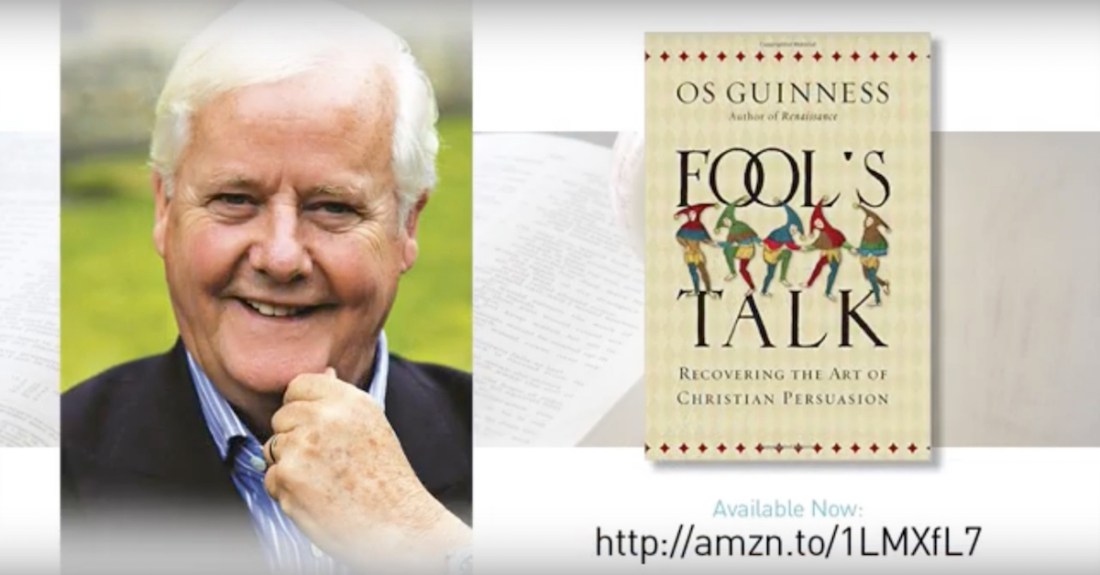
I recently had the honor to interview Os Guinness about his newest book, Fool’s Talk: Recovering the Art of Christian Persuasion.
Dr. Guinness is one of our world’s most prominent social critics. He’s a devout Christian who seems equally comfortable assessing issues in the church and in the world. One of the things I love most about Guinness’s work is that he constantly points us back. Rather than creating new solutions, his work is about recovering what’s been lost.
Our interview covers apologetics and evangelism in the changing American landscape, errors in church growth, hypocrisy as a useful tool, and America’s historical near-sightedness. You can listen (right-click here to download), watch, or read the transcript below.
(My apologies for the *dings* you’ll hear if you listen. I’ll have those cleaned up before the next interview.)
Teddy Ray: I’m talking with Os Guinness today. Dr. Guinness is a prolific writer. He’s written and edited over 30 books. His most recent book is called Fool’s Talk: Recovering the Art of Christian Persuasion. Dr. Guinness, thank you so much for joining me today.
Os Guinness: Well, my pleasure to be with you.
TR: In this book, I’ll just jump straight to your main point. The main problem you’re trying to address is that you say we’ve lost the art of Christian persuasion.
Could you explain what you mean by Christian persuasion and then also how you think we’ve lost that art?
OG: Well obviously the passion to communicate, to share our faith with others so that they may know Jesus the way we know him, is at the very heart of the Christian faith.
But if you look, say, at America over the last 50 years, we’ve gone from a broad Christian consensus where everyone understood, even if they didn’t themselves speak Christian. We’ve gone to a world in which public life has grown infinitely more secular and many people are trying to drive religious voices out altogether. And private life has grown infinitely more diverse. People say everyone is now everywhere. Well in that world, we can’t communicate as we used to.
And far too many Christians, if they communicate at all, are using cookie-cutter recipe approaches, formulas, 1-2-3-4, and so on, which simply don’t work with people today.
And we’ve got to go back and really rediscover the Christian tradition, the Christian art of persuasion, which is in the gospels, in the New Testament, and certainly down through history. But we’ve lost much of it in America.
TR: Are you attributing so much of that loss to the fact that we were living in an easier time when we didn’t need to creatively persuade, and we just forgot how to do this in the process?
OG: Well that’s right. You just take one person, say, the Eisenhower era gave rise to Billy Graham. In the Billy Graham era, he was a magnificent preacher of the gospel and reached millions of people. But that was evangelism. And you can see that today, many people are hostile, indifferent, self-sufficient. They’re closed to the gospel.
So we need not only evangelism, sharing the good news straightforwardly. We need apologetics and the art of persuasion to people who are not open, not interested, not needy.
TR: And so because of that, you talk about this creative form of persuasion that starts where people are and helps them open up without their expecting to, as opposed to some of these techniques.
You talked about our left-brain schooling. We’re so well-educated in reason and logic and analysis, but without creativity and imagination and irony. Can you share your antidote to that? How do we get back some of that creativity and imagination?
OG: Well when we talk about this, a lot of people say, “Well obviously I haven’t been educated enough…” And I would argue no, that’s not the problem. The problem is too many of us, I include myself, we’ve been educated too much in an unbalanced, or the wrong way of thinking.
If you look at all the very best––and I’m not minimizing at all––of Western education, it’s rational, logical, critical, and all these good things. Which it should be. I’m not minimizing it.
But what it’s lacking is imagination and irony and creativity and things like this. In other words, we’ve got to fight ourselves out from the chains of much of how many of us in the best universities have been educated and go back to things that were actually much more human all along.
TR: You said that was the case for you, as well. Could you share some about how you made that transition or were able to be exposed to some of those things?
OG: I had the privilege of going to Oxford, which is certainly one of the best universities in the world, but very very heavy on rational, critical thinking, which is magnificent. But not quite so good in terms of the imagination and irony and creativity and things like that.
Whereas, when you look at subversive communication. People often say today, “We’ve got to use stories because we’re postmodern.” In other words, in the modernist world, you could talk logically, discursively and so on, but today in the post-modern world, we’ve got to use stories, narratives and so on.
Well that’s not the way the Scriptures put it. I’d put it somewhat differently. People are open. You can use tough-minded, logical thinking to take something like Paul’s letter to the Christians in Rome. That is very high reasoning, logical thinking, etc. But the Roman Christians were obviously open to what Paul was saying, so it’s thoroughly appropriate. And obviously many people’s sermons are like that.
But you look at our Lord. It wasn’t that he was a countryman talking to country people, as some people say very patronizingly. It’s rather that he was speaking to people—including the scribes, the Pharisees and others—who were dead-set against him. They were anything but open. And so his communication is thoroughly creative, subversive and so on. It’s indirect.
So we tell stories not because we’re post-modern. No, but because many of the people we’re speaking to are not open and stories are more subversive than statements in this case.
But as you know, I’ve got a chapter on all the different ways of communicating in Scripture that carry this particular creative subversion within them.
TR: Your references there, especially to David and then to the prophets and the ways they would approach these things were excellent.
You also mention people like Pascal and Dorothy Sayers and Chesterton and CS Lewis. Is there any living theologian today, or any few, that you would point to and say, “These are people who are doing it that way. They’re exemplifying what I’m talking about here”?
OG: Well I’m sure there are, but I’m not myself a theologian. I don’t move in the world of seminaries very much. I’m much more out in the culture on campuses talking with people who are trying to do apologetics.
One of my complaints in the book is there’s far too much thinking about apologetics rather than doing apologetics. We’ve got to get out there and actually do it.
Now when you come to the practitioners, this approach I don’t think is as strong or as common as I’d like it to be. Now I remember earlier on, Malcolm Muggeridge who came to faith in the Lord in his 70s. One of the reasons he loved the Christian gospel: it gave him a grounding for the way he saw the universe the way he did. It wasn’t just that he was a humorist and a comedian and he saw the world like that. No, no. He saw the gospel gave him a theological basis for that, which I love.
The gospel, put simply—and you’ve got to say it reverently—the gospel is closer to the dynamics of comedy than it is to the dynamics of tragedy. And we’ve got to recover a lot of this.
But I don’t know the world of the seminaries. That’s your world.
TR: And that’s quite all right. I think these, though, are excellent things to bring into that world. And you’re right. What you point out is that you see quite a bit more technique. Here are the four steps to take. Do this, this, this, and this. And this will work with everyone.
You’re saying, “No, every individual requires something different.” So I really appreciated your chapter on technique.
To bring it to church world in a bigger way. You related our obsession with technique to the way we’re starting churches now. I’d love you to say a bit more about that. How you’re seeing that happen and what you would advise.
OG: Well you can see in the last fifty years the popularity of church growth. But there was a very significant moment when Pete Wagner said, “We need church growth,” and I’m quoting now, “on new ground.” In other words, it wasn’t the power of the gospel, the word, the Spirit, and things like that.
It was management, marketing, sociology, psychology. I have nothing against those. My background is the social sciences in my own life. Nothing against them, but they should never replace theology. And I remember there was one book in the early days on marketing the church which made the point that in marketing the church the audience, not the message, is sovereign. I’m almost quoting exactly.
Now that’s a recipe for heresy. The message—the word of the Lord, the gospel itself—is always sovereign.
So yes, we listen to people, we get close to people. Paul says, “I’m Jew to the Jews, Gentile to the Gentiles.” So Gadamer the philosopher’s term of “fusion of horizons,” or what you might call identification. All these various words that come in.
We get as close to people as we can, but they don’t shape our message. We have the same message that brings them back to the Lord.
And so there’s a lot of thinking in the church growth movement that was very unntheological and very unwise. And you can see that just as the extremes of Protestant liberalism led us astray and virtually committed spiritual and institutional suicide over the last 200 years.
We’ve had varieties of some of the extremes of the church growth movement, or the extremes of the emergent church, that have done the same thing within evangelicalism. And that’s been extremely sad. Not nearly enough critical thinking.
TR: It’s funny to me that you say you’re not a theologian, but the ways you’re pointing us back to actual theology over all these other social principles, which you say is your world… I wish we had more people, whether we call them theologians or social sciences people, who would point us in these directions. I appreciate you doing that.
And actually, let me point to another piece of what I would call theological argument that you’re making. You talk about how Christians are inconsistent to our beliefs, too. We claim one thing and then we live differently. You talk about hypocrisy. You didn’t budge on that. You said, “Where unbelievers cannot be consistent, we should be.” Is part of our problem with Christian persuasion tied to holiness?
OG: Oh, absolutely. But I would say we have to appreciate the sting of hypocrisy.
Sadly, we’re at a place today, take, say, the New Atheists, where the main argument for atheism is the Christian faith. In other words, the corruptions and failures of the Christian faith, whether it’s the Inquisition, or the notion that error has no rights and all these things back in the medieval world, or Christians today.
And you can often see some moments in the lives of great atheists, say Bertrand Russell or whomever, where they were wounded by Christians and they never got over it. In other words, we have got to take hypocrisy very seriously. We have created many of the grounds for the objections against the Christian faith.
But as I was arguing, we shouldn’t be depressed by that. Because the simple fact is, people who get really angry about Christian hypocrisy, or any hypocrisy, they sound as if they have outrage on their side, but in fact they don’t have a standard or foundation for truth or for justice by which you can judge anything as hypocrisy, let alone have an answer.
And so I would argue that there is no greater counter-hypocrisy program in all history than our Lord’s, and he is the toughest person challenging hypocrisy, and of course, sadly that includes many of his own followers—us. So we’ve got to take it deeply seriously.
And while non-Christians can’t be consistent to what they claim they believe because it isn’t finally true, we should be! So every time there’s a charge of hypocrisy, we’ve got to say, “Lord, is it right?” And if it is, we’ve got to put something right in our individual lives or in the church as a whole.
Hypocrisy, understood properly, is a very useful accusation. It’s a stinging one, but a useful one.
TR: That’s a great word, and one we seem to miss. I’ve even seen the bumper stickers that say, “The Church—we’re full of hypocrites!” And it has become a celebratory point. “We’re full of hypocrites, and we could take one more, too!” Rather than saying, “No, we have to live differently!”
What you just did there, pointing back to our past, pointing back clearly to our Lord, seems to be a key theme that runs through almost all of your work. You point out a problem in the present, and rather than presenting a new solution, you’re presenting really old solutions. You’re constantly taking us back, even in your social critic work, you’re pointing back to the founding fathers, and in your works on the church, you’re pointing back to classical understandings.
Could you share some about that approach and why you lean on it the way you do?
OG: Well I just happen to have been brought up in England with a strong sense of history. The prime minister when I was a boy was Winston Churchill. You hardly heard a speech of his that didn’t sort of breathe the air of a thousand years of English history.
And you don’t understand anything today unless you understand history. Now I had that in my background, so when I came to faith, I wasn’t one of those who believed that we only discuss things today and we jump back to the New Testament, and know nothing in between. No, obviously the Scriptures for us are authoritative, and our Lord supremely.
But we thank God for every year of Christian history in between. Some of them sad, some of them incredible, some of them really bad. But we need to understand them all so we don’t make the same mistakes today.
So Americans often have a very short sense of history. For example, all the discussion of racism and slavery. I’ve even heard sermons in the last month that speak as if the 19th century––where you had the justification of slavery in the south––was the norm.
And they forget that the whole notion of freedom came from the freed slaves, the book of Exodus. And it was Christians, and long before the 19th century worst happened, Wilberforce— who was a friend of my great-great grandfather’s, who founded the Guinness brewery—Wilberforce had abolished slavery in the British empire. So the greatest reform in all human history was by an evangelical. And we should have some of these great historical perspectives in our mind when we tackle some of these issues today.
But many Americans are incredibly myopic when it comes to history.
TR: I have a friend who talks about “out-traditioning” the traditionalists. He says so often we grab onto the last 20 or 30 years and say, “This is who we are!” He says, “Let’s talk about who we’ve been over the past 200 or 300 years.”
OG: That’s right. You remember the phrase in the 1960’s, “Don’t trust anyone over 30.” And Tom Oden gave a brilliant answer to it: “Don’t trust anyone under 300.” And you can see today, that’s hitting the church and hitting America in what I call generationalism. We’ve narrowed and distorted the generations down to the cohort of shared experience.
And it’s become a new form of identity. “I’m a millennial,” “You’re a boomer…” She’s a this. He’s a that. And it’s become a new form of relativism. “Well of course, you wouldn’t understand, it’s a generational thing.” Now that’s actually crazy.
We see in Scripture the Lord is from generation to generation. Our Lord is the same yesterday, today, forever. So we’ve got to part with this generationalism, this incredibly myopic thinking, and recover a living sense of tradition. And the millennials have a very distorted view of that, as if all tradition is the dead hand of the past rather than safe-keeping from generation to generation.
TR: Yeah, there’s a much deeper identity there. A deeper rooting. That leads me to one final question I wanted to ask you. I wanted to point to one of your earlier books, The Call, because it’s been such a great guide for me. I think I’ve quoted it at least five times in the past year in sermons.
As I was working with a group through it last spring, we started recognizing how calling answers questions that everyone seems to be asking. Christian evangelism always used to start with sin and how you can be forgiven. And that seems to have made sense in earlier eras. But people aren’t asking about sin and forgiveness much in our culture.
They’re still asking a lot about calling and purpose. And that gives me a great chance to say, “There’s no call without a caller,” to quote you. So I’d just ask you if you think we were seeing things correctly. Is calling one of those natural entry points into Christian persuasion?
OG: Oh, absolutely. As you said rightly, calling is the ultimate answer to that human longing for purpose. And it’s one of those wonderful places where… I have this little apologetic principle, “Contrast is the mother of clarity.” And if you look at the other worldviews, religions, philosophies of life in comparison with the gospel, it’s dramatically different at that point.
I’m simplifying it drastically, but if you look at Hinduism and Buddhists, their essential answer to purpose, forget it. Why? To take yourself seriously as an individual is to be called into the world of illusion. And freedom in the East is freedom from individuality. Not freedom to be an individual.
Or if you look, say, at our atheist friends, secularists, agnostics, materialists, naturalists… You can put their position in three words: Do it yourself. In other words, there’s no meaning in the universe. So if you want meaning, you’ve got to create it. You know, Bertrand Russell, or the Greek giant Atlas with his own world on his own shoulders. Or Nietzsche, you’ve got to live to be able to say, “Thus I willed it.” Do it yourself! Frank Sinatra, “I did it my way.”
And you contrast that with the Jewish and Christian, the biblical understanding. There’s purpose because we’re created unique. So it’s, “Be who you are.” But not only that, “Become who you can become.” Because as you rise to follow the call of the Lord, you’re in touch with parts of yourself and things which he knows we can do, which no one else knows for us.
And so, not surprisingly, there’s no deeper sense of purpose in all human history than you have in the biblical understanding of calling.
TR: We had someone in our group… We asked everyone to interview someone about calling, and one of them intentionally interviewed a staunch atheist. And we said, “Well what an interesting thing that you chose a staunch atheist to talk to about calling!” And he said, “This is universal. This guy sat and talked to me about this great calling on his life, and I sat there and said, ‘So where did this come from? Where is the caller?’”
It was a brilliant moment. So I’m seeing how all your work on calling and your work on Christian persuasion come together there.
OG: Well, thank you. No, it’s a wonderful time.
Going back to something you said earlier, Teddy. Many of the of the deepest, profound problems today, whether philosophical or practical, social-political… they raise questions that are only answered in the profundity of the biblical answer. So it’s an incredible moment for us where we’ve got to go back to go forward.
TR: And that’s what you’ve done so well in this book. We’re out of time. Let me just commend to my readers—I would love for you to grab this book and take a look.
It really does counter a lot of our current notions about what evangelism is and really calls us back to something before evangelism and to something that has been lost in our history in a lot of ways. So grab this book if you can. I want to thank you for joining me today, Dr. Guinness. I appreciate your time.
OG: My privilege. Thank you.
TR: That was Os Guinness. His new book is Fool’s Talk: Recovering the Art of Christian Persuasion. You can see the link for it both on my site and on the video here. I’d love for you to pick it up. I hope you enjoyed this conversation. We’ll have more to come.
————–
To be sure you don’t miss the next one, subscribe here to receive future posts.
My deepest gratitude to Jason Huber for producing this. His studio, graphics, and detail work made it possible.