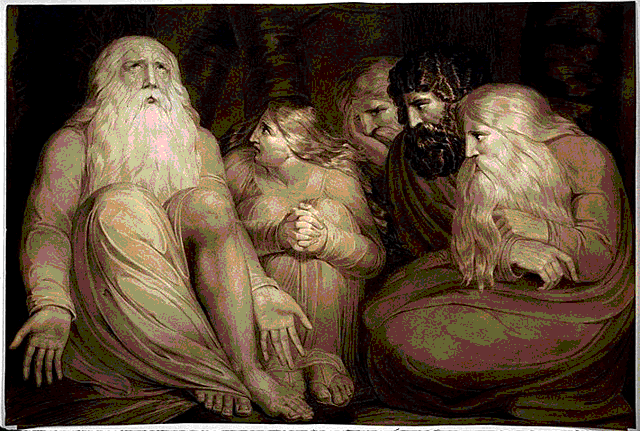
How does an everywhere, all-knowing, almighty God respond to evil and tragedy?

job full

How does God use his power? [pt. I]

The book of Job contains as much about God’s majesty as any book in the Bible. It’s full of lines like, “He alone stretches out the heavens and treads on the waves of the sea,”[1. Job 9:8] and “His eyes are on the ways of mortals; he sees their every step.”[1. Job 34:21]

The most dramatic lines come from God himself—

Where were you when I laid the earth’s foundation? //
Do you send the lightning bolts on their way? Do they report to you, ‘Here we are’? //
Do you know when the mountain goats give birth?
[1. 
Job 38:4, 35; 39:1. If you can, take the time to read all of Job 38-39. It’s a spectacular speech.]

Yet all these declarations about God’s greatness come against a backdrop of tragedy. If you’ve asked theological questions about the problem of evil before, you’ve likely heard someone mention the book of Job.

The book’s introduction presents Job as a “blameless and upright man” who fears God and shuns evil.[1. Job 1:1] He has everything a man of his time would ask for—a large family, enormous flocks and herds, many servants—and he’s called “the greatest man among all the people of the East.”[1. Job 1:3]

But then the narrative cuts to a short conversation between God and Satan.[1. Some people take the book of Job as a type of epic, others view it as actual history. Regardless of how you see it, the purpose of the book seems to revolve around our questions about the presence of evil in the world.] God talks about Job like a proud father. Satan is unimpressed: “Of course he’s loyal to you. You’ve kept a hedge around him. You’ve blessed him in every way. Take away all the blessing and he’ll curse you to your face.”

So God agrees. “Very well, then, I’ll remove the hedge.”[1. My paraphrase of Job 1:8-12]

Then we see Job lose everything in an instant—all of the flocks and herds, every one of his children, and every servant except for the few messengers who escape to tell Job about his losses. When he still doesn’t give up his faith, he loses his health, too.

We usually look to the book of Job to ask why God would allow tragic evil, and most people conclude that it doesn’t give any final answers. The most we can take away is that God’s ways are beyond our understanding. Perhaps the best we can do in the face of tragedy is to respond as Job does, “The Lord gave and the Lord has taken away; may the name of the Lord be praised.”[1. Job 1:21] 

But we often miss an important revelation in Job. At the beginning of the story, why has Job prospered so much? Satan himself says that God has put a hedge around Job and his household and everything he has. And what happens when God removes the hedge? Job loses it all in an instant.

The book of Job shows us that God must have a great hedge around us. If you have anything good in your life—any loved ones, any possessions, any health—there must be some hedge. If the hedge were removed, it would all be destroyed.

We usually look at it the other way. We ask why God would ever remove any hedge of protection. But let’s first recognize what a great hedge God has around us. We don’t see a God who intervenes in every situation the way we’ve asked. We don’t see a God who keeps a perfect hedge around all people and all things. I admit I don’t understand why God performs miracles in some situations and allows others to continue in tragedy. I don’t understand why God keeps his hedge up sometimes and removes it in others. But I’m left with Job, praising a God who gives and provides and protects and works miracles, and praising God still when the hedge of protection comes down and the miracle doesn’t come.

This is the second most compelling way that God uses his power in our world. But it pales in comparison to the most compelling—and shocking—way that God has used his power…

How does God use his power? [pt. 2]

The Gospel of John begins with a shining statement about Jesus’ glory and presence and power.

In the beginning was the Word, and the Word was with God, and the Word was God. He was with God in the beginning. Through him all things were made; without him nothing was made that has been made.[1. John 1:1-3]

He has existed forever. All created things were created through him. He was with God in the beginning, and he is God. But then look at what John says about how we have seen his glory:

The Word became flesh and made his dwelling among us. We have seen his glory, the glory of the one and only Son, who came from the Father, full of grace and truth.[1. John 1:14]

How have we seen the glory of Jesus—the one who is God himself? He took on flesh and made his dwelling among us. Not only did he take on flesh, he took on the very nature of a servant and humbled himself. He became obedient to death—even death on a cross![1. All of this from Philippians 2:6-8]

In Jesus, we see a God who doesn’t just intervene from on high. Instead, we see a God who was made low. He came, and rather than ending all suffering immediately, he participated in our sufferings. Rather than triumphing over the powers of evil in our world as an almighty conqueror, he triumphed over them by the cross.[1. See Colossians 2:15]

How can an everywhere, all-knowing, almighty God allow evil and suffering to persist? The answer we long for is a simple one—that God would use his power to vanquish these things, that there would be no more death or mourning or crying or pain. We long for an answer that says all the tragedies cease––no more cancer, no more earthquakes, no more car accidents, no more school shootings. There’s no more reason to mourn or cry or hurt.

A day is coming when that will be God’s response, when Christ declares, “I am making everything new!”[1. See Revelation 21:4-5] With that, we have a great hope: Death doesn’t have the final word. Tragedy doesn’t have the final word. All the tears now don’t have the final word. Christ has the final word, and he is making everything new.

As we wait for that day, though, how does an everywhere, all-knowing, almighty God respond to evil and tragedy? In Jesus, we see that the God who is everywhere comes down to be present with us. The God who knows all things knows our heartbreak and grieves with us. The God who is almighty has suffered grief and shame and pain alongside us. And in these things, as much as in the stretching out of the heavens and treading on the waves of the sea, we see God’s majesty.

———
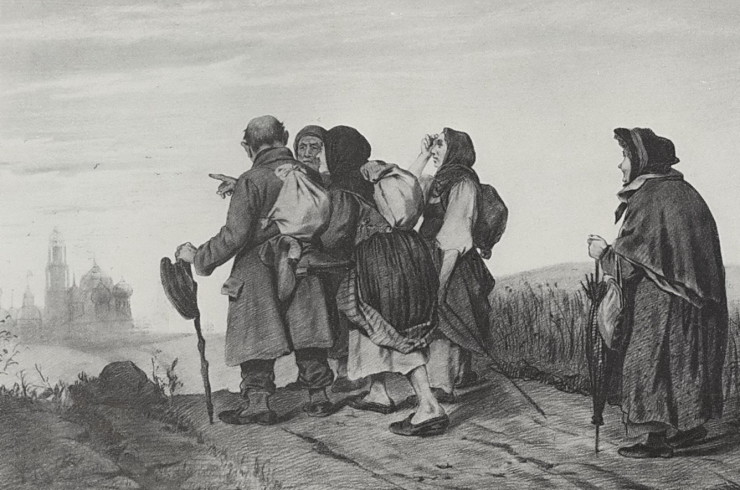
Pilgrim people seeking permanence

pilgrims-on-a-pilgrimage-1867

Cain

Augustine observes that it was Cain (the first murderer) who built the first city, “while Abel, as though he were merely a pilgrim on earth, built none.”

Augustine uses that example to talk about the people of God as a wandering people–– “as on a pilgrimage through time looking for the Kingdom of eternity.”

Babel

The next case of city-building in Scripture is no better. In it, the people say, “Come, let us build ourselves a city, with a tower that reaches to the heavens, so that we may make a name for ourselves; otherwise we will be scattered over the face of the whole earth.” We know that tower as the Tower of Babel.

What’s wrong with this picture? “Let’s make a name for ourselves” is an easy clue. Beyond that, the people are doing their best to avoid scattering “over the face of the whole earth.” That’s a problem when God has already twice told them to fill the earth.

So God confuses the people’s language, ends their building, and scatters them “over the face of the whole earth.” God accomplishes his will, regardless. Sadly, it happens in spite of the people, rather than in cooperation with them.

Abraham

By contrast, look at how the book of Hebrews describes Abraham:

“By faith he made his home in the promised land like a stranger in a foreign country; he lived in tents, as did Isaac and Jacob, who were heirs with him of the same promise. For he was looking forward to the city with foundations, whose architect and builder is God.”[1. Heb 11:9-10]

Cain built a city. Those at Babel tried to build a city. But Abraham lived in tents. Now look at the concluding statement, with references to life on earth and the city of God:

“All these people were still living by faith when they died. They did not receive the things promised; they only saw them and welcomed them from a distance, admitting that they were foreigners and strangers on earth. People who say such things show that they are looking for a country of their own. If they had been thinking of the country they had left, they would have had opportunity to return. Instead, they were longing for a better country—a heavenly one. Therefore God is not ashamed to be called their God, for he has prepared a city for them.”[1. Heb 11:13-16]

Pilgrim people, Pilgrim church

Augustine says that we’re a pilgrim people, even a pilgrim church. But our flesh lusts after safety, security, and permanence.

The Israelites in the desert longed to go back to Egypt. They created romantic ideals in their heads about those great times in Egypt, where they sat around pots of meat and ate all the food they wanted.[1. Exod 16:3] Why the false romantic notions? Because a trek through the desert is neither safe, nor secure, nor comfortable. At least there’s comfort and some security in the known––even if it involves slavery in Egypt.

This is the constant tension we face as the people of God. We live in this world as foreigners and exiles, pilgrims on a journey, never fully settled here because this world and its desires pass away.

We can’t build any new city where we will be fully comfortable. No cloistered community will suffice. The utopian paradise––where we make our own rules and everything works––is a dangerous mirage. The city we seek is the city of God, and it comes only when God’s new creation comes. We can have tastes of it now–– “If anyone is in Christ, the new creation has come!”[1. 2 Cor 5:17]––but these are only tastes. For now, we remain pilgrims.

What does it mean for Christians to live as pilgrim people? What does it mean for the Church to live as a pilgrim Church? It at least means living with less comfort than we would prefer.

We follow a Messiah who said, “the Son of Man has no place to lay his head.”[1. Matt 8:20] One scholar comments on that line: “The nature of his mission kept him on the move and would keep his followers on the move.”[1. D. A. Carson, The Expositor’s Bible Commentary: Matthew] We follow the teachings of a man named Paul who traveled across the Roman Empire, often in peril, to preach the gospel and help establish churches. In my tradition, we follow in the more recent footsteps of circuit riding preachers who traveled the country by horseback––again at great risk to life and health––for the sake of proclaiming the gospel.

In our own desires, we seek safety, security and permanence. Those can seduce us away from the hard, but better, road of pilgrims. We can settle for what’s comfortable and safe. We can try to stop and build our own secure cities and become comfortable in this world, because the pilgrim life is too daunting.

If we ever find ourselves fully comfortable and content––safe, secure, and at ease––might we wonder if we’ve settled too soon, camped out at a way station along the trail as if it were the final destination?

———

A pastor’s reading plan

Since I began posting the books I’m reading, and my best 7 or 8 books of the year*, several people have asked me how I read. How do I categorize and choose what to read? In an email last week, someone just finishing seminary asked:

“There are so many categories and so much I have saved, it is overwhelming. How do you categorize, organize, decide (whatever it is) what to read after seminary and in ministry?”

I thought an answer to this question might be helpful or interesting for several of you…

——-

So many books to read, so little time...
So many books to read, so little time…

That’s a great question!

Seminary was a good introduction to theological study for me. It gave me some critical tools for reading well and a great bibliography to work on. That has made post-seminary study a lot of fun. We do better when we think of seminary as the beginning of our theological education rather than the end of it.

You’ve opened up a pretty deep rabbit hole here. I’ll take you part of the way down…

Categories

I read in nine categories. I use Library of Congress classifications for those (you can find these at catalog.loc.gov and usually on the book’s copyright page). No category system is perfect, but I’m content with this one. It provides quick, broad categories. I asked myself what a well-rounded reading plan would be for my needs as a pastor. These were the nine categories I chose… 

  • BR books, as classified by Library of Congress. This includes some general Christian works and especially focuses on Christian history. It’s where you’ll find most of the writings from the first 1500 years of Christian history. The last thing I read in this category was a book of Augustine’s sermons. The next one I plan to read is a history of the development of Christianity in 18th and 19th century America.
  • BS – Books about the Bible. I’ll sometimes read a commentary front to back, but I usually read other books that will help me be a better, more informed reader of the Bible. I just finished a book of essays on the Psalms. I’m working through N. T. Wright’s monumental series, one volume per year.
  • BT – Doctrinal theology. You’ll find systematic theologies here, along with specific subjects in theology (e.g. the life of Christ, the Church, soteriology). I’m about to start Pelikan’s big series on the Christian Tradition.
  • BV – Practical theology. This includes most any book you read on the practice of ministry and most spiritual formation books. This can be the natural area for post-seminary pastors to spend all of their time. It’s the practical tools that immediately apply. Most of the other categories are slower to application. (How do you apply a history of Christian thought to your ministry this week?) My reading in those other areas is important, but not urgent. It shapes me in ways that affect everything over time, but not much immediately. Our catechesis groups were born from readings in early Christian history and Luther’s works. 

    So this system keeps me from reading only practical theology. Urgent needs could tempt me to stay put in this area. To be clear, these books have been great for me, and they’re more than 1/9th of what I actually read. Almost every book I read with ministry or pastoral teams is a BV book, so I’m always reading one or two on the side.

  • BX Denominational works. Most of my reading here is within the Wesleyan tradition. But I also go to other denominations for a different perspective, on occasion––Baptist history, Presbyterian polity, Roman Catholic theology. I better understand the nuances of our particular faith when I read in the Wesleyan tradition. I better appreciate the wider Christian movement when I read outside my own tradition. The former deepens my understanding, the latter widens my perspective. 
  • B-BQ – These are any other works that begin with B in the Library of Congress catalog. They get you into philosophy, psychology, ethics, and other religions. Right now, I’m reading Malcolm X’s autobiography (filed under BP for Islamic studies). Next I think I’ll be reading The Great Divorce by C. S. Lewis (under BJ for ethics). It’s a broad category.
  • Special Focus category – My focus this year is social sciences––any works categorized under H. I wanted to give some extra time to works on leadership, management, and global social issues. I’ll change this category next year (considering a focus on biographies or devotional classics). 
  • Other – If it doesn’t fit any category above, it’s “other.” These books keep me reading something outside of my typical “pet categories.” I’m planning to start a 3-volume biography of Teddy Roosevelt soon.
  • Wild Card – My ninth category isn’t really a category, but freedom to spend extra time somewhere. I use this to fill my most immediate needs or interests.

I keep these all in three rotations.[1. Since writing, I’ve re-worked this some. I still read three books at a time, but rotation 1 is BR, BS, Other B-, Literature. Rotation 2 is BT, BV, BX, Other. Rotation 3 is all wild card, all the time.]

Rotation 1: BT, BV, BX

Rotation 2: BR, BS, Other B-

Rotation 3: Special Focus, Other, Wild Card

So I have three books that I’m reading at any time. One from each rotation.

This doesn’t include fiction. I have a separate reading schedule for that. It also doesn’t account for any Bible/prayer book/devotional reading

All this is for systematic broad reading. I get into deeper, specific research when I prepare sermons and write. Some pastoral needs also dictate that kind of in-depth research. That research is usually article-length, not book-length. It comes as questions demand rather than systematically.

Selection

I compile my bibliography from a variety of sources. If a source I trust recommends a book, or if I see a book referenced enough times, I put it on my bibliography. If I then see any of those books available for cheap, I buy them. (ereaderiq.com is great for this with Kindle books.) The bibliography can be overwhelming. Mine makes me sad because I know I’ll never make it to all these books––2,558 at present.

So which book to actually read? My plan here doesn’t have much structure. When each category comes up in the rotation, I choose what most fills a current need or interest. Or I choose that book I know I should have read by now. The one systematic aspect to it is a few multi-volume series that I’m reading, one volume per year (Wright, Pelikan, and the Roosevelt biographies, all as listed above, and Wesley’s Works). So one book per year in each of those categories is pre-determined.

Actually Reading

I try to protect one hour of my daily schedule for reading. That’s not as much as I’d like, but it’s as much as I can manage, and sometimes I don’t get that. John Wesley scolded any preachers who weren’t reading enough. He said they were starving their souls and would be “petty, superficial preachers.” I understand why he said that. If I’m not reading, I’m not getting the ongoing guidance I need to be a good pastor, preacher or leader. 

So welcome to my neurotic rabbit-hole. I doubt this system could work, as it is, for anyone else. But I hope it provides some helpful insight for creating your own.

I’m glad you’re thinking about a post-seminary reading plan. Though the formal education may be over, it’s just a nice jump-start to a life of learning for ministry.