Sex, slaves, and rock ‘n’ roll: How should the church engage culture? (pt. I)

How should the church interact with the culture around it? You’ve struggled with this question, whether you asked it in this particular way or not.

It comes in a variety of forms:

  • Public policy issues (environment, economy, immigration, abortion, military …) –– Should the church openly support or reject certain positions? Should individual Christians vote according to their conscience? Should our faith influence our vote? Should we vote?
  • Politicians — bless, endorse, denounce, or ignore?
  • New musical styles –– appropriate for church use?
  • Business techniques –– appropriate for church leadership?
  • Pragmatics –– do the same codes of ethics apply in the world as in the church?
  • The “secular” world –– throw all your Led Zeppelin CDs in the lake, or rock on?

I’m going to share two helpful models for making these decisions and then propose a necessary next step that I haven’t seen them take.

Christ and Culture

Have you heard of Niebuhr’s Christ and Culture paradigms? They’ve been the most prominent way for understanding cultural engagement questions since Niebuhr’s book Christ and Culture was published in 1951.

A brief explanation of his five categories:

1 – Christ Against Culture – Christians should resist the world and its influences. It’s sinful, fallen, corrupted. There is a stark and necessary divide between Christ and the world. Anywhere you see Christians separating themselves from the world, you’re seeing a version of this model.
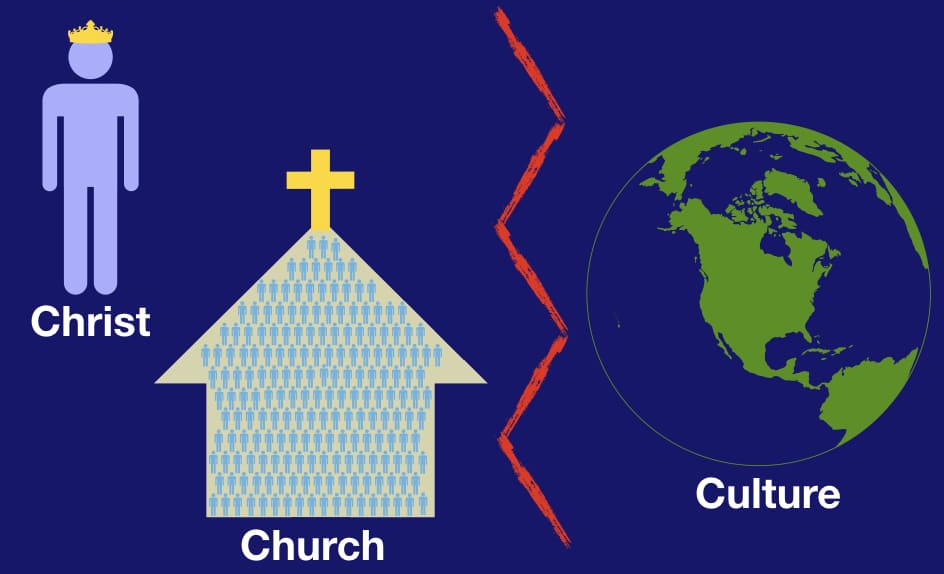
2 – Christ of Culture – This is the opposite of the one above. It says that God created everything, so we can expect to find God’s truth and goodness throughout creation. There is no divide between Christ and the world. Anywhere you see Christians talking about “plundering the Egyptians,” you’re seeing a view like this.

With these two we’ve set the poles. The other three fall somewhere in between:

3 – Christ Above Culture – This is the both/and position. We don’t have to fully reject the culture as bad or accept it as good. Instead, we celebrate the good we find and reject anything contrary to the gospel. There’s a divide, but it’s not a complete divide like the “Christ against Culture” model.

In this paradigm, we also distinguish between a “secular” and a “sacred” world. God rules over both, but in different ways. So we can find God’s goodness in nature (secular), but we can only experience his full goodness through his supernatural grace (sacred). If you see Christians talking about submitting to the governing authorities in the world but also maintaining their Christian identity, it’s probably related to this view.

4 – Christ and Culture in Paradox – This is similar to the Christ against Culture position above. Except it doesn’t draw the line between a sinful, hopeless world and a holy church. Instead, it draws the line dividing good and evil “through every human heart,” as Solzhenitsyn described it. Each of us is a mix of good and evil. Ultimately, that draws the line between unholy people (all of us!) and God. The culture is not the problem. We are the problem.

In this model, humanity and God live in tension because all of us have both good impulses and wicked impulses, leading to both good and wicked expressions in our culture. Anywhere that we recognize that we’re totally helpless to save ourselves and that we have to trust in God’s grace, it’s a reflection of this model. As Paul said it, “What a wretched man I am! Who will rescue me from this body that is subject to death? Thanks be to God, who delivers me through Jesus Christ our Lord!”[note]Romans 7:24-25[/note]

5 – Christ the Transformer of Culture Like the Christ of Culture paradigm, this view understands God’s creation as good. But it recognizes the ways that evil has perverted that goodness. In this view, God is transforming his broken creation, restoring it to the original goodness he intended. And Christians can and should participate in that work. Anywhere you see Christians working for social change, it reflects this kind of understanding.

Keller’s extension

Tim Keller has contributed to this discussion in a way that helped me. He identifies our view of Christ and culture according to two questions.

His two questions:

  1. Should we be pessimistic or optimistic about the possibility for cultural change?
  2. Is the current culture redeemable and good, or fundamentally fallen?

That leads to this chart:
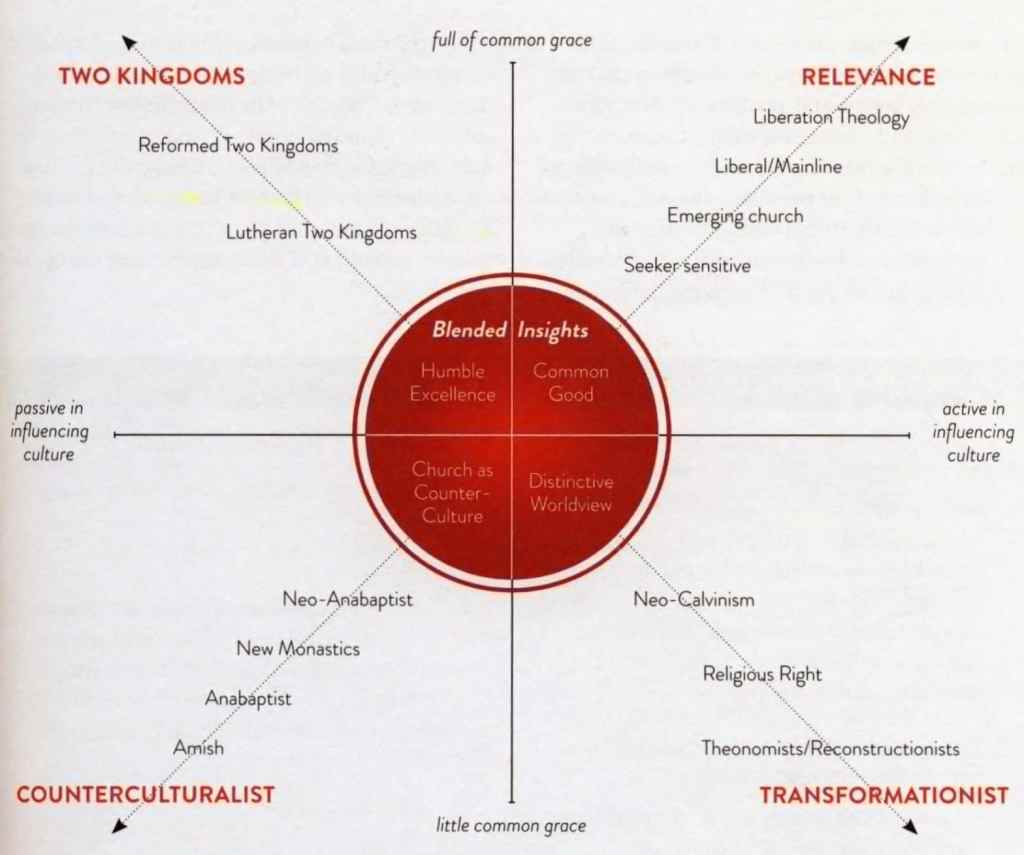
Very briefly:

The Relevance Model assumes the culture is good and that the church should be active in the world, so it finds ways for the church to learn from the world and catch up. You can see a lot of the “Christ of Culture” view in it.

The Transformationist View assumes the culture is not good and that the church should be active in the world, so it seeks ways for the church to transform the world. You’re thinking of “Christ the Transformer of Culture” here, right?

The Counterculturalist View assumes the culture is not good but that the church should not be active in the world. In this model, the church becomes a counter culture, an alternative reality to the model of the world. It’s a city on a hill, calling people in the world to come in, while avoiding being corrupted by the world. Another take on “Christ against Culture.”

The Two Kingdoms View assumes the culture is good but that the church should be separate from it. Think of separation of church and state. In this model, Christians participate as good citizens in the world and good members in the church, but we acknowledge that these are separate. This is most like the “Christ and Culture in Paradox” paradigm.

I didn’t list the “Christ above Culture” paradigm. It probably fits somewhere between “Two Kingdoms” and “Relevance.”

Which is right?

If these are new to you, take enough time to consider each of them. Then pick one. Is there one that best reflects your understanding of how the church should relate to the world?

Do you believe our primary stance in the world should be to work for positive change –– take our Christian worldview and seek to create a society that fits and follows that worldview? If so, you’d probably choose the Transformationist model.

Or do you believe our primary stance should be to celebrate God’s goodness as we find it already in the world –– to seek the common good? Then you’d probably choose the Relevance model.

Or maybe you think the primary stance of the church should be to serve as a shining city on a hill, a holy people in a fallen world, people who have others notice there’s something different about us and ask why. You’d choose the Counterculturalist view, if so.

Or finally, do you think you have an important but different role in church and world? We celebrate Word and Sacrament in the church; we do our work with humble excellence in the “secular” world. They’re very different worlds, and that’s okay. Then you’d choose “Two Kingdoms.”

Have you chosen your preferred model? The understanding you tend to use?

When I learned about these models, I began to understand what was happening in some of my disagreements. I was frequently coming to conversations about the church with a Counterculturalist mentality, and most of the people I was talking to were coming with a Relevance or Transformationist mentality. People had a hard time understanding why I would offer ideas about the church serving as an “alternate economy,” ask if it would be better if ministry were a bad career, suggest Christians pay less attention to elections, or deride pragmatism.

If you’ve had a hard time understanding or being understood in these kinds of conversations, perhaps the models explain why.

But which of us is right? Which is the proper model?

Keller answers that none is best. He says that we need to instead find balance. The answer is in the middle.

This is where I’ll disagree with Keller. Balance is often a mirage and rarely the answer. (The most annoying part of any discussion of Christian personality is when people get to Jesus and blather on about how Jesus is the perfect balance of all types — “He’s peaceful like a 9, a thinker like a 5, cares deeply about morals like a 1, bold like an 8…” Because how could we dare suggest Jesus had one actual personality, to the exclusion of others?)

In the case of cultural engagement, would we really advocate for “balance” across these four models in how the church handled the issue of slavery? In matters of human sexuality, slavery, and rock ‘n’ roll, does a balanced use of all of these models achieve what we need to? I don’t think so. I don’t think we can, or should, treat sexuality, slavery, and rock ‘n’ roll the same. They each require a different kind of Christian response. But how do we choose?

I find that we usually choose the model for each particular issue that we like most. This allows us to justify almost any response to any issue. And perhaps we call that “balanced.” But I think we can do better. In my follow-up post (now available here: “The church in a (once) sexually-liberated world”), I’ll try to extend these models to a more helpful use. For now, I’d be interested to hear your thoughts and questions about the models outlined here.

Your Personal Mission & Vision: Chosen or Given?

I went through a guided mission-vision-values exercise a few weeks ago. This was at least the fifth time I’ve been through an exercise of the sort.

I appreciated this one because the facilitator asked us to consider our lives holistically, not just our professional lives. We had time to assess our mission/purpose: “Why do you exist?” And we had time to envision the future: “What is the desired future that produces passion for you?”

My responses have changed over the years. That’s no surprise. My context has changed. My interests, hopes, and desires have changed. To some extent, we would expect this. As I’ve become a husband, a father, and a pastor, shouldn’t those contexts influence my understanding of purpose and preferred future?

But I began to wonder if some of our choosing and creating life missions has to do with a bigger change in how our culture understands human personhood. The cultural waters we swim in begin with the assumption that we’re free and autonomous. We get to choose why we exist! That’s not the way it’s always been portrayed.

Mission: Chosen or Given?

Before mission and vision statements came in vogue, the church was already talking about our purpose and ends. It spoke not in terms of options and possibilities, but with definitive answers.

“What is the chief end of man?”[note]I’m quoting it as it is. When the Westminster Catechism was written, “man” signified all of humanity. The question applies to all of humanity––women, men, and children alike.[/note] asks the Westminster Catechism with its first question.

It gives no space for people to choose their own answers. Instead, it answers for all of us: “Man’s chief end is to glorify God, and to enjoy him forever.”

The Catechism of the Roman Catholic Church makes a similar claim: “Of all visible creatures only man is able to know and love his creator. He is the only creature on earth that God has willed for its own sake, and he alone is called to share, by knowledge and love, in God’s own life. It was for this end that he was created, and this is the fundamental reason for his dignity.”[note]Again, “man” here intends all of humanity. I’ve chosen not to alter the RC Church’s language here. Women, men, and children are equally included here.[/note]

Our personal mission statement exercises and the church’s catechisms have some telling differences in their assumptions. Our personal missions suggest that purpose is chosen and conceived. Meanwhile, the Church suggests that purpose is given and received.

Before we embark on those personal mission and vision exercises, we need to first grapple with another question: Do we get to choose?

How Christian theology understands your meaning & purpose

The church’s catechisms ask about the chief end of humanity and give one unwavering answer: We exist to glorify God and enjoy him forever. Said a bit differently, we exist to know and love God.

We didn’t choose these reasons for our existence. God did.

In a parable, Jesus even provides a related vision of the future. To servants who were good stewards of all they received, their master says, “Well done, good and faithful servant! You have been faithful with a few things; I will put you in charge of many things. Come and share your master’s happiness!”[note]Matthew 25:21, 23[/note] Is this a vision of God’s intended future for all of us? To hear “well done,” to be given responsibility according to our faithfulness, to share our master’s happiness?

This all flies in the face of our culture’s understanding of the self as free and autonomous. We want full command of our lives, authority to choose our own way, to “be the me I want to be.” But have we been given that freedom? And should we really want it?

The Church’s understanding of you is that God has already named the reason for your existence. God created you to know and love and serve him. God created you to share in his eternal happiness. If we try to choose a different meaning for our lives, we haven’t so much created a new reason for our existence as we’ve rejected the real meaning of our lives.

Have we no agency?

You may get this far and object that surely we’re not all identical. Surely we each have a unique contribution to make in our world. I agree.

I don’t intend to ignore human agency and difference. We make choices. Each of us is unique. Your personality, skills, interests, and context are like no one else’s. And those should all affect the particulars of how you live.

So consider a personal mission statement like this: “My mission is to make the world a more beautiful place through art and loving relationships.”

That’s good! God is glorified in good art and loving relationships and the beauty of the world. If this sounds similar to whatever personal mission you have hanging on your wall or saved in your files, don’t assume I’m trying to throw it in the trash. But we should consider a few of the assumptions we make when we do this…

Semantics that are more than semantics

When we create a life mission statement like the one above, we likely make one of two assumptions. The first is to assume that glorifying/serving God is already implicit. Beauty and art and love are the ways that some people best glorify God. If that’s the assumption you’re making, all that’s lacking here is to make God’s glory explicit. (A good “visioneer” would tell you the art and relationships are your strategy––the means by which you best fulfill your life purpose of glorifying God.)

This may seem like semantics to you. Let me explain why I don’t think it is.

During the presentation, we heard the life story of someone who had overcome a great deal of tragedy. I began to think of people who have lost the most important people in their lives, the positions that defined them, or the abilities that set them apart. What did those losses mean for their purpose in life? For mothers and fathers who lose their spouses or children, what happens if their stated life purposes revolve around those people? Have their lives lost all meaning?

According to many of the ways we approach it, our life purpose can be stripped away in a moment. One tragedy can rip away everything we understood to give our lives meaning.

But the church answers in these times that we still have purpose and meaning. We still exist to glorify God and enjoy him forever. We still exist to know and love and serve him. That capacity can’t be ripped away. The particulars of how we go about it may have to change, perhaps in painful ways, but nothing can take away the meaning God has given to our lives.

Did you notice the reference to dignity in the Catholic Church’s catechism answer above? Because God created you to know and love him, you have human dignity. You can’t lose it by any circumstance or action––yours or anyone else’s. Your dignity comes from God’s unalterable, indestructible purpose for your life.

Freedom and autonomy reconsidered

While some people assume that God’s glory is implicit in their personal life mission, a second assumption goes further: That we’re free to choose the meaning of our lives. With this perspective, we’ll fight for our freedom and autonomy. No one else will dictate our meaning or govern our lives, we say.

To go this far, we’ll need to reject God’s claim on our lives. In fact, some people may be inclined to reject God for this very reason. They don’t want anyone else as sovereign in their lives.

I talked to a friend recently who was grieving the loss of her brother. He’s addicted to drugs, in denial, rejecting assistance, and estranged from his parents, siblings, ex-wife, and children. Is that man free and autonomous? According to modern libertarian notions he is. But according to Christian theology, he is far from free. He’s in a deep captivity, even if no one outside of him is exerting any control over his life.

Christian theology names a different freedom for that man: That he would be freed from the powers of Sin and Death that are ruling over him and freed to live as God created him to live––to live a life that glorifies and enjoys his creator.

That man’s example is more extreme than most of ours. But the end remains the same. When we live unrestrained and making our own choices about right and wrong, modern libertarianism calls it freedom, but Christian theology calls it bondage. When we instead live our lives devoted to God and his glory, our culture may call it unnecessary constraint and bondage, but we call it freedom.

Finding Abundant Communities in Unexpected Places – Mike Mather interview, pt. II

I shared part I of my interview with Mike Mather last week. Here’s part II.

Take this as a short teaser for his outstanding new book, Having Nothing, Possessing Everything: Finding Abundant Communities in Unexpected Places. I highly recommend that you buy it, read it, and if you are part of a church leadership team, consider reading it together.

Also, if you’d like to listen to the full interview, here’s the audio for streaming or download:

—————-

Teddy: So (in the first part of the interview) you mentioned DeAmon and you mentioned young people asking questions. Say a bit more about this whole roving listener, how long you’ve been having roving listeners and how this came about.

Mike: So the local development corporation contacted us from our neighborhood and said they were going to do a strategic plan and they wanted us to partner with them, which meant they wanted money. And we said, “Well, we’ll partner with you on this, but we have three conditions. One is you won’t do it by doing a need survey. You’ll do it by doing a survey of what people have, not what’s missing from people. The second thing is we get to choose the person who leads it. And the third is we get to supervise that person, because though their lips said, “yes, yes, yes,” their eyes said, what are you talking about? 

And so we went to DeAmon, who lives in our neighborhood and would walk down and see me every day. And he was a member of our church and he would talk to me about, “Oh, I just met this guy who lives at the corner of 32nd and Park. And he plays chess on his porch every afternoon and all the kids gather around and he’s teaching them about life when he does this.” Or, “I just ran into the Buddha boys, this local gang at the corner of 31st and Broadway and one of them’s a poet and one of them is a mechanic and one of them loves science.” And he would tell me these things.

So we went to DeAmon and said, “How’d you like to get paid for what you already do?”

Teddy: That’s a good deal.

Mike: Yeah, and he said, “What do you mean?” I said, “Well, you seem to recognize the giftedness of people, and so we need you to do that for this strategic planning process.” So he began to do that. So again, when I had come back to Broadway, we had been running the summer program the same way as when I left at the end of ’91. So now it’s 2004 or ‘05. We’re still running the summer program basically the same way. It wasn’t bad, it wasn’t doing anything destructive. But from my perspective and from a really practical perspective, it wasn’t really changing anything.

Somebody once talked about discernment by nausea, where you know something has to change and it’s not going to be fun…  So we took a couple of days off, we prayed together, we talked with one another. And what we decided to do out of that was to build on the work DeAmon had been doing by hiring young people who live in our neighborhood and paying them to meet their neighbors.

They do three things. They name the gifts, talents, dreams, and passions they see in the lives of their neighbors. They lay hands on them and bless them. And they connect them to other people who care about the same thing. So if they find gardeners, they connect them to other gardeners. If they find cooks, they connect them with other cooks… people who love business. And then the gift of the church is that we can connect them to people who are outside of the neighborhood and care about the same things.

But then people aren’t meeting about needs. They’re meeting about, “Oh, we all cook,” or “We all garden.” So when they get together, they’re not talking about “what can I do to help you?” They’re talking about, “So what’s your favorite recipe? What kind of flour do you use for this? What are the tools you use in this gardening project? How did you start your business? Let me tell you how I started mine.” And then people are meeting each other, as we would say in the church, as sisters and brothers. 

Teddy:  Oh, that’s great! Mike, was it you who had the tee shirts or the signs that said, “I See You.” Or am I thinking of someone else?

Mike: And we also had the sign that said, “I am more than you see.” Is that what you’re thinking of?

Teddy: I think so. 

Mike: We did have “I see you” stuff, too, and we talk about that a lot. It’s a greeting in South Africa when people greet one another. They say, “I see you.” And the response is something along the lines of, “It is good to be seen.”

It is good!

Teddy: And that seems just the premise that runs through all of this – bringing people together in those settings where they can really see and be seen.

That’s not just an unconventional approach to your neighborhood. It’s in the rest of the ministry, too. I was just telling someone a few weeks ago as we were talking about youth ministry that I talked to a guy who hired a youth minister and said, “If you create a youth program, you’re fired.” That’s one of my favorite quotes from you, because I think it illustrates how this mentality is something within your church’s ministry, too.

Mike: That’s right. Inside the walls and outside the walls.

Teddy: So what does that mean, “If you create a youth program, you’re fired”?

Mike: One of the things is—studies have shown this—that youth groups don’t do a good job of developing people who then are part of the faith later on in life. So one thing is we keep doing something that we know practically doesn’t work. But the other thing is how does it reflect what we really believe? So I can’t remember if I told this story in the book. Did I tell the story about how Methodist Hospital started in Indianapolis?

Teddy: I’m not sure.

Mike: So over 100 years ago… Again, let me stress this, over 100 years ago, a group of young people from around the city who were Methodist came to the Methodist conference and said, “There is not a hospital for poor people in this city. So give us $1 million. [This is over 100 years ago!] And we’re going to start one.” And they did! I mean, they were young people, like 17 to 29 years old.

Now, what we ask for our young people these days is to go on the stage at Annual Conference and jump up and down and clap!

But we believe that… In most cultures in the world, when you’re 12 years old, you’re expected to be making a contribution. So we believe people have something to offer and that God’s at work in people.

So one of the things that we did with that was we would organize individual meals around each young person. (We do this for young people, both in the church and outside the church.) We would go to the young person’s home or in some cases, very few, but in some cases, the young person didn’t have a home, so we would go to a restaurant. The young person’s family had to be there. The young person could invite whoever they wanted to be there. 

And then we would invite a couple of extra people. We’d eat together, and then when the meal was over, we’d ask everybody there to tell the young person what gifts they see in that young person’s life. And so people go around the room and do that. And then we ask the young person to speak to us about what he or she thinks their calling in this life is going to be and is. And then after that young person speaks about that, we turn to everybody there and say, “Does anybody here have anything to offer to the gifts of this young person, to what this young person thinks they’re going to do with their life?”

Now how many of us are doing what we thought we’d be doing at 15? Not very many of us. But that isn’t the point. The point is people recognizing and affirming that God is moving in our lives. That we have particular uniqueness and a call and a giftedness. So the first couple of young people that we did this with, we had them come and talk to the Governing Council of the church and after they left, the people in the Governing Council asked, “Why are we just doing this for young people?”

So you know, actually the most recent thing we’ve done with that is we’ve started doing it for shut-ins. And we did that because somebody felt the call to be with older folks, and we said, “Okay, well how about doing this?” And it’s been great! It’s the church caring for each other and doing what we can do like that.

Teddy: And you’re beginning to answer one of the other questions that I had for you, because you’re in a different setting from a lot of folks who will read this book. You’re sitting in a neighborhood that’s considered impoverished by the city around it and has different groups coming in all the time to try to improve it. I wanted to talk some about if a church in the middle-class suburbs asked you, “How do we change what we do?” What would you tell them? And I think you’ve answered at least a part of that. I wonder if there’s anything else you would say.

Mike: We do a couple things with that because we do get this question. And one of the things we’ve come to say to people is, take one of the things that you’re already doing and try an experiment.

So let me give you a couple of examples. One was a church that comes in and does a meal every Sunday for people in the inner city. So they said, “How could we do something different with this?” I said, “Well why don’t you try and make this as easy as possible? Don’t make it really complicated.” So you have somebody in your group who listens well. I’m sure there is. Because in every group there is somebody. So for the next two months, just ask that person to hang out with people who come to the meal and listen. And then at the end of that two months, have that person come and talk to your whole group and ask them, “What did you hear? What did you notice? Is there something we can build off of here?” So that’s one thing.

Another thing is, say you’ve got some program you’re doing in the inner city. One of the things we’d like you to do is try and identify one or two people who you’re serving who have similar interests as the people in your group. If you have people in your group who like to knit or if you have people in your group who like to do carpentry, what you’re looking for is somebody who you meet who has that same love for that. And then do something together. First of all, just get together for a meal and talk together about that. And then what we ask the pastor to do is to show up and listen and not say anything, which is sometimes hard for them.

Teddy: No doubt.

Mike: But then try to figure out, where did you see the spirit moving in that, and how can I invest in that? Asking people to change the ways completely they do things is crazy. It’s impossible. But asking people to begin to look at this and try to do it step by step… try to connect, get the gardeners together, get the cooks together, get people who love poetry together. It doesn’t matter what it is, and it’s idiosyncratic to every group of human beings you have.

But just one step at a time.

Teddy: It’s humbling to listen to you talk and to read your book because, like I said near the beginning of this conversation, so much of it feels like it should be intuitive. But it’s only when I hear you say it that I go, “Oh, this shouldn’t be that difficult!” It’s really just taking small steps.

Mike: Well, again, the reason it isn’t difficult is because it’s the way we already believe. The difficult thing is figuring out what it looks like to actually do it. Because all our practices are built around scarcity.

Teddy:  Say another word about that. Is there anything about this work that you’re talking about that’s unique to the gospel? That is, there’s a lot of it that we could call humanitarian, even spiritual, but is there anything that you would say makes it unique to the Christian faith?

Mike: Well, I would say a couple things about that. One is that I have what people would consider a realized eschatology. In Matthew 11, John the Baptist is in prison and he sends his disciples to go talk to Jesus and say, “Are you the one?” And Jesus says, “Go back and tell John, the blind see, the deaf hear, the dead are raised, the poor have good news, and blessed is the one who takes no offense at me.” I believe those things are already true. I think the poor have good news. And I think what’s uniquely Christian is that we can see this when nobody else will.

I think that Jesus heals more people of blindness than he heals of anything else because that’s our biggest problem. Think about the story of the man born blind in John 9. That’s a really long story, and we know if we read the story, at the end Jesus is talking about the blindness of the religious leaders. But early in the thing, he heals the guy born blind and the guy goes back to his village, and it says that many did not recognize him. He was blind! He wasn’t disfigured. But they could only see him for what he was missing, for what was wrong with him.

And so I just think over and over again…  Blind Bartimaeus! There are more stories in particular about Jesus healing someone of blindness than of any other particular thing. There’s like nine instances of Jesus healing somebody from blindness in the gospels.

Paul talks about this in Corinthians when he says, “Now remember who you were dear sisters and brothers, for from a human point of view, few of you were wise or powerful, from high social standing, but God purposely chose what the world considers foolish in order to shame the wise, and God purposely chose what the world considers weak in order to shame the strong, and God purposely chose what the world looks down on and despises and thinks of as nothing in order to destroy what the world thinks of as important.”

I think what is uniquely Christian here is this recognition that God in Christ has done these things and has changed the world unalterably and forever, and we can act like it, or we cannot. 

And it doesn’t change what God in Christ has done. What it changes is, are we entering into that joy that Jesus talks about in John 15 when he says, “I came that you may have joy and that your joy may be full.” I think it’s that! And I think it’s over and over again. I think I wrote in the book that in John 6 at the feeding of the 5,000, Jesus tells the disciples to gather up the scraps. And it says, “They gathered up baskets full.” When he says to them to gather up the fragments, it’s the same language, it’s the same word that he uses in John 10:10 to say, “I came that you may have life abundant.” These fragments are the abundance. It’s all these pieces that are present right now. That’s what I think is uniquely Christian about this.

Teddy: That’s a great realized eschatology laid out in full.

Mike, I could talk to you all day. I hope you keep writing, because you’ve just shared a lot that didn’t make the cut in this book. I think there’s a lot more to go. Thank you. I really appreciate this.

Mike: Thanks for having me, Teddy. 

Teddy: Having Nothing, Possessing Everything. I especially loved your subtitle, “Finding abundant communities in unexpected places.” That’s just right.

Thank you so much for this time. I told you earlier I’ve already bought a good half dozen of your books, and I’m probably planning to buy another half dozen more to send to different people. And that’s the first time I’ve done that in a few years. I don’t do this often, but I really think this is valuable, and I appreciate you writing it and doing what you’re doing. So thank you, Mike.

That’s all for my interview with Mike. Now go buy his book. Get a copy for yourself and a copy for a friend. And consider sharing this interview so some other people can be exposed to it, too.