Neill Townsend – 1980-2012

neill townsend

neill townsendToday I had the honor and the dismay to preside at the funeral of Neill Townsend, an old friend. For those who knew Neill but were unable to attend the ceremony, I’m posting my sermon below, in his memory. You can also find Neill’s obituary and leave a note in his guest book here.

Neill Townsend Funeral Sermon – October 12, 2012

I met Neill when we were in preschool. He had those big glasses and that big smile. We went on to 1st and 2nd grade together, where I remember Neill already being heads and shoulders above the rest of us when it came to anything athletic. He was funny and made friends easily. And he was really smart. I can still remember him explaining to me in front of the class why I should know 7 + 5 can’t be 13.  We ended up at separate schools for a few years after 2nd grade.

I didn’t see Neill again until we were in 6th grade. The big glasses were gone, but not much else had changed. He still had that big smile, was starting for the basketball team, the quarterback for the football team, and the star of the academic team. Yes — quarterback for the football team, star of the academic team. And seemingly friends with everyone.

Again, we ended up at different schools after middle school, and I didn’t see Neill for a few years. We actually ended up re-connecting not long after his terrible car accident in high school. That was a hard time, obviously, but also one where I was impressed with how Neill carried himself through it. I still remember him at Aldersgate Camp just about a year after the accident, sharing one night about the incredible change in his life because of the people who had surrounded him and the renewed hope God had given him.

And even in that tough time, Neill still had some bravado. We went on a first date double-date together – on Valentine’s of all days! – and Neill insisted that we take roses. He walked up to the door, put the rose in his back pocket to make it a surprise, and then stepped inside where the door closed and chopped off the head of the rose! He ended up pulling out an empty stem. And yet he came back to the car smiling and shaking his head, and he dated the girl for another year. From big to small, Neill rolled with some of those punches a lot better than most of us do.

At root, it was still the same Neill. Still an excellent athlete, still incredibly smart, still a special knack for making people laugh and smile, still a loyal friend.

I hadn’t been in touch with Neill since high school, but it wasn’t surprising to hear the more recent stories as I talked with Lee, Jane, and Scott this week:

  • Stories about a workplace that saw him come in and quietly do his job, and before they knew it, he seemed to have his hands in everything. They’ve been talking about how many people they’ll need to hire to replace him now.
  • Stories about Neill asking his mom to put him on speaker phone so he can talk to the dog
  • Stories about friends that Neill had reached out to and been a steady presence in difficult times

I think Scott said it best the other day. A number of different people have been calling, writing, visiting, and sharing about Neill. Scott said some of the stories were new, but none of it was news. He said, “We just keep getting confirmation that everyone knew the Neill we knew. The same Neill we’ve known all his life.”

And though we all knew the same Neill, it’s also amazing how many different sides there seemed to be:

  • The athlete and the avid reader.
  • The person who could so easily make a crowd laugh and the person who went out of his way to give special attention to friends going through tough times.
  • The passionate sports fan and the passionate advocate for justice, all the way from Appalachia to international war crimes victims

We gather this morning to thank God for blessing us with Neill in all of his wonderful diversity.

At the same time, as much as there is to celebrate about Neill’s life, we can’t believe we’re here.

Several of us have had the same thoughts this morning as we came here. We’ve had the same thoughts throughout this week. “It just doesn’t seem real. Doesn’t seem believable that we would be preparing for Neill’s funeral.”

In the reading from John, we just heard Jesus say, “Let not your hearts be troubled,” and, “Peace I leave with you.” Now I doubt most of us could honestly say our hearts haven’t been troubled this week. It would be difficult to say we have had a real peace throughout. And that’s okay. In the Bible, we even find Jesus weeping at the tomb of his friend Lazarus.

But I’m comforted to know that even in the face of a terrible loss like this, the words of Jesus are still, “Let not your hearts be troubled… Because I live, you also will live.” This is the hope I know and rely on in times like this.

In Jesus Christ, we see the promise of life, even where the world may see only death. In Jesus, we see that God sent his only Son to walk this earth and to endure even death, so when we come to times like this, we know that God is not a distant God, unable to understand or empathize with our pain.

And in Jesus, we see a triumph over the grave and over the forces of evil. When Jesus said, “Because I live, you also will live,” he told us that death does not have the last word. And when he died and rose again, he proved that word true. This is why he says, “I am the resurrection and the life. The one who believes in me will live, even though they die; and whoever lives by believing in me will never die.”

We sang “Great is Thy Faithfulness” earlier. We heard Jesus say, “You trust God, trust also in me.” We believe that God’s compassions do not fail, that God gives strength for today and bright hope for tomorrow, that He is a faithful God.

If you come here today with deep pain, the best thing I know to do is point you to the God who says, “Comfort, comfort, my people.” If you come with sorrow and distress, I pray you find hope in Christ who says, “My peace I leave with you.” Though we mourn now and have every reason to, I trust a God who says that in time he will turn our mourning into gladness; he will give us comfort and joy instead of sorrow.

With that hope, we come now and entrust Neill to God, who can be trusted.

The most important thing in our faith…

John Meunier captures the heart of Methodism well in a recent post: “How is your heart today?”

[You should really go read the whole thing. Actually, you should just go ahead and subscribe to him. He’s on the money pretty much all of the time.]

I’ll quote his whole ending, which is particularly good:

We confuse ourselves for generic American evangelicals because we use much of the same language. But the Methodist accent often falls on different notes than the Baptist or Calvinist or non-denominational versions of the faith. Justification or “being saved” or “born again” is but the first dawning of Christianity in the soul of a person. It is important, but only as a starting point. If it is not the beginning of a new life and growing holiness of heart and life, then it loses its value. We can unmake ourselves and be unborn. The old self that dies in Christ is a vampire. It will rise again if we allow it.

For many Christians, the key question is something like “When were you saved?” For the Methodist, the key question is always “How is it with your heart?” Our “once saved, always saved” brothers and sisters often speak as if the most important thing in our faith is something that happened in the past. Methodists believe the most important thing in our faith is what we are doing today, right now.

So, I ask myself and ask you: “Do you feel the love of God in your heart?”

Did you catch that? “Methodists believe the most important thing in our faith is what we are doing today, right now.” This is about a life-long journey. The starting point (i.e. conversion) is important, but we miss the whole point if we think that’s all there is to it.

C.S. Lewis made a similar point in the conclusion to the last book in his Chronicles of Narnia series:

All their life in this world and all their adventures had only been the cover and the title page: now at last they were beginning Chapter One of the Great Story which no one on earth has read: which goes on for ever: in which every chapter is better than the one before.

Though he was attempting a [suitable] comparison between this life and the after-life, I think a similar comparison can be made between conversion and ongoing Christian life.

Note: I was gone for a good while. Sorry about that. Other life demands got the best of me. Then I tried to get back in the saddle with last week’s “What if I don’t believe the Bible?” Then new unforeseen things this week. Hopefully back more regularly next week!

“What if I don’t believe the Bible?”

creation

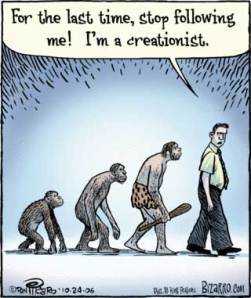
creationI’ve run into a number of people who are struggling with Christianity because they’re not sure they can believe the Bible. If you can’t believe the Bible, how can you be a Christian?

The struggle tends to revolve around a tension between faith and science. Can you be a Christian without believing God created everything in 6 days? What if you don’t even buy that those days represent six geological eras (after all, the sun appears after the earth and its vegetation)? What if you struggle to believe a man named Noah got two of every kind of animal onto a big boat?

Some people and groups will tell you that you can’t be a Christian – or at the least that you don’t have enough faith – if you don’t believe these things. Some simply reject science in favor of whatever the Bible “literally says.” Some have come up with clever ways to show that the Bible and science are compatible.*

At the end of the day, though, even the most loyal biblical literalists fail to believe the Bible literally. None of them believe that Jesus was a literal vine, or that his disciples were branches, even though Jesus referred to them that way. Few, if any, believe that the rivers literally clapped their hands or that the mountains and trees sang for joy, even though we see those things happening in the psalms.

Why don’t we believe Jesus was a literal vine, even if we fully believe the Bible? Because we understand how to read a figure of speech. When someone speaks metaphorically, we don’t have to believe them literally to believe what they’re saying. Actually, we’re likely to totally miss their point if we’re focused on believing them literally.

What if there were big debates among Christians today about whether Jesus was a literal vine? First, we’d look pretty silly and lose a lot of credibility. But second, and even worse, we would miss the real point of Jesus’ statement, “I am the vine; you are the branches. If you remain in me and I in you, you will bear much fruit; apart from me you can do nothing.”

I think much the same has happened in our faith and science debates – particularly regarding the early accounts in the Bible. 

I’ll come clean. I’m not sure I believe a historical couple named Adam and Eve were the first to walk the earth, that they encountered a serpent, ate fruit, saw that they were naked… Actually, I’m not sure a historical man named Noah ever took animals onto a boat and survived a flood.

Do I believe these things could have happened historically? Sure! I don’t question God’s power to have accomplished any of this historically. I just don’t believe that’s the point of the accounts. So I would say I believe these accounts deeply and fully for what they were intended to convey, even if I don’t necessarily believe them historically.

The early accounts in the Bible are written in a mythic fashion. Don’t take “myth” here to mean “false.” Ancient societies all had mythic poetic narratives that helped them understand who they were, who their gods were, and the purpose of all life. The first eleven chapters of Genesis – where we find creation, Adam & Eve, Noah, and the Tower of Babel – have the form of a mythic poetic narrative.

So what changes if we read the first eleven chapters of the Bible as mythic poetic narrative?

First, we stop fighting over whether it was six literal 24-hour days. Some people stop trying to prove how Noah got all those animals on that boat, while others stop worrying that they must not have enough faith because they don’t believe he did.

Second, we start believing the Bible in what I would call a deeper way:

  • We see that the creation narrative tells mankind shocking things – like that humanity was created in the image of a holy God (while most other cultures had less-than-holy gods who didn’t think very highly of humans)!
  • We are presented with one almighty God who created all things and called them good. A major contrast with the quarreling and only partially powerful gods of the surrounding cultures.
  • We see God’s deep anguish over humanity’s wickedness in the flood account, not the gods’ petty annoyance with humanity presented in other versions of that epic story.

[I’m not able to do justice here to a reading of these accounts as mythic poetic narratives. As I have seen them this way, they have become much more profound to me and important to my faith than when I simply believed them as history. Perhaps in the future I’ll try to give a more in-depth approach to them.]

If you have struggled to believe some of these early accounts as history, please don’t let that struggle prevent you from faith.

If you have fiercely supported the historicity of these early accounts, two things:

  1. I commend you for being dedicated to what the Bible says and believing it. I’m certainly not saying that you must stop believing these accounts as history to be a good Christian, or even to be right. I am asking you not to question others’ faith if they don’t call this history, though.
  2. Make sure you haven’t devoted so much attention to arguing that Jesus is a literal vine that you’ve missed the deeper point of “I am the vine; you are the branches.”

An important note here: I doubt that the first eleven chapters of the Bible are literal historical truth. I believe there are several pieces outside those first eleven chapters that may also qualify. I would insist, though, that the accounts of Christ’s incarnation, life, death, and resurrection are historical truth. I believe these were written to be understood as historical truth, and as the most important events of human history. I would be martyred for the belief that Jesus was historically crucified, died, and was buried. The third day he rose from the dead! I wouldn’t be martyred for the belief that the first woman was literally made from the rib of a man.

Was this helpful or interesting to you? If so, JOIN my e-mail update list.

____________

* Perhaps the most perplexing of these attempts, in my humble opinion, is gap creationism. The theory is essentially an attempt to squeeze a whole new narrative in between Genesis 1:1 and 1:2, all to allow people to believe in a literal six-day creation  and also believe scientists who say that the world is really very old. Gap theorists say there’s biblical evidence to suggest this gap. Oddly, though, no one had ever noticed that biblical evidence until geologists’ studies started to show that the earth is much older than previously thought. Hmmm….