A different perspective on ministry in “impoverished” areas

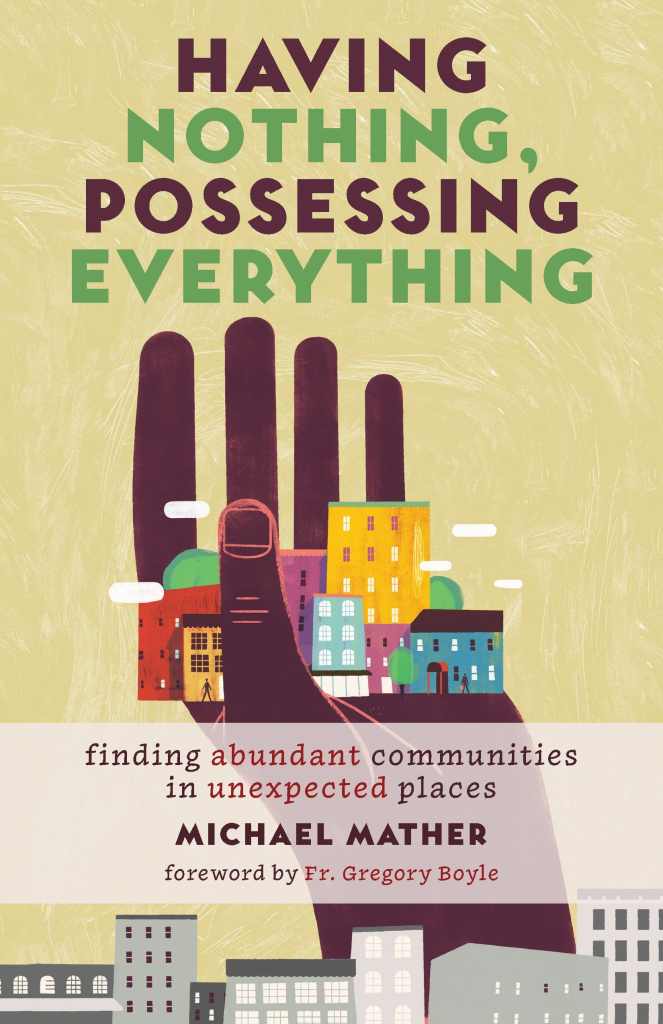
Once every few years I come across a book that’s so helpful and intriguing that I buy a dozen copies and send them to important people in my life. Michael Mathers’s Having Nothing, Possessing Everything: Finding Abundant Communities in Unexpected Places is the most recent of those books.

Mike is a United Methodist pastor in Indianapolis. He has served for the past sixteen years as the senior pastor at Broadway UMC, sitting right in the middle of what most people would call an impoverished neighborhood. But Mike doesn’t tend to refer to this as an impoverished neighborhood. He refers to it as a community of abundance.

I met Mike a few years ago at a ministry conference, and I was so intrigued by the different way that he thought and talked about ministry in his neighborhood that I wanted to see it first-hand. So the next year, our pastoral team went to spend a couple of days in Indianapolis with the Broadway UMC team. I came home impressed, inspired, and telling their story.

I’m so grateful that Mike has put a lot of this story in writing now. I think it will help leaders in ministry, non-profits, and perhaps government and granting organizations think differently about the people they work with––whether they would be considered “impoverished” or not.

I asked Mike for a short interview so I could introduce him to you. Consider this a teaser for his book, which covers the things we discussed in much more depth. I hope you’ll buy a copy after you read/listen. Or buy a dozen and give them to important people in your life.

I’ll be sharing a written form of the interview here in two parts (lightly edited for reading), and I’m also providing the audio if you’d like to listen instead.

I think Mike is a delightful conversationalist, so I personally recommend the audio. Whether you read or listen, enjoy!

Stream the audio here or click the dots at right to choose the download option.

—————-

Teddy: Hi, Mike. I’m really glad to be able to talk with you.

Mike: Sure. Thanks Teddy. Good to see you again.

Teddy: One of my favorite stories that you shared with me back when we visited your church was about your church tutoring program and Maya. And as I was getting toward the end of your book, I was surprised you had never told it. I was thinking, “This is one of his best stories, and he held it back!” And then there it was. It was your closing for the whole book. So I guess I’m starting with a spoiler, but I think that story is worth people hearing a few times. I think it’s a great illustration of the change in how you’re approaching ministry in your neighborhood. Would you mind to share that in short form?

Mike: So we had run a tutoring program for over 30 years in the neighborhood. And we did 50 people, one-on-one tutoring, and we would get tutors from other United Methodist churches in town. We would get tutors from leaders from United Way. We would get tutors from Lily Pharmaceutical. But we never asked for tutors from among our neighbors, because this is who we were doing this service for. So we had hired DeAmon, who was a member of our church and lived in the neighborhood to be a roving listener, to find the gifts and talents of our neighbors.

And he called me one day and said, “Well, Mike, you need to talk to Maya.”

I said, “Well, who’s Maya?”

DeAmon said, “Well, she runs tutoring out of her house.”

And I said, “What do you mean?”

And he said, “Well, you need to talk to her.”

So he gave me the phone number and I called her. She’s 34 years old at the time. She lived in our neighborhood her whole life. She lived in the house her parents raised her in. She worked at AT&T at night. And when she got up in the summer at 11 o’clock in the morning, the kids from her block would come over to her house.

I asked, “What do you cover in tutoring with them?”

And she says, “I cover everything from phonics to Sophocles.”

I said, “What do you mean?”

She said, “Well, if they don’t know how to read, we do phonics. If they do know how to read, we do Sophocles. And then every Friday I have a barbecue at my house and their parents come over and they present what they’ve learned that week.”

Now, we at the church should not be saying to Maya, “Hey, come and be involved in what we’re doing with the tutoring program at the church.” We should be asking, “How can we be a part of this amazing work that’s going on in your life, in your neighborhood?” And so that’s what we did.

[We didn’t get to the end of this story. See Mike’s book to hear how the church started to be part of what Maya was doing. It’s a great story of a church thinking differently about its role in the community.]

Teddy: And that seems to encapsulate so much of what you’ve been doing over the last few years or decades, just constantly recognizing what’s already happening in the community.

There’s something about what you’re doing that must be counterintuitive or at least that contradicts something about how we’ve been taught to think about poverty and service. Everything you say sounds so obvious … except for the fact that we’ve all done it exactly the other way. Why isn’t this the way we naturally think? 

Mike: So years ago I read a book about a guy named Paul Farmer. I don’t know if you’ve read that, called Mountains Beyond Mountains. He’s a MacArthur Genius Grant award winner, a doctor in Haiti. One of the things he talks about is that we are schooled in scarcity. And I think the reason, Teddy, that you thought, “Oh, this is so obvious” is, that’s the way it came to me, too, when I first started looking at things this way. It’s like it was so obvious.

Why wasn’t I doing it? It’s because all my practices were built around what was missing, not about what was present. And so the practices really, it’s the practices of running the food pantry or the tutoring program and the way we’ve done it that really reflects what we believe, even though we say we believe something else. And so trying to school ourselves in abundance is the bigger challenge, I think.

Teddy: It even seems like a different understanding of human dignity. A lot of times in our service, we’re attempting to fill that thing that’s missing, that’s preventing someone from having dignity rather than recognizing that the dignity comes from acknowledging them as a full human being with something to offer. But usually we come in with our big idea and the attitude that we’re going to fill someone else’s need.

Mike: Well, you know, I kind of like to think that I have really great ideas. And maybe the other side of that is, does that mean I’m thinking that other people don’t have good ideas? I don’t know. But I feel like what I had done for many years in running programs for people was not treat people as if they had really cool ideas and wonderful things going on in their lives as well.

And your question about why, I mean it’s a really good question. You know, maybe it’s a mystery in some places or maybe it means facing some hard truths about ourselves in some other ways.

Teddy: That’s a great way to put that. I’m not going to put this on everyone else, but I wondered for myself if this can turn into serving people for my own good. I really want to believe that I did something significant, so I help someone else in need. And even the service is about me. I may never really put my eyes on them and who they are as a person, just who they are as someone to make me feel better about doing something good.

Mike: Well, the one thing I would say is that that is a thing that works within us. But because that’s a thing that works within us, we should recognize that it’s a thing working within others as well. So if we like being needed, maybe we need to think maybe the person I think I’m serving, maybe they want to feel needed as well.

And in terms of being part of the church and the Christian idea of this, this is the part where Philippians talks about emptying ourselves. This is not about ourselves, but about giving others the chance to give. I think one of the things I wrote in the book was, we say that old statement is that it is more blessed to give than to receive. So why do we hoard all the giving to ourselves? Or to say it another way connected to what you said before, if we know that this is what motivates us, how come we don’t think that that might motivate the person sitting in front of us as well?

Teddy: Right. And you tell so many stories about that. It was interesting to me to see that shift. You talked about the group that wanted you to do something for the neighborhood around Christmas. And they led with, “You could do this for us; you could do that for us.” And then you ended up going around on Christmas Eve with them in Santa Claus suits.

Mike: Yes! They had said, “Well, why don’t you pay a utility bill for everybody on the block?” And I was like, “My God, I know your gas bill is $600 a month. What do you think we have here? But what would it look like if you did something?”

And so then he said, “Well, me and my friends, we could dress up like Santa Claus and go door to door.”

And I was like, “Oh my gosh! I would have never come up with that in a million years on my own.”

And I would’ve never thought that they wanted to do something like that. But boy, that is the ultimate example of the thing you were just talking about, right? I mean, that wanting to feel good: playing Santa Claus!

Teddy: No kidding. It could almost be a metaphor for the whole thing. So often we come in and we just want to play Santa Claus and never give anyone else that opportunity to be on the giving side of it.

So much of this has seemed to me like a shift in mindset and attitude where we shift our focus to asking, What assets do these other people have? What gifts do they have? And then just participating with them in that.

Have there been any times that the focus on the neighbors and their gifts was right, but something else went really wrong in the process? It seems like surely you’ve had some major busts along the way, and I’m curious about any of those.

Mike: Well, I think all the time there are things that don’t work along the way. But that was pretty much true when I was doing things the old way. So the issue is not, does everything always go well? It’s what do I do that in service of? Am I doing it in service of believing and trusting in God’s abundance in someone?

So one of the stories I don’t think I told in the book as an example of this is about a neighbor who came over and talked to me. And we had this old thrift shop, which I did talk about in the book. And we had closed the thrift shop because the people who wanted to run it didn’t want to run it anymore.

And this neighbor, Delores, came over to me and said, “Hey, I’d like to open a boutique in here.”

And I said, “Great! You can do that.”

And she said, “Okay, I want you to paint it and get it fixed up for me.”

And I said no.

She was mad, and I didn’t see her for a year and a half. And then a year and a half later she showed up to see me one day and she said, “Hey, I want you to come over and look. I’ve been painting in the room.” And she paid and fixed it up and has done a boutique there now for several years.

I think the biggest failure was of course running that summer program with those nine young men who died. Nine young men dying in nine months. I could have just done the funerals and then not thought about it anymore or much more except just to grieve. But I thought, Man, am I being nearly as helpful as I thought here? And I think this all the time, I think we’re doing things and Rachel who I worked with for a lot of years here, did this survey of congregations around Indianapolis asking what they were doing about poverty, and they would all tell her the programs they were offering, and then her second question was, “and is it effective?” And people were like, “Oh, I never thought of that.”

Well, yeah, that was sort of the way I acted.

Teddy: Those nine funerals seem like they were the big first turning point for you. Is that right? 

Mike: That’s right.

And people would say to me, “Oh, but if you hadn’t been doing the summer program or those other things, it would’ve been even worse.” And I had two responses to that. One is “no,” and the second response is, “even if you’re right, this isn’t good enough.” I mean, in a four block radius in a major American city to have that many young people dying, and most of them had grown up in the programming that the church ran. That was a really hard reality for me to face.

You know, you talked about this as a mindset change, and I do agree, but the other thing I want to say with that is, in recovery movements, we say that people don’t think their way into new ways of acting, but act their way into new ways of thinking.

And this is why I think practices are so important. We begin to develop practices of, instead of asking people how poor are you, tell me how rich you are, tell me how gifted you are. Tell me what the people who love you would say about you. You know, what do you do with yourself when you’re not doing something you have to do? What brings you alive? What gives you joy in your life? You know, oftentimes when we ask people, the very first thing they say is something they think you want to hear. You know, like, “I’m really good at cleaning.” But they don’t say that with joy.

Teddy: And so how do you get to that next level? You shared some of this in the book, and I thought it was pretty interesting.

Mike: Well, you ask questions about the other people in their lives or, particularly if they’re with somebody else when they come to see you, you say to that person, “So tell me about your mom. Tell me about your son here. Tell me about …” whoever it is they’re with. “What would you tell me about this person?”

I remember one woman came to me one time and she was there for some food and we were talking about what she was good at. And she said, “Well, I’m a really good friend.”

And so we said, “Well, how do we know that?”

And she said, “Well, I have this friend, and she was living on the street, and I took her into my home and I talked to her and I told her, ‘You can do better than this and I’m gonna be with you all along the way.’”

And I kept thinking of the words of Isaiah when he said, “Take the homeless poor into your home.” And I thought of words of Jesus when he said, “No longer do I call you servants, but friends.” And we said to this woman, “You are a good friend and there are some people who could use to talk to you because there are people who could use a friend.”

And she was great with that. But it wouldn’t have happened if I would have just asked her the questions we used to ask when somebody came to the food pantry. We’d ask, “How many members of your family?” And then we’d put together the package for four or six people or whatever, then send them on their way. It wouldn’t be an interesting conversation about what’s most meaningful in somebody’s life. And what I would say as a pastor is, I want to see what the Holy Spirit is doing in this person’s life, in and through this person, that they may not even see. I think a lot of our work as pastors is just holding up a mirror to people and saying, “Look! Look at this remarkable holy thing I’m seeing in this mirror when I see you.”

Teddy:  It’s interesting when you mention the questions we usually ask. Out of some good intention, we say we want to do this service in the community. And then the questions that we end up asking of people, you would never expect them to produce good conversation. They’re not interesting questions. They’re not questions of interest about another human being. They’re just filing someone through the line, and each answer is pretty similar to the one before and the one after. And you’ve totally reversed that to ask things that are unique to each person and make them stand out and special to you … and to themselves.

Mike: The young people who do the asking of the questions in our neighborhood, I’ve been learning a lot from them. One of the questions they love is, “Tell me what you’re most proud of in your life.” Man, the things they hear are amazing! “Tell me what dream you have for your life.” They get a chance to hear some pretty interesting stuff.

That’s all for part I. Now see part II here.

Like it? Or just want to discuss it more? I’d be so happy if you’d share it. Click here to share on Facebook. Click here to share on Twitter.
In Favor of a UMC Separation

I wrote this shortly after the UMC’s 2016 General Conference. At that time, UMC separation was still a quite unpopular opinion. Perhaps because of that, and for a few other reasons at that time, I never published this. Now I come late to the game––after majorities of both the WCA and UMC Next have called for an amicable separation. For the reasons given below, I’m pleased that this is now a majority opinion. I decided to publish this now (1) to add another voice to those calls for separation, and (2) to provide a slightly different perspective than those I’ve seen.

I occasionally meet with married couples who are in marital crisis. I tell them that I’m biased. I love each of them and want what’s best for each of them. In that, I’m not neutral.

I also tell them that I’m biased in favor of reconciliation. Reconciliation and divorce are not equal options to me. Divorce is inherently destructive. It does (nearly) irreparable harm to something that was sacred. I will not celebrate it. At best, I’ll recommend it in grief, as the best option among a number of sad options.

But despite my bias, I will occasionally recommend divorce. I reject the easy answer that says, “God hates divorce!” and makes it off-limits. That has sent many people back into abusive relationships, thinking it their duty to stay. We can’t idolize “no divorce” and allow the violence to continue.[note]A note: I won’t necessarily recommend divorce just because infidelity has occurred. If genuine repentance has followed, I’ll actually encourage the violated spouse to attempt forgiveness and reconciliation, if (s)he is willing.[/note]

I’ll recommend divorce when someone has suffered violence (sometimes both parties) and there’s reason to believe the violence will continue. That violence may have come in the form of abuse (physical, verbal, emotional, sexual…) It may have come in the form of infidelity to the marital covenant without repentance.

I won’t recommend divorce just because people have “fallen out of love,” claim “incompatibility” or say they have “irreconcilable differences.” In those situations, I urge people to find a way to honor the covenant they’ve made, hard though it may be.

UMC in Crisis

The UMC has many similarities to a marriage in crisis. We need to call this what it is––a relationship that has suffered violence and shows every sign of that violence continuing. Specifically in our treatment of human sexuality, two large groups feel like[note]I am using “feels like” and “perceived” for both groups’ feelings throughout, not to diminish the experience of either group, but to acknowledge that both groups may quibble with the other’s definitions of violence and abuse.[/note] they have suffered violence. “Progressives”[note]I don’t particularly like the categories of “progressive,” “traditionalist,” and “moderate” that I’ll be using here. But I’ve struggled to find better terms that don’t consume too much time in defining. And when I tried to write this without giving an identifying name to a group, it was difficult to understand. I wish I could do better than concede to these terms that I don’t like. Sorry that I haven’t been able to here![/note] believe that the UMC’s current official stance regarding human sexuality is discriminatory, hurtful, and makes our church an unsafe place for them. For this group, this is an abusive relationship.

“Traditionalists” believe the UMC’s current official stance regarding human sexuality is orthodox and necessary. They believe it’s unfair and abusive when they are called bigots or discriminatory for holding to these stances. They, too, have felt unsafe, especially during some acts of protest. They also feel like they’ve experienced infidelity to the UMC’s clergy covenant without repentance.

If I were counseling this married couple, I think I would make the observation not just that they both feel like they have irreconcilable differences, but that it’s hard to see how both sides won’t continue to experience violence. In fact, tensions appear to be escalating, not deescalating. The accusations on both sides are becoming more serious, not less. The situation is getting more inflamed. I’m not sure any objective observer would disagree.

Trying to work it out together is only inflaming the situation. Every time we get in a room, we grow further apart. Even the good times (e.g. worship services at General Conference) still carry the tension of an underlying agenda. Sacred moments like Holy Communion at General Conference and the consecration of Bishops have become occasions for deep division and strife.

Time to Separate

If I were meeting the UMC in counseling right now, I would urge a separation. I’m not urging divorce yet, but unless there’s a clear sign that some patterns in the relationship are going to change, it’s moving in that direction.

It’s time to separate, to work on ourselves, to see if the inflammation can go down. A heart surgeon recently told me that after a heart attack, she only does what’s most urgent. She waits until the inflammation has gone down to take care of the next issues. It’s not good to try to fix too much while everything is inflamed. This is where we are. We need to see if some of the inflammation can go down. That won’t happen while we continue living under the same roof.

We can’t keep repeating the “unity” mantra in the same ways that some repeat “God hates divorce,” all the while allowing the violence to continue. It’s time for a separation. Time to live under different roofs, different sets of house rules.

The highest hope: we separate as amicably as possible (don’t burn every bridge as we go!) and give these groups some time for the inflammation to go down, time away from a hostile atmosphere. In that relative calm compared to the storm, we reassess ourselves and consider how we can handle difficulties in a relationship better the next time. How do we handle disagreement without it turning into violence? How do we continue to offer grace and charity in times of conflict? Hopefully there comes a point that growth has occurred, inflammation has subsided, and we can perhaps attempt reconciliation. It’s also possible, though, that this reconciliation will never come. That’s a hard and sad reality. We won’t celebrate it; we’ll grieve it as a bad option. But it may be less bad than all of our other options.

Of course, we have more than two groups affected by all of this. This affects members of UMC churches across the world. It affects boards and agencies. It affects any true “moderates” who just wish we could stop fighting and move on. These are all like the kids or the family in the whole messy relationship. They’re suffering right now.

  • They suffer because we can’t do other important things since we’re too busy fighting. The UMC has many issues to deal with and finds itself unable to get to them all because of the time and energy this fight consumes. (Does any other large organization have a structure where they only have a 2-week window every four years to make major decisions? This seems ludicrous.)
  • They suffer because they’re forced to take sides. On every vote I’ve seen at our General Conference, there are two options: yes and no. On nearly all, the “progressives” are on one side, the “traditionalists” on the other. The “moderates” are left picking sides.[note]A note after GC2019: those who have claimed the “centrist” or “moderate” position voted consistently with “progressives” at that meeting. They have rejected “traditionalist” positions as exclusionary and intolerant but have not acknowledged that many “progressive” positions exclude and will not tolerate what the “traditionalist” position requires.[/note]
  • They suffer the embarrassment of the never-ending fights. Some UMC church members are confused about why their church’s leaders seem to be always fighting and posturing. Some are put in the uncomfortable position of explaining why their leaders can’t get along.

Any separation – and certainly any full divorce – will clearly be harmful to the whole family. It could especially threaten some of our best ministries. What happens to a great mission like UMCOR? What happens to “Imagine No Malaria”? I hope they would be like the loved children in the middle of a messy divorce––still receiving support and attention from both sides. In fact, I hope that they might benefit long-term from this kind of separation. Their best option is to have a full UMC that has learned how to live at peace with each other. Where this fails, though, the best of the bad options for these missions may be a separated UMC––a UMC that can give them the time they deserve rather than spending all of their time together fighting.

A separation is terribly harmful to the true “moderates.” Unless a miracle occurs and we find a way to stay together peaceably, the moderates will again have to choose a side.[note]Even worse for them would be if the constitutions of both “progressive” and “traditionalist” new denominations contain elements they can’t accept, and they end up separated from both.[/note] Or they’ll have to find a solution that appears more like split custody––keeping some affiliation with both sides, yet not living entirely in the house of either. I honestly don’t know what that looks like in practice. But I’d like to explore it. These are the ones who don’t want a full break with anyone. We should work hard to facilitate that. (A note to update this, originally written in 2016: I think the Connectional Conference Plan was our closest effort to achieving this. I’m still sad this didn’t get serious attention in 2019 and is unlikely to receive serious attention in 2020.)

Finally, a separation is harmful to UMC church members across the globe. Now they have to explain not just fights but schism. This kind of separation will not play well in public. It could be embarrassing for them to even be a part. More than ever, this kind of separation will highlight our denomination’s disagreements on human sexuality. Every individual member may feel like they have to choose. Which side will they take on this single issue?

An important note to those church members: You are not required to choose and conform! Those who believe we should ordain people in same-sex unions and perform same-sex marriages will still be welcome in most “traditionalist” churches. Those who believe we should not will still be welcome in most “progressive” churches. Unless it is an absolute violation of your conscience to be in a church that holds a certain position on this issue, you can remain where you are. Full conformity of belief is not required!

I’m no lawyer. I don’t know the ways we can structure this that are legal/constitutional. We need someone to help us work out those complex legalities, to work out how we handle all of our mutual assets, how we make this as amicable as possible. But with deep grief, I’m suggesting that it’s time to separate. Divorce is an awful option. But it is a better option than allowing the violence to continue.

——————-

Essential Sources for Biblical Interpretation: A new quadrilateral? (or, Use these sources, but don’t say “quadrilateral”)

In my response to Adam Hamilton, I suggested a move from contextual reading to canonical reading. I want to be careful to say that I don’t intend a move away from contextual reading. We need it! We just can’t leave it by itself.

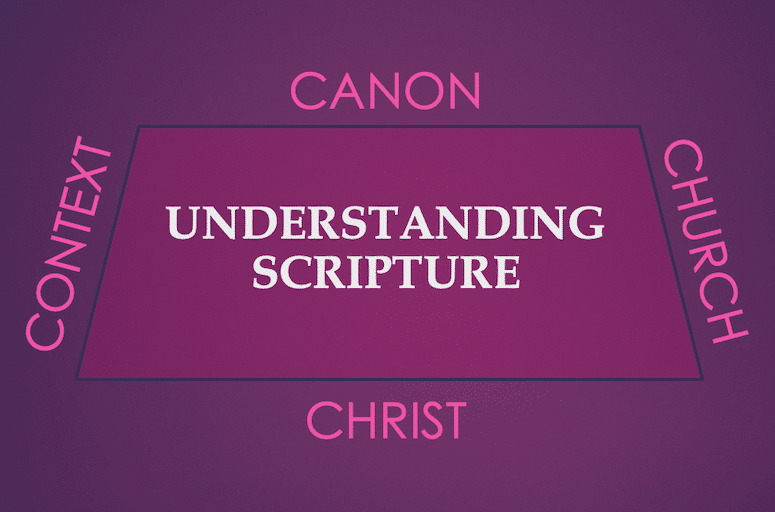
I’ll propose here that we need four essential sources for good biblical interpretation. When we lack any of these, our interpretations go askew. Those four: Context, Canon, Christ, Church.

Context

N. T. Wright has observed that some take a “skin-deep-only appeal to ‘contextual readings,’ as though by murmuring the magic word ‘context’ one is allowed to hold the meaning and relevance of the text at arm’s length.” [note]Scripture and the Authority of God, p. 111[/note]

As David Watson says in response to anyone who claims they can’t believe something in the Bible because it reflects an ancient worldview: “The whole Bible reflects an ancient worldview. There’s not one word of Scripture that doesn’t reflect an ancient worldview.” [note]See it in this excellent short video: “How Not to Deal with the Challenging Parts of Scripture”[/note] We can’t be excused for dismissing the entire Bible because of its ancient context, but neither can we overlook it.

The biggest problem with neglecting a passage’s cultural context is that we ignore our own context in the process. We forget that we may be reading into a text something entirely different from its intent.

All texts had a particular author, setting, genre, and purpose. Ignoring those can lead us to false and unnecessary conclusions. Ignore the context of Genesis 1 and you may treat it as a science textbook. Ignore the context of discussions about slavery and polygamy and you may assume that these discussions are endorsements. This is what we typically regard as fundamentalism.

God has acted in history, including in the historical writing and reception of these texts. We need to understand them in those historical contexts to understand them well.

Canon

I’ve argued for canonical reading in various forms in the previous two posts. This beautiful quote from John Wesley demonstrates a reverence for the whole scriptural canon as a word from the living God:

Concerning the Scriptures in general, it may be observed, the word of the living God, which directed the first patriarchs also, was, in the time of Moses, committed to writing. To this were added, in several succeeding generations, the inspired writings of the other prophets. Afterward, what the Son of God preached, and the Holy Ghost spake by the apostles, the apostles and evangelists wrote.

This is what we now style the Holy Scripture: this is that word of God which remaineth for ever: of which, though heaven and earth pass away, one jot or tittle shall not pass away. The Scripture therefore of the Old and New Testament, is a most solid and precious system of Divine truth. Every part thereof is worthy of God; and all together are one entire body, wherein is no defect, no excess. It is the fountain of heavenly wisdom, which they who are able to taste, prefer to all writings of men, however wise, or learned, or holy.

from Explanatory Notes Upon the New Testament, Introduction, par. 10.

Some people in the UMC have since suggested that it’s unnecessary to read the biblical canon as divine revelation. They point to our Doctrinal Standards[note]rejecting any of Wesley’s Works as binding and ignoring them as informative[/note] that say only that the biblical canon reveals the Word of God, thereby giving themselves liberty to choose which Scriptures are revelation and which are not.

This won’t do. Without a view of Scripture as the Word of God, we make ourselves arbiters of truth and use the Bible when we find it helpful. We approach the Bible with an historical-critical view that allows us to stand as an authority over the text and its authors rather than to sit under their authority.

We may even make claims to a christological reading, but so long as we give ourselves permission to choose which texts are human and which divine, we’ll inevitably create a Jesus who looks a lot like us. The frequent criticism of historical Jesus scholars (those who are identifying what the real, human Jesus was like) is that they look down a deep well to find the truth about Jesus and see a very familiar face staring back up at them.

Just as dismissal of context leads to a fundamentalist reading, dismissal of canon leads to a subjective reading, where our feelings and opinions overrule anything displeasing we encounter in the Bible.

Part of Scripture’s historical context in the Church is that it has been written and read as divine revelation. To read it as anything less will surely lead us astray.

Christ

I made a more extended case for christological reading in the last post. I’ll reemphasize that when we read with Christ as our lens, it does not mean our construction of the historical Jesus is the final judge of what’s true in Scripture. Instead, we read every letter of Scripture as one directed to Christ and finding fulfillment in him.

When we read christologically, we read the Bible not as stories but as a story––the story of God’s creating, redeeming, and sustaining action in our world, and particularly through Jesus Christ. Neglect a christological reading and we’ll end up with a secular reading––one focused on good stories and morals or interesting history.

Church

Finally, we must read Scripture in and with the Church. The Christian faith is an apostolic faith, come down to us through the proclamation of those who came before us. They met in ecumenical councils and developed creeds which served as a rule of faith, a means of reading Scripture through the lens of the Christian faith.

When we read the Bible as God’s living Word for us, we read it acknowledging that this Word has spoken to and shaped centuries of believers before us and a global population of believers around us. To read the Bible well, we can’t read alone. We need to read with the whole communion of saints––those who have gone before us and those all around us.

When we dismiss the teaching of the historic church and the reading of the global church, we risk an individualist reading. That individualist reading could be the reading of a solitary person or the reading of an isolated group. It comes whenever we only listen to the voices most like us and most in agreement with us and dismiss the rest.

Contextual, Canonical, Christological, and Communal

So I want to suggest that we must read with all of these as essential sources. That doesn’t make our biblical interpretation easy. We prefer simple explanations and easy solutions––the kind that would fit on a bumper sticker. As H. L. Mencken reminds us: “Explanations exist; they have existed for all time; there is always a well-known solution to every human problem — neat, plausible, and wrong.”

When we dismiss whatever parts we don’t like, we can find those neat, plausible, and wrong solutions. Much more difficult is the task of holding these four together and managing the tensions they present. But when we fail to hold these in tension, our biblical interpretation falls to the control of fundamentalism, subjectivism, secularism, or individualism.

Everything should be as simple as possible, but no simpler. As simple as possible in biblical interpretation means we must engage context, canon, Christ, and Church.

If you’re interested in more, I highly recommend David Watson’s article “On the Authority of Scripture” and his book Scripture and the Life of God, which deal with many of the same themes (and many more) in much greater detail.

Two Brief Postscripts

Barth’s Threefold Word of God

You can see something similar to Karl Barth’s doctrine of the Word of God here. Barth spoke of a threefold nature of the Word of God––Scripture, Jesus, and the proclamation of the Church. These cannot be separated. Scripture is the written Word of God; Jesus is the revealed Word of God; the Church’s preaching is the proclaimed Word of God. We cannot know them apart from one another.

Barth understood these according to the Trinity: “There is only one analogy to this doctrine of the Word of God […] This is the doctrine of the triunity of God.” [note]In Church Dogmatics I.1[/note] To those who dismiss either the biblical canon or the Church’s historical teaching as Word of God, Barth would say they cannot properly understand Jesus (whom they claim as the Word of God).

By the Power of the Spirit

I didn’t include the Holy Spirit as a source for biblical interpretation. That didn’t seem the right category. But we believe the Spirit is essential for us to receive and understand God’s Word to us. Again, Barth’s treatment is profound and helpful. He spoke of Scripture as becoming the Word of God for us by the power of the Holy Spirit. Only by the inspiration of the Spirit do we receive the Bible as God’s Word. Only by the power of the Spirit can we receive Christ. Only by the gift of the Spirit do we continue to teach, proclaim, and hear the Word of God.

Some people have taken Barth’s claims as an opportunity to suggest that the Bible is less than the divinely inspired Word of God. That was not his intent and ignores his clear claim that Scripture is the written Word of God.