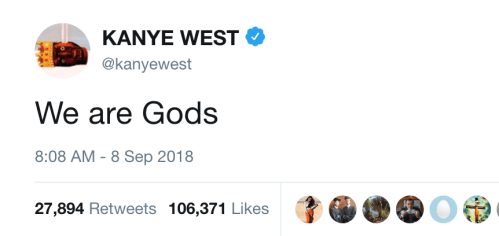
“We are gods.” What if Kanye is right?


Kanye West tweeted something that many of Christianity’s greatest theologians would agree with…


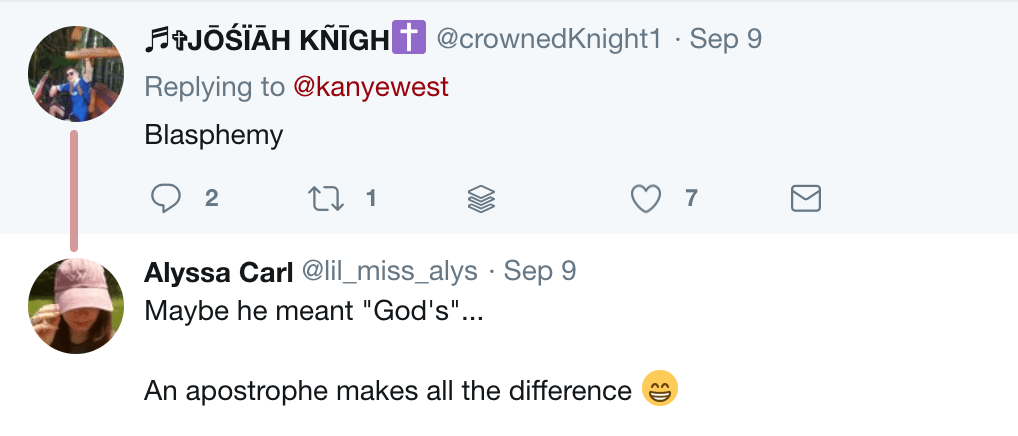
And Christian–or at least theistic–tweeters rebuked him…



To be clear, I doubt Kanye intended what those Christian theologians intended when they said the same. But what if his words were actually orthodox Christian belief?[note]Best to make that “g” lower case[/note] It’s a belief that we’ve mostly lost along the way, and as a result, we’ve lost a lot of the richness and depth of Christian experience. Let’s take a quick look at our relationship to God, as depicted in the Bible and the early church.

Sharing in the Life of the Father

Jesus tells a parable many refer to as the Parable of the Prodigal Son.[note]Find it in Luke 15:11-32[/note] A son asks his father for his inheritance, then leaves his father’s house and squanders it all. He ends up so destitute that he longs to eat even pig slop. Finally, he returns to his father, hoping to receive a position as a servant in his house. The father receives him back, but as his son, not a servant. And the father throws a feast. His son has returned—kill the fattened calf!

The story closes with the father consoling his other son, who refuses to come in to the feast. The older son is upset—how could his father have a feast for the one who squandered his inheritance when this obedient son has never even had a young goat for a party with his friends? The father responds, “You are always with me, and everything I have is yours.”[note]Do you recognize that? It sounds a lot like when Jesus says, “All that belongs to the Father is mine.”[/note]

Neither son has understood his real inheritance. It’s not what they can receive from their father to enjoy on their own. The inheritance begins now—it’s sharing at the feast of the father! Everything he has is theirs! Now!

This makes me wonder if I usually look for God’s “blessings” in the wrong places. I look for how God is benefiting me, making my life better, providing the right opportunities. These “blessings” are about what I can receive from God to enrich my own life. Like the brothers in that parable, I may misunderstand the real inheritance when I watch for these as God’s blessings.

What a wonder! God invites us to participate in the divine life as his children. He invites us to his table. He invites us to share everything he has.

An important distinction: the inheritance isn’t just to take what the Father gives, but to share what the Father has.

If our real inheritance is to share what our Father has, it means we can share in God’s perfect love and holiness and joy and peace. We share in God’s divine nature.

Union with God?

This is where some theologians have talked about a sort of union with God that would sound unthinkable to many Christians. One of the greatest early Church Fathers wrote, “If the Word became a man, it was so men may become gods.”[note]From Irenaeus in the preface of Book V in Against Heresies. To be sure, this is the universal use of “men,” males and females are included equally in it.[/note]

Did you gasp reading that? We might be quick to respond, “There is no God but one!” We are creatures, not the Creator.[note]The difference between God (Father, Son, and Spirit) and humanity is that the Father eternally begets the Son and brings forth the Spirit from his very own substance. But God created humanity in time from nothing. We retain our human nature, even if we might be called “gods” or “one with God” as we participate in the divine nature.[/note]

That will never change. Those theologians would certainly agree. But we can become so united to God that we share God’s will and thoughts and actions. We can be so united to God that we become holy as God is holy. One New Testament letter refers to this as “participating in the divine nature” (2 Peter 1:4).

In Mere Christianity, C. S. Lewis comments on it like this:

The command Be ye perfect is not idealistic gas. Nor is it a command to do the impossible. He is going to make us into creatures that can obey that command. He said (in the Bible) that we were “gods”[note]A note: God really does call people “gods” in the Bible. You can see this in Psalm 82, and then as Jesus refers to it in John 10:34-35.[/note] and He is going to make good His words.[note]On page 205 of the 2001 HarperCollins edition.[/note]

Notice how much more this is than the standard ways we think of life with God. Some people talk about “inviting God into your life” or a “God-shaped hole” that reveals our need for God. But God’s invitation goes infinitely beyond his entering into our small lives or filling some particular hole or desire in our lives. Instead, God’s invitation is that we would come into his divine life. This doesn’t so much fill a particular hole as it consumes the whole of us. It consumes the whole of us to the point that we would be called fully God’s, and by being God’s, we would actually be called <gasp> “gods.”

An early Christian theologian named Augustine famously wrote of God, “You have formed us for yourself, and our hearts are restless till they find rest in you.”[note]From the first paragraph of Book I in The Confessions.[/note] He didn’t say our hearts are restless until they find a place for God, as if we should have God take a seat at our table. Instead, our hearts are restless until they find rest in God, until we are seated at the very table of God.

The problem when we decide to have life our way isn’t just that it’s sin—some sort of disobedience to our Father. The greater tragedy is that while we indulge our small desires, it’s as if we’ve chosen pig slop when we could instead be feasting at the table of God.

What if Kanye is right?


If you’re going to follow the Billy Graham Rule …

In his autobiography, Billy Graham writes about a group of evangelists who recognized the serious threat of sexual immorality. This could be a special threat for men (these were all men) who were traveling and separated from their families. So they all pledged “to avoid any situation that would have even the appearance of compromise or suspicion.”

“From that day on,” Graham writes, “I did not travel, meet, or eat alone with a woman other than my wife.”[1] This has become known as the “Billy Graham Rule.” It came into popular discussion recently when the Vice President said that he keeps the same boundaries. Now it’s back in popular discussion because people have contrasted Pence with Harvey Weinstein.

Let’s first acknowledge the noble intent in the Billy Graham Rule. I’m tired of the headlines about sexual immorality involving Christian leaders. You are, too, I’m sure. One study had 38.6 percent of clergy admitting to some “sexual contact” with a parishioner, 12.7 percent admitting to sexual intercourse.[2] Those numbers terrify me. I don’t want to believe them. Let’s be thankful for a group of leaders who resolved to not become one of those headlines or statistics.

We can also acknowledge that a meeting or meal alone isn’t the root problem here. Some people have built straw men on this point, then kicked them over with self-righteous vigor. “I can go to lunch and keep my pants on.” Yes—and we congratulate you for that. The meal isn’t the problem. There are surely some deeper issues of accountability, the state of the heart, etc. But it’s probably true that being alone in one setting makes it easier to be alone in another—a slippery-slope, if you will.

Also, being alone develops intimacy. And intimacy can lead to sexual attraction. And sexual attraction is one of the leading causes of sex. But again, we shouldn’t confuse intimacy for the root problem here. We shouldn’t confuse intimacy for a problem here. We’re created for intimacy. Even, dare I say, with people we may find attractive.

The Billy Graham Rule doesn’t deal with the root problems of accountability and lust and the state of the heart. But I bet it has prevented some people from falling into inappropriate sexual relationships over time. Let’s not condemn it through and through.

The problem with the Billy Graham Rule is the way it puts women at a severe disadvantage in any majority-male industry (or vice versa). A lot happens during a meal or a one-on-one meeting or a car ride—planning, mentoring, trust- and camaraderie-building. As many decisions are made at lunch tables as in conference rooms. They may become official in the conference room, but they really happened at lunch. The man who can go to lunch with his boss gets an edge over the woman who can’t (or vice versa, again).

So what do we do? I’m not ready to write off the Billy Graham Rule for everyone. Though I think there are deeper issues at root, ones that I’d like us to get to, I expect this Rule has been helpful, even necessary, for some men and women. I don’t follow the Billy Graham Rule myself, nor do I advocate it for others. But if a person thinks it a good buffer, I don’t want to discourage them from it.

Here’s a different option for anyone who thinks they should stick to the Rule: make the Rule universal, not gender-specific. Don’t do one-on-one meals or meetings or travel with any colleague, male or female. Find ways to keep all of these interactions in a group setting. You probably don’t love that idea. But right now, you’re denying important opportunities to people because of their gender. You can’t do that. Follow the Rule with everyone or get rid of it altogether.

Regardless of whether you follow this Rule or not, more important to get serious about those root issues. How are your systems of accountability? How’s your heart? Who are you talking to about any of the vices that may be taking root in your life?

——–

[1] Just As I Am, p. 128.

[2] This was a survey of 300 pastors in Richard Allen Blackmon’s The Hazards of Ministry (1984), a Ph.D. dissertation for Fuller Theological Seminary. It was a long time ago. Several other follow-up studies had similar results. I’d like to believe the numbers would be lower today, but haven’t found a good recent study to cite.

Theology and Sex: Do we write a Three Views book or a new creed?

Earlier this week, Tim Tennent posted an excellent article to distinguish perspectives and positions in theology. If you haven’t already read it, you should go do that. You might notice my comment at the bottom of the post. I build on that below.

Here I’m going to: (1) summarize how Tennent defines perspectives and positions and draw some logical conclusions for the church, (2) note how these categories should alter what I wrote last week on the UMC Divide, (3) ask whether human sexuality is a theological perspective or position, and (4) make a note on the crisis of authority in the post-Reformation Church.

A Summary of Perspectives and Positions according to Tennent

Theological perspectives allow for a “generous orthodoxy” (my words). We have different views about these matters, but we’re not calling anyone a heretic or unChristian for disagreeing.[1] Want to see all the sides of one of these debates? Zondervan has made a whole series for it––31 volumes. You can get Four Views on HellFive Views on the Church and PoliticsTwo Views on Women in Ministryor even Four Views on God and Canaanite Genocide.

While we celebrate that “generous orthodoxy” regarding perspectives, we allow no such variance for our positions. These are the core doctrines of the faith, “matters where the church has historically spoken with a single voice,” according to Tennent. You hopefully won’t find Two Views on Whether the Son was Created or Three Views on Christ’s Nature: Human, Divine, or Both? That’s because these matters are settled in the church. The early church convened councils, wrote creeds, and excommunicated people over them.

If someone teaches a belief contrary to a Christian position, there is no room for “generous orthodoxy.” We’re dealing with heterodoxy or heresy. The proper response isn’t to write a Three Views book, it’s to correct or excommunicate the heretic.

Perspectives, Positions, Sex, and the UMC Divide

Given the current controversy in the American church and especially the United Methodist Church, the elephant in the room throughout Tennent’s article is our theology of human sexuality. Which category does it belong to––perspective or position? Though the article doesn’t mention human sexuality directly, readers surely glanced in the elephant’s direction while they read this line in a paragraph on core doctrines: “We are told that we are ‘on the wrong side of history’ and we should ‘get with the times.'”[2]

Whether we treat this as a matter of perspective or position will change every aspect of how we handle this controversy. A few people took issue with the comparisons in my last post between United Methodists who flout our stance on baptism and those who flout our stance on same-sex marriage. To use Tennent’s definitions, I believe they were arguing that one is a perspective (generous orthodoxy!), the other a position (heresy!) That misses the point, as I was comparing the two regarding fidelity, not doctrine. If covenant matters, then all of the covenant matters.[3]

Though the categories of perspective and position don’t change that part of my post, they do draw two other parts into question.

1 – I listed several areas where a United Methodist church and clergyperson would be expected to keep covenant. That list is a medley of the two categories. It includes perspectives like women in ministry, itineracy, and baptism practices.[4] It also includes United Methodist doctrine, which in itself is part perspective (e.g. Wesleyan soteriology) and part position (e.g. the bodily resurrection).

Underneath that list, I said, “These questions do not ask for full agreement, only obedience.” That was a statement too broad for a medley of perspectives and positions. You don’t have to fully agree on itineracy, just obey. But on the eternal divinity of Christ, you must agree.

The denominational perspectives require obedience for the sake of fidelity.
The positions require agreement for the sake of orthodoxy.

The other item I included in that list was same-sex marriage. Is it a perspective that requires obedience or a position that requires agreement? This brings another part of my post into question.

2 – I said that I believe the church needs dissenters who will keep dissenting. I included those with different views on same-sex marriage as needed dissenters. If this is a perspective, then we should welcome appropriate debate on the issue. If it’s a position, then as Tennent says, it is “not a point of discussion;” debate and disagreement about same-sex marriage should be tolerated no more than Arianism.

I treated our debate over same-sex marriage as a matter of perspective, not as a matter of position. (Or at least, not as a matter so settled as to close the door on discussion.)

Is our theology of human sexuality perspective or position?

If we say this is a perspective, we can keep full communion, even while differing on this matter of theology.[5] But we’ll have to answer why the church’s consistent historical position on sexuality has come back up for debate. If the church has always taught sex as unitive (uniting two into one flesh) and procreative––prohibiting it whenever it didn’t have these two meanings––what permits us to question these now? Could historical teaching on Christ’s humanity or eternal divinity also come back into play?

If we call this a position, we’ll say the church has historically spoken with a single voice. This is not a point of discussion. We cannot keep full communion with those who disagree. They’re not orthodox Christians. But if we rely on tradition here, we’ll have to answer how the situation is different from as recent as the 15th century, when women’s ordination and the confessional view of baptism looked much closer to prohibited positions than permissible perspectives. Moreover, we’ll need to answer whether Protestant churches have truly held to the historical position of the church––that sex must have a unitive and procreative meaning. The Roman Catholic Church would surely argue that our perspective on contraception is a violation of the church’s historical position on sexuality.

I don’t conclude here with an answer. Tennent’s post has given me helpful categories to name my confusion. I’m a traditionalist on human sexuality. From Scripture and the church’s tradition, I’m convinced that sex is properly unitive and procreative. But I’m unsure whether I can call this a perspective or a position. The difference is glaring. Do we write a Two Views book with each other (it’s already out there), or do we say this is no point of discussion and correct or excommunicate the heretic?

The Crisis of Church Authority

Most of the church’s major theological crises were settled when there was a definable church. Then, as now, they did not have one side arguing from the Bible and another denying the Bible. Instead, they had two sides arguing their position from the Bible. They were able to convene ecumenical councils as one body, identify orthodox belief and heresy, and write creeds that specified Christian belief.

A theological crisis like this over human sexuality reveals the trouble with church authority after the Reformation. A denomination can convene a council, but that council speaks for the denomination, not for the Church universal. A council speaking for a denomination is, by definition, clarifying a perspective, not a position. Without an ecumenical council, where do we go to confirm and clarify positions in question?

I write about theology, ministry and the UMC, usually about twice a week. Click here to subscribe by email.

I don’t have comments here any more. If you’d like to discuss it with friends, share it with them and discuss. If you’d like to discuss it with me, send me an email. I’d love to hear from you.

[1] Well, most of us aren’t, anyway.
[2] When I run a Google search for “wrong side of history” and “church,” six of the first seven articles are about human sexuality.
[3] For a better direct comparison between doctrinal points, see my discussion of our treatment of human sexuality in relation to same-sex marriage.
[4] That we would include baptism as a perspective is especially interesting, and almost all of us would. Tennent supports this by saying that both views of baptism have theological arguments to support them and that historically, “the church has not found common ground on every aspect of baptism.” We can certainly say this today, but could 15th century theologians have said the same? Or would they have called baptism (or at least infant baptism) a matter “where the church has historically spoken with a single voice”––a position?
[5] This point especially comes into focus as the UMC and The Episcopal Church discuss full communion.