I’ve been receiving various questions from readers. I promised to try to answer some of them in a series of posts. I chose two questions that are poles apart for part I. I’ll have several more to get to in part II. And please feel free to email me yours.
“My question is 3-fold:
1) Do you personally believe our salvation is conditional according to the Scriptures?
2) In your view, what Scriptures support this stance?
3) How to maintain our salvation then?”
Someone who says she has “just been persuaded of this position” sent that question. As a result, she said she joined the Methodist Church last week.
Yes! I do believe our salvation is conditional. In fact, I think that’s good news. This is a place where I disagree with my Reformed/Calvinist friends. (And yes, they are friends. We can disagree without animosity.)
No small amount has been written on this subject. Rather than write a whole booklet, as Wesley did, or an entire book, like this from Walls and Dongell, let me give you my simple version.
We start here:
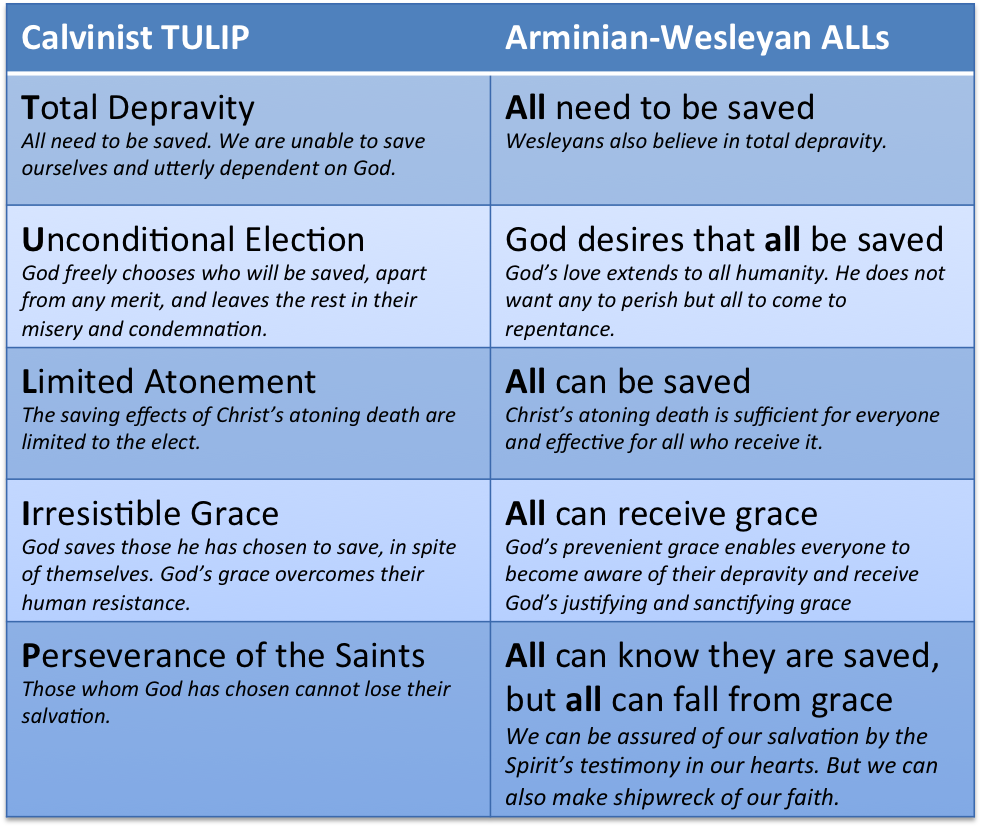
1. God “desires everyone to be saved and to come to the knowledge of the truth” (1 Timothy 2:4).
My Calvinist friends begin to object here. They want to qualify that “everyone.” In their framework, God gets whatever God desires. It doesn’t make sense to them that an Almighty God could desire something that doesn’t happen. So they claim “everyone” means every people group, not every individual. But the same Calvinist friends also say that if you read the Bible at face value, you have to agree with them. So let’s acknowledge at the start that we’re all qualifying certain statements in Scripture. And to qualify “all” and “everyone” is no minor nuance.
2. Everyone can be saved. We have a mediator, Christ Jesus, “who gave himself a ransom for all” (1 Timothy 2:6) “so that by the grace of God he might taste death for everyone” (Hebrews 2:9). His atoning death is sufficient for all to be saved.
More of that pesky “all” and “everyone” language. See my note above.
3. Not everyone is saved. The biblical witness is clear on this.
I believe this is what has run aground several of my Calvinist friends. By their logic, God would save all whom he desires to save. That leads them to two options: universalism (everyone will be saved) or limited atonement (Christ did not die for everyone).
4. Everyone who believes is saved. Christ’s atoning death is effective for all who accept it.
That is to say, Christ’s atoning death is universallysufficient (see #2) but conditionally effective.
Here’s how Paul put that condition: “If you confess with your lips that Jesus is Lord and believe in your heart that God raised him from the dead,” [a break to note that this is, by definition, a conditional clause] “you will be saved” (Romans 10:9).
Paul lays out the conditions of salvation plainly in Acts 20:21: “turn to God in repentance and have faith in our Lord Jesus.” If we accept that much, we should spend some serious time looking into repentance and faith. What do those words mean in Scripture and the Christian tradition? I said “everyone who believes is saved” above. Please don’t accept that for the simple, “Sure, I believe in Jesus” faith common in our culture. Repentance and faith mean much more.
That’s a start. I could point to many more passages, along with most of the Christian tradition, on these points. My Calvinist friends will, of course, have opposing verses to share. I’ll not attempt a full defense of those here. They don’t deny #3 above, and I believe their arguments against #1 and #2 are strained. I believe the witness of Scripture, the Christian tradition, and our own experience all favor a view of salvation as conditional.
To your final question about how we maintain our salvation… Be alert, on guard, disciplined! Because the devil prowls like a roaring lion, looking for someone to devour. Practically, I’d especially encourage those means of grace encouraged throughout Scripture and church history: participate in the life of the Church and its sacraments, search the Scriptures, pray and fast.
The notion that we could lose our salvation may scare people. But it shouldn’t need to instill more than a healthy fear. God is good, and God is faithful. The faithful married person, for instance, doesn’t go around in constant fear that their loving spouse will leave them. But they also know that they’re not guaranteed security in that relationship if they’re unfaithful. Just as the devil can entice you to be unfaithful to your spouse, he can entice you to be unfaithful to your God. Both of those infidelities can lead to shipwreck. We need to be vigilant! But we needn’t be afraid.
“You’ve written several things about pastors’ salaries and talked about being paid part-time. But you also have a coffee shop where I assume you make money. For full-time UMC pastors, that’s not an option. Do you think that difference should be part of the equation?”
That’s a good point. I hear this has been a conversation for some pastors in my conference, so I think it’s best for me to be transparent. I know this kind of public discussion of personal finances can seem distasteful, so I’ve hesitated to do it. If it’s in bad taste to you, you might just stop now.
I am a partner in a coffee shop here in Lexington––a fun little venture. Two quick notes about your question, though: 1) I’ve been talking and writing about pastors’ salaries since before that shop existed, and 2) I’m not an employee. The UMC prohibits full-time pastors from working other jobs, but they don’t prohibit pastors from being partners. So that particular venture hasn’t influenced what I’m saying, and it’s a possibility for other UMC pastors, too. I’d encourage it for more pastors, actually. It has been a good learning opportunity and a different way to bless the community and be involved in it.
As for finances, between the church, the coffee shop, and a few other small sources of income, my total income is about $21,000 less than our conference’s minimum package.[note]That number will decrease next year––my church is giving me a generous raise.[/note] That coffee shop might be able to replace my income one day, and I’d celebrate that. But for now, it’s just a nice supplement.
I could stop there, but I should also acknowledge our family has had other advantages. Our parents have been very good to us––we rarely pay for babysitting, get to go on family trips that we don’t pay for, regularly receive clothes and other things for the kids, and even got our first mini-van from them. When we went to Spain, 40% of our cost for the year was covered by the generosity of our church, family, and friends. I was also able to work the whole time I was in seminary and paid as I went. No seminary debt has been a huge advantage.
We have a number of advantages and unique circumstances. In all, though, I don’t think our situation prevents me from being able to speak about clergy pay.
Note that I’ve never called anyone else to receive less than full-time minimum or claimed that our minimum-paid pastors are making too much. I have asked, for the sake of integrity, that we quit acting like our pastors live like paupers. Even our minimum-compensation pastors are in the top 27% of all U.S. income earners,[note]That figure includes their housing, as I’ve argued it should.[/note] with a very generous retirement and insurance plan on top. The average pastor in Kentucky is in the top 14%, and our director-level positions are in the top 8%. I would venture that never in Methodism’s history have our pastors been so highly compensated relative to our society.[note]I haven’t run all the numbers on this, but see the chart in my interview with Wesley Sanders for a representative sample.[/note]
Our pastors are good people. They work hard and have hard jobs. In the business world, many of them might be highly compensated for their work and talent. But the church is a different entity, and the church’s offering is no ordinary source of revenues. If John Wesley himself were among our highest-paid UMC pastors, I would be questioning his pay. Though I doubt I would need to. I think his voice on this issue would make mine sound weak and soft.
I recently had the honor to interview Thomas Jay Oord about his newest book, The Uncontrolling Love of God: An Open and Relational Account of Providence. [1. Dr. Oord is a leading theologian advocating something known as open theism. I don’t adhere to open theism and don’t agree with all of Dr. Oord’s positions. My interview with him (and with any others) is no full endorsement of his views, but an endorsement of someone whose work merits attention, even if I don’t agree with it all. You can also see this post by Roger Olson for the most cogent criticism of the book that I’ve seen (though it is more technical than what you’ll find below and the disclaimers at the beginning will be unnecessary for most––see the part on miracles for his most useful commentary)]
Our interview focuses on a question we’ve all asked: How can a good and loving God allow the kinds of evil and tragedy we see in the world today. Dr. Oord deals with difficult and often controversial issues. He was right at the center of controversy you may have heard of this spring when Nazareth Nazarene University laid him off. We discuss that in the interview, as well.
Teddy Ray: I’m here today with Thomas Jay Oord. He is a theologian and philosopher. He’s actually written and edited over 20 books, and he’s just about to come out with his newest book. It comes out on December 9th, and it’s called The Uncontrolling Love of God. This is a book that tackles questions that probably a few of us have asked. It’s about the problem of evil and random tragedy and trying to find some different solutions to some of those problems, so Dr. Oord thanks for being here with me today.
Thomas Jay Oord: Hey, you’re welcome. It’s good to talk with you.
TR: Before we really get into some of the questions about the book, I just wanted to thank you and compliment you on the way that you write. You wrote something really interesting and accessible and the kind of thing that I can actually hand to a friend and say, “Hey, you will enjoy this, and you’ll understand it.” I’ve become so frustrated with a bunch of our great theological thinkers who are saying really important things but I know I can’t hand what they’re saying to almost anyone, and so I appreciate that you’ve been able to do that. Thank you. I’m sure that’s something that is a really intentional thing for you.
TO: It is. It’s a major compliment for you to tell me that because I’ve worked very hard at that, and I’ve had the same kinds of frustrations that you’ve just expressed. So I’ve worked hard on my prose. I actually got to thinking about this fairly early in my career after I finished my PhD trying to tell people what my dissertation was about and why it mattered. And then I took a job as a newspaper reporter for a science and theology news and I realized I had to change the way I wrote so that people could grasp the concepts. So I’ve been working at it for a while, so it’s gratifying to hear you say that I’ve been at least partially successful.
TR: Yeah absolutely. I really appreciated that.
Well let me go ahead and ask: You are constantly asking questions about some of the hardest and most controversial topics. What draws you to thinking and writing about these kinds of subjects?
TO: Probably, I have those questions myself. I think that part of the Christian task, or at the very center of the Christian task is the issues of love. Not only loving others and loving ourselves and loving God but loving that’s with our whole being, which includes our minds, which includes asking the difficult questions, expressing the doubts, trying to find plausible answers. And I find that far too many Christians are afraid of those difficult answers and feel too uncomfortable, and I want to pursue them in the hope that I can have some satisfying explanation for what I think, and to give an account of the hope that I have in Christ Jesus.
TR: And so this particular book, I think maybe the summary of the reason you wrote this book: you wrote, “I believe it is impossible to worship wholeheartedly a God who loves half-heartedly.” And that seemed to just sum up so much of what you’re talking about.
TO:Yeah yeah. I want to be full-out in my love for God as well. And that means, as I understand it at least, worship is at least in part an act of love. And if I have some real doubts about God being steadfast in loving, then I have some real difficulty in giving my whole heart, giving my whole devotion to a God who just doesn’t seem to be, perhaps, at least in the way some theologians talk about God, perhaps isn’t entirely loving.
TR: And so what you’ve done is you laid out for a number of chapters these are all my problems with understanding a God that we’ve seen in this way—that either allows evil, or even in some cases is the cause of that evil. And you went in a different direction, and you talk about something, your solution in two words is essential kenosis. Could you explain what you mean by essential kenosis when you say that’s the solution to the problem of evil?
TO: Sure. Let me begin by thanking you for noting these issues of God causing or allowing evil. You know, there are some theological traditions that have God being the ultimate cause and the primal cause of everything. This sort of hardcore theological determinism. But most Christians don’t really buy into that view. Most Christians think God doesn’t really cause these bad things. God didn’t cause would happened in Paris this past weekend, but rather God allowed that. God had the kind of power to prevent it, but for some mysterious reason God allowed this suffering.
And then there’s been a reaction to that that is trying to say, “Hold on a second. This doesn’t make a lot of sense. Why would a loving God allow the horrors we saw last weekend?” Or just start naming all the incredibly painful things that have happened in history, let alone our own personal lives. And so there are some Christians who have re-thought God’s power in a way that make it sound as if there’s some kind of external constraints upon God, some kind of laws or forces or other beings or other gods, and God is constrained by these external factors.
Essential kenosis says there are some real constraints on God’s power. There are some things God cannot do. But those things derive from God’s own nature. Kenosis, as you know, and probably most of your listeners know, is mentioned in several places in Scripture, but it’s most prominent in the Philippians passage. It talks about God as being revealed in Christ Jesus. And I like to call it this self-giving, others-empowering love.
And so, the heart of my notion is that God must give power, agency, self-organization, etcetera, to creation because of God’s nature of love. And God cannot withdraw that, take it away, override it. God cannot control others entirely because of God’s love.
TR: I know some people would hear that and they would say, “So you’re claiming God is not Almighty. We can’t say God Almighty anymore based on what you’re saying.” I don’t think that’s what you’re saying. Can you differentiate?
TO: Well first of all, let me acknowledge that what I’ve just said is going to make some people really uncomfortable. And that’s part of the reason why I think people have been really afraid to re-think God’s power.
I do want to say God is almighty, but of course I have a particular way of thinking about God’s almighty-ness. The Bible is not clear exactly what we mean when we say God is Almighty, but I like to say God is almighty in three senses.
First, God is mightier than any others. Mightier than all others.
Secondly God exerts might upon all others. In other words, we’re all influenced by God’s power.
And then third, God is the source of power for everything that exists. God gives power to others. So God is Almighty in all these three senses without being capable of entirely controlling anyone or anything.
TR: So even when you keep pointing back to God’s nature, the simple example I’m pretty sure you gave in the book was God can’t make a round square, and that’s not because God isn’t almighty, it’s just that it defies simple definitions. And right at the heart of this, this is trying to defy a simple definition of God as love when we say that God would override some of these things. Is that right?
TO: It sounds really strange to some Christians to say that God cannot do some things. If you look carefully at the Christian tradition, in fact the majority of Christian theologians have said God can’t do some things. Most of the time, they’ve put it in the realm of logic. “God can’t be Triune” in 357. God can’t make a rock so big that God can’t lift it. Those kinds of things.
What I do in this book is take this one step further and say, God’s nature is love. God must love. And this love involves certain kinds of activities: Others-empowering, self-giving, and God can’t control because of his nature.
TR: So let’s talk about creation because that’s an interesting place in God’s self-giving love, and you argue God can’t intervene now in any sort of coercive way. Is God’s creation of this world a coercive sort of activity? I think you would probably say this is a self-giving activity from the beginning. And then I would go on and say, so does that mean this is the best creation a loving God could have created?
TO: Excellent question. So I think that God is always creating. And although I don’t explore this particular concept in the book, I have in other books. I think we need to take seriously what seems to me the most straightforward reading of the Bible, which is that God began to create this universe in relation to that which God had created previously. So in other words, I deny the classic Christian doctrine, and Muslim doctrine, of creation out of nothing.
I have the Bible on my side on this one, I like to say. Most biblical scholars would agree that creation out of nothing is not in Genesis. The closest you can get to it is a passage in Second Maccabees. But even that one, most biblical scholars say, isn’t God creating out of absolute nothing.
So as God has always been creating out of that which God previously created, God is always working in relationship with creation. Bringing about something new, yes. But in relation to what came previously.
And because of that, this is not “the best world it could have been,” because creatures are always responding and we all know that all have sinned and fallen short of the glory of God. And so the “perfect world” would be a world in which every creature continuously cooperated with God. We don’t live in that world, and so there could have been a better world, not that God decided not to create that, it’s that we as creatures didn’t respond well to God.
TR: Right, okay. And the other piece that you get into is what you call law-like regularities. So a person gets killed by a rock being flung into her car, and we say, well that was no one’s evil. Nobody did anything. How does that fit, then, in God’s greater loving creation?
TO: Yeah that’s a good question. It’s one I think stumps a lot of people. A lot of people say, “Well, God honors the free will of the terrorists and that’s why God doesn’t stop it.” But you know, the rock example you gave… I don’t think rocks have free will, so what would be wrong with God stopping a rock coming through the air, or even a bullet, for that matter, if it doesn’t involve taking away anyone’s free will?
And so I think the way to handle that is to say that God’s loving presence is throughout all the universe, not just to humans but to non-humans as well: other creatures, inanimate objects, etc. And that love gives existence and being. And because of that love, certain law-like regularities emerge throughout the created order. We tend to call these the laws of nature. Although that category, laws of nature, is highly-contested among scientists, or philosophers and scientists.
But the basic idea is that we see these law-like regularities in the world, and I believe God can’t interrupt those law-like regularities to stop the rock going through the air, or the bullet flying out of the gun because God not only loves humans and other animals, he loves all of creation, and that kind of existence-interruption is not possible for a God of love.
TR: So this leads us straight to miracles. Because I read through this book going, “Okay, so what is he going to say about miracles? He can’t believe in miracles.” And your whole final chapter is saying, “I believe in miracles.” And you walk a really thin line to say you believe miracles happen, but you also are really careful to define those in a particular way. Say something about how in the world we can have miracles based on everything you’ve just said.
TO: So I think the real problem when it comes to miracles is not the idea that miracles can occur, it’s the idea of why only some miracles occur, and not a whole lot more, or what I call the problem of selective miracles.
I’ve been a part of church since I was a young boy, and we’ve come and prayed in small groups, or gone to the altar. We’ve poured oil over people, we’ve prayed for healing, and a very small percentage of those people we pray for are actually healed.
We pray for miracles to help people out of financial difficulties, and a fairly small percentage of people really get back on their feet. So yes, miracles occur, but not nearly as often as we would like them to. And so, is God arbitrarily picking some people and some instances to do something powerful and other instances not? I mean, that’s a real big issue.
So what I say in this chapter is that miracles should be understood as having three fundamental parts: One, miracles are good things. Not just any old event that that happens is a miracle. It has to be some sort of goodness involved in it.
Secondly, it’s unexpected. Unusual, I should say. By unusual, I mean it’s not just your everyday kind of occurrence. Some people say all of life is a miracle. I say no, Christians have typically identified miracles as instances that are uncommon.
And third, and the big one, is that I think miracles occur because of special divine action in relation to creation. And by special I don’t mean that God totally controls or intervenes or overrides, but that God acts in special ways in relation to what’s possible in the situation. But there must be some positive creaturely response, whether that’s free will agents or other organisms or things involved in that.
So as I look at Scripture, the vast majority of Jesus’ miracles are done in relation to humans. And just about every story has some statement about a cooperative element, either the faith of the person healed or the faith of the friends or something like that.
Also when I look at history in terms of the miracles reported since Scripture, or even prior to that, the vast majority are miracles related to humans and organisms that have the capacity to cooperate or not cooperate.
Now it gets a little more difficult, I will be honest, when we talk about so-called nature miracles. Because when Jesus calms the wind and the waves, I don’t think wind and waves have free will. So here I appeal to chaos theory, to quantum physics, and some of those kinds of ideas to propose some ways in which such miracles, rare as they are, can occur without God totally controlling the elements involved. But I admit that it’s harder for us to imagine that scenario. Of course, it’s also far, far, far more rare to have these kinds of nature miracles, so I don’t feel like I have a huge burden to carry on that one. But that’s how I’m affirming miracles despite God not having all-controlling power.
TR: That makes sense. And I can imagine that your biggest difficulty is going to be people who say, “So water into wine. There were people who cooperated, but how did that not violate a law-like regularity in our world?” Water doesn’t turn into wine, no matter how many people cooperate with pouring the water into the right buckets and all of that. But you’re right, too, to say, “Those are few and far between.” There are a few, but it did seem to me in reading that’s still the biggest loophole is what do we do with these? And you acknowledge that. These are the most difficult to deal with.
I think the other thing that a lot of people I know would be most skeptical of, actually I can just say directly that I get most skeptical of, whenever I hear something that sounds like a theological invention, something that’s new—I think at one point you said “I created this solution”—I start to ask a lot of questions. So how did the church and theologians for two thousand years miss it, and now someone’s figured it out. Can you answer some to that?
TO: Yeah, I I can understand that. It might appear like I’m the ultimate in hubris. I have the answer and no one else. I guess I should answer it this way. I don’t think Christians have got it all figured out, not in the past or in the present. I think God is still active. I think there are still big questions. And I think God calls us to creatively engage Scripture, the world we live in, each other, etc., to try to find the most plausible answers to our big questions.
So while I have great respect for the tradition, I think the tradition was wrong on lots of things. I mean, we could probably start naming things we thought they were wrong on in terms of social issues like ordaining women, slavery, whatever. But also on some theological issues. I think the tradition was wrong in affirming this strong divine impassibility. There are some voices in the tradition that I think characterize creaturely freedom in ways that make it very difficult not to see how God is controlling things. So obviously not everyone in the tradition had that view, but there are definitely voices there.
So while I have respect for the tradition, I feel like there are big questions still looking for answers. And I feel compelled to try to find those.
What I propose I’m not saying is the definite absolute truth. But I am arguing that I find what I’m proposing, and so do a lot of other people, by the way, more plausible than some of the other answers they’ve heard. So while I want to be humble, I also want to be bold. And that’s what I’m doing in this book.
TR: And to be sure, I think you’ve done a great job of proposing something and saying, “This is new, and I think I’m setting forward something that hasn’t been set forward in quite this way,” without sounding brash about it. You sound humble throughout, even though you’re setting forward something new. So I did appreciate that.
Let me press on to one other subject. You’ve gotten yourself into trouble. You deal with controversial issues. You deal with hard questions. And so just this spring, something came out about your university, Nazareth Nazarene, having layoffs. You were a tenured professor, and it was announced that you were laid-off because of low enrollments. Now most other people don’t really buy that. They think it had to do more with some other theological things. How are you doing now? How are you reflecting on that?
TO: Yeah, it’s been a really painful year and half. It really began a year prior to that, when the President asked me to leave, and I said no. And then, this last spring he laid me off for what I think are dubious reasons, and so do most of my colleagues. My colleagues at the university gave the president a 77% no-confidence vote. And so it’s been a difficult time for me throughout all of this.
I think that if you’re a theologian operating at the cutting edge, your critics will be tempted to use that cutting edge to cut you some. And I think I’ve been cut some over the last year and a half. Now, of course, it’s my choice to live at the cutting edge. Someone might say, “Well, you should expect that, given that you’re there.” And maybe there’s some truth to that, that people are going to take advantage of the precarious positions that I put myself in because I’m asking difficult questions.
But again, I feel called to do this. I feel like this is part of what it means, at least for me as a Christian theologian who’s trying to make sense of Scripture, tradition, reason, experience, trying to make sense of the gospel of Jesus Christ in our contemporary world. This is the task I feel called to. I want to do that in the name of love, as best I can.
TR: I saw something you had written as a reflection on it and was just so impressed. I think you called it, “Ten things I’ve learned about love through this process.” To be able to reflect that way, instead of with anger or bitterness or anything else was really impressive.
One other quick question in that general light: what do we do with confessional schools and scholars on the cutting edge? Is there a place for confessional schools? How do we allow scholars to be on the cutting edge in that sort of environment? Any thoughts on that?
TO: Yeah, that’s a tough one. I’ve been thinking an awful lot about that. In my particular tradition, the Church of the Nazarene, which is a part of the larger Wesleyan tradition, nothing I said expressly went against the doctrines and what we call the articles of faith in the Church of the Nazarene. I affirm all of those. So this was never an issue of me explicitly taking on article 8 or whatever. This was a matter of the way people interpreted what I had to say as being controversial, as being a lightning rod.
And so I’m disappointed that a denomination, or at least some people in the denomination, would want to force those out who agree with the denomination’s articles of faith, but who are asking difficult questions. My view: we ought to have a broad tent and allow diversity in that tent. The scholars in my tradition, even though they may not agree with the particulars of my view, are all 100% behind me in terms of believing that my voice is needed in the tradition.
I think what happens often time, is that people are elected into leadership who don’t have the benefit of a strong theological education and don’t maybe understand the importance of the broad tent and the possibility that people need to have some freedom within that tent. Yeah, we’re going to affirm some very basic things, but we need the freedom to explore.
Just one more quick thing on that. Over and over again people have expressed to me the worry that because of what’s happened to me, many leaders, especially younger leaders, will be fearful of staying within the denomination and want to go elsewhere, where they can have more freedom to ask difficult questions and seek plausible answers. And that really worries me. I don’t think we need to be a place that discourages strong young minds from trying to give an account of the hope that lies within them.
TR: That’s a great point. Something I’ve been talking with other Methodists about even, saying, “How far can I go without getting in trouble?” And just asking some important questions about how far should you go? When is this an important question and when is this just you saying something you didn’t need to say?
Well thank you. I’ll conclude with that. I really appreciate your time today and this opportunity to chat and enjoyed reading the book. So thank you.
TO: Well I appreciate you offering me the opportunity to talk with you and for thinking about these ideas in the book. Obviously I’m putting them out there because I’m hopeful that they will be helpful, not just for me, but for many others who ask difficult questions about evil and randomness in our world.
TR: Well thanks Dr. Oord. I appreciate it so much. Have a good day.
That was Thomas Jay Oord. His newest book is called The Uncontrolling Love of God. It comes out on December 9th. If you’d like to hear a lot more, this was just a basic summary of what he shares in that book. I have an Amazon link on my post here, or you can pick it up in your local bookstore soon.
—————
To be sure you don’t miss the next one, subscribe here to receive future posts.
My deepest gratitude to Jason Huber for producing this. His studio, graphics, and detail work made it possible.
Two people who became some of my closest friends in high school were invited to a youth camp one summer and decided to come. They thought it would be fun but weren’t into the religious stuff––so they made a deal before coming: “We’re not going to ‘get saved.'” Well, on the last night, they “got saved.” Sometimes those last-night camp commitments don’t travel back home well. These did. Those friends went from ordinary teenagers to extraordinary models of virtue and grace. God’s work in them was clear. 17 years later, it still is.
One of the most important mentors in my life––the one who was bold enough to tell me when I was 16 that I was doing the wrong thing if I didn’t go into pastoral ministry––recently chronicled his “conversion chain.” It lists 23 people/groups. None of them are pastors. They’re mostly friends, colleagues, and others he respected. I wonder where I would be if it weren’t for those 23.
I had a college roommate who became a Christian after a friend sent him one of those Christian chain emails (yes, you read that right) and asked him to consider it. God changed his life, and he was a model of devout faith to me through college.
Another dear friend was invited to a Young Life camp and came to faith during that week. He is one of the most thoughtful, sincere, and talented people I know, and God is using him in some pretty spectacular ways (as in––he writes a pastoral column with a readership of a quarter million on a slow week).
Several other friends––too many to count––have less exact and profound stories. For many, they already called themselves Christians, but it didn’t mean much. Then someone invited them into a setting that helped them experience the depth and richness of the Christian faith. They stopped being Christians in name only and became real, full-fledged, transformed followers of Christ.
These are just a few that stand out in the moment. God’s grace has transformed them. And what a celebration to know they’ll be there at that great heavenly banquet!
I hear an occasional story about someone who hit rock bottom, or just sensed that something was missing, and began to consider Christianity on their own. But the much more common story begins with someone who wasn’t really looking––they were just invited and accepted the invitation. Sometimes it was the first invitation, sometimes it was the 23rd.
Is there someone you could call, or email, or text message this week and give a simple invitation? That person doesn’t have to be a staunch atheist, or the most immoral person you know. Most of my friends above wouldn’t have fit that.
What if you invited that person to come to a church service with you on Sunday?
What if that simple invitation marked a turning point in someone’s life? What if it changed eternity?
One person. One invitation. When I think about the people above, I wonder why I so rarely extend an invitation.

 1. God “desires everyone to be saved and to come to the knowledge of the truth” (1 Timothy 2:4).
 teddy ray