
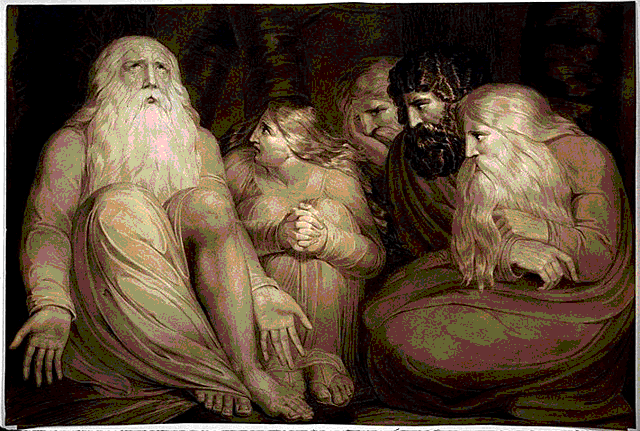
How does God use his power? [pt. I]
The book of Job contains as much about God’s majesty as any book in the Bible. It’s full of lines like, “He alone stretches out the heavens and treads on the waves of the sea,”[1. Job 9:8] and “His eyes are on the ways of mortals; he sees their every step.”[1. Job 34:21]
The most dramatic lines come from God himself—
Where were you when I laid the earth’s foundation? //
Do you send the lightning bolts on their way? Do they report to you, ‘Here we are’? //
Do you know when the mountain goats give birth?[1. Job 38:4, 35; 39:1. If you can, take the time to read all of Job 38-39. It’s a spectacular speech.]
Yet all these declarations about God’s greatness come against a backdrop of tragedy. If you’ve asked theological questions about the problem of evil before, you’ve likely heard someone mention the book of Job.
The book’s introduction presents Job as a “blameless and upright man” who fears God and shuns evil.[1. Job 1:1] He has everything a man of his time would ask for—a large family, enormous flocks and herds, many servants—and he’s called “the greatest man among all the people of the East.”[1. Job 1:3]
But then the narrative cuts to a short conversation between God and Satan.[1. Some people take the book of Job as a type of epic, others view it as actual history. Regardless of how you see it, the purpose of the book seems to revolve around our questions about the presence of evil in the world.] God talks about Job like a proud father. Satan is unimpressed: “Of course he’s loyal to you. You’ve kept a hedge around him. You’ve blessed him in every way. Take away all the blessing and he’ll curse you to your face.”
So God agrees. “Very well, then, I’ll remove the hedge.”[1. My paraphrase of Job 1:8-12]
Then we see Job lose everything in an instant—all of the flocks and herds, every one of his children, and every servant except for the few messengers who escape to tell Job about his losses. When he still doesn’t give up his faith, he loses his health, too.
We usually look to the book of Job to ask why God would allow tragic evil, and most people conclude that it doesn’t give any final answers. The most we can take away is that God’s ways are beyond our understanding. Perhaps the best we can do in the face of tragedy is to respond as Job does, “The Lord gave and the Lord has taken away; may the name of the Lord be praised.”[1. Job 1:21]
But we often miss an important revelation in Job. At the beginning of the story, why has Job prospered so much? Satan himself says that God has put a hedge around Job and his household and everything he has. And what happens when God removes the hedge? Job loses it all in an instant.
The book of Job shows us that God must have a great hedge around us. If you have anything good in your life—any loved ones, any possessions, any health—there must be some hedge. If the hedge were removed, it would all be destroyed.
We usually look at it the other way. We ask why God would ever remove any hedge of protection. But let’s first recognize what a great hedge God has around us. We don’t see a God who intervenes in every situation the way we’ve asked. We don’t see a God who keeps a perfect hedge around all people and all things. I admit I don’t understand why God performs miracles in some situations and allows others to continue in tragedy. I don’t understand why God keeps his hedge up sometimes and removes it in others. But I’m left with Job, praising a God who gives and provides and protects and works miracles, and praising God still when the hedge of protection comes down and the miracle doesn’t come.
This is the second most compelling way that God uses his power in our world. But it pales in comparison to the most compelling—and shocking—way that God has used his power…
How does God use his power? [pt. 2]
The Gospel of John begins with a shining statement about Jesus’ glory and presence and power.
In the beginning was the Word, and the Word was with God, and the Word was God. He was with God in the beginning. Through him all things were made; without him nothing was made that has been made.[1. John 1:1-3]
He has existed forever. All created things were created through him. He was with God in the beginning, and he is God. But then look at what John says about how we have seen his glory:
The Word became flesh and made his dwelling among us. We have seen his glory, the glory of the one and only Son, who came from the Father, full of grace and truth.[1. John 1:14]
How have we seen the glory of Jesus—the one who is God himself? He took on flesh and made his dwelling among us. Not only did he take on flesh, he took on the very nature of a servant and humbled himself. He became obedient to death—even death on a cross![1. All of this from Philippians 2:6-8]
In Jesus, we see a God who doesn’t just intervene from on high. Instead, we see a God who was made low. He came, and rather than ending all suffering immediately, he participated in our sufferings. Rather than triumphing over the powers of evil in our world as an almighty conqueror, he triumphed over them by the cross.[1. See Colossians 2:15]
How can an everywhere, all-knowing, almighty God allow evil and suffering to persist? The answer we long for is a simple one—that God would use his power to vanquish these things, that there would be no more death or mourning or crying or pain. We long for an answer that says all the tragedies cease––no more cancer, no more earthquakes, no more car accidents, no more school shootings. There’s no more reason to mourn or cry or hurt.
A day is coming when that will be God’s response, when Christ declares, “I am making everything new!”[1. See Revelation 21:4-5] With that, we have a great hope: Death doesn’t have the final word. Tragedy doesn’t have the final word. All the tears now don’t have the final word. Christ has the final word, and he is making everything new.
As we wait for that day, though, how does an everywhere, all-knowing, almighty God respond to evil and tragedy? In Jesus, we see that the God who is everywhere comes down to be present with us. The God who knows all things knows our heartbreak and grieves with us. The God who is almighty has suffered grief and shame and pain alongside us. And in these things, as much as in the stretching out of the heavens and treading on the waves of the sea, we see God’s majesty.
———


 teddy ray