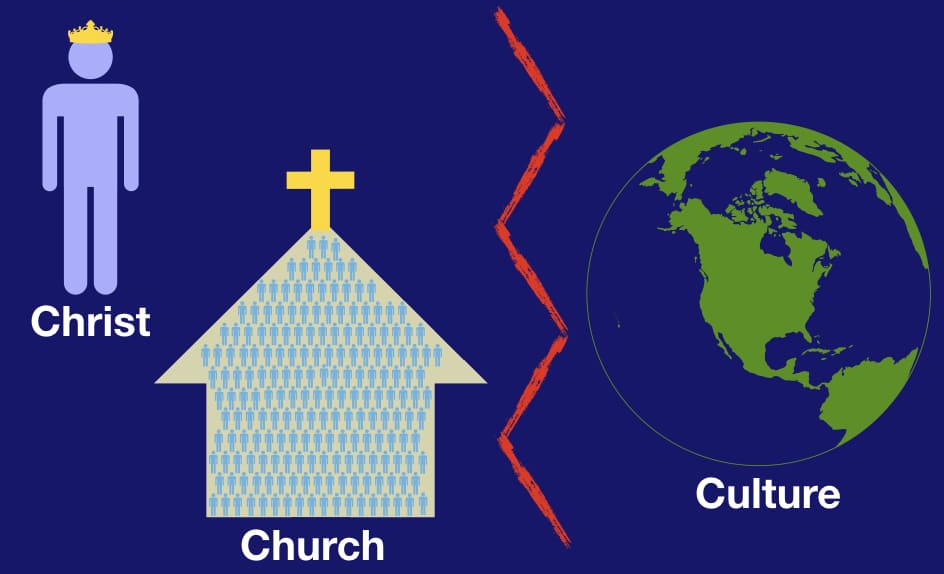
Christ in Culture: A new proposal

In the past two posts (see here and here) I’ve been discussing how the church engages with the world. I shared two popular models that try to describe our options.

We can take a “Christ of Culture” / Relevance approach to the world and assume what we see in culture is good, relevant to the Christian life, and should be embraced.

We can take a “Christ against Culture” / Countercultural approach and assume what we see in culture is bad, harmful to the Christian life, and should be rejected.

Or we could take a mediating view. You can see more about those in the previous posts (again, here and here).

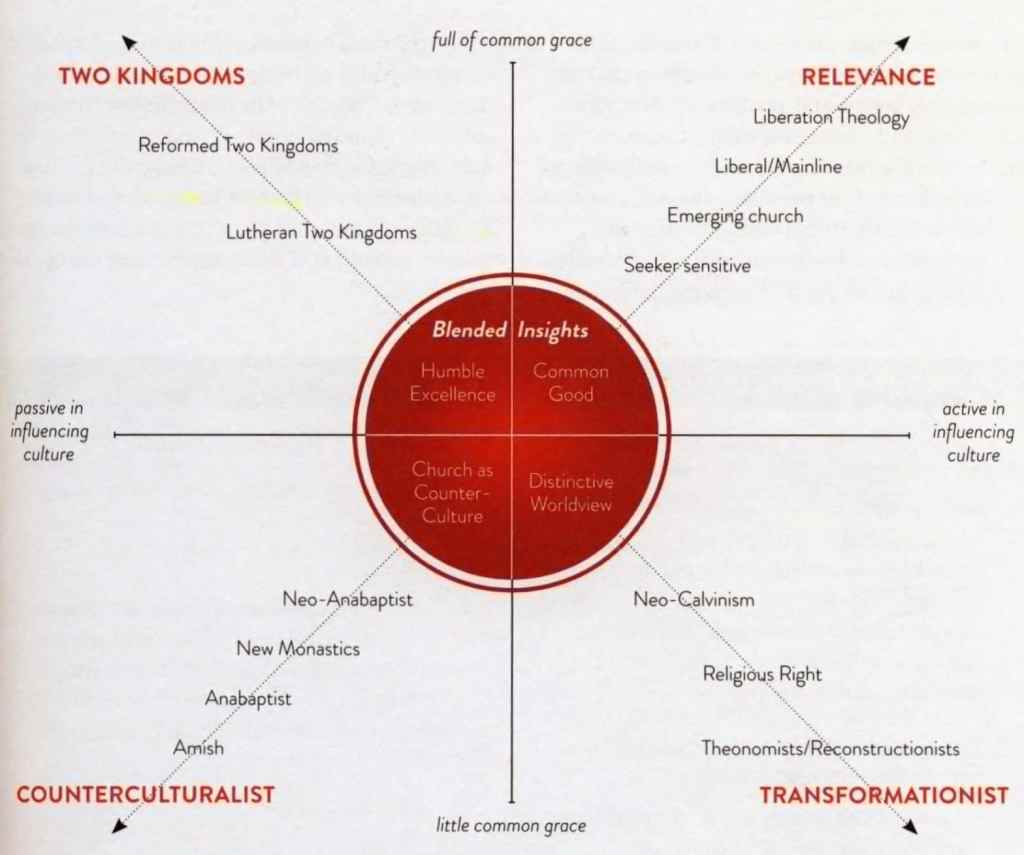
Here’s Keller’s model again. It asks whether the world is generally good or bad (how full of common grace?) and whether the church should be active or passive in influencing culture.
The problem with the models

These different models for how the church and Christians can engage culture are helpful descriptive models. But they’re flawed when we begin to use them as prescriptive models. We can’t begin with a “Relevance” mindset, for instance, and assume that we can apply it to everything we see in our culture. As I concluded in my last post, whatever perspective you take on how the church engages with our culture on sexuality, you almost certainly wouldn’t maintain the same position with slavery and rock ‘n’ roll. No one model fits all situations well.

This is where Tim Keller advocates balance––we should move toward the center and not go too extreme in any direction. But “balance” isn’t enough help, and it’s not always right. We celebrate that William Wilberforce didn’t take a “balanced” approach to the injustice of slavery.

A Prescriptive Model: Christ in Culture

The models we use for Christ and culture say too much. They try to claim Christ has a single position relative to our culture: of, against, above, transforming … But the reason we have all of these models is because we see that Jesus took all of these positions in his first century culture. And as the Body of Christ, the church does the same, or should. We should understand ourselves as the Body of Christ in culture––sometimes adapting, sometimes rejecting, sometimes transforming, etc.

I’m going to propose that we use love as our guiding principle for engaging culture. Novel, right?

More specifically, let’s use Jesus’ great commandment as our first guideline. Jesus says, “‘Love the Lord your God with all your heart and with all your soul and with all your mind.’ This is the first and greatest commandment. And the second is like it: ‘Love your neighbor as yourself.’”

Everything we do should be aligned to loving God and loving God’s creation.

[I’m taking a liberty here to use “creation” instead of neighbor. “The earth is the Lord’s, and everything in it.”[note]Psalm 24:1; 1 Corinthians 10:26[/note] All people, creatures, and creation. He has given it all to us as a gift. Use the comments if you disagree with me.]

So now we can expand on what we mean by love. We’ll draw it out like this:

Notice that this isn’t like some of the other questions we’ve seen about cultural engagement. It doesn’t ask us to claim which is the right way of viewing things, as if one side of the pole is right and the other wrong. It asks a situational question instead: “Are we talking about love of God or love of God’s creation in this situation?”

To be clear, these are in many ways inseparable. If the creation is God’s precious gift to us, we can hardly abuse that gift while loving God. And our ability to love comes from God. Nevertheless, some questions primarily have to do with how we relate to God and others with how we relate to others.

It won’t be enough for us to talk about love, though. Love takes different forms, and these will come into play. Here’s how we see it described in Romans 12:9 – “Love must be sincere. Hate what is evil; cling to what is good.”

So let’s draw a second line:

That looks a lot like Keller’s four quadrant model above. But it doesn’t ask us for our generic approach to the culture. It asks for our specific approach to every issue that presents itself.

How do we engage the culture in each of these quadrants?

Bless the Good

Take a look first at that upper left quadrant. What does it mean to “love God’s creation” and “cling to what is good”?

It means blessing and delighting in God’s good creation. The earth is the Lord’s and everything in it. He created it and called it good. We continue to see God’s goodness in his creation. And wherever we see it, we should celebrate it.

This may be the quadrant that “evangelical” Christianity has most neglected over the past several decades. It’s the reason many Christian teenagers have come away from the church with generally negative views of sex as something dirty, shameful, and sinful. (Just search “purity culture.”) It’s the reason many people view the church according to what it stands against.

The Church –– and especially evangelical Christians –– could stand to spend a lot more time in this quadrant. What do we see and celebrate as good in God’s creation? How can we name and bless and delight in what is good?

If you read or listened to my interview with Mike Mather (here and here), this defines well what he’s doing. The “Relevance” and “Christ of Culture” models find their roots in this quadrant.

When we bless the good, we focus on goodness and beauty. We recognize these as attributes of God and God’s creation. The Western Church has undervalued beauty in recent years. N. T. Wright talks about beauty as part of the three-fold mission of the church, along with justice and evangelism.[note]See ch. 13 of Surprised by Hope.[/note] I doubt most of his readers would have been surprised to see justice and evangelism on that list. But I bet few of them expected to see beauty there.

Seek Justice

Look now to the bottom left quadrant. What does it mean to “love God’s creation” and “hate what is evil”?

Above all else, we believe that everyone is created in the image of God. Everyone. And where people are oppressed, neglected, or treated in a way that denies their dignity, justice is perverted.

Wherever God’s good creation is treated without dignity, it’s unjust. The Christian response: seek justice.

You’ll find wings of the Church that hold this as their primary concern and others that have neglected it. Where we’ve done well, we’ve defended those who were abused and taken advantage of. We’ve taken up the cause of those who have been deprived of power and pled the case of those who have been deprived of voice.

I discussed both the #MeToo movement and the abolition of slavery in the previous post. If those are movements you believe Christians should have celebrated and taken part in, it’s because of a sense of justice. To many people’s surprise, evangelical Christianity has a long history of activism, including the abolition of slavery, fighting for the poor, and women’s rights. I’ve written about that in more detail here.

Where we get things wrong with seeking justice, we make two opposite mistakes. One mistake is to ignore it. That happens when we discount the value and goodness of God’s creation and focus entirely on salvation. We feed people’s souls but neglect their bodies. We point to God’s kingdom in the future without regard for God’s will done on earth, as it is in heaven.

In the other instance, we mistake ourselves for saviors and use language about “building the kingdom,” usually through our own revolutionary tactics, as if it were ours to build. We can act as if we “want the Kingdom without the King,”[note]In Mark Sayers’s brilliant parlance.[/note] doing it all ourselves with little attention to Christ.

You’ll also find occasions where we fight for justice with such rabid force that we oppress, neglect, or deny the dignity of another person or group in the process. Look to the current state of politics in the United States and across the Western world, and I believe you’re seeing opposing social revolutions. Both are giving attention and voice to groups that have long been ignored and excluded.[note]See the increasing progressive focus on race, gender, and sexual identity. See also the thesis of President Trump’s inaugural address: “The forgotten men and women of our country will be forgotten no longer.” His surprising victory came because of his unique appeal to small town voters, mostly white people without college educations, long neglected by both political parties and unrepresented in our nation’s elected leadership.[/note] Meanwhile, their seeming hostility toward another long ignored and excluded group grows. One of the greatest idolatries of our time––partisan politics––threatens to deny some people justice in its fervor for justice for others.

The “Transformationist” and “Christ the Transformer of Culture” models find their roots at least partially here. When we seek justice, we focus on God’s nature as a just God who will set his world to right.

Be Holy

We move now to the upper right quadrant. What does it mean to “love God” and “cling to what is good”? I’ve chosen “Be Holy” as the way to represent this. We could also use language here about worship or devotion. This is about clinging to God, because God is good.

I’m using language of being and holiness because this quadrant isn’t just about what we do; it’s about who we are. When you hear anything about “being holy,” your mind likely goes to something like rule-following. But holiness is much bigger than that.

Throughout the New Testament, we encounter the incredible claim that we are united with Christ. This was the premise of my serious post with a tongue-in-cheek opening: “We are gods.” What if Kanye was right? Or see this helpful article: “10 Things You Should Know about Union with Christ.”[note]It’s written through the lens of Calvin’s theology. My discerning Wesleyan readers might pick up on that in a few places. I think it is overall a very good, agreeable representation. Use the comments if you take issue with any of its claims.”[/note]

Holiness is not so much an expectation of who we should be as it is good news about who we can be. It’s not so much God’s requirement of us as it is a calling, a possibility, God’s very design for us. And if God has designed us for holiness, he will surely do it in us.

We’re God’s holy people, set apart for God and set apart from sin.

In my previous post, I suggested that Christians have the option to look to our culture for our sexual ethics: don’t make such a big deal about casual sex, casual nudity, extramarital sex. If you objected to that approach, it was probably because of this notion of holiness. By the grace of God, we’re a set apart people. We give that up when we follow whatever the world tells us is okay. It’s specifically regarding sexual ethics that the apostle Paul reminded us that we’re united with Christ: “Do you not know that your bodies are members of Christ himself? Shall I then take the members of Christ and unite them with a prostitute? Never!”[note]1 Corinthians 6:15[/note]

Some people may view Christians as prudes or holier-than-thou or self-righteous because of our moral stances. If we come off that way, it may be because we’ve misunderstood holiness. Holiness is not about being better than other people. It’s not about looking down on others. It’s not about following unnecessary rules. None of these would describe Jesus as we see him in the gospels. And yet we say that Jesus is fully holy––unerring in his devotion to the Father, neither looking down on others nor condoning sin, the model of prudence.

The “Counterculturalist” and “Christ Against Culture” models find their roots in this quadrant. They recognize that Christians live our lives devoted to God, even in union with God. Compare that to this from 1 John 2:16, “For everything in the world––the lust of the flesh, the lust of the eyes, and the pride of life––comes not from the Father but from the world.”

With holiness, we encounter one of the biggest differences between the Church and the world. At your business, should someone be eliminated from consideration for leadership if they aren’t a devoted Christian? In almost all instances, the answer is no. But in the church, should devotion to God––marked by holiness––be prerequisite for certain positions? Yes!

Speak Truth

I think there’s another reason some people accuse Christians of being holier-than-thou. (To be clear, I’m not discounting the first problem: that we really can behave that way.) That other reason is that Christian holiness can unveil idolatry. And no one likes their idolatry unveiled.

Take a look at that bottom right quadrant. What do we get when we cross “love God” and “hate what is evil”? What we should hate is when something or someone other than God is worshiped. We call this idolatry (turning something else into our god) or heresy (misrepresenting the true God).

How do we engage a culture that worships other gods and misrepresents the true God? By speaking truth.

We see Jesus and the apostles speaking truth in these kinds of ways throughout the New Testament. In addition to the compassion and grace Jesus extends to the Samaritan woman in John 4 (because all people are created in the image of God and to be treated with dignity––Bless the Good), Jesus also says, “You Samaritans worship what you do not know; we worship what we do know, for salvation is from the Jews.”[note]John 4:22[/note] It’s a claim about who the true God is, spoken against a false notion about God.

Paul’s speech in Athens does the same thing: “You are ignorant of the very thing you worship––and this is what I am going to proclaim to you. The God who made the world and everything in it is the Lord of heaven and earth and does not live in temples built by human hands.”[note]Acts 17:23-24[/note]

Do Jesus’ and Paul’s words here seem abrasive? Unkind or uncaring? They weren’t received well by all who heard (some who heard Paul sneered at him), but others responded with belief. Their false worship of other gods turned to true worship of the living God.

We have no fewer idols today than they had then. We likely have more. Christians today need to continue unveiling idols and heresy for what they are. There will be many methods, and I would advocate the more winsome ones as best––ones that don’t forget the dignity of the other person. But if we abandon any effort to speak truth in our world, we’ve abdicated the Church’s ongoing call to proclaim the good news.

The “Transformationist” model also has some roots in this quadrant, along with the “Seek Justice” quadrant above. That’s because truth-telling and justice-seeking are different means of transforming our culture. In both, we must be careful not to ignore the dignity of those whose hearts, minds, and behaviors we seek to change.

Most of our idols today are not bad things. They belong in that upper left quadrant. They’re good. But when they take the wrong place in our lives, they cease to be goods and become gods.

Problems with this model

This model won’t answer all our problems quickly or easily. The big question it doesn’t answer: What is good and what is evil?

Niebuhr’s and Keller’s models allow us to start with an assumption about good and evil in the world. We either expect the things we encounter to be good or we expect them to be evil. Of course, the problem with those models is that our assumption will often be wrong. Not all things in our culture are good. Nor are they all bad.

So this leaves us to do the hard work in an ever-changing culture. And we’ll frequently find that a question requires us to work in all four quadrants. For instance, the church’s swirling debates about human sexuality involve human dignity, justice, holiness, and truth. How do we go beyond holding these in a weak balance to observing each to its fullest?

Lots more still to consider. For now, go and Bless, Be, Speak, and Seek.

See the next post in this series here: “Blessing and Delight: Goods and gods, pt. I”

Did you think this was helpful? If so, PLEASE share it with others. Social media, email, word-of-mouth. However you share things. Click here for Facebook sharing. Or here for Twitter sharing. Or here for LinkedIn sharing. TikTok sharing is unavailable.

The Church in a (Once) Sexually-Liberated World: Sex, slaves, and rock ‘n’ roll (pt. II)

In my last post on how the church engages culture, I showed you two popular models for how we can understand cultural engagement. I finished with Tim Keller’s four quadrants. They look like this:

Keller has said that none of these is the “right” answer. Instead, he argues for balance. We shouldn’t get too extreme in any of these directions, but instead utilize all of them in appropriate ways.

That’s a decent start, but it has the potential to lead us astray. A generic “balance” isn’t the answer. In fact, there are times that our response to something in our culture should be one of these in the extreme. But Keller’s model doesn’t help us identify when to favor one of these stances, and it doesn’t help us identify how to adopt that stance. Neither did Niebuhr’s earlier model (also described in the previous piece).

The problem is the starting premise in both models. They attempt a top-down approach to cultural engagement. They ask general questions about the nature of a culture: Is it good? Is it bad? Should the Church be actively involved in it? But we don’t approach a culture generically. We approach it in all of its particulars, and each is different.[note]Niebuhr was aware of this. He writes, “When one returns from the hypothetical scheme to the rich complexity of individual events, it is evident at once that no person or group ever conforms completely to a type” (See chapter 1, part IV of Christ and Culture).[/note]

Amid the rich complexity of individual events, the models that Niebuhr and Keller propose leave us aimless––or even worse, justifying bad positions. To demonstrate, I’ll consider three case studies: sex, slavery, and rock ‘n’ roll. This post focuses on the sex and uses slavery and rock ‘n’ roll as its foils. I’ll expand on those if you think it would be helpful.

The Church in a Sexually-Liberated World

For all the sex on our TV shows and movies, almost none of it is between married couples. Our culture’s accepted and celebrated sexual ethic has little in common with historic Christian teaching. The idea that sex and marriage should go together seems outmoded. And now, some are arguing that it’s not just a quaint, antiquated notion. They’re claiming that it’s bad, harmful, repressive.

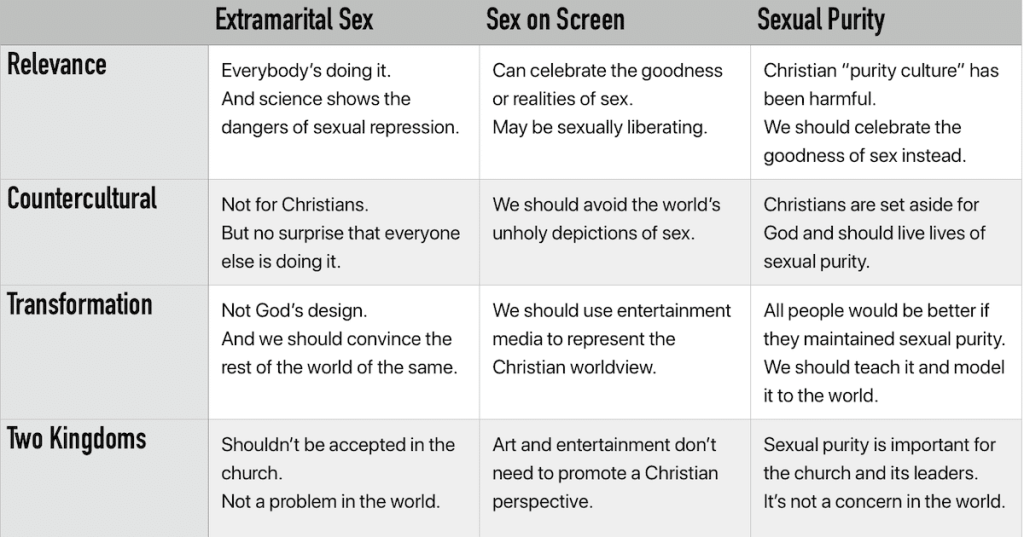
How do Christians handle the difference between our historic teaching and the culture’s generally accepted practice? Let’s consider Keller’s four approaches:

The Relevance model

Are you looking to our culture for the answers to sexual ethics questions? You fit here. A faithful church attender said to me not long ago, “It’s the 21st century. I don’t think God is too worried about sex outside of marriage anymore.” Look around. Get with the times. Read up on the harm that comes with sexual repression.

The Relevance model will probably also talk about the harmful shaming and fear that Christian “purity culture” has caused and instead focus on the goodness of sex and sexuality.

Christians who take the Relevance position on sexual ethics won’t stand out from the world. That’s part of their intent. If you want people to be attracted to the faith, you need to quit making it look so weird.

The Counterculture model

If you fit here, you see our culture’s unrestrained attitude toward sex as unsurprising. But you also see it as incompatible with the Christian life. You expect the church to model something entirely different, even if we don’t try to impose it on others.

The counterculture church maintains lives of purity and chastity: fidelity in marriage, celibacy in singleness. (A note: the kind of “purity” this church should advocate is neither shame- nor fear-based, but holiness-based.)

There’s no concern here about changing our culture’s views on sexuality. The world will be the world.

This will be the crowd most likely to abstain from the shows and movies that promote a different view of sexuality. At the least, they’ll likely reject shows and movies with nudity and graphic sexuality. As a wise person once said, “Casual sex, casual nudity, and pornography are eroding our respect for the body and sex. They’re training us to separate two things that God created to go together––intimate relationship and the intimate giving of our bodies.”

The Transformation model

If you’re a transformationist, you want to go further than the group above. You want to change the culture’s views and practices. You believe it would be better for the world around us to maintain a Christian sexual ethic, even if they don’t adhere to the Christian faith.

If that’s you, we need to ask how this transformation would come about.

One option is to mandate it. Legislate it. Make laws against cohabitation and extramarital sex. You’re probably not ready for that, are you?

If we don’t legislate it, the church could seek transformation in another way: by spreading our worldview. Hold out the Christian understanding of sexuality in its most winsome form across our culture so that it would become the mainstream view of what’s good and right. This is where some Christians have advocated heavy involvement in the entertainment industry and education sector.

Like money or food & drink, human sexuality is a good thing when it’s used as God intended. But when we cast off restraint, it becomes a form of idolatry that’s deeply destructive to ourselves and others. The transformationist tries to convince our society of that, whether they’re Christians or not.

The Two Kingdoms model

Maybe none of these sound quite right to you. You’re more of a live-and-let-live kind of person. You’ll continue to maintain a sexual ethic as the church teaches it, but you won’t stand out. You’ll neither compromise your own standards nor expect others to live by them.

The two kingdoms model will have you live in both the Church and the world, but in different ways. For instance, you probably won’t have any problem with a co-worker or employee who sleeps around or lives with his girlfriend. But if your pastor is doing the same, you’re not okay with it. In fact, you’d probably consider it unjust if your secular employer fired someone for anything to do with their sex lives (excepting anything illegal, which is a different matter), but you’d consider it highly appropriate for your church to fire the pastor who has a sexual relationship with someone other than his/her spouse.

According to Two Kingdoms, we expect different things in the Church and in the world. What would be considered an unfair or unjust expectation in one place would be a requirement in the other.

An aside: The Cracks in our Sexual Liberation

The #MeToo movement has highlighted many of the problems with our sexually-liberated society. When sex is disentangled from relational commitment, we create a whole new set of questions about when it’s appropriate. The cracks in our sexual liberation are showing.

We’ve landed on “consent” as our guide, but we’ve seen that even that standard can be difficult to define. In a relationship where one person has more power, does the other person really have power to consent? Is “Baby It’s Cold Outside” a playful song or predatory? When one or both people are drunk, can they consent? We’ve had plenty of instances where one person claims the encounter was consensual and the other claims it wasn’t. And so we’ve created forms and apps that allow us to contractually consent to sex.

Imagine that … associating sex with a contractual commitment. We’ve heard about this somewhere before.[note]To the wokest, I agree that consent can even be at issue in a married relationship. And that sex should never happen without both parties’ consent. Every problem I know of from the #MeToo movement, though, involved people who had not freely chosen to be married to each other. Marriage continues to be one of the most reliable indicators about whether someone generally consents to having sex with the other person.[/note]

How do we choose?

Did one of these models strike you as most appropriate? Or maybe you found portions of a few of the models that you would endorse? Did any seem like inappropriate ways of handling sexual ethics in our culture? You may even say that a nice balance of these is best in this situation.

Whatever model of engagement fits you best for this question, I would bet that it won’t fit you best when we discuss slavery or rock ‘n’ roll.

You may have thought the idea of legislating sexual morality was a bad idea, you might have liked the live-and-let-live approach of the Two Kingdoms view or the “alternate society” approach of the Counterculture view, but I bet you would be glad Christians were involved in changing laws about slavery. And you doubtfully would say they should have just been balanced in their positions.

You may agree with me that we shouldn’t look to our culture and “evolve” to whatever it believes is a proper sexual ethic, but you may also be okay with an “evolving” acceptance of musical styles as the world around us changes. (Hey, even the organ was once a new invention.)

The models explain which stances we’re taking, but they don’t explain why. They might even allow us to justify a position that we shouldn’t justify (e.g. wholesale acceptance of our world’s sexual norms or anyone who took a “live-and-let-live” approach to American slavery).

I think we can ask better questions to arrive at better answers. I’ll detail those in the next post.

For now: Does one of these models sound closest to your view? What helps you identify which positions to take and which to reject?

Like it and want to see the follow-up post? Click here to subscribe for blog updates.

Love it? Most people find this blog because you share it. Thanks! Hit a sharing button to share with others.

A Summary Chart

Sex, slaves, and rock ‘n’ roll: How should the church engage culture? (pt. I)

How should the church interact with the culture around it? You’ve struggled with this question, whether you asked it in this particular way or not.

It comes in a variety of forms:

  • Public policy issues (environment, economy, immigration, abortion, military …) –– Should the church openly support or reject certain positions? Should individual Christians vote according to their conscience? Should our faith influence our vote? Should we vote?
  • Politicians — bless, endorse, denounce, or ignore?
  • New musical styles –– appropriate for church use?
  • Business techniques –– appropriate for church leadership?
  • Pragmatics –– do the same codes of ethics apply in the world as in the church?
  • The “secular” world –– throw all your Led Zeppelin CDs in the lake, or rock on?

I’m going to share two helpful models for making these decisions and then propose a necessary next step that I haven’t seen them take.

Christ and Culture

Have you heard of Niebuhr’s Christ and Culture paradigms? They’ve been the most prominent way for understanding cultural engagement questions since Niebuhr’s book Christ and Culture was published in 1951.

A brief explanation of his five categories:

1 – Christ Against Culture – Christians should resist the world and its influences. It’s sinful, fallen, corrupted. There is a stark and necessary divide between Christ and the world. Anywhere you see Christians separating themselves from the world, you’re seeing a version of this model.

2 – Christ of Culture – This is the opposite of the one above. It says that God created everything, so we can expect to find God’s truth and goodness throughout creation. There is no divide between Christ and the world. Anywhere you see Christians talking about “plundering the Egyptians,” you’re seeing a view like this.

With these two we’ve set the poles. The other three fall somewhere in between:

3 – Christ Above Culture – This is the both/and position. We don’t have to fully reject the culture as bad or accept it as good. Instead, we celebrate the good we find and reject anything contrary to the gospel. There’s a divide, but it’s not a complete divide like the “Christ against Culture” model.

In this paradigm, we also distinguish between a “secular” and a “sacred” world. God rules over both, but in different ways. So we can find God’s goodness in nature (secular), but we can only experience his full goodness through his supernatural grace (sacred). If you see Christians talking about submitting to the governing authorities in the world but also maintaining their Christian identity, it’s probably related to this view.

4 – Christ and Culture in Paradox – This is similar to the Christ against Culture position above. Except it doesn’t draw the line between a sinful, hopeless world and a holy church. Instead, it draws the line dividing good and evil “through every human heart,” as Solzhenitsyn described it. Each of us is a mix of good and evil. Ultimately, that draws the line between unholy people (all of us!) and God. The culture is not the problem. We are the problem.

In this model, humanity and God live in tension because all of us have both good impulses and wicked impulses, leading to both good and wicked expressions in our culture. Anywhere that we recognize that we’re totally helpless to save ourselves and that we have to trust in God’s grace, it’s a reflection of this model. As Paul said it, “What a wretched man I am! Who will rescue me from this body that is subject to death? Thanks be to God, who delivers me through Jesus Christ our Lord!”[note]Romans 7:24-25[/note]

5 – Christ the Transformer of Culture Like the Christ of Culture paradigm, this view understands God’s creation as good. But it recognizes the ways that evil has perverted that goodness. In this view, God is transforming his broken creation, restoring it to the original goodness he intended. And Christians can and should participate in that work. Anywhere you see Christians working for social change, it reflects this kind of understanding.

Keller’s extension

Tim Keller has contributed to this discussion in a way that helped me. He identifies our view of Christ and culture according to two questions.

His two questions:

  1. Should we be pessimistic or optimistic about the possibility for cultural change?
  2. Is the current culture redeemable and good, or fundamentally fallen?

That leads to this chart:

Very briefly:

The Relevance Model assumes the culture is good and that the church should be active in the world, so it finds ways for the church to learn from the world and catch up. You can see a lot of the “Christ of Culture” view in it.

The Transformationist View assumes the culture is not good and that the church should be active in the world, so it seeks ways for the church to transform the world. You’re thinking of “Christ the Transformer of Culture” here, right?

The Counterculturalist View assumes the culture is not good but that the church should not be active in the world. In this model, the church becomes a counter culture, an alternative reality to the model of the world. It’s a city on a hill, calling people in the world to come in, while avoiding being corrupted by the world. Another take on “Christ against Culture.”

The Two Kingdoms View assumes the culture is good but that the church should be separate from it. Think of separation of church and state. In this model, Christians participate as good citizens in the world and good members in the church, but we acknowledge that these are separate. This is most like the “Christ and Culture in Paradox” paradigm.

I didn’t list the “Christ above Culture” paradigm. It probably fits somewhere between “Two Kingdoms” and “Relevance.”

Which is right?

If these are new to you, take enough time to consider each of them. Then pick one. Is there one that best reflects your understanding of how the church should relate to the world?

Do you believe our primary stance in the world should be to work for positive change –– take our Christian worldview and seek to create a society that fits and follows that worldview? If so, you’d probably choose the Transformationist model.

Or do you believe our primary stance should be to celebrate God’s goodness as we find it already in the world –– to seek the common good? Then you’d probably choose the Relevance model.

Or maybe you think the primary stance of the church should be to serve as a shining city on a hill, a holy people in a fallen world, people who have others notice there’s something different about us and ask why. You’d choose the Counterculturalist view, if so.

Or finally, do you think you have an important but different role in church and world? We celebrate Word and Sacrament in the church; we do our work with humble excellence in the “secular” world. They’re very different worlds, and that’s okay. Then you’d choose “Two Kingdoms.”

Have you chosen your preferred model? The understanding you tend to use?

When I learned about these models, I began to understand what was happening in some of my disagreements. I was frequently coming to conversations about the church with a Counterculturalist mentality, and most of the people I was talking to were coming with a Relevance or Transformationist mentality. People had a hard time understanding why I would offer ideas about the church serving as an “alternate economy,” ask if it would be better if ministry were a bad career, suggest Christians pay less attention to elections, or deride pragmatism.

If you’ve had a hard time understanding or being understood in these kinds of conversations, perhaps the models explain why.

But which of us is right? Which is the proper model?

Keller answers that none is best. He says that we need to instead find balance. The answer is in the middle.

This is where I’ll disagree with Keller. Balance is often a mirage and rarely the answer. (The most annoying part of any discussion of Christian personality is when people get to Jesus and blather on about how Jesus is the perfect balance of all types — “He’s peaceful like a 9, a thinker like a 5, cares deeply about morals like a 1, bold like an 8…” Because how could we dare suggest Jesus had one actual personality, to the exclusion of others?)

In the case of cultural engagement, would we really advocate for “balance” across these four models in how the church handled the issue of slavery? In matters of human sexuality, slavery, and rock ‘n’ roll, does a balanced use of all of these models achieve what we need to? I don’t think so. I don’t think we can, or should, treat sexuality, slavery, and rock ‘n’ roll the same. They each require a different kind of Christian response. But how do we choose?

I find that we usually choose the model for each particular issue that we like most. This allows us to justify almost any response to any issue. And perhaps we call that “balanced.” But I think we can do better. In my follow-up post (now available here: “The church in a (once) sexually-liberated world”), I’ll try to extend these models to a more helpful use. For now, I’d be interested to hear your thoughts and questions about the models outlined here.