Finding Abundant Communities in Unexpected Places – Mike Mather interview, pt. II

I shared part I of my interview with Mike Mather last week. Here’s part II.

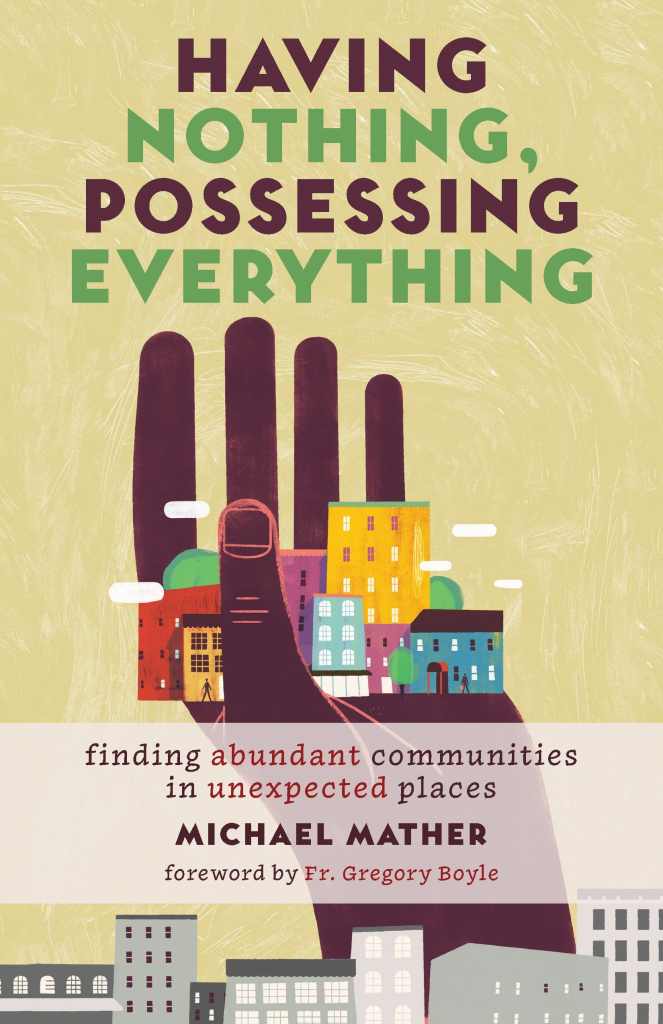
Take this as a short teaser for his outstanding new book, Having Nothing, Possessing Everything: Finding Abundant Communities in Unexpected Places. I highly recommend that you buy it, read it, and if you are part of a church leadership team, consider reading it together.

Also, if you’d like to listen to the full interview, here’s the audio for streaming or download:

—————-

Teddy: So (in the first part of the interview) you mentioned DeAmon and you mentioned young people asking questions. Say a bit more about this whole roving listener, how long you’ve been having roving listeners and how this came about.

Mike: So the local development corporation contacted us from our neighborhood and said they were going to do a strategic plan and they wanted us to partner with them, which meant they wanted money. And we said, “Well, we’ll partner with you on this, but we have three conditions. One is you won’t do it by doing a need survey. You’ll do it by doing a survey of what people have, not what’s missing from people. The second thing is we get to choose the person who leads it. And the third is we get to supervise that person, because though their lips said, “yes, yes, yes,” their eyes said, what are you talking about? 

And so we went to DeAmon, who lives in our neighborhood and would walk down and see me every day. And he was a member of our church and he would talk to me about, “Oh, I just met this guy who lives at the corner of 32nd and Park. And he plays chess on his porch every afternoon and all the kids gather around and he’s teaching them about life when he does this.” Or, “I just ran into the Buddha boys, this local gang at the corner of 31st and Broadway and one of them’s a poet and one of them is a mechanic and one of them loves science.” And he would tell me these things.

So we went to DeAmon and said, “How’d you like to get paid for what you already do?”

Teddy: That’s a good deal.

Mike: Yeah, and he said, “What do you mean?” I said, “Well, you seem to recognize the giftedness of people, and so we need you to do that for this strategic planning process.” So he began to do that. So again, when I had come back to Broadway, we had been running the summer program the same way as when I left at the end of ’91. So now it’s 2004 or ‘05. We’re still running the summer program basically the same way. It wasn’t bad, it wasn’t doing anything destructive. But from my perspective and from a really practical perspective, it wasn’t really changing anything.

Somebody once talked about discernment by nausea, where you know something has to change and it’s not going to be fun…  So we took a couple of days off, we prayed together, we talked with one another. And what we decided to do out of that was to build on the work DeAmon had been doing by hiring young people who live in our neighborhood and paying them to meet their neighbors.

They do three things. They name the gifts, talents, dreams, and passions they see in the lives of their neighbors. They lay hands on them and bless them. And they connect them to other people who care about the same thing. So if they find gardeners, they connect them to other gardeners. If they find cooks, they connect them with other cooks… people who love business. And then the gift of the church is that we can connect them to people who are outside of the neighborhood and care about the same things.

But then people aren’t meeting about needs. They’re meeting about, “Oh, we all cook,” or “We all garden.” So when they get together, they’re not talking about “what can I do to help you?” They’re talking about, “So what’s your favorite recipe? What kind of flour do you use for this? What are the tools you use in this gardening project? How did you start your business? Let me tell you how I started mine.” And then people are meeting each other, as we would say in the church, as sisters and brothers. 

Teddy:  Oh, that’s great! Mike, was it you who had the tee shirts or the signs that said, “I See You.” Or am I thinking of someone else?

Mike: And we also had the sign that said, “I am more than you see.” Is that what you’re thinking of?

Teddy: I think so. 

Mike: We did have “I see you” stuff, too, and we talk about that a lot. It’s a greeting in South Africa when people greet one another. They say, “I see you.” And the response is something along the lines of, “It is good to be seen.”

It is good!

Teddy: And that seems just the premise that runs through all of this – bringing people together in those settings where they can really see and be seen.

That’s not just an unconventional approach to your neighborhood. It’s in the rest of the ministry, too. I was just telling someone a few weeks ago as we were talking about youth ministry that I talked to a guy who hired a youth minister and said, “If you create a youth program, you’re fired.” That’s one of my favorite quotes from you, because I think it illustrates how this mentality is something within your church’s ministry, too.

Mike: That’s right. Inside the walls and outside the walls.

Teddy: So what does that mean, “If you create a youth program, you’re fired”?

Mike: One of the things is—studies have shown this—that youth groups don’t do a good job of developing people who then are part of the faith later on in life. So one thing is we keep doing something that we know practically doesn’t work. But the other thing is how does it reflect what we really believe? So I can’t remember if I told this story in the book. Did I tell the story about how Methodist Hospital started in Indianapolis?

Teddy: I’m not sure.

Mike: So over 100 years ago… Again, let me stress this, over 100 years ago, a group of young people from around the city who were Methodist came to the Methodist conference and said, “There is not a hospital for poor people in this city. So give us $1 million. [This is over 100 years ago!] And we’re going to start one.” And they did! I mean, they were young people, like 17 to 29 years old.

Now, what we ask for our young people these days is to go on the stage at Annual Conference and jump up and down and clap!

But we believe that… In most cultures in the world, when you’re 12 years old, you’re expected to be making a contribution. So we believe people have something to offer and that God’s at work in people.

So one of the things that we did with that was we would organize individual meals around each young person. (We do this for young people, both in the church and outside the church.) We would go to the young person’s home or in some cases, very few, but in some cases, the young person didn’t have a home, so we would go to a restaurant. The young person’s family had to be there. The young person could invite whoever they wanted to be there. 

And then we would invite a couple of extra people. We’d eat together, and then when the meal was over, we’d ask everybody there to tell the young person what gifts they see in that young person’s life. And so people go around the room and do that. And then we ask the young person to speak to us about what he or she thinks their calling in this life is going to be and is. And then after that young person speaks about that, we turn to everybody there and say, “Does anybody here have anything to offer to the gifts of this young person, to what this young person thinks they’re going to do with their life?”

Now how many of us are doing what we thought we’d be doing at 15? Not very many of us. But that isn’t the point. The point is people recognizing and affirming that God is moving in our lives. That we have particular uniqueness and a call and a giftedness. So the first couple of young people that we did this with, we had them come and talk to the Governing Council of the church and after they left, the people in the Governing Council asked, “Why are we just doing this for young people?”

So you know, actually the most recent thing we’ve done with that is we’ve started doing it for shut-ins. And we did that because somebody felt the call to be with older folks, and we said, “Okay, well how about doing this?” And it’s been great! It’s the church caring for each other and doing what we can do like that.

Teddy: And you’re beginning to answer one of the other questions that I had for you, because you’re in a different setting from a lot of folks who will read this book. You’re sitting in a neighborhood that’s considered impoverished by the city around it and has different groups coming in all the time to try to improve it. I wanted to talk some about if a church in the middle-class suburbs asked you, “How do we change what we do?” What would you tell them? And I think you’ve answered at least a part of that. I wonder if there’s anything else you would say.

Mike: We do a couple things with that because we do get this question. And one of the things we’ve come to say to people is, take one of the things that you’re already doing and try an experiment.

So let me give you a couple of examples. One was a church that comes in and does a meal every Sunday for people in the inner city. So they said, “How could we do something different with this?” I said, “Well why don’t you try and make this as easy as possible? Don’t make it really complicated.” So you have somebody in your group who listens well. I’m sure there is. Because in every group there is somebody. So for the next two months, just ask that person to hang out with people who come to the meal and listen. And then at the end of that two months, have that person come and talk to your whole group and ask them, “What did you hear? What did you notice? Is there something we can build off of here?” So that’s one thing.

Another thing is, say you’ve got some program you’re doing in the inner city. One of the things we’d like you to do is try and identify one or two people who you’re serving who have similar interests as the people in your group. If you have people in your group who like to knit or if you have people in your group who like to do carpentry, what you’re looking for is somebody who you meet who has that same love for that. And then do something together. First of all, just get together for a meal and talk together about that. And then what we ask the pastor to do is to show up and listen and not say anything, which is sometimes hard for them.

Teddy: No doubt.

Mike: But then try to figure out, where did you see the spirit moving in that, and how can I invest in that? Asking people to change the ways completely they do things is crazy. It’s impossible. But asking people to begin to look at this and try to do it step by step… try to connect, get the gardeners together, get the cooks together, get people who love poetry together. It doesn’t matter what it is, and it’s idiosyncratic to every group of human beings you have.

But just one step at a time.

Teddy: It’s humbling to listen to you talk and to read your book because, like I said near the beginning of this conversation, so much of it feels like it should be intuitive. But it’s only when I hear you say it that I go, “Oh, this shouldn’t be that difficult!” It’s really just taking small steps.

Mike: Well, again, the reason it isn’t difficult is because it’s the way we already believe. The difficult thing is figuring out what it looks like to actually do it. Because all our practices are built around scarcity.

Teddy:  Say another word about that. Is there anything about this work that you’re talking about that’s unique to the gospel? That is, there’s a lot of it that we could call humanitarian, even spiritual, but is there anything that you would say makes it unique to the Christian faith?

Mike: Well, I would say a couple things about that. One is that I have what people would consider a realized eschatology. In Matthew 11, John the Baptist is in prison and he sends his disciples to go talk to Jesus and say, “Are you the one?” And Jesus says, “Go back and tell John, the blind see, the deaf hear, the dead are raised, the poor have good news, and blessed is the one who takes no offense at me.” I believe those things are already true. I think the poor have good news. And I think what’s uniquely Christian is that we can see this when nobody else will.

I think that Jesus heals more people of blindness than he heals of anything else because that’s our biggest problem. Think about the story of the man born blind in John 9. That’s a really long story, and we know if we read the story, at the end Jesus is talking about the blindness of the religious leaders. But early in the thing, he heals the guy born blind and the guy goes back to his village, and it says that many did not recognize him. He was blind! He wasn’t disfigured. But they could only see him for what he was missing, for what was wrong with him.

And so I just think over and over again…  Blind Bartimaeus! There are more stories in particular about Jesus healing someone of blindness than of any other particular thing. There’s like nine instances of Jesus healing somebody from blindness in the gospels.

Paul talks about this in Corinthians when he says, “Now remember who you were dear sisters and brothers, for from a human point of view, few of you were wise or powerful, from high social standing, but God purposely chose what the world considers foolish in order to shame the wise, and God purposely chose what the world considers weak in order to shame the strong, and God purposely chose what the world looks down on and despises and thinks of as nothing in order to destroy what the world thinks of as important.”

I think what is uniquely Christian here is this recognition that God in Christ has done these things and has changed the world unalterably and forever, and we can act like it, or we cannot. 

And it doesn’t change what God in Christ has done. What it changes is, are we entering into that joy that Jesus talks about in John 15 when he says, “I came that you may have joy and that your joy may be full.” I think it’s that! And I think it’s over and over again. I think I wrote in the book that in John 6 at the feeding of the 5,000, Jesus tells the disciples to gather up the scraps. And it says, “They gathered up baskets full.” When he says to them to gather up the fragments, it’s the same language, it’s the same word that he uses in John 10:10 to say, “I came that you may have life abundant.” These fragments are the abundance. It’s all these pieces that are present right now. That’s what I think is uniquely Christian about this.

Teddy: That’s a great realized eschatology laid out in full.

Mike, I could talk to you all day. I hope you keep writing, because you’ve just shared a lot that didn’t make the cut in this book. I think there’s a lot more to go. Thank you. I really appreciate this.

Mike: Thanks for having me, Teddy. 

Teddy: Having Nothing, Possessing Everything. I especially loved your subtitle, “Finding abundant communities in unexpected places.” That’s just right.

Thank you so much for this time. I told you earlier I’ve already bought a good half dozen of your books, and I’m probably planning to buy another half dozen more to send to different people. And that’s the first time I’ve done that in a few years. I don’t do this often, but I really think this is valuable, and I appreciate you writing it and doing what you’re doing. So thank you, Mike.

That’s all for my interview with Mike. Now go buy his book. Get a copy for yourself and a copy for a friend. And consider sharing this interview so some other people can be exposed to it, too.
A different perspective on ministry in “impoverished” areas

Once every few years I come across a book that’s so helpful and intriguing that I buy a dozen copies and send them to important people in my life. Michael Mathers’s Having Nothing, Possessing Everything: Finding Abundant Communities in Unexpected Places is the most recent of those books.

Mike is a United Methodist pastor in Indianapolis. He has served for the past sixteen years as the senior pastor at Broadway UMC, sitting right in the middle of what most people would call an impoverished neighborhood. But Mike doesn’t tend to refer to this as an impoverished neighborhood. He refers to it as a community of abundance.

I met Mike a few years ago at a ministry conference, and I was so intrigued by the different way that he thought and talked about ministry in his neighborhood that I wanted to see it first-hand. So the next year, our pastoral team went to spend a couple of days in Indianapolis with the Broadway UMC team. I came home impressed, inspired, and telling their story.

I’m so grateful that Mike has put a lot of this story in writing now. I think it will help leaders in ministry, non-profits, and perhaps government and granting organizations think differently about the people they work with––whether they would be considered “impoverished” or not.

I asked Mike for a short interview so I could introduce him to you. Consider this a teaser for his book, which covers the things we discussed in much more depth. I hope you’ll buy a copy after you read/listen. Or buy a dozen and give them to important people in your life.

I’ll be sharing a written form of the interview here in two parts (lightly edited for reading), and I’m also providing the audio if you’d like to listen instead.

I think Mike is a delightful conversationalist, so I personally recommend the audio. Whether you read or listen, enjoy!

Stream the audio here or click the dots at right to choose the download option.

—————-

Teddy: Hi, Mike. I’m really glad to be able to talk with you.

Mike: Sure. Thanks Teddy. Good to see you again.

Teddy: One of my favorite stories that you shared with me back when we visited your church was about your church tutoring program and Maya. And as I was getting toward the end of your book, I was surprised you had never told it. I was thinking, “This is one of his best stories, and he held it back!” And then there it was. It was your closing for the whole book. So I guess I’m starting with a spoiler, but I think that story is worth people hearing a few times. I think it’s a great illustration of the change in how you’re approaching ministry in your neighborhood. Would you mind to share that in short form?

Mike: So we had run a tutoring program for over 30 years in the neighborhood. And we did 50 people, one-on-one tutoring, and we would get tutors from other United Methodist churches in town. We would get tutors from leaders from United Way. We would get tutors from Lily Pharmaceutical. But we never asked for tutors from among our neighbors, because this is who we were doing this service for. So we had hired DeAmon, who was a member of our church and lived in the neighborhood to be a roving listener, to find the gifts and talents of our neighbors.

And he called me one day and said, “Well, Mike, you need to talk to Maya.”

I said, “Well, who’s Maya?”

DeAmon said, “Well, she runs tutoring out of her house.”

And I said, “What do you mean?”

And he said, “Well, you need to talk to her.”

So he gave me the phone number and I called her. She’s 34 years old at the time. She lived in our neighborhood her whole life. She lived in the house her parents raised her in. She worked at AT&T at night. And when she got up in the summer at 11 o’clock in the morning, the kids from her block would come over to her house.

I asked, “What do you cover in tutoring with them?”

And she says, “I cover everything from phonics to Sophocles.”

I said, “What do you mean?”

She said, “Well, if they don’t know how to read, we do phonics. If they do know how to read, we do Sophocles. And then every Friday I have a barbecue at my house and their parents come over and they present what they’ve learned that week.”

Now, we at the church should not be saying to Maya, “Hey, come and be involved in what we’re doing with the tutoring program at the church.” We should be asking, “How can we be a part of this amazing work that’s going on in your life, in your neighborhood?” And so that’s what we did.

[We didn’t get to the end of this story. See Mike’s book to hear how the church started to be part of what Maya was doing. It’s a great story of a church thinking differently about its role in the community.]

Teddy: And that seems to encapsulate so much of what you’ve been doing over the last few years or decades, just constantly recognizing what’s already happening in the community.

There’s something about what you’re doing that must be counterintuitive or at least that contradicts something about how we’ve been taught to think about poverty and service. Everything you say sounds so obvious … except for the fact that we’ve all done it exactly the other way. Why isn’t this the way we naturally think? 

Mike: So years ago I read a book about a guy named Paul Farmer. I don’t know if you’ve read that, called Mountains Beyond Mountains. He’s a MacArthur Genius Grant award winner, a doctor in Haiti. One of the things he talks about is that we are schooled in scarcity. And I think the reason, Teddy, that you thought, “Oh, this is so obvious” is, that’s the way it came to me, too, when I first started looking at things this way. It’s like it was so obvious.

Why wasn’t I doing it? It’s because all my practices were built around what was missing, not about what was present. And so the practices really, it’s the practices of running the food pantry or the tutoring program and the way we’ve done it that really reflects what we believe, even though we say we believe something else. And so trying to school ourselves in abundance is the bigger challenge, I think.

Teddy: It even seems like a different understanding of human dignity. A lot of times in our service, we’re attempting to fill that thing that’s missing, that’s preventing someone from having dignity rather than recognizing that the dignity comes from acknowledging them as a full human being with something to offer. But usually we come in with our big idea and the attitude that we’re going to fill someone else’s need.

Mike: Well, you know, I kind of like to think that I have really great ideas. And maybe the other side of that is, does that mean I’m thinking that other people don’t have good ideas? I don’t know. But I feel like what I had done for many years in running programs for people was not treat people as if they had really cool ideas and wonderful things going on in their lives as well.

And your question about why, I mean it’s a really good question. You know, maybe it’s a mystery in some places or maybe it means facing some hard truths about ourselves in some other ways.

Teddy: That’s a great way to put that. I’m not going to put this on everyone else, but I wondered for myself if this can turn into serving people for my own good. I really want to believe that I did something significant, so I help someone else in need. And even the service is about me. I may never really put my eyes on them and who they are as a person, just who they are as someone to make me feel better about doing something good.

Mike: Well, the one thing I would say is that that is a thing that works within us. But because that’s a thing that works within us, we should recognize that it’s a thing working within others as well. So if we like being needed, maybe we need to think maybe the person I think I’m serving, maybe they want to feel needed as well.

And in terms of being part of the church and the Christian idea of this, this is the part where Philippians talks about emptying ourselves. This is not about ourselves, but about giving others the chance to give. I think one of the things I wrote in the book was, we say that old statement is that it is more blessed to give than to receive. So why do we hoard all the giving to ourselves? Or to say it another way connected to what you said before, if we know that this is what motivates us, how come we don’t think that that might motivate the person sitting in front of us as well?

Teddy: Right. And you tell so many stories about that. It was interesting to me to see that shift. You talked about the group that wanted you to do something for the neighborhood around Christmas. And they led with, “You could do this for us; you could do that for us.” And then you ended up going around on Christmas Eve with them in Santa Claus suits.

Mike: Yes! They had said, “Well, why don’t you pay a utility bill for everybody on the block?” And I was like, “My God, I know your gas bill is $600 a month. What do you think we have here? But what would it look like if you did something?”

And so then he said, “Well, me and my friends, we could dress up like Santa Claus and go door to door.”

And I was like, “Oh my gosh! I would have never come up with that in a million years on my own.”

And I would’ve never thought that they wanted to do something like that. But boy, that is the ultimate example of the thing you were just talking about, right? I mean, that wanting to feel good: playing Santa Claus!

Teddy: No kidding. It could almost be a metaphor for the whole thing. So often we come in and we just want to play Santa Claus and never give anyone else that opportunity to be on the giving side of it.

So much of this has seemed to me like a shift in mindset and attitude where we shift our focus to asking, What assets do these other people have? What gifts do they have? And then just participating with them in that.

Have there been any times that the focus on the neighbors and their gifts was right, but something else went really wrong in the process? It seems like surely you’ve had some major busts along the way, and I’m curious about any of those.

Mike: Well, I think all the time there are things that don’t work along the way. But that was pretty much true when I was doing things the old way. So the issue is not, does everything always go well? It’s what do I do that in service of? Am I doing it in service of believing and trusting in God’s abundance in someone?

So one of the stories I don’t think I told in the book as an example of this is about a neighbor who came over and talked to me. And we had this old thrift shop, which I did talk about in the book. And we had closed the thrift shop because the people who wanted to run it didn’t want to run it anymore.

And this neighbor, Delores, came over to me and said, “Hey, I’d like to open a boutique in here.”

And I said, “Great! You can do that.”

And she said, “Okay, I want you to paint it and get it fixed up for me.”

And I said no.

She was mad, and I didn’t see her for a year and a half. And then a year and a half later she showed up to see me one day and she said, “Hey, I want you to come over and look. I’ve been painting in the room.” And she paid and fixed it up and has done a boutique there now for several years.

I think the biggest failure was of course running that summer program with those nine young men who died. Nine young men dying in nine months. I could have just done the funerals and then not thought about it anymore or much more except just to grieve. But I thought, Man, am I being nearly as helpful as I thought here? And I think this all the time, I think we’re doing things and Rachel who I worked with for a lot of years here, did this survey of congregations around Indianapolis asking what they were doing about poverty, and they would all tell her the programs they were offering, and then her second question was, “and is it effective?” And people were like, “Oh, I never thought of that.”

Well, yeah, that was sort of the way I acted.

Teddy: Those nine funerals seem like they were the big first turning point for you. Is that right? 

Mike: That’s right.

And people would say to me, “Oh, but if you hadn’t been doing the summer program or those other things, it would’ve been even worse.” And I had two responses to that. One is “no,” and the second response is, “even if you’re right, this isn’t good enough.” I mean, in a four block radius in a major American city to have that many young people dying, and most of them had grown up in the programming that the church ran. That was a really hard reality for me to face.

You know, you talked about this as a mindset change, and I do agree, but the other thing I want to say with that is, in recovery movements, we say that people don’t think their way into new ways of acting, but act their way into new ways of thinking.

And this is why I think practices are so important. We begin to develop practices of, instead of asking people how poor are you, tell me how rich you are, tell me how gifted you are. Tell me what the people who love you would say about you. You know, what do you do with yourself when you’re not doing something you have to do? What brings you alive? What gives you joy in your life? You know, oftentimes when we ask people, the very first thing they say is something they think you want to hear. You know, like, “I’m really good at cleaning.” But they don’t say that with joy.

Teddy: And so how do you get to that next level? You shared some of this in the book, and I thought it was pretty interesting.

Mike: Well, you ask questions about the other people in their lives or, particularly if they’re with somebody else when they come to see you, you say to that person, “So tell me about your mom. Tell me about your son here. Tell me about …” whoever it is they’re with. “What would you tell me about this person?”

I remember one woman came to me one time and she was there for some food and we were talking about what she was good at. And she said, “Well, I’m a really good friend.”

And so we said, “Well, how do we know that?”

And she said, “Well, I have this friend, and she was living on the street, and I took her into my home and I talked to her and I told her, ‘You can do better than this and I’m gonna be with you all along the way.’”

And I kept thinking of the words of Isaiah when he said, “Take the homeless poor into your home.” And I thought of words of Jesus when he said, “No longer do I call you servants, but friends.” And we said to this woman, “You are a good friend and there are some people who could use to talk to you because there are people who could use a friend.”

And she was great with that. But it wouldn’t have happened if I would have just asked her the questions we used to ask when somebody came to the food pantry. We’d ask, “How many members of your family?” And then we’d put together the package for four or six people or whatever, then send them on their way. It wouldn’t be an interesting conversation about what’s most meaningful in somebody’s life. And what I would say as a pastor is, I want to see what the Holy Spirit is doing in this person’s life, in and through this person, that they may not even see. I think a lot of our work as pastors is just holding up a mirror to people and saying, “Look! Look at this remarkable holy thing I’m seeing in this mirror when I see you.”

Teddy:  It’s interesting when you mention the questions we usually ask. Out of some good intention, we say we want to do this service in the community. And then the questions that we end up asking of people, you would never expect them to produce good conversation. They’re not interesting questions. They’re not questions of interest about another human being. They’re just filing someone through the line, and each answer is pretty similar to the one before and the one after. And you’ve totally reversed that to ask things that are unique to each person and make them stand out and special to you … and to themselves.

Mike: The young people who do the asking of the questions in our neighborhood, I’ve been learning a lot from them. One of the questions they love is, “Tell me what you’re most proud of in your life.” Man, the things they hear are amazing! “Tell me what dream you have for your life.” They get a chance to hear some pretty interesting stuff.

That’s all for part I. Now see part II here.

Like it? Or just want to discuss it more? I’d be so happy if you’d share it. Click here to share on Facebook. Click here to share on Twitter.

Evangelical Activism (pt. II): The dangers of good activism

In an earlier post, I suggested that the pro-life cause may have been the most galvanizing political issue since slavery for American evangelicals.

A note: I’m neither endorsing this as clearly appropriate (many other issues are serious and could have been galvanizing––especially regarding civil rights), nor would I call it inappropriate (the numbers are tragic). I’m simply naming that this has been a galvanizing issue, whether you agree that it should have been or not.

For evangelicalism as a whole, I’d like to suggest that religious affiliation led the way to political affiliation. But somewhere along the way, I wonder if the political cart got ahead of the religious horse.

How evangelicals became Republicans

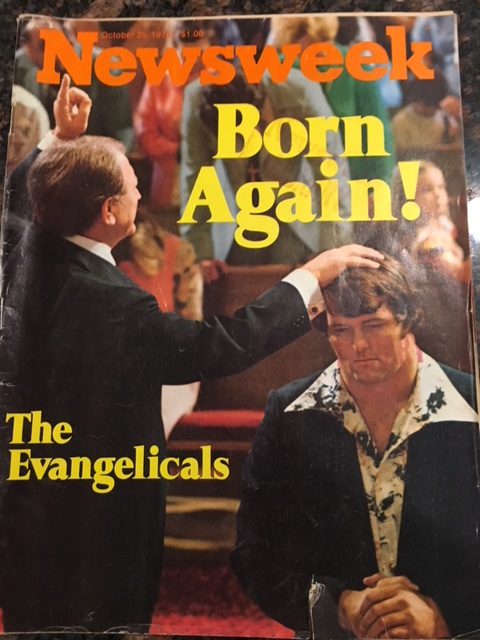
In 1976, Democrat Jimmy Carter became the first “born again” evangelical to become president. Newsweek declared it “The Year of the Evangelical.”

To be sure you caught that… The first “born again” evangelical to be elected President of the United States… was a Democrat. Less than a half-century ago, evangelical did not mean Republican. In fact, the election of a Democrat[note]this particular Democrat––not that all evangelicals were Democrats[/note] to the presidency spurred Newsweek to deem it “The Year of the Evangelical.”

And then in 1980, the Republican Party added anti-abortion planks to its platform. They have continued as the anti-abortion / pro-life party to this day.

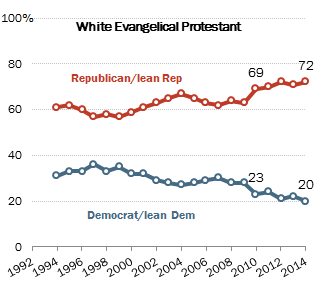
By 1992, white evangelicals leaning Republican outnumbered Democrats 2 to 1. By 2014, white evangelicals leaning Republican outnumbered Democrats 7 to 2.

picture from Pew Research Center

In April 2018, a Public Religion Research Institute survey showed white evangelical support for President Trump at an all-time high: 75% compared to general population favorability of 42%.

For many people, evangelical and Republican have become one and the same.

It was not this way in 1976 when Jimmy Carter was the first evangelical elected to the presidency. But as anti-abortion / pro-life policy made the Republican platform, evangelicals flocked to, and took up leadership in, the GOP.

The dangers of good activism 

If we think we may be among those who would have flocked to the Liberty Party in the 1800s because of its anti-slavery platform (see that earlier post), I don’t think we can blame evangelicals for doing the same because of the GOP’s anti-abortion platform.[note]To be sure, there are other ways to advocate for the lives of unborn children. Especially by offering hospitality and the option to adopt to pregnant women unprepared for a baby. I’ve watched several pro-life advocates (some whom I’m related to) make serious personal sacrifices to do exactly this. And they have also advocated for changes in public policy. The two don’t have to go together, but they’re not mutually exclusive, either.[/note]

But over time, that good activism has led many evangelicals to be more Republican than evangelical. This large voting bloc came to the political party primarily because of one issue. They saw anyone who was anti-abortion as ally and all others as foes.

An interesting thing tends to happen over time with allies and foes. Our allies begin to look like heroes to us. We’re so committed to them on the one issue that we begin to see all of their battles as ours. And our foes begin to look like villains to us. We’re so opposed to them on the one issue that we begin to see every battle as a battle against them.

So today white evangelicals are the demographic group most likely to support refugee bans and deportation of immigrants living in the U.S. illegally.[note]Yes, I know even the terminology for this group of people has become a political debate. Here I use the terminology used by pollsters in the linked poll.[/note] They have more positive views toward guns than the general public. And they’re the group least concerned about environmental protection. All of these stances have some kind of reasonable case associated with them (some of them, in my humble opinion, a very weak case). But the case for each is mainly a Republican case. We can’t argue that Christian faith obviously leads us to any of these stances. In fact, on the surface at least, Christian faith would lead us in the opposite directions.

It is not because of biblical arguments that white evangelicals have become the single demographic group most likely to say the U.S. has no responsibility to accept refugees. Not when the Bible persistently advocates for special care for the foreigner, the fatherless, and the widow. (See Deuteronomy 10:18; 14:29; 16:11, 14; 24:17, 19-21; 26:12-13; 27:19; Psalm 94:6; 146:9; Jeremiah 7:6; 22:3; Ezekiel 22:7; Zechariah 7:10; Malachi 3:5)[note]One well-meaning evangelical recently asked, “But are there any examples in the Bible of a group of foreigners who are growing in numbers and could take over the country?” He wasn’t encouraged when the only example I could think of came from Exodus 1: ” ‘Look,’ [Pharaoh] said to his people, ‘the Israelites have become far too numerous for us. Come, we must deal shrewdly with them or they will become even more numerous and, if war breaks out, will join our enemies, fight against us and leave the country.’ So they put slave masters over them to oppress them with forced labor.”[/note]

I expect this century’s general evangelical disregard, or even hostility, toward those who are not American citizens to look as bad for the Christian cause in the future as the American church’s failure in the last century to speak and act with one voice against lynching and segregation.

Religion led many evangelicals to the Republican Party over the last fifty years because of abortion policy and its wider attitudes toward abortion (as something to lament rather than openly celebrate). But once they got there, the political cart of the full Republican platform got ahead of the religious horse that brought many evangelicals here. White evangelicals, as a voting bloc, seem now more inclined to support and oppose issues based on partisan divides than based on an examination of Scripture and the Christian tradition.

The threat of religious idolatry

Is it possible that political partisanship is one of today’s most threatening idols? Someone’s political party identification is now far more reliable than their religious identification for predicting their stance on issues as wide-ranging as abortion, the environment, or immigration. Their political party identification seems more reliable than their faith for determining when a politician’s misdeeds are cause for moral outrage and when they’re an occasion for understanding and forgiveness.

This is not only a problem among white evangelical Republicans, but also among many Christian Democrats who insist their faith has led them to their political stances. When one politician talks with messianic overtones, the partisan Christian responds, “We already have a savior!” Yet when they hear similar statements from their own preferred party, they respond with silence or celebration.

Christians of all stripes, it SHOULD NOT BE THIS WAY! This is not far from idolatry, if it isn’t idolatry, properly defined. Neither of America’s political parties derives its standards from the Christian faith. Both parties include people of virtue and both include people whose behaviors should be cause for moral outrage. If we find ourselves always morally outraged by one side’s policies or people and always defending the other, it may be a signal that our politics have become our gods.

It may have begun with good activism. It’s threatening to become idolatry.

Agree? Strongly disagree and want to discuss it more? “I don’t agree with all of this, but it raises some interesting points…”? Share it using the social media links here. Or send me an email for follow-up discussion. Or if you haven’t already, click here to subscribe for more. Thank you!