Evangelical Activism (pt. I): From abolition to abortion

What do you think of when you think of evangelicals?

Almost none of us think of the group Donald Dayton describes. He tells of 19th century evangelicals who were “heavily involved in the abolition of slavery, fighting for the poor, and women’s rights.”

“Evangelical revivals called people not only to personal atonement but to putting faith into action. At their ‘altar calls’ people would come to Christ and immediately sign up for the anti-slavery campaign!”[note]That’s Jim Wallis’s summary of Dayton’s book in the foreword to Rediscovering an Evangelical Heritage.[/note]

You probably don’t associate evangelical with these great social justice causes, do you? Of the people I know, those who would identify as strong advocates for social justice would be the least inclined to identify as evangelical. But Dayton paints this picture of activist evangelicalism in Rediscovering an Evangelical Heritage (I highly recommend it).

Above all, he depicts them as devoted abolitionists. Others at the time may have considered them rabid abolitionists –– abolition-at-all-costs abolitionists.[note]Jonathan Blanchard, founder of Wheaton College –– “the Harvard of evangelicalism” –– is a good example of one of those radical abolitionists. He called slave-holding “not a solitary, but a social sin” and would not tolerate advocacy for anything less than quick and total abolition.[/note] They constituted a sizable voting bloc, with heavy support for and leadership in the Liberty Party––a party devoted above all else to abolishing slavery.

How closely aligned were the Liberty Party and evangelicalism? Dayton says “the party functioned almost like an evangelical institution in which antislavery votes served as evidence of sanctified living […] An antislavery ballot provided proof of a person’s unqualified allegiance to God.“[note]pp. 131-132, emphasis mine[/note]

If Dayton’s picture is accurate, those 19th century evangelicals were one-issue voters. I wonder if I would have been (acknowledging the impossibility of that hypothetical). Was this one issue so important that any like-minded politician would be considered an ally and everyone else a foe, regardless of all the rest? Living in the early 19th century, could I have ever voted for a politician who would not advance the cause of abolition?

Another definition of evangelicalism names activism as one of its four distinctive marks.[note]See David W. Bebbington’s The Dominance of Evangelicalism. This activism includes both evangelism and social work. “[S]ocial work that carried over into pressure for reform was equally characteristic for this period,” he writes (p. 38).[/note] Evangelicals are, by nature, activists, pushing for reform. The U.S. has never seen such an important cause for activism as slavery. And so the cause united evangelicals politically like few others could.

Evangelicals and activism today

For the past half-century, the large majority of those who identify as evangelical have again united around one political cause: the cause to abolish abortion.

If you don’t like that statement, stick with me.

[If you have have had an abortion, assisted, or insisted in one, a much better starting place: “A pastor’s note to women who have had abortions––and to those who assisted or insisted.”]

Abortion is a complicated and nuanced issue. Anyone treating it as black-and-white hasn’t had enough honest conversations or sought out enough information.[note]Though we treat it as clear-cut in retrospect, the abolition debate also dealt with many nuances. To the point that Abraham Lincoln’s stance opposed the kind of quick abolition those early evangelicals called for. It could be catastrophic to the lives and futures of many slave-owners and slaves alike. He wrote, “the promulgation of abolition doctrines tends rather to increase than abate its evils.” (see Collected Works of Abraham Lincoln, volume 1, p. 75.) This isn’t to equate the two. After the abolition of slavery, there would now be no nuance in a debate about reinstituting it. If abortion were entirely abolished, we would forever face the complexities that would come with that decision.[/note] Many pro-life evangelicals recognize those nuances and know they require compassion and careful thought. We would benefit from more pro-life evangelicals recognizing these nuances.

The vast majority of those who call themselves evangelical agree on this: The abortion statistics in the U.S. are tragic. Of the more than 600,000 abortions likely to take place in the U.S. this year, less than 8% are likely to be because of rape, incest, or health concerns. Many in the pro-life cause would like to consider how abortion can remain safe and legal in those rare cases.
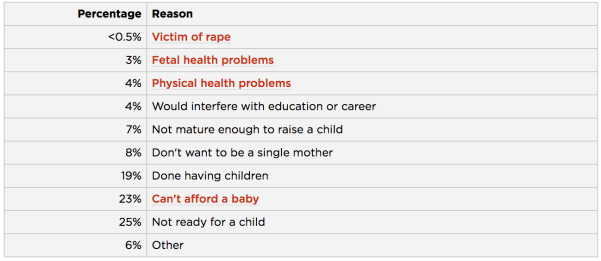
From a 2004 Guttmacher Institute survey, shared on http://abort73.com/abortion_facts/us_abortion_statistics/

For the other cases––whether you agree with them or not, most evangelicals hear “can’t afford a baby” as a reason for abortion the same way abolitionists heard “can’t afford to lose my slaves” as a reason to keep the institution of slavery. It is a significant concern––and at our best, one that we rally to support someone through––but not a reason to take a life.

For American evangelicals, the pro-life cause over the past 50 years may have been the most galvanizing political issue since slavery. (Aside: We have plenty of reason to ask why this would be the case. Why not anti-lynching campaigns or other civil rights causes? That the American Church did not speak with one voice on these issues is a tragic failure.)

Many evangelicals are likely to say they could never cast a vote for someone who will not fight for the ~540,000 unborn children who will be aborted this year when rape, incest, the health of the mother, and other extreme cases, are not at root. Though they see many other tragedies in the world, this is the one that has caught their attention and seems to them the worst.

For all the rhetoric about abortion being legal, healthy, and rare, many are heartbroken and appalled that abortion is currently the leading cause of death in the United States.[note]It just edges out heart disease and cancer. You usually won’t see it listed this way, since most people reporting these statistics don’t consider abortion a “cause of death.”[/note] Abortion in the U.S. is not rare.

So for many evangelicals, I wonder if an anti-abortion vote today would be similar to an anti-slavery vote in the 1800s: evidence of sanctified living, proof of a person’s unqualified allegiance to God, an attempt to set at right the most wrong of all wrongs in our society today.[note]”Most wrong of all wrongs” as they perceive it. I’m not making the absolute claim that abortion is, in fact, the “most wrong of all wrongs” today. But I think we can make a strong case for it.[/note] For many evangelicals, I wonder if the connection between faith and this one issue is just as strong––hard to imagine that any real Christian could support a politician on the other side of this issue. (To be clear: This is not my position. Just as I also don’t hold the position that no real Christian could possibly vote for Trump.)

At a conference earlier this year, I attended several sessions on the state of evangelicalism. At least among this group, there were no #MAGA celebrations going on. These crowds were generally aghast about our President’s contempt toward people who weren’t born in the U.S. or Western Europe. (I think it was the week of his “shithole countries” comment.) But also in every one of those sessions, someone from the audience asked, “But what do we do about abortion?” It wasn’t a rally cry to the GOP. It was a morally conflicted question. These people couldn’t imagine voting for someone whose Supreme Court nominees would uphold more progressive standards regarding abortion––not just preserving the status quo, but likely to advance a more progressive standard––and for decades.[note]For instance, if Antonin Scalia and Anthony Kennedy had been replaced by more progressive judges, the Court would be expected to rule against pro-life pregnancy crisis centers that do not want to be required to post notices about state programs providing free or low-cost abortions.[/note]

The evangelical position here is no deluded extremist position. People like Ross Douthat––a columnist for the New York Times, a #NeverTrumper and ongoing Trump critic… hardly a FOX News contributor––have called for “judicial action, not restraint [in] Overturning our inhumane abortion settlement.” I don’t know that Douthat could be identified as an evangelical (he’s Roman Catholic), but he names the position held by many evangelicals. They want to see change to how our country views and uses abortion. For many, it’s enough to make any like-minded politician an ally and all others foes.

You may or may not agree with this stance on abortion. You should know it is there. If you disagree because of the nuance and complexity of the situation, that is understandable. Not that we can simply shrug at inhumane practices because they’re nuanced and complex. (See also: current immigration and refugee crises.) If you disagree because you don’t find abortion to be that morally problematic, I admit I don’t understand you at all. I’d love to know more. If you disagree because you say, “But what about [insert other issue]?”… let’s talk about that. Next week.

This is part I. Part II: “How evangelicals became Republicans, and the dangers of good activism” will post next week. To be sure you don’t miss it, click here to subscribe.

“Is it okay to give to other missions instead of my local church?”

We’re in the last month of the year. People are paying closer attention to their bank and credit card accounts. Some are lamenting rampant consumerism in America. Others are already making plans for how they’ll handle their money well in 2018. In light of that, each week for the rest of the year, I’m sharing an article on money and generosity for your consideration. If you’ve followed this blog for several years, you may recognize some of these. They were helpful for me to review again. I hope they will be for you, too.

This post is a response to a reader question:

Hi Teddy,

I have a question about giving. My family has always appreciated the discipline of generosity. So we wanted to give generously––beginning with a tithe as minimum––but we DIDN’T give it back into our local church. We felt no conscience about this, but when my senior pastor found out, he was very displeased about it.

As I think about becoming a senior pastor in the future, I’m less concerned that my staff tithe to the church and more concerned that they are generous in other kingdom ways that expand beyond a mere tithe.

As of now, I could direct most of my giving somewhere besides the church without having a conscience issue SO LONG AS my family is being generous TO THE BODY as a whole.

Maybe that’s the question – where is the line between the local body and the larger body of Christ? Why does one seem to demand priority in our giving?

What a great question! Thanks for asking. I certainly relate to this. We give to several missions outside our local church. It would be hard not to. There are a lot of great missions / missionaries we believe in, and it’s fun to be a part of what they’re doing. We don’t necessarily separate out “tithing” to the church and “giving” to other places, so I’ll just talk in terms of giving. And let me commend you for considering “tithe” (10%) your minimum and then giving more. The vast majority of American households have the capacity and should be giving more than 10%.

In my case, I would have a conscience issue if we weren’t giving––and giving substantially––to our church. I obviously see up-close how the money available affects what our church can do. We depend on people’s generosity to continue the mission. If I believe in our mission, I need to be supporting it with our finances. If I don’t believe in our mission, I need to be working on a short-term “reform or exit” plan.[note]A note: If I find myself constantly exiting places because of my disagreements with them, it’s probably time to ask if the problem is me––if my standards are too high, or if my initial selection criteria is poor. Beware the person who leaves angry and often.[/note]

That wasn’t always my position. For a couple of years, I didn’t give to our church. I had told our Sr. Pastor at the time that I didn’t believe in how we were spending money and couldn’t contribute to it. In retrospect, I’m embarrassed by that. If I couldn’t believe enough in the church to give it our money, I should have left. (I’m not suggesting I should have actually left in that situation. Rather, I think I should have been giving, despite my disagreements. They weren’t big enough to warrant leaving, so they shouldn’t have been big enough to warrant withholding my money.) Moreover, that position made it difficult for me to lead and to call for others to buy-in. I wasn’t bought-in myself. I didn’t realize the difference that made in my leadership until later.

Jesus’ words, “where your treasure is, there your heart will be also” have proven more true than I expected (see the linked article on generosity for more on that). Once I started giving, even sacrificially giving, to our church, I began to love the church a lot more. I began to lose my cynicism and feel much more like a full member of the team.

“Buying in” doesn’t prevent me from raising questions and challenging certain things. But now I’m doing it as a fully-committed member. For any of us who fashion ourselves “reformers” of any sort, we need to do it as committed members. That kind of commitment doesn’t have to require lock-step agreement. But it requires being in. So long as I was criticizing our use of other people’s money while not contributing myself, I was just standing on the outside throwing stones.

In short, my love and commitment for our church and our mission have followed my money more than they preceded it. If I waited until I was in full agreement with how we spent money, I probably never would have given. (For what it’s worth––I’m very proud of how our church uses money now. Along with the important work we’re doing locally, we send 25% out the door for missions bigger than our own. And we’re in the minority of UMC churches that pay our full apportionments, no matter how tight the budget. How can we ask our members to be faithful with their giving––even in tough times––if we aren’t being faithful to our commitments to the larger body?)

I’m able to ask for other people’s full investment––prayers, presence, gifts, service, witness––because I’m willing to stand at the head of the line, as someone who’s all-in. With that experience, it’s hard for me to imagine leading again if I weren’t all-in myself. That’s not so much advice as personal testimony.

I don’t know if that answers any questions about lines between “local body” and “larger body” giving. I don’t know if I would ever tell anyone else that their local church demands priority. I wouldn’t point to any biblical regulations to say that your church should receive your first-priority giving. But I might point to your personal situation. The mission I’m most directly a part of is First Church’s. So by virtue of participation, First Church’s mission is our top priority. For us, that means it needs to be our top priority for giving, too.

Thanks for giving me a chance to reflect on that. I hope it might be helpful to your situation.

———–

“Better to lose one part of your body than the whole body go to hell” — Church discipline, pastoral authority, and schism

church-disc

One of Jesus’ most extreme instructions to his disciples was this one in the Sermon on the Mount:

“If your right eye causes you to stumble, gouge it out and throw it away. It is better for you to lose one part of your body than for your whole body to be thrown into hell. And if your right hand causes you to stumble, cut it off and throw it away. It is better for you to lose one part of your body than for your whole body to go into hell” (Matthew 5:29-30).

That was instruction to anyone committing adultery or even looking at a woman lustfully. Most Christians have tended to take this in the same way: figurative and for our individual bodies.

We usually read this as hyperbole, intended to make a point but not to be followed. Surely Jesus wouldn’t ask us to gouge out our eyes! I still have both eyes and both hands, despite the sins that have come by them.

But even if we take this as hyperbole, we dare not miss the point: avoid sin at all costs. Because sin leads to death, eternal death, hell. What’s worse than going through life without an eye or a hand? Losing your life for all of eternity—the whole body going into hell. And if willful sin persists, that’s our trajectory.[1. Many balk at this. “We all sin. We’re human!” First—by that very statement, you deny Christ’s humanity or his perfection. Be careful. Second—passages like 1 John 3:6 say the opposite: “No one who lives in him keeps on sinning. No one who continues to sin has either seen him or known him.” Third—see my article “Why I Love Wesleyan Theology” for more.]

This is usually where we stop when it comes to this passage, if we even make it this far, but I wonder if its application can be broader.

What if we read this in a different way: literal and for our corporate body—the church?[1. I’m not suggesting that Jesus intended this statement for that purpose. But I am suggesting that it properly applies, as Jesus’ and Paul’s later words demonstrate.]

It is better for you to lose one part of your (church) body than for your whole body to go into hell

The early church practiced this kind of instruction about cutting off parts. We see it from both Jesus and Paul.

Jesus’ instruction

Jesus instructed his disciples to cut people off, if necessary. For a “brother or sister” who sins, he gave a whole process for trying to turn them from their fault. The goal was restoration, not punishment! The last step: bring it before the church, “and if they refuse to listen even to the church, treat them as you would a pagan or a tax collector” (Matt 18:17).

We know from his other interactions that Jesus didn’t treat pagans and tax collectors with scorn. He treated them with love. But he also didn’t treat them as “brothers and sisters” in the faith.[1. Unless they had come to faith, at which point they would no longer be pagans and no longer keep the unscrupulous practices of other tax collectors] He treated them as sick, as sinners, as those he was calling to be healed through repentance and faith.[1. See Matt 9:12-13]

Paul’s instruction

Later, the apostle Paul wrote to the church in Corinth. He was apoplectic.

It is actually reported that there is sexual immorality among you, and of a kind that even pagans do not tolerate: A man is sleeping with his father’s wife. And you are proud! Shouldn’t you rather have gone into mourning and have put out of your fellowship the man who has been doing this?” [1. 1 Cor 5:1-2]

His final instruction to them was a quote from Deuteronomy, “Expel the wicked person from among you.” That line occurs seven times in the book of Deuteronomy, where my version translates, “You must purge the evil from among you.” [1. Deut 13:5; 17:7; 19:19; 21:21; 22:21, 24; 24:7] Seven repetitions—that’s enough to be taken seriously.

(A note for those who ask why the church should be so obsessed about sex, the passages we’ve looked at above were both about sexual sin. Sex is not, and should not be, our only issue. But it is one of the most prominent issues of morality in Scripture, which warrants our attention.)

On church discipline

It is better for you to lose one part of your (church) body than for your whole body to go into hell. This was part of Paul’s rationale in the situation above. He asked, “Don’t you know that a little yeast leavens the whole batch of dough?” [1. 1 Cor 5:6]

When we tolerate outright sin in the church among “brothers and sisters,” we aren’t just doing them damage because we’re unwilling to have the hard conversation. We also risk potential damage to the whole church—devastating damage. We teach the church that we don’t really believe avoid sin at all costs. We treat sin not as our menacing enemy, but as a minor nuisance—or even less, as something we shrug off and tolerate.

When we tolerate outright sin in the church, do we risk the whole body being thrown into hell because one part caused it to sin? A little yeast leavens the whole batch.

John Wesley longed for preachers who “fear nothing but sin and desire nothing but God.” [1. From his letter to Alexander Mather on August 6, 1777] When we treat sin with anything less than fear, as anything less than cancer, we have treated it as too little. When we fear offense, impropriety or misperception more than we fear sin, we have treated sin as too little.

Brothers and sisters, we must flee from sin. We flee not just for ourselves, but for the sake of the whole body. A little yeast leavens the whole batch.

The Protestant Distortion

In the earliest Protestant tradition, the church was defined by three practices, as the community where (1) the Word of God is preached, (2) the sacraments are administered, and (3) church discipline is observed, all according to Christ’s institution.

We have largely abandoned the third part of that definition. This may be the logical end of Protestantism, at least in its cheapest form.

Where we have emphasized above all else the private reading and interpretation of Scripture, what place is left for church discipline? What place is left for anything but someone’s private reading and application of the Word of God? What authority does anyone else have to tell a Christian brother or sister that they’re in the wrong?

As we abandon the authority of the church and the authority of the pastor, no space is left for church discipline. Though I don’t believe my doctor is infallible—or in perfect health himself!—I generally trust him when it comes to my physical health. I give him authority to tell me where he sees problems in my health, to tell me where things look good, and even to prescribe new things for me.

Pastors today rarely hold that same kind of authority regarding people’s spiritual health. This isn’t to suggest a domineering relationship (just as our relationships with our doctors tend to avoid that extreme), but a relationship that recognizes the pastor as a spiritual authority, someone who should be expected to examine, diagnose and prescribe, as needed.

Instead, American religion today is more akin to that sad observation in the book of Judges: “In those days Israel had no king; everyone did as they saw fit.” [1. Judg 17:6; 21:25] That line makes Phillip Tallon’s remark in my interview with him especially interesting: “We’ve leaned hard into pastor-as-teacher, but while neglecting the authoritative element. Especially in Wesleyan circles, I think we’ve emphasized the pastor-as-prophet and pastor-as-priest, but overlooked pastor-as-king.” [1. emphasis mine]

How can we flee from sin when we give no one permission to name it? How can we help the church to flee from sin when we go on tolerating it in our midst?

If the church is a body, and if it is truly better to lose one part than for the whole body to go into hell, then we must restore the practice of church discipline.

On Schism

The largest form of this “cutting off” members of the body comes in the form of schism. This is an extreme form of church discipline.

We should avoid schism at great pains. Because God loves unity. Because Jesus prayed for unity among his followers. We demonstrate that unity most specifically at a common table, at shared Eucharist. When any church comes to the point that it can no longer share at the one table, schism has already occurred. All that’s left is the crying, and perhaps the lawyers.

We avoid this schism at great pains, but we cannot avoid it at all costs. Namely, we can’t avoid schism at the cost of tolerating sin. Because we must avoid sin at all costs, even at the cost of losing a member of the body.

In times of severe strife in the church, our best option is to compromise and be faithful to one another while we work for a way to reconcile. But this is a solution only if the presenting issue is anything less than sin.[1. I could also say “sin and heresy” here, but I’m allowing heresy to come under the broader umbrella of sin.] If a minority group believes they would have to sin to submit to the church’s authority, then they have no options but sin or schism. And they must not choose sin.

Similarly, if the dominant group in a church believes the other is willfully practicing or endorsing sin, they have no options but to condone the sin or expel the group[1. assuming, of course, that they have first attempted to correct and restore them] (i.e. create schism). And they must not choose sin.

If we’ve come this far, let’s be honest about what’s happening. Each side believes the other is in sin or heresy. They’ve already stopped believing the other is truly Christian. They’ve stopped treating them as “brothers and sisters” and begun to treat them as pagans or tax collectors. Schism has occurred in spirit, only institutional trappings remain. In those cases, we would be better to acknowledge that schism and treat each other as pagans or tax collectors—but this in the best possible sense: not with scorn, but with love, gently but persistently calling the other to repentance and faith.

In marital counseling, I tell people that I’m biased toward reconciliation. I will go to great pains to avoid divorce. But I won’t avoid divorce at all costs. Namely, we can’t avoid it if there has been violence in the relationship (in the form of infidelity or abuse, in any of its varieties) and there’s reason to believe that violence will continue.

In the church, schism becomes necessary at the same point. We should take great pains to reconcile, even if it means tolerating anything less than sin. But when violence has occurred (in the form of infidelity to our mutual covenants or abusive behavior toward each other) and there’s reason to believe it will continue, it’s time to separate. In fact, a relatively amicable separation may offer the greatest hope for future reconciliation.

Postscript: A note on judging “outsiders”

The church in recent times (maybe always?) has done pretty well about identifying immorality “out there” among the pagans. This is exactly the opposite of what we see in the passages above. Paul specifically said that when he wrote about not associating with sexually immoral people he was “not at all meaning the people of this world who are immoral… In that case you would have to leave this world.”[1. 1 Cor 5:10] He asked, “What business is it of mine to judge those outside the church? Are you not to judge those inside? God will judge those outside.”[1. 1 Cor 5:12-13]

For those who don’t claim faith, we don’t judge. We go to them as they are. We love them as they are. And we gently but persistently call them to repentance and faith.

Some people don’t like the first part of that—they prefer to keep their distance, and perhaps hurl some stones. Others don’t like the last part—calling people to repentance implies that they’re sinners, which could be offensive and seem intolerant. Jesus did both without apology. If we have the same love for others as Jesus, then we will go and do likewise.

—————