If you observe the church calendar in your church, or in your home, the coming season is one of the strangest and most difficult to navigate.
In America, Christmas season begins in full on Black Friday. Some radio station has had 24-hour Christmas playing since November 1, and even the one-holiday-at-a-time snobs will listen to it now. We’ll spend the next month wearing ugly Christmas sweaters, decorating Christmas trees, and going to more parties than we may have attended for the whole eleven months prior. By the time December 25 comes, we’ll have had so much sugar and spent so much money, that we’ll already be thinking about how we need to cut back (on the calories and the spending) come January.
Meanwhile, in the church, Advent season is beginning. It’s a season of longing, waiting, restraint. We’ll sing “O come, O come, Emmanuel,” remembering those believers who came before us, who longed for a Savior to come. And we’ll recognize that we still await a Savior, Christ who will return to restore a broken world. For us, Christmas season begins on December 25, just when the world around us is ready to put their Christmas trees on the curb. For us, Christmas songs begin just as they’re going off the radio. The babe goes in the manger, and we begin to sing, “O come let us adore him, Christ the Lord!”
While the world around us has its most festive season––and a time often derided for its excesses––the church has one of its most subdued seasons.
For my family, the church’s Advent has been a good balance to the culture’s Christmas. We celebrate Christmas for the good opportunities to gather with family and friends. We wear Christmas sweaters, watch Elf, and decorate trees. But we’re also learning to celebrate Advent, in fact to let Advent be our primary season.
Rather than sharing about our own practice here, I want to share my friend Sarah Jackson’s story. Sarah has reflected on this more deeply, and made more change, than we have. When we met Sarah, she loved that holly jolly Christmas time more than anyone we knew. She usually had a June or July breakdown and had a solid week of “Christmas” (cookies, music, maybe even some decorating). But the church’s calendar has changed, and is changing, her practices. I hope her account is as helpful to you as it was to me…
From Sarah:
A shift took place a number of years ago for me––it was the Advent season of 2009. Before this year, I was the merriest of all the little elves at Christmastime. My family had numerous fond traditions around decorating, baking, tree trimming, gifting, etc. that I was happy to make my own. The months of November, December, and half of January were consistently the happiest months of the year for me––full of sparkle, music, surprises, parties, and general coziness.
But in December of 2009, I was mentored into the celebration of Advent by a woman named Julie Tennent. Her 4-week study opened my eyes to the themes of Advent that are similar to Lent: Waiting. Darkness. The climax of longing at its brink of despair, as it is about to give birth to an epiphany of unexpected Hope. December became mostly Advent, and Christmas became similar to Easter. The overall “coziness” of the cultural holiday was overshadowed by the earth-shattering memory of the one true God, as a real son, in a mother’s arms.
Since that year, I’ve been conflicted. Even sad. I want my old cozy! I want 24/7 holiday radio! and gingerbread pajamas! and Home Alone! I want a marshmallow world, and sugar cookies! I want reindeer lights! But I’m different now, and the meaning behind the tradition is different. I’m still figuring out what to do. We still have some cultural traditions that are cozy, but I admit my excitement about them isn’t the same as it used to be (and sometimes I get sad about that). Scaling back on some things has brought balance to our lives. I’m rarely stressed in December, now that I’m not shopping and baking and decorating as hyper-actively as I used to. But I also have a sense of missing out on the cultural merriment sometimes.
The reason I long to properly celebrate Advent is in order to fully appreciate the real Christmastide. But it’s December in America! It’s hard to fast at a cookie exchange, or to darken the house when the neighborhood is lit up, or to sit in reflective quiet while jingle bells are ringing. I am ready to shout CHRISTMASTIDE!!!!! from the rooftops on December 25, but Target is putting out its Valentine’s Day candy. Everyone is “over it” by the time the church is ready.
And yet… Advent is about cultivating longing. So as much as I can, and more every year, I will join the historic church by putting off comfort and joy until its proper time, to let the expectancy build for the best and truest celebration of Christmas (..and Epiphany…and Lent…and Easter…and Pentecost…)
I recently had the honor to interview Ron Sider to discuss the debate about welcoming Syrian refugees. Dr. Sider is an evangelical Christian and one of our world’s most prominent and thoughtful theologians discussing social concerns. He has written and edited over 30 books, including Rich Christians in an Age of Hunger, which Christianity Today listed as one of the 100 most influential religious books of the past century.
In the interview, Dr. Sider shares some helpful reflections on Christian and American history, the role of government, what Christians can do now, and the larger question of open borders.
You can see the transcript below, download the audio here or see the video here:
TRANSCRIPT
Teddy Ray: Well this is Teddy Ray. I’m talking today with Dr. Ron Sider. Dr. Sider is one of the most prominent and thoughtful theologians in our world today, especially in the area of social concerns.
He’s the founder of Evangelicals for Social Action. He’s written a number of books that you might have heard of, including Rich Christians in an Age of Hunger. He wrote a book called Completely Pro-Life about the sanctity of life, and Good News Good Works about the combination of those two, and most recently two books called The Early Church on Killing, which is a survey of everything that we see in those early church documents about killing, and a book called Nonviolent Action.
So given everything that you’ve been looking at through your whole career, Dr. Sider, I would imagine you have something to say about the Syrian refugee discussions going on right now.
Ron Sider: Yes, I’m saddened by what a number of people are saying. I think that the Bible says pretty clearly that God and God’s people are to have a special concern for widows and orphans and the sojourner, which is to say the refugee, the person who is not a citizen of the country, but who lives in one’s area. And again and again and again, the prophets say that God has a special concern for those people, and that God’s people are supposed to have a special concern for those people. So just in terms of basic biblical teaching, there is an enormous emphasis in the Scripture on God’s demand that his people have a very special concern for the sojourner, for the stranger, for the refugee.
And then of course, you know American history is a whole history of people who are fleeing from one kind of problem or terror and another. Almost all of us in this country are immigrants, the exception being the Native Americans, who still survive after centuries of really tragic, tragic abuse on the part of us European immigrants. And of course, in some ways African-Americans, they certainly didn’t come here willingly. They were brought as slaves, but almost all of us are foreigners, and so I think our own history—“Give me your tired, your poor, your huddled masses, yearning to breathe free”—all of that, speaks in terms of this country being a very special place, unusual in its openness to embracing people from other places. And it’s sad when that long, distinguished, and really very biblical history in some important ways, is being ignored and trampled upon by people today.
TR: You just did something really interesting there. You talked about the history of the biblical people and everything we see in the Bible, and you connected it to American history. And I’ve actually heard a number of people doing the opposite, saying, “Look that’s the history of this theocracy, God’s people, and we can’t claim that today, and we can’t impose our religion on other people here. So even if we think we should welcome refugees, politically, the top duty of our government is to protect people. And we’re not sure that we’re protecting them either from physical harm. Or even, we have higher unemployment right now, why would we bring more people in to take more jobs when Americans need jobs?” And they’ve actually argued that there’s a diversion and we shouldn’t impose our religion on other people. Anything that you would say to American Christians that are making that point right now?
RS: Well the question of how especially the Old Testament material, but the biblical material, applies to this nation at this point in time is an important question. And it’s certainly true that, thank God, we’re not a theocracy or a dictatorship. We’re a democracy and there is that significant difference.
Israel was, in an important way, a theocracy. But all through the Old Testament you see the text saying that the people of Israel are supposed to be a light to the nations. In other words, God’s speaking in effect to everyone saying, “This is how I want people to treat each other, with love and justice and fairness and concern for the sojourner,” if you will. And furthermore, the Old Testament again and again applies the kinds of norms that the prophets applied to Israel, applies them to other nations. In Amos chapters 1 and 2, you see Amos talking about evil things that othersurrounding nations have done, and he says God’s going to punish them for those things. And then he switches to Israel and says how God’s going to punish Israel for their injustice and neglect of the poor, and so on. And you also get the prophets applying the biblical text to Nebuchadnezzar on the kind of concern for the poor, and saying that God’s gonna punish them because he doesn’t have that kind of concern.
So I think it’s certainly true that we don’t simply take the specific details of this or that Old Testament text—applying the death penalty, for example, to children who are not respectful to parents––but basic principles of justice and peace that the Old Testament tells us should be applied to all nations. Now that doesn’t mean we go into the political realm today and we say, “God says in such and such biblical text that you’ve got to do this, and if the American nation doesn’t do that then hellfire will come down.” But I think we as Christians are informed by what the Bible tells us about justice and treatment of refugees, and then we go into the political realm and we use language that Christians and non-Christians can understand, and we make a case for acting in that kind of way.
Because finally what God was telling Israel in terms of the basic shape of justice is what God wanted Abraham and his people to share with the whole world. Because God said, “I’m calling you to be a light to the nations.”
TR: So when you talk about that justice orientation, the importance of hospitality, how do we balance that, or do we, with a duty of government to protect people? With the people who say, “But what if this isn’t safe?” Should we expose people to risk that they shouldn’t be exposed to because of this?
RS: Well certainly it’s a proper task of government to protect the people of that nation. And as a matter of fact, we have a very elaborate process in place that is designed to do exactly that. It takes a couple years at least for refugees to get processed and to have the authorities do all the very, very elaborate kinds of things they do to make sure that we’re not letting in dangerous people. So it’s not a matter of trying to make sure that terrorists don’t come in. It’s a matter of doing that and being generous with our long history to be concerned with refugees.
So I mean, we’ve only I think approved a couple thousand refugees in the last several years. Germany is going to take in 800,000 this year. I mean, surely the United States, with a much much larger population—four times or so that of Germany—surely we could decide to take in some tens of thousands. President Obama said 10,000 more. I mean, that’s really not enough. We ought to take in twenty and forty thousand over the next several years, at least that many.
We’ve also got a tragic history of not doing what we should. You know, in the days of Hitler, there were many Jews that were fleeing Hitler and wanted to come to this country. And there were even ships that approached our shores with Jewish refugees, and we turned them away. And they had to go back to Germany and many of them died in the in the death camps. We dare not repeat that kind of history. At that point, you know, there were people who said that those Jews were dangerous somehow to our culture. So people who stir up a kind of nativist fear in this kind of situation, it’s simply, fundamentally un-Christian and un-American.
TR: That’s a strong statement, especially since we have 26 states I believe it is now, where the governors have announced, “We are refusing refugees.” What does the average Christian in one of those states, or really anywhere in the US, do practically here? Can we be anything more than a voice? What do we do?
RS: First of all,they don’t have any authority to do that, so it’s empty rhetoric. It’s obviously just political standing and posturing and it’s an example of a kind of sad, finally I think disgraceful use of a particular fear that’s around to take a stance that just isn’t in keeping with American history or with our values. But I think Christians and Jews and other people of good will in those states ought to be writing their governors and the legislatures, if the legislatures are involved, and say, “This is not what we believe in. This is not the kind of country we have been and want to be. And we oppose your stance, and we vote, and we want you to change what you’re saying.”
TR: Thank you. That’s a great word. I’m just down the road from Asbury Seminary here, and was really proud to see them recently say, “You know what, we’ve got to do something ourselves,” and so they said, “We’re going to make room for a refugee family here,” and have offered through the government to personally house a refugee family. It’s exciting to see some people say we can do something here.
RS: That kind of personal modeling is powerful and wonderful and if evangelical Christians, congregations, and so on, organizations would do that on a wide scale it would really be noticed, it would be a part of the public discussion, and it would make a difference.
TR: Let me ask you one broader question because we talk about refugees here, we talk about hospitality and justice. With the bigger issue of how do we open our borders, or how much do we remain a country that isolates and protects. Do we get to totally open borders, or what would you advocate when we look at the bigger issue there?
RS: That’s obviously a very difficult question. I don’t think a biblical framework means that we must have totally open borders, but I also think it’s the case that there’s no biblical justification for saying that the people in one particular geographic area—which happens as we know, to be very beneficial and bountiful in the US—that we’ve got all the right to all that wealth and abundance just to keep for ourselves, and not to share with people in other places. That contradicts any kind of biblical teaching from Jesus that we’re supposed to love our neighbor, and the neighbor is anybody in need, not just one’s own ethnic or religious group.
So at the very least it seems to me a biblical understanding of nations is that yes, the people in that nation have worked together and they’ve created wealth, and it’s right to think that to some extent, some significant extent, they have a right to enjoy that. But it’s also true that, the US is an example, that we’ve created a lot of wealth because we had enormous abundant resources—land and favorable climate and all kinds of natural resources—and furthermore, we benefited from trade relations with other parts of the world. Sometimes those trade relations weren’t even particularly fair and they’ve benefited us in a way that they didn’t help poor people. So some of our wealth has come to us because of unfair trade relations, although that’s another complex topic.
So in basic summary, what I’m trying to say is I think it’s a crucial biblical theme to say that for Christians, everybody in need is one’s neighbor. And that means that we ought to be always pushing our nation to be generous, to use our abundant resources, to empower poor people around the world, to feed refugees and make things better for them.
I mean, just one more very concrete example: the United Nations refugee program is telling us that they have I think it’s less than fifty percent of the money they need right now to feed the refugees that they’re trying to care for. I mean, it would be no problem at all for the US to say, “We’ll give another five billion this year so that we can feed and care in a decent way for the refugees in Jordan and Lebanon and in Turkey, some of whom are flooding into Europe in a way that creates problems. At the very least we ought to immediately provide generous funding for both governmental programs like the UN refugee program and private agencies. Christians should give vastly new sums to programs of evangelical and other Christian agencies that are working with the refugees in those parts of the world.
So one thing to do immediately is a lot more funding for the refugees who are fleeing Syria and Iraq but living in surrounding countries in desperate kinds of circumstances.
TR: That’s an interesting point because some of the people I’ve heard speaking to this have said, “Can’t we help without having to extend hospitality?” And I hear you saying, not one or the other, but we need to do both of these.
RS: And one other comment: it’s just fundamentally un-American and un-Christian to say we should take in Christian refugees but not other refugees. It’s contrary to the first amendment, to the whole approach of this country to be a welcoming place for people of all faiths. That’s not to say that there are not specific circumstances at particular moments in time where a particular group of people are being so mistreated that it’s appropriate for us to have a special concern and activity for them.
We’ve done that sometimes in our history. The group of Sahidis, they were being mistreated in a very special kind of way, and it’s not wrong to say we’ll have a special concern, special category for them. That’s not because they’re that religious group. It’s because they’re in a special circumstance of enormous mistreatment and danger. But to say that, “Okay, it’s safe, and we’ll welcome Christians, but not Muslims,” is just tragically wrongheaded.
And it’s really sad when we have prominent evangelical leaders who make sweeping statements about Islam as an evil religion. I think there are significant parts of Islam that are finally wrong. But it’s certainly not true that there are no good parts of Islam, and it’s certainly not true that all Muslims are terrorists, the way some people imply, although hardly anybody is that crude to say it directly.
And it’s desperately urgent that Christians, especially evangelical Christians at this point in time, reach out and get to know Muslims better. Now it’s true that ISIS and related kinds of groups are a dangerous threat to the world. That kind of terrorism grounded in a very wrongheaded, finally un-Muslim view of Islam is a real threat in the world. But almost all of our political leaders acknowledge that long-term you’re not going to defeat that primarily with arms. You’ve got to defeat it in the level of ideas, the level of economic development, the level of hope for the young people in those countries that can’t find a job and in desperation turn to violent terrorist groups. And that means that we need to get to know Muslims in this country one-on-one.
That means we need to have our Christian agencies doing better economic development in poor Muslim countries. It means that in all kinds of ways, Christians need to have a much better understanding and relationship with Muslims than we do at this point in time.
TR: I’m going to underscore that again, you said it’s desperately important that evangelicals today get to know Muslim believers. I think that’s a great point to end on. I know we’re out of time here. I just want to thank you again for your time today, Dr. Sider.
I commend again to anyone watching or listening to this some of Dr. Sider’s books. You can find a number of them on Amazon. Most recently again, some issues related to justice: The Early Church on Killing and Nonviolent Action. I hope you might have a chance to pick up one of those up.
———-
I’ll post more of these interviews in the future. To make sure you don’t miss one, click here to subscribe to my blog updates list.
I recently had the honor to interview Stanley Hauerwas about his newest book, The Work of Theology.
One reviewer has called Dr. Hauerwas, “probably the most creative, provocative, and exasperating theologian in the English-speaking world.”[1. from The Times Literary Supplement‘s review of his Blackwell Companion to Christian Ethics] This book continues to show off his creativity and showshow some of it has developed. It also serves as a response to those Hauerwas has provoked and a defense against those he has exasperated. I thoroughly enjoyed the book and enjoyed the opportunity to talk with him about it even more.
Our interview covers his responses to critics, why he gives so much emphasis to the church, and some advice for young pastors and their congregations. You can listen (right-click here to download), watch, or read the transcript below. [1. My deepest gratitude to Jason Huber for producing this. His studio, graphics, and detail work made it all possible.]
Interview transcript
Teddy Ray: Stanley Hauerwas was named the “best theologian in America” by Time magazine in 2001. Despite that, he’s also been accused of not caring about the poor, not caring about human rights, and not actually doing “theological” work. He thinks retirement is a bad idea, and he’s having some more time to reflect on that now that he’s retired. His newest book is called The Work of Theology, and I’m honored to have a chance to talk with him about it.
Dr. Hauerwas, thanks so much for your time this morning.
Stanley Hauerwas: I’m pleased to be here.
TR: I’m going to jump to the end of your book because it seems like something you say on almost the last page is the basis for a lot of the book. You say about doing theological work, “You finally cannot stop because what you have said makes it necessary to respond to the problems that are created by what you have said.” Is that what a lot of this book is?
SH: Yes. I think that’s a good… I hadn’t really thought about that as being a kind of summary of the book, but I think you’re quite right. That’s what the book’s about.
TR: In particular, I was struck by the way you kept coming back and saying, “Here’s what people have accused me of, and let me set the record straight. Or let me say a little more to try to help them understand what I’m really doing.” How do you, as such a public theologian, handle all of the different criticisms? You’re a big target, obviously. How do you handle those when people take you the wrong way, or when people say things that you feel like aren’t fair or aren’t true about you?
SH: Well, you’re never happy about being misunderstood, but you have to take responsibility oftentimes for being misunderstood, because you think you haven’t put it as well as it could be put. So even misunderstandings are a gift that make you think again about what you need to say, given that you’ve created this misunderstanding. Often, one of the problems that you confront when you’re trying to change the questions, not just the answers, is that people insist on interpreting you by saying that you must be meaning what they would mean if they said the kinds of things I said. And I’m not in the same position they are in. So it really is a mostly generational problem, just to the extent what I represent, I think, is a different set of considerations than have been characteristic of particularly American Protestant theology in the last fifty years.
TR: That’s interesting. So when you say you’re in a different situation, you’re really referring to people younger and people coming from different traditions—Nicholas Healy coming out of the Catholic Church—addressing different things than you’re trying to address.
SH: That’s some of it, though I think he is a very good critic, and while I’m not particularly sympathetic with every kind of argument he makes against me, I take him very seriously.
TR: Let me go to one of the quotes—I think I counted this at least 10 times in your book—and it seems to be one that people have especially come back to you about over and over. You say, “The first task of the church is not to make the world more just but to make the world the world.” Could you say more about that? Pastors and churches are told a lot of different things about their first task, and I’d love for you to say why that’s how you’re naming it.
SH: Well, of course, it draws on the Gospel of John. You don’t know that there is something out there called the world unless there is an alternative to that, and that’s called church. So the fact that there is a gathered body of people around the world that are interconnected through the Holy Spirit creates an alternative that is named world.
Now world is God’s good creation, that has taken the time of God’s grace not to be church. That doesn’t mean everything about the world is wrong, but it does mean that the world simply lacks the possibilities that the church has been given by God’s good grace. And that’s an eschatological set of judgments about why it is that God has called out a people from the world to be for the world, so that the world might know what it means to worship God.
TR: That’s great. I think you even said somewhere else that some of your critics have claimed your stress on the church tempts you and those influenced by you to ignore the world. From what I hear you saying and everything I’ve read, it seems that they’re confusing ignoring with being separate from the world. Is that a fair distinction?
SH: I certainly… Everything you do as church is to be a witness for the world. So you have to take the world very seriously, indeed.
TR: I think what I love most about reading your work is that you help me love the church more—as a pastor and as a worshiper. And it’s not just the church that could or should exist. It’s the church that actually exists.
SH: Well, I certainly hope so. People accuse me of having an idealistic view of the church, and I say, “How can that be? I come out of Methodism!” You can hardly have an idealistic view of the church. I go to a wonderful church, and I’m very happy that we’re there, but I don’t assume that we’re without blemish. We’ve got all kinds of problems.
TR: And by no means do you avoid those.
SH: No. I try not to.
TR: So for me, at least, what you’ve done for me isn’t so much to discourage me. It compels me to keep urging the church to be the church. And that’s what I appreciate. There’s this high, lofty thing, but it’s also to say, “This is who we should actually be, and let’s not give up on the church when we’re not that. Let’s keep striving to be that.”
SH: I keep saying, “It’s a miracle that the church exists.” I mean, that it just exists. What an extraordinary thing, in the world in which we find ourselves, that there exists a body of people set aside to worship God! I mean, that’s a miracle!
TR: That is very true. And I think with that, of everything in your book, the piece I loved most––and maybe it was because it spoke to me directly as a pastor––was chapter six on theology and the ministry. It seems like that’s where how we live as the church and how pastors pastor the church really come out. You emphasize the need for pastors and priests to be theologically astute, but you also acknowledge several times all the different demands of ministry and all the different directions we can be sent. A lot of the people I’m talking to are young preparing pastors and young pastors. What do you recommend for both them and for their congregations? How do we create that atmosphere for them to be the kind of ministers we need.
SH: I think it’s very important for people in the ministry to train their congregations on why, as ministers, they need to have time set aside to pray and to read. I know that sounds odd, because one says, “Well, they probably are doing that all the time.” No, I just think you need time set aside for study, and study is a form of prayer. And the congregation needs to value that in the minister as something that is crucial if they are not going to burn out.
TR: What do you recommend we do less of, then? For pastors to say, “I don’t have the time to do these things,” or “These shouldn’t be priority things so that we can actually prioritize prayer, study, and reading.”
SH: You have to visit the sick. You have to take the Eucharist to the sick. You have to care for the broken. No one knows, other than the minister, how many marriages are out there just hanging by the thread. And you can’t ignore that. It doesn’t mean that you’ve got to fix it. You’ve got to help people get places that can help them get it fixed.
I think people in the ministry have spent too much time being nice, in the sense they have to make sure they’re interacting all the time, and showing that they’re good people, and so on. And I think that takes a real toll after a number of years. I mean, who wants to go through life always being nice? And so I think that to claim that to be ordained sets you aside to have very particular commitments that require study and prayer is very important. I think the amount of time spent on preparing sermons is important.
TR: Yeah, you really emphasize that. You said, “One of the most fruitful genres for theology remains the sermon.” I love that you keep emphasizing the importance of your works that are sermons, and your Matthew commentary, that people don’t seem to be paying as much attention to as some other work, and you’re pointing to those as primary theological work.
SH: Right. No, I don’t think the Matthew commentary is read very much. I think it’s read by people that are ministers, which I am very pleased about.
TR: So when you say, “not read very much,” it’s not read by laity?
SH: It’s not read by other theologians.
TR: Oh, okay! That makes sense. They think there’s more serious work to be done in the theological books. I had somebody once tell me that if I really wanted to understand Augustine’s theology, I needed to read his sermons.
SH: That’s true! His sermons are terrific.
TR: So let me ask along those lines… Jaroslav Pelikan describes this movement in history, where most of the great early theologians were bishops, then there was a shift, and they were monks, and then after the Reformation, a shift to academics. If you accept his premise in the first place, do you think we’re poised for another shift?
SH: I think there’s a good possibility that that could occur. Obviously, the American university is increasingly secular. It has… What were once, quote, religious schools, have no place for theologians in the undergraduate curriculum. They might have a seminary, and they can exist there. But how long seminaries will be valued by secular universities is gonna be a real question. So my hunch is that theologians will increasingly come from out of the parish. And some of them may be ordained, some of them may not. But it’s gonna be a big change.
TR: Is that one that you would say you celebrate, or just one that you would say, “It is what it is.”
SH: It is what it is.
TR: There are so many other things I’d love to talk to you about. Let me ask just one last question, though. You said, “The theologian always begins in the middle and the theologian’s work is never finished.” Is there any work you’ve especially wanted to get to and it just seems you never get around to it, never get the time for it?
SH: It always seems like whatever you’ve done is only to scratch the surface. And you keep wanting to go back and say more about the virtues. You keep wanting to go back and say more about language about God, and why it’s so fragile. You keep wanting to go back and revisit questions about how the church can become a more disciplined community, and so on and so on. So it’s never over, and that’s great! I mean, just think about how boring it would be, if it was.
TR: That’s where I love how you present retirement. Now you just have more time to keep on working on those things. I don’t understand the concept of retiring and just quitting on things like that, either.
SH: I’m very fortunate to have a task that’s never over!
TR: The job is never done. Nice job security.
Well, Dr. Hauerwas, our time’s up. Thanks again for being so generous with your time this morning.
SH: Well, I was pleased to do it, and I wish you well.
Dr. Hauerwas’s most recent book isThe Work of Theology. We’ve just barely skimmed the surface of so many topics he addresses there. For more, pick up his book. You can find it here.
I’ll have more interviews like this forthcoming. To see them all, sign up to receive my blog updates, along with other exclusive subscriber content.


 If you observe the church calendar in your church, or in your home, the coming season is one of the strangest and most difficult to navigate.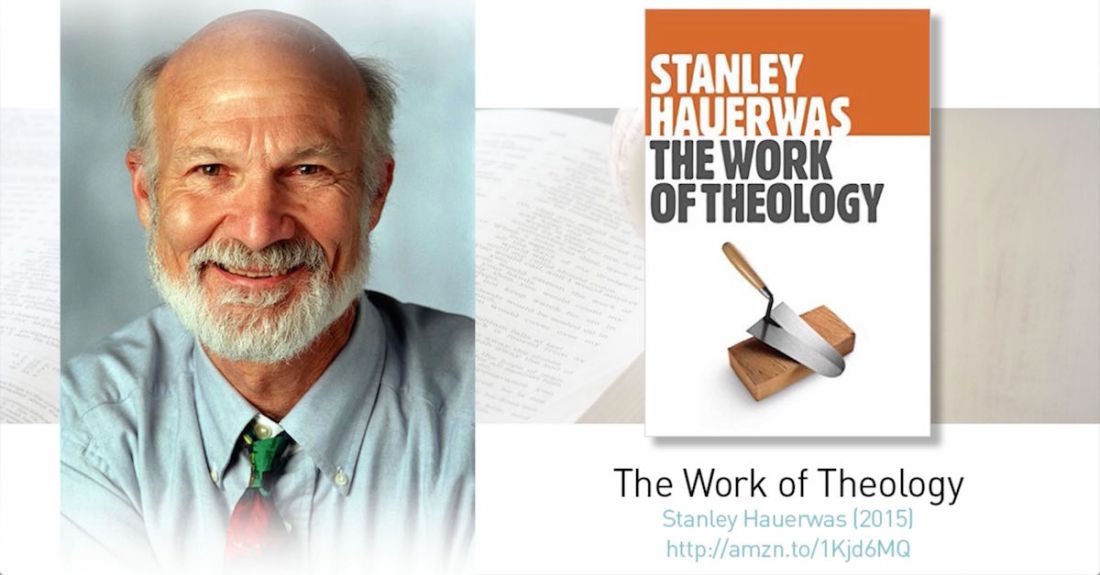
 teddy ray