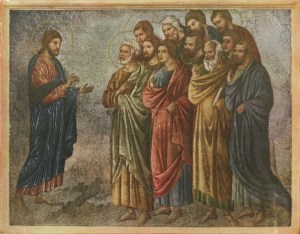
“Where does discipleship lead?” or “The disciples became apostles”

sending disciplesDiscipleship is often treated today as an end in itself. And to a certain extent, I’ll agree with that. When we worship, pray, study Scripture, fast, do works of mercy and works of piety, etc., these activities are the point. They’re means of God’s grace and ways we honor God, so we do them.

But it’s also important to note that the disciples became apostles! The primary designation for this bunch throughout the gospels is disciples. Once we get to the book of Acts, though, their primary designation becomes apostles. [There are no hard lines here. We see “apostles” in the gospels and “disciples” in Acts.]

That shouldn’t be surprising. When Jesus calls the disciples, he says, “Come, follow me, and I will send you out to fish for people.” At Jesus’ discipleship call, he tells them their roles will change. He will send them. They will end up going out to make disciples.

It’s not just that the disciples will be inwardly transformed – becoming people who know God differently, who pray and read Scripture and do good deeds and avoid evil. They will be sent to reproduce themselves with more disciples!

When we call people to discipleship today, do we tell them we are calling them to send them? My experience is that we too often simply call people to be disciples. We say something to the effect of, “Come, follow Jesus… so that you can keep following… and keep following… and keep following.” And keep following we must! But that isn’t all.

If this is all we call people to, many will imagine themselves going to Bible studies and learning new interesting things, and perhaps applying small bits of those in their lives from now until they die.

But do they understand that they are called to be sent? Do they understand that a call to discipleship inherently includes preparation to become apostles and pastors?

By “apostles and pastors,” I don’t mean to suggest here that all Christians must become career ministers, who draw a paycheck from a church or missions organization. Quite the opposite. Many of the early Christians remained as carpenters, fishermen, and tent-makers, yet spread this radical revolution across the land. Many of the unheralded heroes of the early Methodist movement continued on as plant workers, yet served as the pillars and backbone of local churches as class leaders (see my post “Re-evangelizing America…“)

What I mean to suggest is that Christian engineers and landscapers and business(wo)men must see themselves as people sent to be apostles and pastors. That these people see themselves as the pillars and backbone of the Christian movement today. That these invest themselves as seriously as they can in their own discipleship, because they know it leads to a sending.

Disciples, are you treating your discipleship as if you’re being prepared to be pastors and apostles, leading others to the Christian faith and/or discipling them in that faith? We need you!

Career pastors and preachers, when you call people to discipleship, do you say, “And I will send you out to fish for people.” Is that your expectation of disciples? And are you investing enough in them to make that a reality?

[I want to be careful here not to contradict my post “When ‘missional church’ gets too outwardly focused.” I think there’s a place for what I said there and what I say here. I was addressing one problem in that post, and a problem on the opposite side in this. If you think I’m just contradicting myself, call me on it.]

Why Catechesis Now?

catechumen
catechumen
This isn’t the kind of catechumen we’re working toward.

If you’ve been reading for a while, you’ve seen that I have a great interest in catechesis. I believe this ancient Christian practice is desperately needed in the church today.

I’m excited to see that I’m in good company! Please go read this article by Tim Keller: “Why Catechesis Now?” It succinctly articulates why we need to bring back this “almost completely lost” practice.

A snippet:

The church in Western culture today is experiencing a crisis of holiness. To be holy is to be “set apart,” different, living life according to God’s Word and story, not according to the stories that the world tells us are the meaning of life. The more the culture around us becomes post- and anti-Christian the more we discover church members in our midst, sitting under sound preaching, yet nonetheless holding half-pagan views of God, truth, and human nature, and in their daily lives using sex, money, and power in very worldly ways […]

This is not the first time the church in the West has lived in such a deeply non-Christian cultural environment. In the first several centuries the church had to form and build new believers from the ground up, teaching them comprehensive new ways to think, feel, and live in every aspect of life. They did this not simply through preaching and lectures, but also through catechesis.

Some other things I’ve written on catechesis:
Why we’re teaching our kids a catechism
“How is it with your soul?” – a question we ask every week in catechesis groups
2 more questions to ask and be asked every week
How Sunday School created a theologically illiterate American Church
Why the United Methodist Church needs a catechism
Do catechisms create parrots?

And go see the Echo Catechism that we developed for use in our community. 98 tweet-length questions and answers to address the most important historical Christian beliefs, along with the Apostles’ Creed, Lord’s Prayer, and 10 Commandments.

Do Catechisms Create Parrots?

sentinel parrotsYou may have seen some of my suggestions about using a catechism (with kids, as a crash course in theology, instead of just Bible teaching in Sunday School, or in the UMC) and thought the idea a bit odd. Using a catechism is pretty peculiar for most people.

When I began using the Echo catechism with a group it was admittedly awkward for a few weeks. In our group, I actually ask the questions aloud and have either the whole group or individuals recite the answers. That’s an unusual teaching method in the Church today, but I believe it has its place. I’ll share how we go beyond mere recitation in a future post.

Creating Parrots?

When others hear we’re reciting a catechism, they ask if we’re just creating parrots. “Why not help people construct their own answers to these questions?”

A catechism assumes a different starting point. We don’t start with a bunch of individuals trying to figure out their faiths. We start with a Church that God birthed out of Christ’s suffering, death, and resurrection.

That Church has a faith which was handed down by the apostles and through the Scriptures. When people come into the Church, they come into a community of faith that has established, common beliefs. We want to teach those beliefs clearly.

Once we teach our people common, concise language about the Church’s faith, I think they can then ask better and deeper questions about whether their faith matches the faith of the Church. They have a starting point for asking what this faith really means and what it requires.

Benefits of a Catechism

When we don’t begin with the Church’s faith, we spend more time on our own thoughts and guesses. It’s good to have space to think through things on our own, but it’s also good to have something with some authority to rely on.

Look at this passage from Sinclair Ferguson, explaining the importance of catechisms for understanding God’s guidance:

Christians in an earlier generation rarely thought of writing books on guidance. There is a reason for that (just as there is a reason why so many of us today are drawn to books that will tell us how to find God’s will). Our forefathers in the faith were catechised, and they taught catechisms to their children. Often as much as half of the catechism would be devoted to an exposition of the answers to questions like the following:

Question: Where do we find God’s will?

    Answer: In the Scriptures. 

Question: Where in particular in the Scriptures?

    Answer: In the Commandments that God has given to us.

Why were these questions and answers so important? Because these Christians understood that God’s law provides basic guidelines that cover the whole of life. Indeed, in the vast majority of instances, the answer to the question “What does God want me to do?” will be found by answering the question: “How does the law of God apply to this situation? What does the Lord require of me here in his word?”

This was quoted in the blog post “The Benefits of the Catechisms,” a good, humorous read if you have time.

In all, I believe a common catechism can be an excellent tool for learning, sharing, and teaching a common faith. The point isn’t to create parrots. It’s to allow the Church’s faith to form our own.