Three perspectives on evangelism

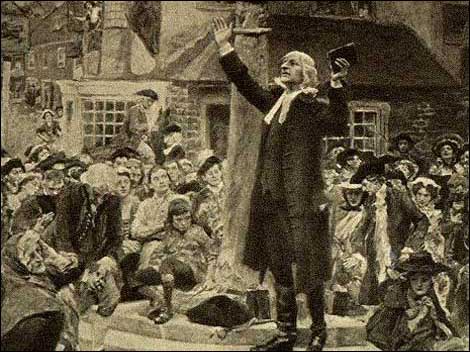
Methodist field preacher

Since I’ve already admitted to being a terrible evangelist, I thought it might be better to start us thinking about evangelism with some other people’s wisdom.

Here are three good articles on evangelistic efforts from diverse perspectives. I hope you’ll take the time to read them.

  • Four Questions at the Heart of Evangelism – John Meunier draws four self-evaluation questions from a book on real life evangelism. These are hard hitting. “We cannot share what we do not have,” he says. How do you answer these four questions?
  • Re-building a vital congregation – Though he never uses the word evangelism, the work Don Haynes is doing in a small community is deeply evangelistic. He’s urging us to visit from house to house! Maybe there’s really something to it. I’m most interested in the “sitting where they sit,” “appointed to territory,” and “from house to house” sections. And by the way – though this is a small-church pastor doing these things, nothing is preventing all of us, regardless of occupation, from similar practices.
  • What happened to the missional impulse of the Methodists? – Steve Manskar shows how new church plants are using the practices of the early Methodists to reach new people. He laments that the Methodists have mostly forgotten these practices. Two men I deeply respect are reviving that impulse among Kentucky Methodists. Paul Brunstetter was the first person to help me understand that creating new places for new people–and raising up new leaders for those communities–may be the most effective and historic model of evangelism there is. Aaron Mansfield is the most die-hard, old-school evangelist I know. He’s showing us the importance of constantly going to people where they are, and then inviting them to faith and into the church. If you’re a Kentucky Methodist, you have reason to have hope. We Methodists must get our missional impulse back.

These three articles come at it from different angles, but all three lead us to the same place. How fervently do we believe the gospel, and how strongly have we experienced its power? Will we now go wherever people are to help them toward repentance, faith, and holiness? Will we be intentional about developing disciples, not mere converts?

Which of these challenges you the most? Are any of these ideas or perspectives new for you? Is this all church-talk, or can the average Christian take and apply these?

Subscribe by e-mail or RSS to get regular updates on theology, ministry, and life with God.
What does ordination mean?

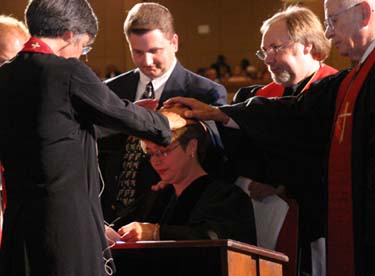
United Methodist clergy are asked 19 historic questions at the beginning of their ordination. A good friend just asked me which of these are binding, and which are simply a nod to our history.

That’s a difficult question to answer when you look at them. I’ve just said that the biggest lie told at every UMC Annual Conference is when ordinands respond to the question, “Will you visit from house to house?” As I look at these other questions, I wonder how many of these we are telling the truth about.

How many pastors recommend fasting or abstinence by both precept and example? How many have avoided massive debt? How many actually approve our church polity and government?

Are any of these still standing but the first: “Have you faith in Christ?”

By winking and grinning at the other 18, are we compromising even the expectation of faith in Christ?

How do you think these historic questions should be used? Binding? Nod to history? Should we consistently evaluate whether clergy are adhering to any/all of these? Which ones?

The historic questions:

  1. Have you faith in Christ?
  2. Are you going on to perfection?
  3. Do you expect to be made perfect in love in this life?
  4. Are you earnestly striving after it?
  5. Are you resolved to devote yourself wholly to God and his work?
  6. Do you know the General Rules of our Church?
  7. Will you keep them?
  8. Have you studied the doctrines of The United Methodist Church?
  9. After full examination, do you believe that our doctrines are in harmony with the Holy Scriptures?
  10. Will you preach and maintain them?
  11. Have you studied our form of Church discipline and polity?
  12. Do you approve our Church government and polity?
  13. Will you support and maintain them?
  14. Will you diligently instruct the children in every place?
  15. Will you visit from house to house?
  16. Will you recommend fasting or abstinence, both by precept and example?
  17. Are you determined to employ all your time in the work of God?
  18. Are you in debt so as to embarrass you in your work?
  19. Will you observe the following directions? a) Be diligent. Never be unemployed. Never be triflingly employed. Never trifle away time; neither spend any more time at any one place than is strictly necessary. b) Be punctual. Do everything exactly at the time. And do not mend our rules, but keep them; not for wrath, but for conscience’ sake.

Subscribe by e-mail to get regular updates on theology, ministry, and life with God.

For more UMC-specific posts, go to my UMC Posts page.

The Modern Pastor and the Reformed Pastor

“There’s really only time for two things in ministry. Lead a fine worship. Visit the people. The program, leave to volunteers and gung-ho seminarians.”

Several years ago, I came upon that provocative advice from a man named Sam Stanley. It has constantly challenged me regarding the duty of the pastor.

Then a couple years ago I discovered Richard Baxter’s brilliant book, The Reformed Pastor. George Hunter calls it “the most influential book that most pastors today have never read.” That book probably influenced Sam Stanley considerably, whether or not he ever heard of it.

I wish the modern pastor could look much more like Baxter’s Reformed Pastor.*

The Reformed Pastor doesn’t have time for running a big enterprise. Only two things: worship and visit.

The Reformed Pastor can’t be consumed with climbing the career ladder or making more money. If they were unable to visit all of their people, Baxter told pastors they better cut their salaries and hire enough assistants to do the job. Here’s one of his not-too-subtle challenges for anyone whose congregation is too large to visit them all:

If you have but a hundred pounds a year, it is your duty to live upon part of it, and allow the rest to a competent assistant, rather than that the flock which you are over should be neglected. If you say, that is a hard measure, and that your wife and children cannot so live, I answer, Do not many families in your parish live on less? Have not many able ministers in the prelates’ days been glad of less, with liberty to preach the gospel?

Tell us what you really think, Mr. Baxter. The work is so good that I’m fighting to control myself from copying pages’ worth of direct quotation.

The value of visiting from house to house seems utterly lost. I heard almost nothing of it in seminary. I haven’t seen “model pastors” celebrated for it. I’ve practiced it far too little myself.

Before people are ordained in the United Methodist Church, they are asked, “Will you visit from house to house?” They affirm that they will. My friend Aaron calls it the biggest lie told at Annual Conference each year.

Why forsake more study, more sermon prep, more e-mails or strategic planning meetings, more church administration so that we can visit more?

A few reasons to focus on visitation, taken rather directly from Baxter:

  1. Evangelism – We have the best opportunity to convince people of the truth when we speak to each one’s particular questions and situation. We need to be able to say to the sinner, “You are the man!” and plainly mention his particular case. Too direct? Perhaps more later on our terrible inability to identify sin with clarity and care.
  2. Education – Visiting from house to house comes from Paul’s example in Acts 20. He says he taught in public and from house to house. Our people need personal instruction in the faith, not just public preaching. By the way, Baxter used a catechism for this.
  3. Preaching – Our preaching is much better when we know the people hearing it. This is the Word of God for the people of God. We preach best when we know both. I fear that more sermons now originate in the boardroom (the strategic direction speech) than a living room. I even worry that too many sermons originate only in a pastor’s study (the academic treatise or the personal reflection that misidentifies where others are).

A personal example: In a pastoral visit I made a while back, I ended up being able to confront someone very directly, yet lovingly, about some sin in his life. I also learned that he doesn’t read Scripture because he doesn’t feel like he knows how to, and I was able to give some instruction. I ended up standing in his doorway answering his questions about what sanctification is and how we receive it.

Yes, I believe visiting from house to house is one of the most important things for me to do as a pastor. I also know I do it far too little. My challenge is to find a way to give it the pride of place it deserves on my agenda. How about you?

So much more to say about The Reformed Pastor, visiting the people, Church discipline, etc. But I’d also like to get to some other topics. How interesting is this to you? Stay here or move on?

* George Hunter argues that Baxter was “a major source of error” and that John Wesley properly damned his work with faint praise and mainly ignored it. I get what Hunter is saying – that it shouldn’t just be the ordained acting as pastors – but I disagree with him on the value of Baxter’s work and how Wesley handled it. I think John Meunier gets it right on this.