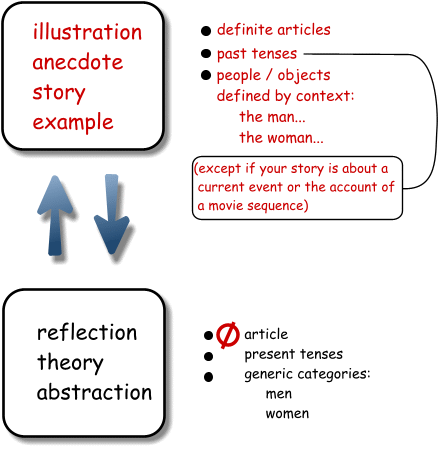
Don’t tell about a story, tell a story

abstract_concrete

I once heard a missionary give a talk about all of the amazing things happening on his mission field. He said people were experiencing a lot of personal healing. He said there were worship services where the Holy Spirit was clearly present. He told us their leaders were growing incredibly.

It sounded like a lot of great things were happening. But that’s it. He hinted at a lot of great stories, but he didn’t tell any of the stories.

“Amazing things are happening” is nice to report, but what does it mean? If amazing things really are happening, pick out the one or two most amazing stories, and tell them. If leaders really are growing incredibly, choose one of those incredible stories of growth and tell it.

I believe that missionary was telling the truth. And I think he really wanted us to know the truth and be excited. But he had become so accustomed to hearing and giving reports full of generalities and clichés that he missed a great opportunity to invigorate a crowd of supporters. I doubt anyone left that day to tell other people, “You should hear about this amazing mission.” Because they didn’t have any picture in their minds of what it looked like. There was nothing to tell.

For preaching and testimony

Preachers –– want to improve your preaching? Search your sermon manuscript for broad, abstract statements. Then replace them––or at least complement them––with something concrete: nouns that you can touch and verbs that you can see.

I say that as an off-the-charts abstract thinker. The concrete world is often unreal to me. My wife wrapped my Christmas presents in front of me two years in a row without me knowing. So this doesn’t come naturally, nor do I always get it right. But when I make the effort, I see the benefits. People retell my stories. They rarely retell my abstract statements. (For the record, I’m referring to real stories here, not the ones you find in 101 Sermon Illustrations.)

The same applies when you share your testimony. Describe it as if you were narrating a short video. Phrases like, “I was lost and directionless” don’t bring images to people’s minds. Compare that to the testimony of a cop who says, “I told everyone I was okay… and then I flipped my car on an on-ramp, beat a suspect unconscious, got suspended… but I was ‘okay.'”[1. a quote adapted from The Thomas Crown Affair, 1999] The first one hints at a story, the second one tells the story.

For conferencing

For my United Methodist friends, what if a few simple tweaks could change how we think about our conferencing?

What if we never again heard from the conference floor, “Now we’ll hear a report from our camps committee”? And instead we heard, “I want you to hear a great story from one of our camps.” What if we solicited the very best stories from across our conference, chose four to eight of them, and told them with gusto? (My conference is doing some of this. We’re hearing more stories and less reports. We’re already halfway there!)

With not much more than that, we could change our whole approach to Annual Conferences. We could sell tickets.

I know this because I just attended something similar. I paid several hundred dollars and drove to Washington, D.C., for the International Justice Mission (IJM) Prayer Gathering. They work in thirteen different countries with a $47 million budget. During their main sessions, I heard four stories. A drop in the bucket compared to all that they do. But I left inspired and invigorated. I began recruiting others to go to next year’s Prayer Gathering. I began conversations about how our church could give to their work.

This is a classic case of “less is more.” Lots of reports and statistics were available to us––2,668 people freed from forced labor slavery in India, 18,900 people trained in violent crime detection and prevention––but what made it all real to me was the story of four young girls being rescued from an Indian brothel. I didn’t hear about the similar work being done in Cambodia, the Dominican Republic, and the Philippines, but I didn’t need to. That single rescue story was much more important for me than hearing generalities about rescues happening across the world.

What if our Annual Conferences took a cue from these? Worship, tell our best stories, and pray together. Sell tickets and turn it into a rally. What if United Methodists from across the conference looked forward to that annual gathering and went home telling others they had to go? What if they left excited about “paying apportionments” (local church funds given to the conference) because they stopped viewing them as “dues” and started viewing them as contributions to mission? (As for the 2-3 hours’ worth of actual business and essential reporting, we could move those into a special delegates-only session.)


Our opportunities to share are precious. How are you using yours? Are they inspiring, making believers, giving people something they’ll remember and maybe even retell? Next time you catch yourself saying, “Great things are happening” or talking about “healing” or “transformation” or “forgiveness” or “life change,” ask what the specific stories are behind those general statements.

————-

A pastor’s reading plan

Since I began posting the books I’m reading, and my best 7 or 8 books of the year*, several people have asked me how I read. How do I categorize and choose what to read? In an email last week, someone just finishing seminary asked:

“There are so many categories and so much I have saved, it is overwhelming. How do you categorize, organize, decide (whatever it is) what to read after seminary and in ministry?”

I thought an answer to this question might be helpful or interesting for several of you…

——-

So many books to read, so little time...
So many books to read, so little time…

That’s a great question!

Seminary was a good introduction to theological study for me. It gave me some critical tools for reading well and a great bibliography to work on. That has made post-seminary study a lot of fun. We do better when we think of seminary as the beginning of our theological education rather than the end of it.

You’ve opened up a pretty deep rabbit hole here. I’ll take you part of the way down…

Categories

I read in nine categories. I use Library of Congress classifications for those (you can find these at catalog.loc.gov and usually on the book’s copyright page). No category system is perfect, but I’m content with this one. It provides quick, broad categories. I asked myself what a well-rounded reading plan would be for my needs as a pastor. These were the nine categories I chose… 

  • BR books, as classified by Library of Congress. This includes some general Christian works and especially focuses on Christian history. It’s where you’ll find most of the writings from the first 1500 years of Christian history. The last thing I read in this category was a book of Augustine’s sermons. The next one I plan to read is a history of the development of Christianity in 18th and 19th century America.
  • BS – Books about the Bible. I’ll sometimes read a commentary front to back, but I usually read other books that will help me be a better, more informed reader of the Bible. I just finished a book of essays on the Psalms. I’m working through N. T. Wright’s monumental series, one volume per year.
  • BT – Doctrinal theology. You’ll find systematic theologies here, along with specific subjects in theology (e.g. the life of Christ, the Church, soteriology). I’m about to start Pelikan’s big series on the Christian Tradition.
  • BV – Practical theology. This includes most any book you read on the practice of ministry and most spiritual formation books. This can be the natural area for post-seminary pastors to spend all of their time. It’s the practical tools that immediately apply. Most of the other categories are slower to application. (How do you apply a history of Christian thought to your ministry this week?) My reading in those other areas is important, but not urgent. It shapes me in ways that affect everything over time, but not much immediately. Our catechesis groups were born from readings in early Christian history and Luther’s works. 

    So this system keeps me from reading only practical theology. Urgent needs could tempt me to stay put in this area. To be clear, these books have been great for me, and they’re more than 1/9th of what I actually read. Almost every book I read with ministry or pastoral teams is a BV book, so I’m always reading one or two on the side.

  • BX Denominational works. Most of my reading here is within the Wesleyan tradition. But I also go to other denominations for a different perspective, on occasion––Baptist history, Presbyterian polity, Roman Catholic theology. I better understand the nuances of our particular faith when I read in the Wesleyan tradition. I better appreciate the wider Christian movement when I read outside my own tradition. The former deepens my understanding, the latter widens my perspective. 
  • B-BQ – These are any other works that begin with B in the Library of Congress catalog. They get you into philosophy, psychology, ethics, and other religions. Right now, I’m reading Malcolm X’s autobiography (filed under BP for Islamic studies). Next I think I’ll be reading The Great Divorce by C. S. Lewis (under BJ for ethics). It’s a broad category.
  • Special Focus category – My focus this year is social sciences––any works categorized under H. I wanted to give some extra time to works on leadership, management, and global social issues. I’ll change this category next year (considering a focus on biographies or devotional classics). 
  • Other – If it doesn’t fit any category above, it’s “other.” These books keep me reading something outside of my typical “pet categories.” I’m planning to start a 3-volume biography of Teddy Roosevelt soon.
  • Wild Card – My ninth category isn’t really a category, but freedom to spend extra time somewhere. I use this to fill my most immediate needs or interests.

I keep these all in three rotations.[1. Since writing, I’ve re-worked this some. I still read three books at a time, but rotation 1 is BR, BS, Other B-, Literature. Rotation 2 is BT, BV, BX, Other. Rotation 3 is all wild card, all the time.]

Rotation 1: BT, BV, BX

Rotation 2: BR, BS, Other B-

Rotation 3: Special Focus, Other, Wild Card

So I have three books that I’m reading at any time. One from each rotation.

This doesn’t include fiction. I have a separate reading schedule for that. It also doesn’t account for any Bible/prayer book/devotional reading

All this is for systematic broad reading. I get into deeper, specific research when I prepare sermons and write. Some pastoral needs also dictate that kind of in-depth research. That research is usually article-length, not book-length. It comes as questions demand rather than systematically.

Selection

I compile my bibliography from a variety of sources. If a source I trust recommends a book, or if I see a book referenced enough times, I put it on my bibliography. If I then see any of those books available for cheap, I buy them. (ereaderiq.com is great for this with Kindle books.) The bibliography can be overwhelming. Mine makes me sad because I know I’ll never make it to all these books––2,558 at present.

So which book to actually read? My plan here doesn’t have much structure. When each category comes up in the rotation, I choose what most fills a current need or interest. Or I choose that book I know I should have read by now. The one systematic aspect to it is a few multi-volume series that I’m reading, one volume per year (Wright, Pelikan, and the Roosevelt biographies, all as listed above, and Wesley’s Works). So one book per year in each of those categories is pre-determined.

Actually Reading

I try to protect one hour of my daily schedule for reading. That’s not as much as I’d like, but it’s as much as I can manage, and sometimes I don’t get that. John Wesley scolded any preachers who weren’t reading enough. He said they were starving their souls and would be “petty, superficial preachers.” I understand why he said that. If I’m not reading, I’m not getting the ongoing guidance I need to be a good pastor, preacher or leader. 

So welcome to my neurotic rabbit-hole. I doubt this system could work, as it is, for anyone else. But I hope it provides some helpful insight for creating your own.

I’m glad you’re thinking about a post-seminary reading plan. Though the formal education may be over, it’s just a nice jump-start to a life of learning for ministry.

“What are you passionate about?”

passion

“What are you passionate about?”

It’s a common question, at least in church world. And it’s a good question. You should do what you’re passionate about. (There are bounds to this, but we’ll leave them alone for now.)

But it’s also not the only question to ask… or perhaps it’s too narrow a question.

Some needs exceed the passion to fill them. For instance, chairs that need to be set up present a regular need, but rarely ignite a passion. Same for dishes that need to be cleaned. In most places, I’ve seen that the number of children who need to be cared for exceeds the number of adults passionate about caring for them. (That one is a sad reality to me. I get it––it’s taxing, and for many, intimidating. But I still hope for a day that our passion for kids exceeds any need.)

For some necessary things, we may need to supplement passion with sacrifice––people who do something not because they wake up excited to do it, but because it’s important and needs doing.

This is where we might broaden our questions about passion. Someone may not be passionate about washing dishes, but she’s passionate about community meals. And she’s willing to wash the dishes to make it happen. Someone may not be passionate about leading children’s ministry, but he’s passionate about children being ministered to, so he volunteers.

Whatever church community you’re a part of, let me urge you to do two things:

1 – Ask yourself what you’re passionate about. And be sure the leaders in your community know. Ask if there are ways for you to give in one of those areas.

(Also be aware that there are some areas where passion exceeds need. These tend to be the more visible roles. Don’t be disappointed if there’s not as much opportunity to serve in those areas of passion as you’d like.)

2 – Dedicate yourself to one thing that’s a need, even though it’s not a passion.

Look around and see what areas of need you can identify. If you can’t find them, ask the leaders in your community, “Where are the places you could really use more help? If you could have someone show up regularly and faithfully to do something, what would you ask for?” They’ll be able to answer those questions with ease.

Find one of these things and do it on a regular, scheduled, disciplined basis. When you do this, it’s not because you love doing it (though maybe a love could grow for it), it’s because you’re passionate about the larger mission of the church. And that small act of service is essential to the bigger mission.

Occasionally #1 and #2 go together. That’s the person who truly has a passion for setting up chairs (have I met you??) and does it faithfully. If that’s you, I hope you know how special you are to the community. Same to that children’s Sunday School teacher who has been doing it for 20 years and loves it.

“I don’t have time to do both,” you say. “Do I serve in the area of need, or passion?”

Let’s start with a question: Is the thing you’re passionate about something where passion exceeds need in your community (i.e. if you gave up your spot, people would rush to fill it)? If so, I’d recommend you stop doing the passion thing for a time and only fill the need.

Otherwise, you’re leading in a coveted role without demonstrating the servant leadership of also leading in a needed role. Also, when you stay away from that area of passion until your time frees up, you’re likely to find a way to free some time.


Every great movement is a mix of passion and sacrifice. People do things they love, and they’re excited to be part of a great cause. People also make sacrifices to do less-interesting things, because they know those things are part of the larger mission.

The church can and should be the greatest movement on earth––the greatest mixture of passion and sacrifice that our world sees.

To the many, many, many of you who already exemplify that––thank you! Those small things may not seem like much, but that chair you set up, or that diaper you change, is what makes it possible for the rest of this great mission to happen.

To any of you who wouldn’t yet be described as a model of passion and sacrifice in your community, there’s still time to sign up.