Real Life Examples – David Sparks

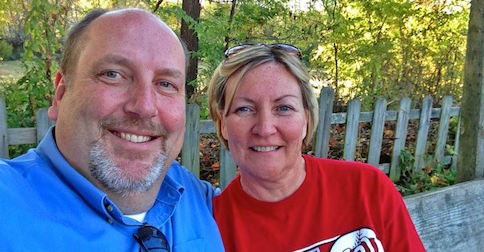
David and Dawn Sparks

I want to share with you a private note I sent last year to someone you may not know. His name is David Sparks.

I’m sharing this with you for three reasons. I’ll give the first reason here––the second two after the note.

First – we learn a lot from seeing other people’s examples. I want you to learn from David’s example.

To give some background to this note, David was my middle school youth minister. Several years later, when I became a youth minister myself, he was one of the first calls––calling to tell me I was the perfect person for the job, to tell me he’d do anything he could to support me, and to invite me to a weekly youth ministers’ breakfast at Bob Evans (which he started and kept going until he moved away from Lexington).

Here’s what I wrote to him last year…

David,

I’ve thought of you a number of times over the past several months. I think getting my head above the day-to-day workings of the church has given me a chance to see the bigger picture and especially to be thankful, and I wanted to send a quick note. 

You have been one of my most consistent supporters and encouragers for nearly 20 years now. You gave me some of my first real encouragement as a leader early on in middle school. You were probably my most consistent support throughout my first few years in youth ministry. Bob Evans breakfasts were a highlight in my week. And then as you took your conference position, you gave me opportunities to get involved at the conference level. Looking back, I know you went out of your way to accommodate me in some of my early learning, and even when I was stubborn or cynical. And you’ve continued to send random texts, tweets, etc. of encouragement….

I’m glad you’ve always considered yourself a youth pastor, regardless of the official role. I’d imagine there are many others that you got to know in youth ministry and then have continued to encourage. I’m sure they’re getting much of the same at Bethany [his current church] now. So thank you!

Oh – and thanks for twisting my arm to keep playing Fantasy Football when I wanted to quit. I’ve got a feeling this is my year. [It wasn’t.]

Teddy

You see a lot there about support and encouragement. David believes in people. Sometimes that’s all we need. Just someone to believe in us––to tell us we can do something, to challenge us to do it, to keep rooting us on. I think that will be David’s greatest legacy.

Why has he done that? I think it has to do with how David believes in God––that God has created each of us with incredible promise and potential, that God can use us beyond what we would imagine, that God doesn’t give up on us despite all our past failures. That makes me recognize just how ungodly are any of my cynical attitudes, when I fail to trust people or give up on them too quickly.

So I’m sharing this with the hope that the rest of us might follow David’s example. Who will be able to send me a note twenty years from now and say, “You never stopped encouraging me”?

The second reason I share this – I sent this note last year because I kept thinking about David’s influence on my life and started wondering whether I had ever expressed my gratitude to him. For someone who had been such a consistent support, I wasn’t sure he knew how much I valued it.

Is there anyone in your life who might fit that description? Can I urge you to jot them a short note before the end of this week?

The third reason I share this is to ask for your help. A month after I sent that note, David was diagnosed with renal cell carcinoma. Since then, he and his wife, Dawn, have been a model of hope and perseverance. Even the most discouraging bits of news have come laced with hope, often with a smiling picture of David (or even a joking video). See their Facebook Page –– “Dave and Dawn’s Army of Hope.”

Just today, they announced that David will be entering Hospice care.

I know that many of you don’t know David, but would you please consider doing two things?

1 – Would you pray for David and Dawn? I’ve made it my habit every time I receive a health update just to place my fingers on their heads on my screen––the closest I can come to laying on hands––and to pray for them. Would you do that, too?

2 – Would you consider making a donation? I hate that along with everything else, cancer can leave a family with an enormous stack of bills. Some friends have begun a YouCaring fundraiser for David and Dawn here.

That’s David Sparks. Real life example. May you follow that example. And thanks for your prayers and financial support for David and his family.
Priorities for organizing a weekly schedule [Pastoral Letters]

In July, I’ll be returning from a sabbatical year to be the lead pastor of the Offerings Community at First UMC in Lexington. I’m sharing some pastoral letters with them in advance of that return. Though some notes here are specific to that congregation, the letters are a broad attempt to share a pastoral theology.
Credit for original photo to www.planetofsuccess.com/blog/
Credit for original photo to http://www.planetofsuccess.com/blog/


In two years’ time, the lead pastor position in Offerings has moved from 1/4-time to 3/4-time. I’m thrilled about this and what it can mean for our community.

I’ve thought and prayed a lot about how we need to use this position most faithfully. What does our community need most from the lead pastor? And what are the best contributions I can make?

How we spend our time says a lot about our values, so I’m sharing this as a way of showing you my values. I also think it’s important for you to know what I’m doing with the time you’ve given me.

Though no single week will look exactly like this, here’s a general sketch of how I plan to spend my time:

1 – Preaching and Writing
In my first letter, I said the gospel is the primary thing that motivates everything I do in ministry. I think preaching and writing are our best broad opportunities to proclaim the gospel.

Several people have told me they think one of the greatest strengths of Offerings is faithful preaching. We need to continue that. I want to invest the time to do it well.

I love that we have a preaching team. It gives us a chance to hear a number of voices and perspectives. So my “preaching and writing” time will also include working with our other preachers––helping each other refine and improve our preaching.

I’ve also discovered what a great pastoral opportunity writing is. It affords a reach beyond what Sunday morning allows. It can focus on issues that wouldn’t be appropriate preaching topics, allows people to read in their own time, and can be passed on to other people.

In all, I plan to spend about 15 hours per week on preaching and writing. My best preaching requires about 15 hours of preparation—roughly what I’ve seen other preachers recommend. When I prepare less, it’s noticeable. For the weeks I’m not preaching, I’ll devote the extra time to writing and to working with our other preachers.

2 – Pastoral Visitation
Pastoral visitation is my best opportunity for deep connections. In that first letter, I also told you that I believe in you. Visiting with people is one of my best chances to invest in all of you.

I’m planning to meet individually with all of our leaders several times per year in addition to leadership team meetings. I also hope to visit each of you—as an individual or a family—once per year, preferably in your home. This category also includes visiting new guests, pastoral counseling, door-to-door visits in our neighborhood, and special need visits (people in the hospital, new babies, etc.)

Investments in these relationships are the best extension of myself—the best way to encourage and equip our leaders, and the best ways to make sure people are receiving good pastoral care and to encourage them to take next steps in discipleship. In all, I hope to spend about ten hours per week in various forms of visitation with people and leadership teams.

3 – Administration 
Again, in that first letter, I said I believed in the church—and specifically in First UMC. Because of that, I’ll make a priority for First UMC administrative, staff, and pastoral meetings. It’s important for Offerings to be well-represented in those meetings and well-connected to the larger church. And it’s important for us to make a good contribution to the big church’s direction.

We also have plenty of administrative needs for Offerings. I’ve loved being able to count on a weekly email this past year and plan to continue those, along with any other things we need to do to ensure good communication. Faithfulness in small things—quick responses to calls and emails and taking care of any paperwork—help keep everything moving smoothly. I want to take care of those well.

As we explore moving into a new location, the details associated with that will take a lot of extra attention to administrative details. In all, I expect our administrative needs to require about ten hours on most weeks, and probably more than that at first.

4 – Connecting with area leaders (especially other church and nonprofit leaders), reading and research  
I plan to keep regular calendar space for meeting with area leaders. That’s an important investment in our community’s relationships to other churches and agencies. I also plan to set aside regular time for reading and research (you can always see what I’m reading on the right sidebar of my blog).

These are the extremely important but not at all urgent. No one will require them of me or immediately notice whether they’re happening or not. It’s a lot like exercise. If I skimp on it for a few weeks or months, people probably won’t notice a difference. But the results in a few years’ time will be drastically different.

For my effectiveness as a preacher, leader, and pastor, there will be major dividends or major holes in the years to come based on whether I’m diligent about these things. I think it’s crucial that I carve out and protect regular time for them.

I hope to spend about six hours per week on this networking and continuing education. I also know, though, that these will be the first things to go when administrative and pastoral demands require more time. Because of that, I’ll be diligent about carving out and protecting regular time for these on my calendar and only back off them when another need is exceptionally important and urgent.

Modeling with my schedule
We’ve talked a lot in Offerings about our pastors’ lives reflecting our values. I think it’s important for me to do that with my schedule. Two specific ways that I’m trying to model important values with my schedule:

1 – I try to limit myself to 45 hours each week except for in rare emergencies—emergency to be read as the kind of thing that happens once or twice a year, not every other week. At my family’s current stage, I don’t think I can stay healthy (physically, spiritually, and emotionally) and take care of my family if I exceed that time.

There are always more things to be done. I would love to devote 30 hours per week to each item listed above. I want to do my best to name the most important things and always take care of them, but some things will inevitably go un-done. I’ll ask for your grace and help in those things.

I’ve seen a lot of people—pastors and other professionals—disregard health and family because there’s always more to do at work. I don’t want you to be one of those people, and I want to model a healthier way with my schedule.

2 – I don’t count my Sunday morning time or my time in a catechesis group, or things like personal devotional time, as “work time.” Those are things I expect all of us to do outside our jobs. I count them as something I do because I’m a Christian and part of the community, not because I’m on payroll.

I hope this helps. I think it’s important for you to know what I’m doing with the time you give me. And thank you for giving me the time to do these things!

Did you enjoy this? Don’t miss the next post. Sign up to receive free updates.

The coming church budget crunch

budget squeeze

This is a revised version of a post from last year. I thought it appropriate as churches are beginning to budget for 2014.budget squeeze

I just asked a friend to run a quick analysis for me: “How much of your church’s contributions come from people age 55 and over?”

His number was 70%.

My friend was unflinching. “Isn’t it always that way? That’s the group that has the most to give, so they give most of the money.” His church looks healthy. The UMC would consider it a “vital congregation.”

But I wasn’t convinced, so I asked him to try a second analysis, if his software could do it. “How much of your church’s contributions 10 years ago came from people age 55 and over?”

This time, my friend came back concerned. Ten years ago, only 50% of contributions came from ages 55 and over. In ten years, giving from people age 55 and over went from 50% to 70%.

A few reasons I had this hunch:

  • If your church is at least 10 years old, it’s probably older now than it was 10 years ago. You may have anecdotal evidence to argue otherwise (that booming parents’ Sunday School class, the three infant baptisms last week…), but unless you can show me the numbers to prove it, I bet you’re older. The average age in the American UMC has gone from 30 in the 1950’s to 57 in 2008.
  • Most churches – even ones that look healthy – have been living off the leadership and giving of the Baby Boomers for a long time. The Baby Boomers are now ages 48 – 66.
  • The Older Boomers (those who were draft age during Vietnam) are all now 56 and older. They’ve been stronger leaders and contributors than the Younger Boomers.
  • The Silent Generation (whose youngest are now 67) were loyalists, committed to the Church, and committed to supporting it with their money.

This shows a fundamental non-shift taking place in our churches. As the Boomers and Silent Generation age, the younger generations aren’t shifting to handle more of the church’s financial burden. There are no signs they plan to fill that void.

We’re living off the fumes of earlier periods’ growth. Meanwhile, we have increased our debt, enlarged our campuses (and their accompanying maintenance and utilities costs), and inflated our staffs and salaries.

If giving from ages 55+ went from half of a church’s giving to 70% in the last ten years, what will happen in the next ten? Unless we experience major change, we’ll see a lot of budget reductions.

What I expect in the next ten years… Since we can’t reduce debt and building maintenance costs without serious consequences, the coming budget crunch will hit staffing, programming, and missions the hardest.

In the UMC, I expect many churches will cut their apportionment payments as they try to preserve ministry locally. Politics will ensue. I would be especially concerned if I were a Wesley Foundation or camp that still relies on money from the conference. Look at your recent conference budgets — what’s going up (e.g. directors’ salaries) will plateau, what’s already going down or plateaued will be decreased or eliminated.

I don’t write this to scare, but I do write it as a wake-up call. Most churches and conferences budget as if giving is going to increase in the next decade. They give raises, take on debt, and defer maintenance because they assume they’ll have enough money in the future to support these items. You might want to do more research before making those assumptions. Budgeting on hope and faith sounds nice, but plenty of churches have had to close after they spent their money on hope/faith rather than reality. Some of those churches even hosted Dave Ramsey courses…