
Finding a Church for My Kids

Last week I wrote about why, as a father, I’m not looking for the exciting children’s ministries I keep hearing advertised. And as a pastor, they’re not what I want to promise. Here’s more about what I’m looking for.

I’ve talked to several people who say their kids are their first priority in choosing a local church. It’s hard to disagree. I want to see my kids grow up to be zealous followers of Christ. There are few things I want more. What role does the church play in that? Here’s a list of the things I’m looking for, in priority order. Some may come as no surprise, but others may not be what you expect…

The state of Kentucky's minimum adult-child ratios and maximum group sizes for childcare services.
The state of Kentucky’s minimum adult-child ratios and maximum group sizes for childcare services.

1. Safety. If I’m not confident my children are reasonably safe in a local church, it’s a deal breaker. Reasonable safety means I know two adults are always in the room and both have been screened and trained. It also means they abide by the state’s minimum adult-to-child ratios and maximum classroom sizes (see at right). These are the minimum requirements. I’d like to see better ratios and rooms that aren’t at maximum capacity, but I wouldn’t accept any worse than meeting these standards.

2. A church where my wife and I will be challenged and strengthened in faith. Note that I’ve put this before anything about my children’s faith. I’ve had several conversations with parents who tell me they’re “suffering through” somewhere they don’t believe they’re growing, but they’re sticking it out because of the great children’s ministry. This is a noble thing to do. I also think it’s a terrible decision. Not just for the parents, but for the children.

Parents, please hear this, your own spiritual condition and growth are more important to your children’s faith than any church programs. Take a look at the diagram below if you don’t believe me. That diagram comes from a huge national survey of youth and religion. It shows the six most likely paths teenagers took to become faithful Christian adults. I’ll reference it several times below. The diagram is for youth, not children, but what’s invested in the childhood years continues into adolescence. You’ll see that four of the six paths include “high parental religious service attendance and importance of faith.”

Stop bearing through in a community that does nothing to strengthen your faith, just for your children’s sake. Your kids see you seven days a week. They’re in the church once or twice a week. You are their primary influence; the church’s programs are a complement. Sadly, since the inception of big youth and children’s ministries, the church has taught parents the reverse. The best children’s ministry in town… is in your living room.
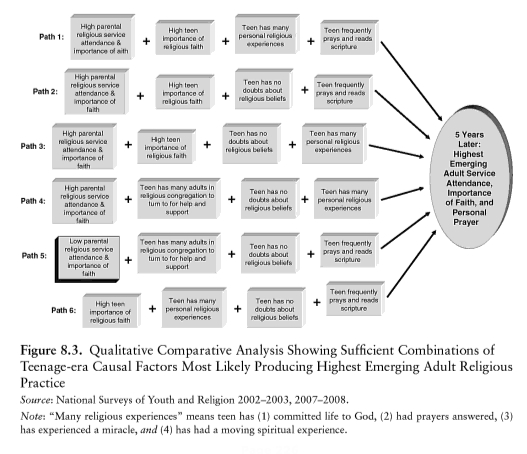
teens who remain adult christians
Found in *Souls in Transition* by Christian Smith. New York: Oxford University Press, 2009.

3. A church where other godly adults will develop relationships with my kids. I put this next because we can do all the things below at home. We want the church’s help with them, but we expect to lead the way. However, we absolutely need the congregation for this piece. In fact, without this larger sense of a “church family,” I think our kids will miss much about what it means to be the church.

In the United Methodist Church, when a child is baptized, the congregation pledges to surround that child with a community of love and forgiveness. In my experience, First UMC of Lexington took that pledge seriously. There were people like Dulaney Wood and Dale Muse and T. O. Harrison, and later Hope Harvener and Paul Shafer and Aaron Mansfield, who took the time to get to know me and encourage me. I believe that made a big difference. I’m looking for the people who will be the same for my kids. You’ll see that having “many adults in the religious congregation to turn to for help and support” is listed as important twice in the diagram above. (more on this in “Exciting is Fickle“)
Where are we leading our kids? There's little more important.
Where are we leading our kids? There’s little more important.

4. A church that helps and encourages my children to pray and read Scripture. Do you notice from that diagram how important these are? It was interesting to see from the study that “frequency of youth group participation” or “satisfaction with youth group” were much less important than Scripture reading and prayer. Christian practices are important for forming people in the faith. I’m looking for a church that will help me teach my kids to pray and read Scripture.

I have fond memories of my parents praying with me and reading Scripture with me at a very young age. And then I had a youth minister, Jerry Ernst, who taught me to love and rely on the Bible and prayer. My parents started it; Jerry complemented it. Their teaching and example have influenced the rest of my life.

5. A church that is committed to teaching Christian doctrine and giving my kids an opportunity to ask questions and express doubts. You’ll also see in the diagram that most of the youth who continued in the faith had “no doubts about religious beliefs.” I’d be interested to know more about this. I don’t think it’s healthy or helpful to raise my kids in an atmosphere where they’re not allowed to question or express doubts. On the contrary, I think the best way to help them have “no doubts about their religious beliefs” is to (a) actually teach them what the Church believes, and (b) give them opportunities to ask lots of questions.

I think a lot of people who walk away from the Christian faith never understood what it was to begin with. In many places, the Church’s focus on teaching doctrine has been cast aside and replaced by social clubs that teach good morals or Bible lessons. I plan to teach my kids Christian doctrine at home, but I would appreciate my church’s help. (See “Why we’re teaching our kids a catechism“)

6. Opportunities for my children to have “religious experiences.” Finally, you’ll see from the diagram that “many personal religious experiences” shows up in four of the six paths. Those are defined as (1) committing one’s life to God, (2) having prayers answered, (3) having experienced a miracle, and (4) having a moving spiritual experience.

That’s an interesting, broadly defined set of experiences. No church can assure these. They can help, though, by putting my kids in a good position for these things to happen. That would involve (a) presenting the gospel and asking them about committing their lives to God, (b) teaching them to pray and spending time in prayer, and (c) expecting that God will be present in their midst and can work miracles.

In my own experience, when I think of things like this, I think back to camps and retreats. I’ll always remember some profound and life-altering experiences I had at Aldersgate Camp during summer camps and youth retreats. These aren’t the only times and places to have profound religious experiences, but I also don’t discount the power of a group of people gathered to worship in a special place and expecting the presence of God. That was routinely the atmosphere at the camps and retreats I participated in. We had lots of fun, to be sure, but we always had serious time devoted to worship. I hope my kids might have similar opportunities. I’d love to find a church that values these things.

How does all this look in simple practice? If I were put in charge of a church’s children’s ministry (something I hope never actually happens!) – I would probably do something very similar to our own “Family Worship,” adapted for a larger setting.

If you found this helpful, I’d love the opportunity to share more. Would you click here to join my subscribers’ list?
Church Staffing and Justice: Two stories, some numbers, and some questions

pastor salary

Two stories

1 – A friend of mine was recently offered a full-time children’s ministry position at a United Methodist Church in North Carolina. She was offered $24,000 and no benefits. No one seemed to blush at that. It’s what they had available.

2 – In another situation I heard about from a few different angles, a youth minister was let go by the UM church where he had worked for nine years. No poor performance was cited. Actually, they believed in what was going on. They just thought one of his assistants could be elevated to the top position and the church wouldn’t have to pay that person nearly as much. After nine years, the released youth minister had one of the higher salaries in the church (though his compensation was still less than 1/2 of the Senior Pastor’s, and without nearly the same benefits).

That was troubling to hear. I was aghast, though, to hear that the church compared his dismissal to the Methodist itineracy process. “Nine years is a long time. We believe in bringing in new leadership and letting leaders move on to other things.”

The not-insignificant difference: when a United Methodist pastor is told “nine years is a long time; it’s time to move on…” that pastor goes on to another guaranteed position, likely with even higher pay. This church kicked their youth minister to the curb and compared it to itineracy. That’s just shameful.

Some numbers

The argument I’m wanting to make here is that we have set up a considerable two-tiered disparity between how we treat Elders and how we treat church staff (often including deacons or part-time local pastors), at least in the world I see most often — the United Methodist world.

The average United Methodist elder in my state has a total compensation package of $101,780.

The minimum compensation package for UM elders in my state is $71,031.

See a larger breakdown of those numbers here.

I’ve heard no small amount of grumbling that our pastors don’t make enough. People have talked about how difficult it must be to get by for for any pastor who only receives the minimum compensation.

Some annual conferences are telling people that their minimally-compensated clergy qualify for food stamps if they have a family. A presentation at my last Annual Conference lamented that teachers in the state make more than our pastors. (Both of these statements ignore the minimum $16,000 in housing benefits that pastors receive.)

The problem

Here’s the problem, though: if we are really so concerned about our under-paid clergy, why is there not absolute outrage over the rest of the church’s employees?

At least from the people I’ve asked and the churches I’ve seen, a typical compensation package for a full-time youth or children’s worker may be between $30k and $36k. It’s quite likely that these positions will have no benefits. If they do, the benefits usually amount to less than $10,000. That makes for a total compensation package (including tax & Social Security payments) somewhere between $36,000 and $48,000.

Let me be quick to say that I’m not convinced that a $48,000 compensation package is bad. Not at all!

But if our leaders really believe that life is barely affordable on our clergy minimum compensation package, why aren’t they horrified that most of our other full-time workers aren’t making anything close to that level? Can it be anything short of hypocrisy for our leaders to lament (based on deceptive data) that some clergy qualify for food stamps, all the while knowing that nearly all of our non-clergy staff are compensated even less?

This is happening with lay employees, and it’s also happening routinely with deacons, since they have no minimum salary, nor are churches required to pay for their housing.

And I should mention that most churches opt out of state unemployment and disability programs. This means that the youth minister in story #2 above ended up without a job and without unemployment help. Meanwhile, the Sr. Pastor who laid him off and compared it to itineracy has a guaranteed appointment and a great disability insurance plan.

A Call to Church Leaders

Dear local church leaders, can I urge you to ask some honest questions and consider what would be truly just in these situations?

How about this: if any of your full-time employees have a compensation package that equates to less than “minimum compensation” as defined by your conference, why don’t you worry more about those employees than you worry about your far more highly-compensated elders? What if you were to require that all employees be brought to the conference’s “minimum level” package before you would consider giving anyone else raises? That’s package, not just salary. Children’s ministers need health insurance and housing, too!

Dear leaders within the larger United Methodist Church, can I urge you to consider these issues a bit more honestly, too? If you believe it’s difficult for your minimally-compensated clergy to survive on $34k + full housing benefits + medical insurance + a really nice retirement plan + a great disability plan, you surely must agree it’s difficult for a full-time youth minister to survive on $30k and no benefits.

Every time you go to a local church and pressure them to raise the salaries of their clergy, you squeeze the church’s personnel budget. When a church has constant pressure to give clergy raises, it’s hard for that church to help the youth minister whose compensation package is half of your approved minimum. What if you stopped focusing on how you can increase clergy salaries and began to look at how the church is treating everyone who’s not an elder?

What’s just in church staff compensation? Perhaps our minimally-compensated clergy really are struggling to provide (though that’s hard for me to believe). But if they are, we should be mortified by what we’re paying everyone else. Seems that there’s a much bigger issue of justice there.

Did you find this helpful or challenging? I write quite a bit about the Church, money, and Methodism. If you’re interested in any of those, click here to subscribe. I’d love to hear from you and continue some conversation.

——————

pastor salary

*Note: this doesn’t take into account that our elders pay self-employment taxes. But it also doesn’t take into account that their housing is exempt from income tax. And I include taxes paid on an employee’s behalf in any “total package” numbers. This also doesn’t take into account the cost for schooling. But I’m talking about disparities much greater than your typical student loan payment [edited after the helpful comments below]. Not to mention that many other church staff members have gone to school, too.

Exciting is fickle

Childrens_MinistryOver the last several years, I heard a number of churches advertising their “exciting children’s ministry.” It seems that every new church start that put an ad on the radio wanted to be sure you knew their children’s ministry was exciting.

I may be in the minority, but as a father, that’s not what I want to hear. And as a pastor, it’s not a promise I want to make.

The demands of “exciting” are relentless. When you’re exciting today, your credit doesn’t last very long, but the expectations increase. What will you do to be even more exciting next week? And the week after that? And how long will people stick around once the excitement wanes? Check out the attendance for a slumping sports team and you might see.

As a father, what I want you to tell me is that your children’s ministry is focused on relationships. I want you to tell me that you have godly adults who will make my children feel special and valued. I want you to tell me that your first focus is investing in those relationships.

Therein lies the difference. Exciting is fickle; relationships are an investment. How much credit do you get from being exciting two weeks ago? A few weeks’ worth, probably. How much credit do you get from building a relationship two weeks ago? My six year-old is still talking about Miss Barry, her Sunday School teacher last year. I still revere some of those adults who loved and cared for me in the church when I was just in elementary school.

As a father, I’m scared that if your children’s ministry focuses on exciting, my kids will eventually give up on the church. There will come a week or month that it’s just not exciting enough and they’ll decide church isn’t for them anymore. Or they’ll join the crowd of roaming, dissatisfied Christians who can never settle down. Nothing excites or delights for long.

As a pastor, I don’t want to promise exciting because I don’t believe we can deliver. Not consistently enough. Because exciting always demands more. “You already did that last week. You need to top it to impress me this week.” I can’t deliver on that. Delivering a constantly bigger spectacle takes too much energy if I want to ever take some time away for anything more than spectacle.

These aren’t mutually exclusive. I really would like my church’s children’s ministry to be enjoyable. I want my kids to want to be there. But I know that they won’t be there long if exciting is the best you have to offer. Offer me more Miss Barry’s, and I expect that my kids’ desire to be part of the church community will grow stronger, not weaker, over time.

** A note: I’ve said nothing here about faith. That’s deeply important to me. But my primary concern isn’t for the church to teach my kids about Christianity. It’s that they surround them with a community of love and forgiveness. It’s particularly that a number of godly adults invest in relationships with them. More on the church’s role in my kids’ faith later.

Did you find this interesting or helpful? I’d be honored if you would click here to join my subscribers’ list to get more.