HOW we need to plant churches: How to NOT squander church resources (pt. III)

In the coming years, the church must find a way to maximize its resources. The United Methodist Church serves as an excellent experimental lab, with thousands of ongoing experiments running in different local churches and Annual Conferences. What can we learn from those experiments? In the last part of this series, I detailed why we need to focus on church planting. This part will focus on the how.

Church Planting

Over the past 200 years, Methodists planted over 800 self-sustaining churches in the state of Kentucky. Those churches have been places of care for their members, mission outposts in their communities, and contributors to a mission far beyond their own.

How can we continue to create places like these for future generations?

I’ve read numerous studies on church planting and conducted some of my own research over the past few years. The most slap-you-in-the-face clear findings: (1) more churches reach more people [see previous post]; (2) initiatives sponsored by local churches usually succeed; the rest usually fail; (3) disproportionate outside funding harms long-term sustainability.

Local Initiatives

One of the best quantitative studies I’ve found analyzes the Christian Reformed Church’s planting success. It compares local initiatives to denominational initiatives. Of the 43 locally sponsored initiatives, 31 were successful, a 72% success rate. Of the 36 other initiatives, 2 were successful, a 94% failure rate!

The author of the study, David Snapper, discusses advances in church growth research and training for church planters. Many people expected good training in church growth techniques would lead to success. However, the denominational-initiative pastors––the 94% failure rate pastors––had received heavy training in church growth techniques. Snapper concludes, “[G]ood technique cannot, by itself, overcome the enormous difficulties imposed by isolation, lack of support, diminished name-recognition, and similar realities of many NCDs.”

Of course, this study was conducted on congregations organized between 1987 and 1994.[note]See “Unfulfilled Expectations of Church Planting” by David Snapper in the Calvin Theological Journal 31 (1996): 464:86.[/note] A lot has changed since the 90’s. Is this data still relevant? Results from recent Kentucky church plants suggest that it is.

I wish our team in Kentucky had come across Snapper’s research study and heeded its warnings fourteen years ago. A study of UMC church planting in Kentucky from 2004-2018 showed similar results. We looked at all plants that had received denominational funding in the past 14 years and have since gone off funding. We categorized them as no longer existent, sustaining,[note]exists, but is not paying denominational apportionments, a sign of continuing financial challenges[/note] and thriving.[note]financially self-sustaining + paying apportionments[/note]
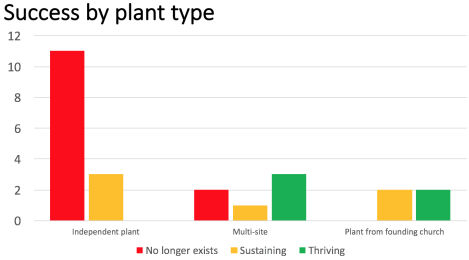
Out of fourteen attempts at independent plants, eleven no longer exist and three are sustaining. None were categorized as thriving. That makes for a 21% somewhat-success rate.

Out of ten attempts at local-initiative plants––multi-sites or plants from a founding church––two no longer exist, three are sustaining, and five are thriving. That makes for an 80% success rate for at least sustaining, 50% success rate for thriving. The two that no longer exist represent one idea that received limited funding and never actually began and one congregation that left the UMC denomination (so they do still exist, just not in the UMC).[note]I’m not including other kinds of plants that were a part of the larger study––multi-language plants (new language, same location), church restarts, and church-within-a-church. Our sample size was too small and results too inconclusive to be of much help. The early results from all of those did not look good.[/note]

Every piece of our findings confirms what that earlier study of the Reformed Christian Church demonstrated: Initiatives sponsored by local churches are likely to succeed, the rest are likely to fail.

As with frequent moving of pastors, the independent plant model of church planting seems to defy basic biology. A church plant is much more likely to succeed as an organic outgrowth from an existing church than as an isolated strategic initiative. God can create ex nihilo. The rest of us will do better with the strong base of support a local church provides.

Disproportionate Funding

Another question we asked about church plants over the past 14 years: How did the amount of denominational funding they received impact their long-term success?

Specifically, we asked, “For every dollar given by church members during a new church’s first year, how many dollars of denominational support did they receive?” Many of us expected an easy answer: the more financial support, the better. That was wrong.

We categorized them into churches that received <$3 in total from the denomination for every dollar contributed by members in the first year (e.g. If a new church’s giving was $50,000 in its first year, the total denominational support was $150,000 or less), churches that received $3 – $9 for every dollar contributed by members, and those that received over $9. Look at the success rates:
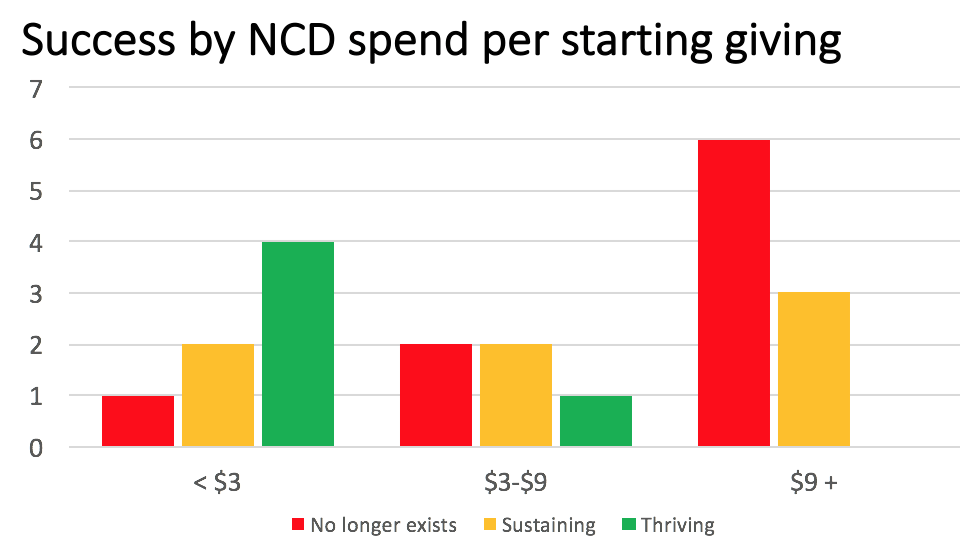
The more disproportionate the denominational support, the less likely a new church was to succeed.

Even more revealing is a look at attendance, giving, and contributions back to the denomination (“apportionments” in the UMC) for each of these categories. We asked, “For every $10,000 our denomination invested, what is the average worship attendance––or annual giving, or annual apportionments paid––today?”
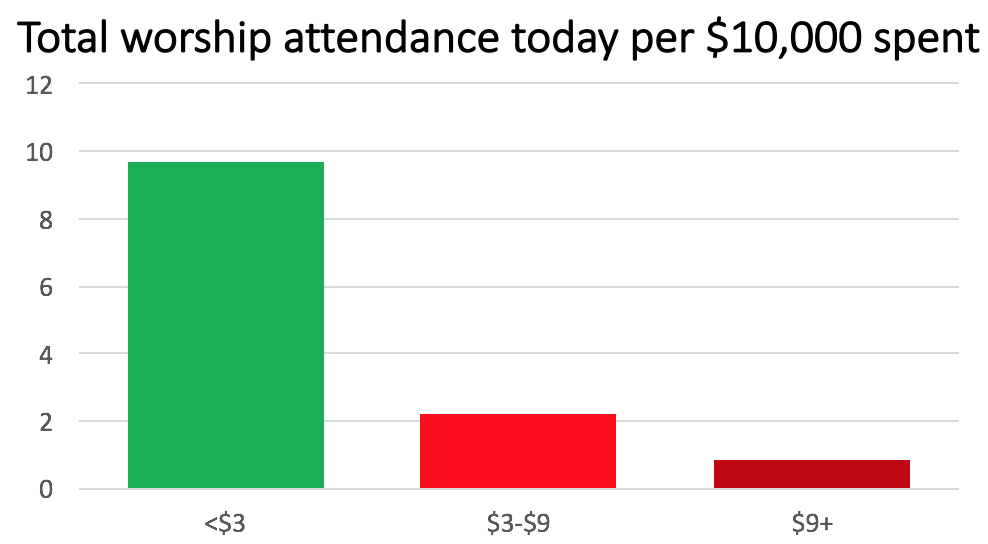
To help make sense of this chart –– The churches that received a total of <$3 from the denomination for every dollar of first-year giving are averaging nearly ten people in worship per $10,000 invested by the denomination. If the UMC invested $100,000 in one of these churches, attendance today is likely around 100 today. By comparison, if the UMC invested $100,000 in a more disproportionate way –– if it was in the middle category, that church is likely to have 20 in worship today.
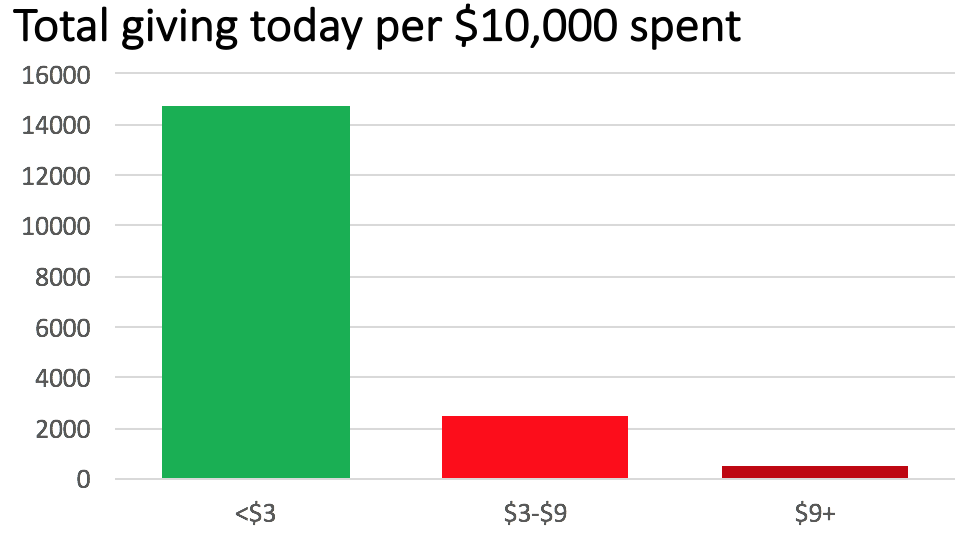
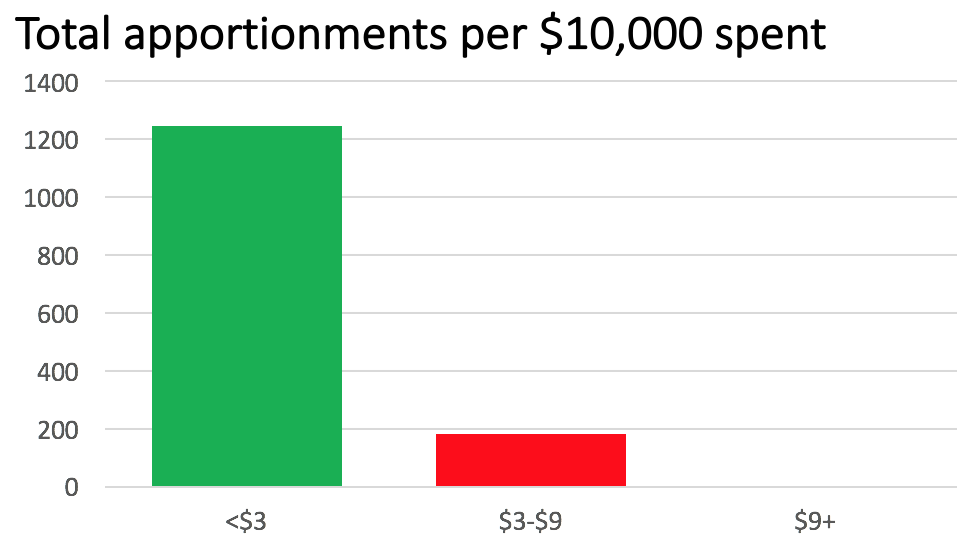
I think what we’re seeing here is that with more disproportionate denominational investment, new churches become dependent on that funding. They are unable to mature into churches that can become self-sustaining.

This runs against much of the logic used in new church development circles. If a church has more internal funding, we support them less, supposing that they have enough already. If a church is struggling financially, we often rush to their aid with more denominational funding, trying to prop them up. Those efforts to prop up will probably be wasted money, keeping a new congregation dependent on the denomination, when it would be better to allow them to either rise to the challenge or close.

Putting it all together

What if we asked only two questions for supporting new faith communities: (1) Is it an initiative coming out of a strong founding church? (2) Can we support it with proportionate denominational funding? In this case, I’ve identified proportionate as matching funding from the denomination that would put a church in that <$3 category above.

In the past 14 years, 12% of Kentucky investments in new church planting have fit those two categories. Look at how those investments have done:
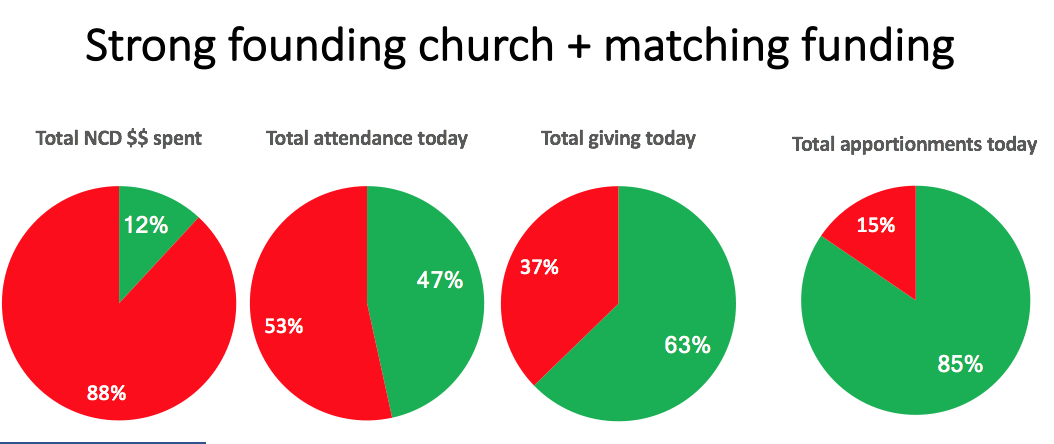
 

I think we have enough evidence to make a change. We should re-focus our church planting resources. Can a good idea + a charismatic leader + massive denominational funding lead to a successful church plant? Of course! But it will be the rare exception to the rule. We’ve spent millions on parachutes for charismatic leaders with good ideas, and we have little to show for it.[note]This should actually provide some reassurance to any of those discouraged leaders. If you tried to start a church without the strong backing of a local church and were unsuccessful, we shouldn’t first assume it’s a reflection on your leadership. The odds were stacked against you.[/note]

Denominations need to keep a focus on church planting, but their role needs to be about inspiring and incentivizing local churches to plant new churches. Denominations should invest in those new plants as partners, not as their primary benefactors. We need to get out of the business of investing in ideas––even ones with exciting, well-crafted plans. We need to run from any notions of centrally-planned initiatives. If we continue investing in initiatives that aren’t based out of a local church or where denominational funding makes up most of a new church’s budget, we need to ask whether we’re squandering our resources.

I don’t want you to miss the next post, and neither do you. To be sure you don’t miss it, JOIN my e-mail update list.
Why we need more churches: How to NOT squander church resources (pt. II)

In the coming years, the church must find a way to maximize its resources. The United Methodist Church serves as an excellent experimental lab, with thousands of ongoing experiments running in different local churches and Annual Conferences. What can we learn from those experiments? I wrote part I of this series on pastoral tenure and transition. The next two parts will focus on church growth and church planting.

Two charts that should change how we think about church growth

I’m going to share two charts with you that should make us reconsider how we typically think about church growth.

These are based on my research of the United Methodist Church in Kentucky. This is obviously a limited data set. One denomination, one state.[note]Not even a full state. Just my conference. A handful of our counties are in another conference.[/note] Nevertheless, it gives us over 800 churches in 105 counties, so there’s a lot to work with here. I suspect that it would hold true if we went beyond my denomination and state.[note]Preliminary research on the North Carolina Conference of the UMC shows similar results.[/note]

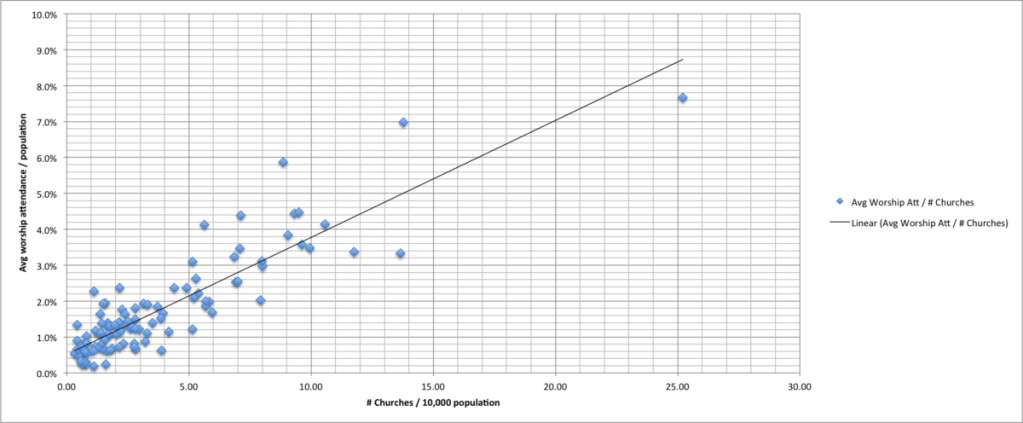
An easy first question: Is there a relationship between the number of churches in a county and the percentage of that county’s population in worship?

If you said yes, you were right. More churches = more people in worship. The chart below plots each county based on its number of UMC churches per capita and the average percentage of the population in worship attendance at UMC churches.
churches-and-attendanceLook at that beautiful direct relationship. More churches = more people in worship.

For people who like math and statistics, the correlation here is 0.884.

If you’re unfamiliar with correlations, they show you how closely related two variables are.

A 1 signifies a perfect positive relationship. Things with high positive correlations: ice cream sales vs. the outdoor temperature, your waist size vs. the amount of junk food you eat.

A -1 signifies a perfect negative relationship. Things with high negative correlations: hot chocolate sales vs. the outdoor temperature, your waist size vs. the amount you exercise.

A 0 signifies no relationship. Things with a near-0 correlation: the temperature outside vs. the amount of money in your bank account.

So a 0.884 correlation suggests a strong relationship between these two things.[note]There’s an important reminder in statistics: correlation does not imply causation. The number of people who drowned by falling into a swimming-pool correlates with the number of films Nicolas Cage appeared in during the year. Nevertheless, I think we have reason to believe that some causation is happening here. A few people might argue that the number of people in worship is causing the number of churches in that county. I don’t think that argument would find much support.[/note] I took this data to a team of MBA students at UK to be sure I hadn’t mishandled my data or misunderstood my results. They came back to me amazed that the data showed such a strong one-variable relationship.[note]For statistical analysis nerds, there’s much more here to discuss re: regression analyses. A regression analysis using county size and churches per capita shows a p-value of 4.4*10^-37 for churches per capita. A regression analysis using county size and average church size shows a p-value of .97 for average church size. I’m happy to continue the conversation and get your help and input for any next steps of study. Email me.[/note]

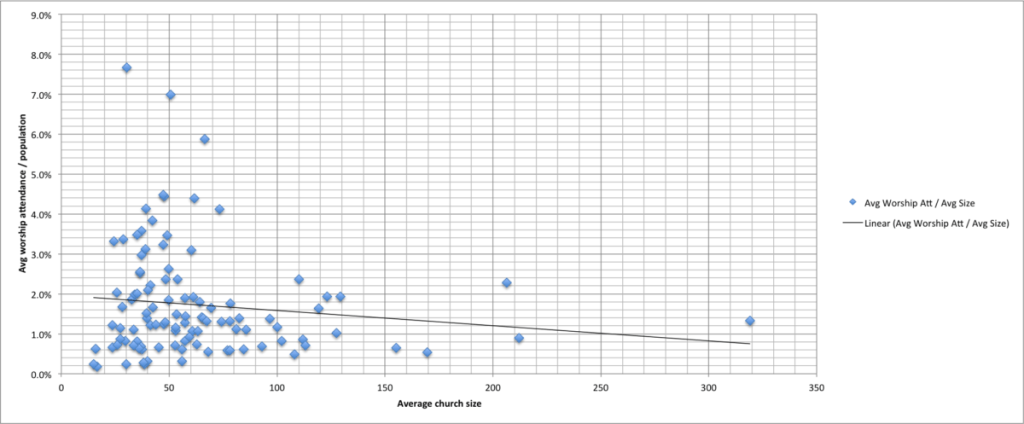
Let’s ask a next question. Is there a relationship between the size of churches in a county and the percentage of the population in worship?

This seems as intuitive as the first question. Bigger churches should equal more people in worship.

If you said yes… you were wrong. Bigger churches = nothing as far as total reach. The chart below plots each county based on the average size of its UMC churches and the percentage of the population in worship attendance.

size-and-attendanceNo relationship. The correlation is -0.12. This doesn’t change significantly even if we separate our counties by size. Even among our large counties––where churches are likely to grow larger––the number of churches per capita relates to how many people we’re reaching, the average size of the churches in that county does not.
More churches, more people

Tell me the number of UMC churches in your county, and I can tell you with decent accuracy what percentage of the county you’re reaching. Tell me the average size of UMC churches in your county, and I can tell you… nothing.

More churches = more people. Bigger churches = no difference.

In the data points above, you might see that the UMC has nearly 8% of one county in worship each Sunday. That’s Cumberland County. That county doesn’t have a single church with more than 100 people in attendance. But it has 17 of them![note]Some people will argue that Cumberland County is an outlier. Except that it’s not. Remove it, and the correlation doesn’t change. It is not an exception to the rule. It’s an extreme data point that proves the rule.[/note] For comparisons’ sake, that’s four more UMC churches than Fayette County has, even though Fayette is 46x larger.

If the Church really believes in reaching more people, it should be locked-in focused on starting more churches. Instead, we seem much more focused on growing churches. We celebrate church growth more than anything. Which people do we put in the spotlight? The ones who grow big churches! “The next speaker grew his[note]Let’s face it, it’s almost always “his.” I don’t celebrate that.[/note] church to ___ thousand in just ___ years!” The not-so-subtle suggestion: we all want to be like that guy and grow massive churches. Or at least grow larger than we are. Because we’ve all been convinced, if not consciously then subconsciously, that bigger churches are better.

We reveal that disposition when we refer to the church down the street as competition instead of as an ally. We reveal it when we say [insert your city name] has enough churches already, or when we advocate for church mergers. (“Do we really need one more church down the street? Why not combine into one bigger church?”)

About those mergers

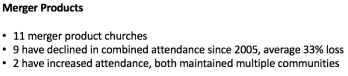
When we look at our merger products, we see more evidence that our bigger is better thinking is flawed. Analysis of Kentucky’s merger product churches over the past decade shows them as the single worst-performing category of churches we found. We had eleven merger product churches. Nine declined in their combined attendance and averaged a 33% loss. Five of them were among our top 20 attendance decreases across the conference during this period. (A category of churches that makes up only 1.4% of the Conference represented 25% of our churches with worst worship attendance losses.)
Two of those merger products actually grew. Those two exceptions are telling. One maintained separate geographic locations. The other maintained worship services in different languages. Neither merger included getting all the people under one roof.

Why we prefer bigger, why we need more

Bigger affords more. Specifically, it affords pastors a bigger pulpit, paycheck, parsonage and pension. (I’ve heard about the 4 P’s more than a few times. So long as they’re prized, our decisions will be based more on pastor preferences than kingdom impact.) So there’s a baked-in incentive for pastors to favor bigger rather than more. If you send people out to start something new, it means that your pulpit will stay smaller. And probably the paycheck and pension, since people will take their money with them. One church of 400 can pay a pastor much more than five churches of 100 can each pay their pastor. But we reach more people the second way.

Bigger affords more, but bigger doesn’t reach more. More reaches more. How can we flip the script in the church to start celebrating more churches more than we celebrate bigger churches?

This post deals with our why. Why plant churches? Because we reach more people. The why isn’t enough, though. How do we plant churches effectively? Next week’s post [now available] will suggest that we already know… but often ignore it. To be sure you don’t miss it, JOIN my e-mail update list.


Pastoral Tenure and Transition: How to NOT squander church resources (pt. I)

Only God is infinite. The rest of us deal in finite resources.

The money available to us is finite. The time available to us, at least on this old earth, is finite. Will we use them well, or will we squander them?

I referenced Moneyball in the previous post. In the based-on-a-true-story book and movie, the Oakland A’s are using a limited budget and trying to compete with the Yankees. (Only God is infinite. But the Yankees’ resources seem close.)

How does a team like the A’s with a $41 million payroll beat the Yankees with their $125+ million payroll? They figure out how to maximize their resources. While most baseball teams are relying on “medieval” thinking––doing it because they think it should work, because it’s the way they’ve always done it, etc.––the A’s rigorously study what makes a difference and follow the results to new ways of operating, unusual or uncomfortable as they sometimes are.

Maximizing the church’s resources

In the coming years, the church must find ways to maximize its resources. This is especially important because our battle is especially important. Our competition isn’t the Yankees. Contrary to popular belief, our competition isn’t the mega-church down the street, the Baptists, the Roman Catholics, etc. Our competition is sin, injustice, and heresy.

These are relentless opponents. But our infinite God has given us all that we need for the battle. Now the question: Will we steward it well, or will we squander it?

In the previous post, I wrote about a group that spent $15 million on church planting over the last decade with almost nothing to show for it today. That was a tragic loss of resources. I’m not quite ready to call it squandering. Perhaps that group was neither reckless nor foolish. Perhaps they were careful, thoughtful… and unlucky. Perhaps they were just doing the best they could. They didn’t know any better They provided, if nothing else, a very expensive set of experiments in church planting.

What would be reckless and foolish is if we didn’t learn enough from that expensive set of experiments before running off to try more.

I want to suggest here that the United Methodist Church is an excellent experimental lab. With the level of autonomy each Annual Conference and local church has, we’re simultaneously running thousands of experiments. We have enough history that it’s time to study those experiments more closely and let the results guide us. If we don’t do that, we’re liable to squander our resources––usually out of a desire to keep doing things the way we want to do them.

Three areas where the results should challenge what we’re doing

Tenure and Transition

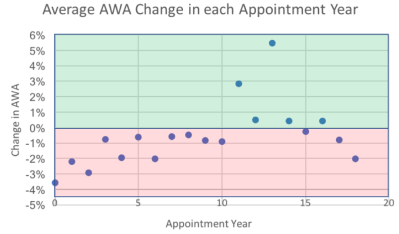
In an earlier post, I shared several studies related to pastoral tenure and transition. These studies showed what every study I’ve seen shows: churches do much better with long pastoral tenures and few pastoral transitions.[note]Some people may suggest the causal relationship actually runs the other way. Though there must be at least some truth to this, our study showed how even successful long-term pastorates suffered losses in their early years.[/note] When I sent results of one of these studies to a friend, he asked, “Do we even need to keep running more studies?” We know by now. My plea to leaders across the UMC: do what you can to increase pastoral tenures and reduce transitions.

While many said it sounded like a good idea, there were also several who corrected me about our problem. The problem wasn’t too many transitions. The problem was that “we don’t do transitions well.”

Do you see what that suggestion affords? A chance to keep making moves as often as we want to, but with more conversation along the way about how to do it “well.”

The problem: We have nothing more than anecdotes about how to do transition “well.” We do, however, have clear evidence that we should try to create fewer occasions of pastoral transition. One retired United Methodist Bishop cited this as the single biggest problem in our denomination. “We have to get our heads out of the sand,” he said. I thought he must have switched topics to our bigger denominational controversies. “No,” he said, “about pastoral transitions.”

We shouldn’t be too surprised that the frequent shuffling of pastors is harmful to ministry. The practice works against basic biology. Harvard professor Robert Putnam writes,  “[F]or people as for plants, frequent repotting disrupts root systems. It takes time for a mobile individual to put down new roots […] frequent movers have weaker community ties.”[note]In Bowling Alone: The Collapse and Revival of American Community  (New York: Simon & Schuster, 2000), 205.[/note] That makes frequent moving harmful for pastors and for churches trying to minister to their communities.

I went to a cooking class a few years ago where the chef talked to us about how amateur cooks feel a need to constantly move the meat around on the grill top. He talked about all the reasons that was unnecessary and could be harmful to the final product. “For some reason, you feel the need to keep moving that meat around. Maybe you need to feel like you’re doing something. You have to stop! Put it there, and then LEAVE IT THE HELL ALONE!” Though I’m not sure that’s quite the way we’d say it to Bishops and Cabinets around the denomination, the chef’s admonition seems fitting, in principle.

We have enough evidence to make this change. Can a pastoral transition be beneficial to a church? Of course! But it will be the rare exception to the rule.[note]In our study, 70% of churches declined after a transition, including 90% of churches that had previously experienced 10% growth or more.[/note] If a Conference’s median pastoral tenure is falling, rather than rising, we have reason to ask whether they’re squandering one of their most important resources. A change to lengthen pastoral tenures––I’ve suggested a target average of 10 years––would involve a change to many standard practices and cultural norms. It wouldn’t be easy. But it’s needed. I’ve provided some practical suggestions about how we could do this in the recommendations section of the bigger research study.

I’ll share pt. II next week. It’s on church planting and includes some research that may confirm or contradict how you think church planting works. JOIN my e-mail update list to be sure you see it.