
This is not a fire

keep_calm_and_carry_onAll the rules of social convention tell you not to stand up and yell in a movie theater. Unless there’s a fire. Then, by all means, stand up and yell. This is a crisis situation. No time for whispering.

During a crisis, we may forgo things that are normally important for the sake of ultimately important things. Being polite and civil is normally important. But when, for example, you’re at the site of a car crash, civility loses its importance for a moment. It’s appropriate to yell, “Get out of the way!” Even at the expense of seeming rude or hurting feelings.

The problem comes when people mistake urgent for crisis. These are not the same. Life brings many urgent decisions—cases when we need to make a choice. These times are often unplanned and unwelcome. Few of these are crises—cases of imminent danger.

When we talk about “putting out fires,” we’re talking about crises. A fire must be put out or we risk serious damage. Unless you’re Jack Bauer, you should not be putting out multiple fires per day, or even week or month. If you are, there’s either a problem with your system or, more likely, you’re confused about what a “fire” is.

If “putting out fires” isn’t the term that’s used, it may come in a different form: drama. Drama takes a presenting need and turns it into a crisis.

When we mistake urgent for crisis, it creates a big problem. In crisis, we live by a different set of values and create a different culture. We re-write or re-order what we consider important for those times.

Here’s how that can look in the church…

Sunday Morning and the Perfect Game

In the church, Sunday morning presents many urgent situations. We have lots of moving parts. We would like each of those parts to move in exactly the right way at exactly the right time. How that looks on a perfect morning: hospitality team greets every person who walks in, microphones are on and off at all the right times, the correct slides are always on screen, everyone hits every cue. I’ve referred to this as “the perfect game.”

I often say to our leaders after worship, “The perfect game still eludes us.” We haven’t pulled it off yet. Every week, something goes wrong––someone misses a cue, a volunteer calls in sick, something isn’t where we expect it. Most likely: I screw something up. But not yet have we had a true crisis. And the worst thing we could do to undermine our values is to treat the pursuit of a perfect game as crisis.

Here’s how urgency can become crisis on Sunday morning…

No gifts

We can’t find the gifts we normally give to guests. This is a problem. An urgent problem. Guests will be standing before us at any moment, waiting for that promised gift, and we don’t have it. You have to make a decision. (A note: this is a situation I think my church has happily avoided. So this is all hypothetical.)

One decision––keep calm. Have some people look around. With a smile, ask anyone who may know where those gifts may be. If all this fails, greet the guests warmly and apologize that the gifts we promised seem to be misplaced.

Another decision––treat it as a fire. Scramble. Panic. Run into rooms breathless, asking where the gifts are, thus sending the whole room into a frenzy.

When crisis comes, we forgo normally important things. We stop smiling, noticing people as people, and speaking to them with warmth. We kick into fight or flight mode, instead. In that example above, the gift is intended to facilitate a more important value––that we value people and want to welcome them well. When we treat the gift as a crisis, we create an environment where the more important thing (valuing people) takes less importance.

When I’m in an environment where “the perfect game” is top priority, I can tell. The people there are tense, even when they try not to show it. They’re unable to give me too much attention because they’re constantly watching for anything that may go wrong. Every problem is a threatening fire.

No gifts for guests is a simple example. Others that may sound more pressing: a key children’s ministry leader calls in sick, the sound board isn’t operating correctly, the preacher just called in sick. All of these are disappointing. All will require some major adjustment. None is a crisis. The first thing to do in each situation: everyone smile and take a breath. We’ll still find a way to worship together this morning.

Why this is important

As a pastor, I’ve learned that this distinction is not a small thing, a minor preference about how we approach worship together. It’s a big thing. It sets the tone for the whole community––how we live and worship together.

I’ve learned this because I used to be more preoccupied with every potential problem. To the point that I couldn’t worship well if something was wrong or threatened to go wrong. That spirit prevented me from giving enough attention to the people in front of me. It occasionally spilled over to stress out those around me. It showed our community that getting things right was the most important thing. When we live on edge like that, we might get the things right, but we get the spirit wrong. We create a culture of fear rather than a culture of joy and celebration. And the culture of joy and celebration needs to remain more important––all the way until there’s a fire threatening real danger.

We can find a way to adjust without that crucial volunteer, without the sound board, without the preacher. It’s not ideal. We’ll hope for better next week. We’ll learn to plan better if we could have. But we will worship with a glad spirit right now, regardless.

This doesn’t intend to shrug off problems. We would like things to go as planned. We should prepare well, with thought and care. That sets us up for success. (Some things that become “urgent” aren’t because of unexpected surprises but because of poor planning. That’s a bad excuse. We should own that failure in planning when it happens and then correct it.) If the same problem keeps happening, it’s irresponsible if we don’t ask why and work on a solution.

But once the planning is over and the time has come, problems are sure to come with it. A good question to ask: is this a problem or a fire? If it’s a problem, stay calm, work toward a solution, stick with the big values you know are most important. If it’s a fire, then you have permission to get stressed out. Run, scramble and yell all you need to. If things go wrong, the consequences could be dire.

We rarely mistake a fire for a smaller problem. Fires stand out. But we often mistake problems for fires.
“How do I become a leader?”

“How do I become a leader?” Several people have asked me that question. That’s usually in relation to the church, but has come in other settings, as well.

We use the word “leader” most often for two particular roles: (1) person who sits at the decision-making table, (2) person entrusted with the most visible and public roles.

And we often address the “become a leader” question with a program or an application. Attend this training, and you’ll become a leader. Or fill out this application to be on our leadership team. That has some merit to it. But it hardly guarantees that you’ll be a true “leader” on the other side. Nor does it guarantee that the people who went through the training or application process are the best people to put in decision-making or public positions.

My simple, two-step process to becoming a leader:

1) Participate

Leadership starts with participation. For a few reasons…

a) Participation itself is leadership training. Our community has discipleship groups called catechesis groups. We believe the primary training for leading a group is to participate in a group. Nothing will help someone understand the nature of these groups better than participating in one.

We see this in American society when we celebrate mailroom to boardroom stories. A friend of mine who started working at a bank said that his bank requires everyone to start as a teller. “You need to know how the front lines work before you do anything else.” Before someone is making important decisions for others or leading in a public role, it helps to know what it’s like to be on those “front lines.” This leads to the second reason…

b) Participation reflects buy-in. In our community, we wouldn’t consider having someone lead in a public role until we have seen a lot of behind-the-scenes faithfulness. Don’t ask to lead in worship if you haven’t put in some good time helping with worship setup, in the nursery, or in one of those other areas of high need. We expect our leaders to be servant leaders, and models of the kind of leadership we need. That means filling the most-needed roles before filling the most-coveted roles.

See “What are you passionate about?” for more along these lines.

c) Participation allows you to see places where you can lead. The more you participate, the more you see real areas of need and opportunity. You may be able to recognize these areas from the outside, but in several instances, your perspective will change once you get more involved. Once you’re participating, you may understand the reasons your ideas from the outside wouldn’t work. Or you may see the real needs, rather than just perceived, surface-level items.

2) Initiate

Leadership requires initiation. If you can’t initiate, you can’t lead. To be clear, that’s okay. If you’re great at taking a list of tasks and accomplishing them, you can be a great asset in a number of places. You are a highly valued servant/follower/assistant! We need many more people like you.

If you want to be a leader, that’s a good starting point. Can you be trusted to do a task you’ve committed to? If not, go back and start there. If you’re already a trusted servant/follower/assistant, now add initiative to it, and you’re becoming a leader.

Initiative in a few forms:

a) “I’ll figure it out.” Here’s simple initiative. One of our volunteers found me on a Sunday morning a few weeks ago and asked, “Do you know who’s picking up the donuts?”

I have no idea how donuts get to us every Sunday morning, but I stood up and grabbed my phone to try to find out. “No, sit down,” he said, “If you don’t know, I’ll figure it out.” I don’t know what he did after that, but I saw donuts later that day.

“I’ll figure it out” is initiative. It says that you’re willing to take responsibility for more than a checklist. You’ll take the next steps to find a solution.

b) Initiative also comes in this form: “Have we ever thought about _______?  I’d be happy to help make it happen, if you think it’s an option.” 

Sometimes it doesn’t even happen that clearly. It’s subtle, behind-the-scenes, almost-unnoticed culture shaping. Sometimes it’s a simple, “Here, I made this” (of course, only when it’s okay that you didn’t ask permission…)

I’ve told our community several times that our vision is limited right now. I don’t dare to paint too much of a vision about five years from now. Because our vision involves a community. It’s about all of us bringing together our passions and gifts. We are who we are today because of a number of people who aren’t even with us anymore. Their contributions outlasted their time with us. And who they made us is different than what we would have planned in a “strategic visioning session.”

We are who we are today because of Andrew’s desire to teach our kids to pray and worship together, and because of his desire for an adult in the community to speak to those kids each week as valued members.

We are who we are today because Jason and Sarah called us to be a community that made sure it included both genders throughout its leadership.

We are who we are today because Adam was determined to give people the warmest welcome possible and because Anna was determined to get them around a table together.

And we will be who our next leaders help us become.

c) If you’re at a loss for where to start, initiative can even come in this simplest of forms. It can be the initiative to learn from a mentor. “I want to grow as a leader. Would you help me find a mentor? I’m willing to do anything they/you think would be a helpful next step.”

And of course, if you’ve already been participating and initiating in a number of ways, but there are more leadership opportunities you aspire to, you can certainly initiate a conversation about those. Go to the right person and tell them you’re interested in more.


Essential Qualifications

These won’t make you a leader, but you can’t lead (or shouldn’t) without them.

  • Holiness – You can be the greatest speaker, decision-maker, creator, organizer, or motivator the world has ever seen, but if your life isn’t a model of holiness, you shouldn’t be leading. Not in the church, at least. An essential question for our leaders: “How is your heart today?”
  • Servanthood – Yes, the Bible refers to disciples and servants much more than it refers to leaders. And we need disciples and servants more than we need leaders. If you are not a model servant, don’t presume to be a leader. That is, if you haven’t demonstrated that you can care for others and set their interests above your own, you’re going to have difficulty being a good leader. At least in the church, when we say “leader,” we need to presume that “servant” is a part of the definition.
  • Trustworthiness – If we can’t rely on you to make your actions match your words (integrity) and to make your words match your actions (honesty), we can’t have you leading us.

Is salvation conditional? And more on pastors’ pay — Q&A, pt. I

I’ve been receiving various questions from readers. I promised to try to answer some of them in a series of posts. I chose two questions that are poles apart for part I. I’ll have several more to get to in part II. And please feel free to email me yours.

“My question is 3-fold:

1) Do you personally believe our salvation is conditional according to the Scriptures?

2) In your view, what Scriptures support this stance?

3) How to maintain our salvation then?”

Someone who says she has “just been persuaded of this position” sent that question. As a result, she said she joined the Methodist Church last week.

Yes! I do believe our salvation is conditional. In fact, I think that’s good news. This is a place where I disagree with my Reformed/Calvinist friends. (And yes, they are friends. We can disagree without animosity.)

No small amount has been written on this subject. Rather than write a whole booklet, as Wesley did, or an entire book, like this from Walls and Dongell, let me give you my simple version.

We start here:

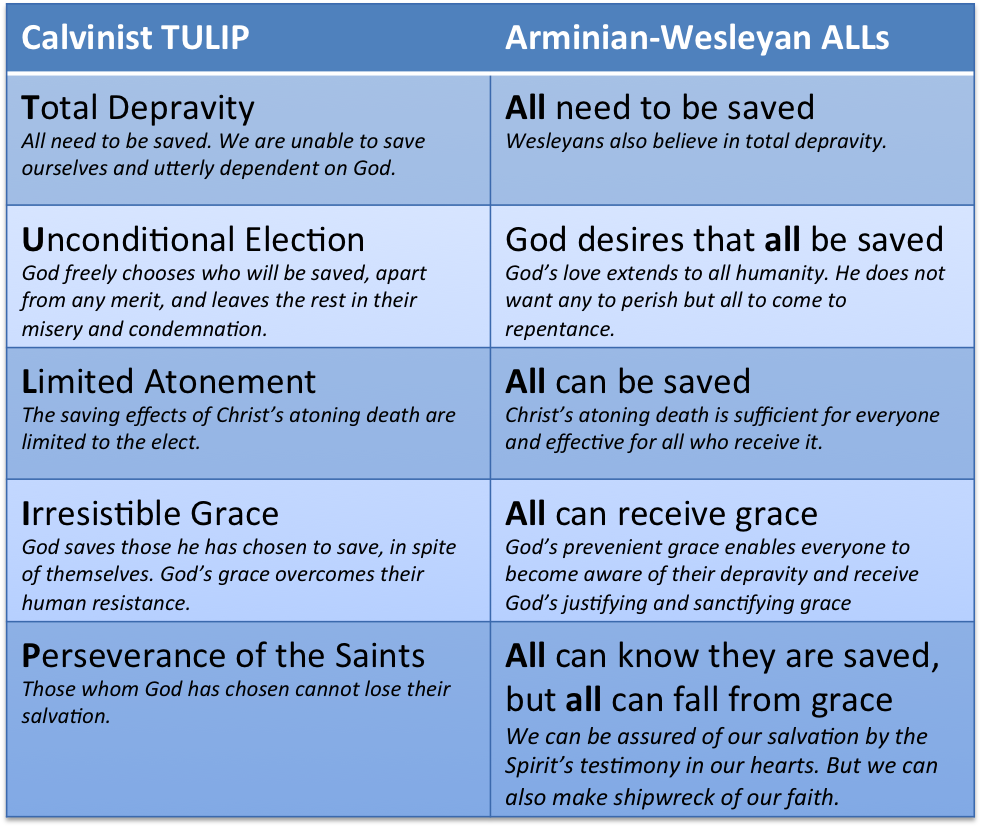
TULIP - ALL1. God “desires everyone to be saved and to come to the knowledge of the truth” (1 Timothy 2:4).

My Calvinist friends begin to object here. They want to qualify that “everyone.” In their framework, God gets whatever God desires. It doesn’t make sense to them that an Almighty God could desire something that doesn’t happen. So they claim “everyone” means every people group, not every individual. But the same Calvinist friends also say that if you read the Bible at face value, you have to agree with them. So let’s acknowledge at the start that we’re all qualifying certain statements in Scripture. And to qualify “all” and “everyone” is no minor nuance.

2. Everyone can be saved. We have a mediator, Christ Jesus, “who gave himself a ransom for all” (1 Timothy 2:6) “so that by the grace of God he might taste death for everyone” (Hebrews 2:9). His atoning death is sufficient for all to be saved.

More of that pesky “all” and “everyone” language. See my note above.

3. Not everyone is saved. The biblical witness is clear on this.

I believe this is what has run aground several of my Calvinist friends. By their logic, God would save all whom he desires to save. That leads them to two options: universalism (everyone will be saved) or limited atonement (Christ did not die for everyone).

4. Everyone who believes is saved. Christ’s atoning death is effective for all who accept it.

That is to say, Christ’s atoning death is universally sufficient (see #2) but conditionally effective. 

Here’s how Paul put that condition: “If you confess with your lips that Jesus is Lord and believe in your heart that God raised him from the dead,” [a break to note that this is, by definition, a conditional clause] “you will be saved” (Romans 10:9).

Paul lays out the conditions of salvation plainly in Acts 20:21: “turn to God in repentance and have faith in our Lord Jesus.” If we accept that much, we should spend some serious time looking into repentance and faith. What do those words mean in Scripture and the Christian tradition? I said “everyone who believes is saved” above. Please don’t accept that for the simple, “Sure, I believe in Jesus” faith common in our culture. Repentance and faith mean much more.

That’s a start. I could point to many more passages, along with most of the Christian tradition, on these points. My Calvinist friends will, of course, have opposing verses to share. I’ll not attempt a full defense of those here. They don’t deny #3 above, and I believe their arguments against #1 and #2 are strained. I believe the witness of Scripture, the Christian tradition, and our own experience all favor a view of salvation as conditional.

To your final question about how we maintain our salvation… Be alert, on guard, disciplined! Because the devil prowls like a roaring lion, looking for someone to devour. Practically, I’d especially encourage those means of grace encouraged throughout Scripture and church history: participate in the life of the Church and its sacraments, search the Scriptures, pray and fast.

The notion that we could lose our salvation may scare people. But it shouldn’t need to instill more than a healthy fear. God is good, and God is faithful. The faithful married person, for instance, doesn’t go around in constant fear that their loving spouse will leave them. But they also know that they’re not guaranteed security in that relationship if they’re unfaithful. Just as the devil can entice you to be unfaithful to your spouse, he can entice you to be unfaithful to your God. Both of those infidelities can lead to shipwreck. We need to be vigilant! But we needn’t be afraid.

“You’ve written several things about pastors’ salaries and talked about being paid part-time. But you also have a coffee shop where I assume you make money. For full-time UMC pastors, that’s not an option. Do you think that difference should be part of the equation?”

That’s a good point. I hear this has been a conversation for some pastors in my conference, so I think it’s best for me to be transparent. I know this kind of public discussion of personal finances can seem distasteful, so I’ve hesitated to do it. If it’s in bad taste to you, you might just stop now.

I am a partner in a coffee shop here in Lexington––a fun little venture. Two quick notes about your question, though: 1) I’ve been talking and writing about pastors’ salaries since before that shop existed, and 2) I’m not an employee. The UMC prohibits full-time pastors from working other jobs, but they don’t prohibit pastors from being partners. So that particular venture hasn’t influenced what I’m saying, and it’s a possibility for other UMC pastors, too.  I’d encourage it for more pastors, actually. It has been a good learning opportunity and a different way to bless the community and be involved in it.

As for finances, between the church, the coffee shop, and a few other small sources of income, my total income is about $21,000 less than our conference’s minimum package.[note]That number will decrease next year––my church is giving me a generous raise.[/note] That coffee shop might be able to replace my income one day, and I’d celebrate that. But for now, it’s just a nice supplement.

I could stop there, but I should also acknowledge our family has had other advantages. Our parents have been very good to us––we rarely pay for babysitting, get to go on family trips that we don’t pay for, regularly receive clothes and other things for the kids, and even got our first mini-van from them. When we went to Spain, 40% of our cost for the year was covered by the generosity of our church, family, and friends. I was also able to work the whole time I was in seminary and paid as I went. No seminary debt has been a huge advantage.

We have a number of advantages and unique circumstances. In all, though, I don’t think our situation prevents me from being able to speak about clergy pay.

Note that I’ve never called anyone else to receive less than full-time minimum or claimed that our minimum-paid pastors are making too much. I have asked, for the sake of integrity, that we quit acting like our pastors live like paupers. Even our minimum-compensation pastors are in the top 27% of all U.S. income earners,[note]That figure includes their housing, as I’ve argued it should.[/note] with a very generous retirement and insurance plan on top. The average pastor in Kentucky is in the top 14%, and our director-level positions are in the top 8%. I would venture that never in Methodism’s history have our pastors been so highly compensated relative to our society.[note]I haven’t run all the numbers on this, but see the chart in my interview with Wesley Sanders for a representative sample.[/note]

Our pastors are good people. They work hard and have hard jobs. In the business world, many of them might be highly compensated for their work and talent. But the church is a different entity, and the church’s offering is no ordinary source of revenues. If John Wesley himself were among our highest-paid UMC pastors, I would be questioning his pay. Though I doubt I would need to. I think his voice on this issue would make mine sound weak and soft.

—————