Evangelizing the Christians

preaching to the choir

The largest mission field in the US is not the self-declared atheists or agnostics. It is not among professing Jews, Muslims, Hindus, Buddhists, etc. The largest mission field in the US is among self-professed Christians.

My own tradition recognized this. Look at what John Wesley said about the Methodist revival in England:

We look upon ourselves, not as the authors or ringleaders of a particular sect or party; (it is the furthest thing from our thoughts) but as messengers of God to those who are Christians in name, but Heathens in heart and life, to call them back to that from which they are fallen, to real genuine Christianity.

In Wesley’s time and place, the vast majority of England was Anglican — baptized and professing faith. But they were heathens in the ways that they lived and in the devotion of their hearts.

Is it enough for someone to say they believe in Jesus, or to have said a certain prayer, or to have “given their lives to God”? Are we just looking for them to say that they’ve acknowledged proper Christian beliefs with their mind? For the early Methodists, Christianity was a total devotion to God in heart and life. Claiming to have faith (i.e. agreeing to some propositions about religion) was not enough.

Perhaps when we think about evangelism, our first thoughts should go to Church-people, or former Church-people. A large mission field lies before us there.

Do you know anyone who has fallen away from the Church? Perhaps initiating a conversation with them is the place to start.

Do you know someone who claims faith but is, well, living like a heathen? Do you have opportunity to draw out the contrast of their professed faith and their life?

Though I’m generally a terrible evangelist, I have had some great opportunities by seeking out and asking professing Christians about their faith. Do you have opportunity to do the same?

Disclaimer: Don’t hear me giving the easy way out on this. I’m not saying that you can forsake all other evangelism until your weekly accountability partner has been perfected in faith.

Crying out to save ourselves

voice in the wilderness

An old Jewish folktale told about Sodom:

A righteous man arrived in the city, and went about telling people to repent. The more he was ignored, the louder his calls for repentance grew.

One day, a young boy said to him, “Why do you continue yelling at people to change their behavior? You’ve been here a long time already, and you have affected no one.”

“When I first arrived,” the man responded, “I hoped that my yelling would change the people of Sodom. Now I yell so that the people of Sodom don’t change me.”

from Rabbi Joseph Telushkin in Biblical Literacy

Maybe your cries in the wilderness aren’t ineffective. Maybe their greatest (sometimes only) effect is your own salvation. If you cease to cry out, you’re likely to conform.

Three perspectives on evangelism

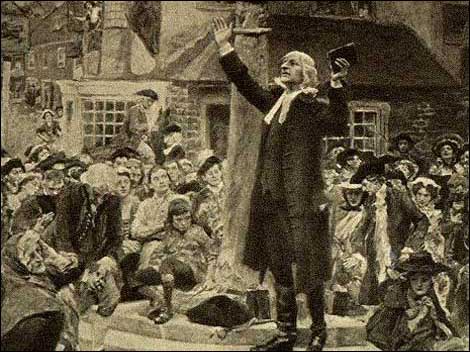
Methodist field preacher

Since I’ve already admitted to being a terrible evangelist, I thought it might be better to start us thinking about evangelism with some other people’s wisdom.

Here are three good articles on evangelistic efforts from diverse perspectives. I hope you’ll take the time to read them.

  • Four Questions at the Heart of Evangelism – John Meunier draws four self-evaluation questions from a book on real life evangelism. These are hard hitting. “We cannot share what we do not have,” he says. How do you answer these four questions?
  • Re-building a vital congregation – Though he never uses the word evangelism, the work Don Haynes is doing in a small community is deeply evangelistic. He’s urging us to visit from house to house! Maybe there’s really something to it. I’m most interested in the “sitting where they sit,” “appointed to territory,” and “from house to house” sections. And by the way – though this is a small-church pastor doing these things, nothing is preventing all of us, regardless of occupation, from similar practices.
  • What happened to the missional impulse of the Methodists? – Steve Manskar shows how new church plants are using the practices of the early Methodists to reach new people. He laments that the Methodists have mostly forgotten these practices. Two men I deeply respect are reviving that impulse among Kentucky Methodists. Paul Brunstetter was the first person to help me understand that creating new places for new people–and raising up new leaders for those communities–may be the most effective and historic model of evangelism there is. Aaron Mansfield is the most die-hard, old-school evangelist I know. He’s showing us the importance of constantly going to people where they are, and then inviting them to faith and into the church. If you’re a Kentucky Methodist, you have reason to have hope. We Methodists must get our missional impulse back.

These three articles come at it from different angles, but all three lead us to the same place. How fervently do we believe the gospel, and how strongly have we experienced its power? Will we now go wherever people are to help them toward repentance, faith, and holiness? Will we be intentional about developing disciples, not mere converts?

Which of these challenges you the most? Are any of these ideas or perspectives new for you? Is this all church-talk, or can the average Christian take and apply these?

Subscribe by e-mail or RSS to get regular updates on theology, ministry, and life with God.