Three perspectives on evangelism

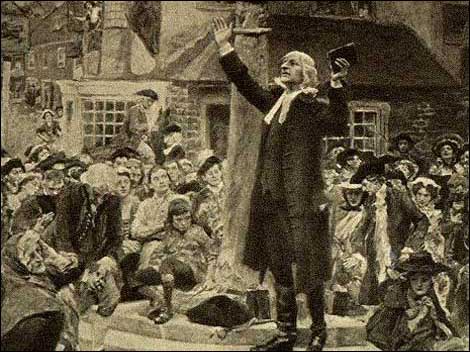
Methodist field preacher

Since I’ve already admitted to being a terrible evangelist, I thought it might be better to start us thinking about evangelism with some other people’s wisdom.

Here are three good articles on evangelistic efforts from diverse perspectives. I hope you’ll take the time to read them.

  • Four Questions at the Heart of Evangelism – John Meunier draws four self-evaluation questions from a book on real life evangelism. These are hard hitting. “We cannot share what we do not have,” he says. How do you answer these four questions?
  • Re-building a vital congregation – Though he never uses the word evangelism, the work Don Haynes is doing in a small community is deeply evangelistic. He’s urging us to visit from house to house! Maybe there’s really something to it. I’m most interested in the “sitting where they sit,” “appointed to territory,” and “from house to house” sections. And by the way – though this is a small-church pastor doing these things, nothing is preventing all of us, regardless of occupation, from similar practices.
  • What happened to the missional impulse of the Methodists? – Steve Manskar shows how new church plants are using the practices of the early Methodists to reach new people. He laments that the Methodists have mostly forgotten these practices. Two men I deeply respect are reviving that impulse among Kentucky Methodists. Paul Brunstetter was the first person to help me understand that creating new places for new people–and raising up new leaders for those communities–may be the most effective and historic model of evangelism there is. Aaron Mansfield is the most die-hard, old-school evangelist I know. He’s showing us the importance of constantly going to people where they are, and then inviting them to faith and into the church. If you’re a Kentucky Methodist, you have reason to have hope. We Methodists must get our missional impulse back.

These three articles come at it from different angles, but all three lead us to the same place. How fervently do we believe the gospel, and how strongly have we experienced its power? Will we now go wherever people are to help them toward repentance, faith, and holiness? Will we be intentional about developing disciples, not mere converts?

Which of these challenges you the most? Are any of these ideas or perspectives new for you? Is this all church-talk, or can the average Christian take and apply these?

Subscribe by e-mail or RSS to get regular updates on theology, ministry, and life with God.
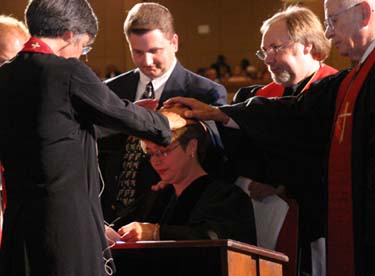
What does ordination mean?

United Methodist clergy are asked 19 historic questions at the beginning of their ordination. A good friend just asked me which of these are binding, and which are simply a nod to our history.

That’s a difficult question to answer when you look at them. I’ve just said that the biggest lie told at every UMC Annual Conference is when ordinands respond to the question, “Will you visit from house to house?” As I look at these other questions, I wonder how many of these we are telling the truth about.

How many pastors recommend fasting or abstinence by both precept and example? How many have avoided massive debt? How many actually approve our church polity and government?

Are any of these still standing but the first: “Have you faith in Christ?”

By winking and grinning at the other 18, are we compromising even the expectation of faith in Christ?

How do you think these historic questions should be used? Binding? Nod to history? Should we consistently evaluate whether clergy are adhering to any/all of these? Which ones?

The historic questions:

  1. Have you faith in Christ?
  2. Are you going on to perfection?
  3. Do you expect to be made perfect in love in this life?
  4. Are you earnestly striving after it?
  5. Are you resolved to devote yourself wholly to God and his work?
  6. Do you know the General Rules of our Church?
  7. Will you keep them?
  8. Have you studied the doctrines of The United Methodist Church?
  9. After full examination, do you believe that our doctrines are in harmony with the Holy Scriptures?
  10. Will you preach and maintain them?
  11. Have you studied our form of Church discipline and polity?
  12. Do you approve our Church government and polity?
  13. Will you support and maintain them?
  14. Will you diligently instruct the children in every place?
  15. Will you visit from house to house?
  16. Will you recommend fasting or abstinence, both by precept and example?
  17. Are you determined to employ all your time in the work of God?
  18. Are you in debt so as to embarrass you in your work?
  19. Will you observe the following directions? a) Be diligent. Never be unemployed. Never be triflingly employed. Never trifle away time; neither spend any more time at any one place than is strictly necessary. b) Be punctual. Do everything exactly at the time. And do not mend our rules, but keep them; not for wrath, but for conscience’ sake.

Subscribe by e-mail to get regular updates on theology, ministry, and life with God.

For more UMC-specific posts, go to my UMC Posts page.

I am a terrible evangelist

I’m going to begin a new series on evangelism in an unusual way. I’m starting with a confession: I am a terrible evangelist.

Here’s what I mean. Evangelistic instincts don’t come naturally to me. I don’t easily recognize opportunities to boldly and clearly share the gospel with people stuck in sin. When I do see an opportunity, I usually feel uncomfortable and awkward about it. My nature doesn’t lend itself to great evangelistic work.

Furthermore, very few people have modeled good evangelism for me. For that matter, most of the church talk I hear about evangelism isn’t really evangelistic. It usually begins with the question “How do we attract people?” A very different question. Doing things that might attract people is much more comfortable than doing truly evangelistic things.

From what I’ve seen and the conversations I’ve had, most of you are like me. You share my discomfort and awkwardness with evangelism. You share my uncertainty about how to even go about it at times. And you share a genuine desire to see people come to Christ…

I am a terrible evangelist. Most of you are, too. But it’s not sufficient for us to say, “That’s just not my spiritual gift.” That cop-out won’t do. It’s like saying you don’t pray because it’s not your spiritual gift. Unacceptable.

I’ll use the next several posts to share some ideas, some experiences, and some challenges for us all. I believe we can and should be doing much better. I hope it will stimulate some new ideas, open opportunity for some discussion, and give us courage to ACT.