Personality unchained [Does God want to change your personality? pt. III]

personalityThe most drastic transition in all of life is birth. Think about an infant in the womb. She isn’t far from the outside world—in fact, it’s all around her. She can already see and hear signs of the outside world, but only with veiled senses. She’s inches from the light of this world and yet lives in relative darkness. We can now take snapshots of her in the womb and have an early sketch of what she looks like. Still, we await the birth to get the first true glimpse.

From the moment the child was created in the womb, she was made for life in this world. She’s already very much alive, but for the rest of time, we’ll mark her span of life by the date of her birth, when she came out of the darkness and into the light. The Spanish-speaking world recognizes the significance of that transition––to give birth is to “dar a luz,” literally “to give light.”

God wants to change your personality—drastically

Some of the New Testament’s most common metaphors about spiritual life refer to darkness, light, and birth.

Jesus calls himself the light of the world and says, “Whoever follows me will never walk in darkness, but will have the light of life.”[1. John 8:12]

A letter to one of the earliest churches declares,

God is light; in him there is no darkness at all. If we claim to have fellowship with him and yet walk in the darkness, we lie and do not live out the truth. But if we walk in the light, as he is in the light, we have fellowship with one another, and the blood of Jesus, his Son, purifies us from all sin.[2. 1 John 1:5-7]

That movement from darkness to light comes from a new birth. “No one can see the kingdom of God unless they are born again,” says Jesus to a man named Nicodemus.[3. John 3:3]

I’ve been writing about personality, and in the past few weeks, I’ve defined personality as disposition + mental health + character.

The new birth we’re considering affects far more than our personalities. But as our personalities go, I believe this new birth may be as drastic a transition as our original births.

I shared in an earlier post that we shouldn’t expect God to change someone’s disposition. God has graced you with a beautiful disposition––whether outgoing or introverted, carefree or cautious, especially emotional or logical. Those aspects of who you are should be celebrated and accentuated, not masked or diminished.

I shared in another post why we should see mental health in a category of its own. We do ourselves and others a lot of harm when we confuse a mental health problem for a character problem, or when we neglect to see the way that problem may be distorting someone’s true, God-given disposition.

The drastic change in our personalities comes because of a change in character––a move from walking in darkness to walking in light. Pride is transformed to humility, wrath to patience, greed to charity. Above all, we become people whose character is defined by love. One of John’s letters makes the connection clear:

Anyone who claims to be in the light but hates a brother or sister is still in the darkness. Anyone who loves their brother and sister lives in the light, and there is nothing in them to make them stumble. But anyone who hates a brother or sister is in the darkness and walks around in the darkness. They do not know where they are going, because the darkness has blinded them.[4. 1 John 2:9-11]

I believe God very much wants to change this part of your personality. Take any disposition and saddle it with malice, deceit, hypocrisy and envy, and you’ll have a perverted version of God’s original creation.

Overlay the same disposition with love, faithfulness, integrity and kindness, and you’ll see not just a brand new person, but the old person as they were made to be. You won’t see someone who isn’t himself anymore. You’ll see someone who is more himself now than he ever was.

Kill the old self?

In his letter to the Ephesian church, Paul tells them to put off the old self and put on the new self. This may be the cause for people’s belief that their personality—disposition included—requires a total overhaul if they want to be a Christian. “The old self needs to die. Whomever I become should be a different person entirely,” they think.

But look at the full teaching. It urges people “to put off your old self, which is being corrupted by its deceitful desires; to be made new in the attitude of your minds; and to put on the new self, created to be like God in true righteousness and holiness.” [5. Ephesians 4:22-24] Paul isn’t urging a wholesale change of the person, so that we’ll see no resemblance between the old and the new. He urges a removal of those things that corrupt, so that true righteousness and holiness can shine through.

Yes, die to yourself. Die to all selfish ambition and vain conceit. But don’t kill the creature of God underneath. God’s grace doesn’t kill your personality. It doesn’t change you into someone you’re not. It allows who you really are––who you were made to be––to be seen.

Two common mistakes

We commonly make two mistakes when we think about our character and what God does:

1 – Expect no change.

The church has promoted all kinds of horrible tag lines that ignore the way that God’s grace transforms us.

  • “Not perfect, just forgiven.”
  • “This church is full of hypocrites, but we can squeeze in one more…”
  • “Of course I keep on sinning. I’m human.”

These may contain kernels of truth, but they contain far more to deceive us. To the contrary, John writes things like, “No one who is born of God will continue to sin, because God’s seed remains in them,” [6. 1 John 3:9] and, “Whoever does not love does not know God, because God is love.” [7. 1 John 4:8] If we expect our character to remain unchanged by God’s grace, how small is our faith?

As much as C. S. Lewis is revered today, we haven’t often taken him seriously on this point:

The command “Be ye perfect” is not idealistic gas. Nor is it a command to do the impossible. He is going to make us into creatures that can obey that command. …If we let Him—for we can prevent Him, if we choose—He will make the feeblest and filthiest of us into a god or goddess, a dazzling, radiant, immortal creature, pulsating all through which such energy and joy and wisdom and love as we cannot now imagine, a bright stainless mirror which reflects back to God perfectly. His own boundless power and delight and goodness. The process will be long and in parts very painful; but that is what we are in for. Nothing less. He meant what He said. [8. Mere Christianity, 1952; Harper Collins: 2001, 205-206]

2 – Expect instant maturity

A child’s birth is miraculous, but it’s also traumatic. Over nine months’ time, that child learned how to live well in the womb. It can take time to learn how to live in the new world outside the womb––to adjust to the light, to breathe and eat for the first time. The event has brought about a dramatic change, but maturity will take time.

Similarly, we need to be careful not to expect instant maturity from new Christians. They are, in many ways, living in a new world and trying to understand how it works.

From all that I’ve read in Scripture and Christian theology, I believe God’s grace removes all hatred and outward rebellion at once. These are the things of darkness and have no place in the light.

But in our immaturity, we can make foolish and naive decisions. We may rush headlong into new convictions without proper forethought, grace, or tact.

In our immaturity, our selfish ambition and vain conceit may continue to hinder us. By God’s grace, we should expect these to be chipped away in us, but we can’t expect them to be gone at once. Just as with the newborn, the drastic transition from light to darkness precedes a lifelong process of growth. We deny ourselves and take up our cross daily. [9. Luke 9:23]

Yes, God wants to change your personality. He wants to transform your character so that you may be like God in true righteousness and holiness––the way you were created to be from the beginning. Have you experienced that transformation? And are you experiencing it still?

God is not far from any one of us. Though we may see only dimly and hear as if with stopped up ears, God’s call is for us to come out of darkness into his wonderful light.[9. 1 Peter 2:9] He is willing, and he is able.

Next week: Want to get the most out of a sermon? Are you listening for these 3 things?

—————-
On mental health –– I was wrong. Or at least incomplete.

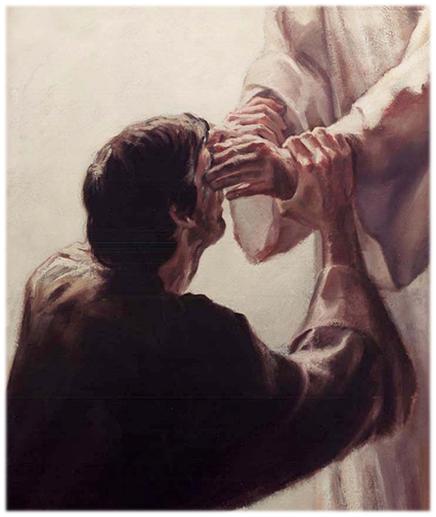
man-born-blindIn John’s gospel, Jesus and his disciples see a man blind from birth, and the disciples ask, “Rabbi, who sinned, this man or his parents, that he was born blind?”[1. John 9:2, NIV]

Of all the questions the disciples ask Jesus, this is the one we’re least likely to ask today. We know that every physical malady doesn’t result from a spiritual problem. That’s a good thing. Can you imagine having a physical disability in a world that assumes it’s a result of sin?

In our modern world, we rarely attribute physical illness to spiritual causes. But many people still see mental disorders in these terms. The reaction to depression or an eating disorder can be close to the disciples’ question: “Who sinned?” People struggling with these issues will commonly feel ashamed. They’ll blame and cast judgment on themselves, as if they have done something wrong. And others’ comments to them might only reinforce that.

In my previous article on mental health and personality, I had that perspective in mind. I was reacting against a sort of pre-modern approach to mental health that disregards the physical things happening in someone’s mind and body. Several of your responses confirmed that you’ve heard this approach to mental health or had it yourself, and it caused ample pain and hardship.

But I committed a common modern era in my attempt to fight a pre-modern mentality. I ignored the spiritual battle entirely. I placed a glass ceiling over our world, denying God any role.

How does Jesus respond after his disciples ask him who sinned to cause the blind man’s blindness? “Neither this man nor his parents sinned, but this happened so that the works of God might be displayed in him.”[2. John 9:3, NIV. THE HOLY BIBLE, NEW INTERNATIONAL VERSION®, NIV® Copyright © 1973, 1978, 1984, 2011 by Biblica, Inc.® Used by permission. All rights reserved worldwide.] And then he heals him! Jesus corrects the common idea that disability must be linked to sin, but he follows it with a miraculous healing, not a scientific discourse.

I made reference to God as healer in my previous post. I mentioned a prayer for healing if my son breaks his leg. But that comment was as glib as I’m sure it sounded. Do I really believe God may miraculously heal that leg? Only just barely. I call Jesus the Great Physician with my lips, but when it comes to physical maladies, I place much more trust in the physician down the road. God, I do believe; help me overcome my unbelief!

So allow me to offer this corrective: the spiritual battle is constant. When we’re weakened in one area, that battle surely intensifies. What better time for our adversary to tell us lies than when we’re too physically, mentally or emotionally weak to refute them? We need extra spiritual protection and provision during those times.

Furthermore, even the physical battle is God’s. He can and does heal. Do we believe it?

To be clear, I’m not retracting anything I said in the previous post. Please seek professional help if you might have a mental health problem. Please don’t attribute a character problem to yourself or others if the real issue is mental health, and don’t assume that you just don’t have enough faith.

But that previous post was terribly incomplete. I should have urged you to seek a spiritual solution while you seek a physical remedy. I should have told you that pastoral counseling and care may be a crucial complement to psychological treatment. I should have encouraged more discernment about where you seek help. Some psychologists operate under a philosophy that stands in direct contradiction to Christian faith and values. Consider asking your pastor for a good reference.

I’ll close by sharing some beautiful words from a reader who captures all the sides of this with a theological depth that I lacked:

I think mental health is one of those tensions between living in the “already, but not yet.” We want to live in a world where all is right. Yet, until Christ comes, we won’t. So, even in matters of mental health, we continue pursuing redemption and restoration, knowing that it is certainly possible in the here and now, but also knowing that we may have to continue living with remnants until Christ returns in final victory.  […]

I would like to see a study on the effectiveness of spiritual disciplines in eliminating undesired behavior or restoring functioning and reducing mood disturbances. My personal experience tells me that they’d be effective.

Special thanks to Julia, who graciously showed me the problem with my original post.

——————

Can a good Christian be depressed? [Does God want to change your personality? pt. II]

** Note: I’m not a trained mental health professional. I felt compelled to write this because of what I’ve seen from a pastoral perspective. I write only from that perspective. Mental health professionals, if you see anything here that you believe should be said differently, please let me know.


Over the years, I’ve talked to several people who suffer from things like depression, excessive anxiety, or eating disorders. For many, those struggles have been a challenge to their faith, or a barrier to faith in the first place. For others, faith has been the only thing that seemed to carry them through the most difficult times.

In many cases, Christians have unintentionally made things worse for the people going through these things. We’ve too often rushed to judgment, given poor advice, or reeled off mantras about God being all we need and never giving us more than we can handle.

I’d like to share some brief words of encouragement for you who suffer with any issues similar to these. I’d also like to give a few suggestions to others about how we can respond well to anyone going through one of these issues.

To those who struggle

If you’re having trouble carrying on with everyday life because of intense and sustained emotions or because of an anxiety or fear that seems paralyzing, you may be dealing with a mental disorder. These moods might result from something like major depressive disorder (aka, clinical depression), bipolar disorder, or an anxiety disorder.

Of course, other causes could exist, too. You may be depressed because you’ve just gone through a stressful life event, or a medication or physical health problem has thrown you into a depression. Something as simple as a lack of sleep could be impacting your mood and mental abilities. If any of these are the case, you may not be dealing with a mental disorder, but your mental health still isn’t good.

If you’re showing signs of an eating disorder––not eating, barely eating, binge eating, vomiting or laxative abuse, or other things that suggest intense and unnatural emotions about food––you also may be dealing with a mental disorder.

Many of us recoil at the suggestion that we could have a mental health problem. It’s a blow to our pride different from most others. It feels more personal. It can make us feel like something is wrong and abnormal about us. But mental disorders are more common than most of us realize. In 2000, the World Health Organization estimated that 48.6% of Americans will experience a mental disorder in their lifetime.[1. See this PDF for the full research paper: http://www.ncbi.nlm.nih.gov/pmc/articles/PMC2560724/pdf/10885160.pdf%5D

I shared a simple definition for personality in the first post of this series. In it, I proposed:

Personality = disposition + mental health + character

This is important for us to consider here for two reasons.

First, if you have a mental disorder, it does not say something about your character. I’m worried that well-meaning people do harm when they misunderstand this. They expect you to snap out of it, change your attitude, or exercise more self-control. Their words suggest that something is wrong with your character, that you simply need to do better. The person who may provide the most critique is yourself, with heaps of shame and self-blame. Christians may be especially hard on you because they tell you that a Christian should be joyful, not depressed; reliant on God, not anxious; self-controlled about how you eat and not preoccupied with your appearance. They’re treating a health problem as a character problem, and it’s not fair.

I say that because I’ve seen several Christians treat people this way. I’ve also seen several Christians offer generous amounts of grace and concern and care for people struggling with these things. I hope that’s what you’ve experienced.

Second, if you have any problem with your mental health, it’s affecting your personality. It’s distorting your wonderful, God-given disposition, and it needs to be addressed.

If something like a physical health problem, a lack of sleep, or a stressful event has affected your mental health, perhaps an easy remedy exists. Maybe you need to go to bed an hour earlier for a week. Or maybe you just need to make it through a bad illness. But if the quick and easy remedies aren’t working or aren’t identifiable, I hope you’ll consider the advice below.

I would urge you to seek help from a mental health professional. Find a way to have an appointment with a psychiatrist, a clinical psychologist, or a clinical social worker.

I’ve seen several people reject these options. In the Christian world, I’ve heard people suggest that God can take care of these things––no need to get “treatment.” I agree with them. God can take care of these things. I’m sure of it. I also believe God can heal a broken leg. If my son breaks his leg, I’ll pray for a miraculous healing, but I’ll also be quick to the hospital.

[Edit: A helpful reader showed me how terribly incomplete this post is. Please also see “On mental health –– I was wrong. Or at least incomplete.” once you’re done here.]

Provided by www.healthcentral.com
Provided by http://www.healthcentral.com

While few people deny that they have a broken leg or refuse to seek treatment for it, I’ve encountered a number of people who deny their mental health problems or refuse treatment. Some of the saddest conversations I had as a pastor were the second, third, and fourth times I told someone I thought they needed to seek psychiatric or psychological help but they dismissed it––often acting astonished that I would suggest such a thing.

If more than one person has suggested that you may have a mental health problem, I urge you to take that seriously. Set up at least one appointment. Maybe that appointment will confirm for you that the others were wrong. Maybe it will be the beginning of getting the help you need. The people asking you to seek help have nothing to gain by sharing with you what they believe is a hard truth.

What are you seeking with treatment? We hope and pray for a cure––for the problem to be expunged. That’s often realistic, but we should also recognize that some of these issues may be like a chronic illness. They may always be with you. If so, the goal is to find a way to manage them, to live in health, even though you may live with the specter of illness hanging over you.

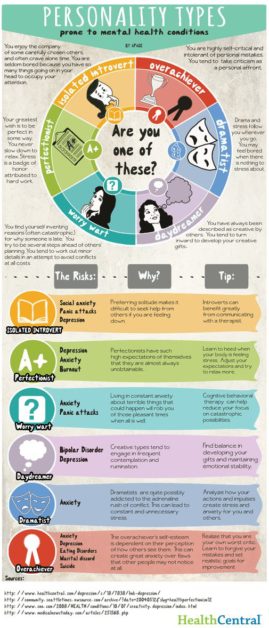
One other note about disposition and mental health: certain dispositions may be more prone to various mental health conditions. See at right the interesting infographic from HealthCentral.

A summary word to you –– can a good Christian be depressed? Or excessively anxious? Or have an eating disorder? Absolutely! These conditions may be no more a reflection of your character than if you had a broken leg or the flu or arthritis. But just as you would want to seek treatment for those issues––to seek a cure or a way to manage them well––you need to seek help for your mental health, as well. Without it, a mental disorder may be terribly distorting the beautiful disposition God has given you.

Three quick suggestions for all of us

If someone you know may be struggling with a mental disorder:

1 – Be careful and slow to make judgments about that person’s character. To treat them as if they need to shape up, have a change of mind, or make better choices is unfair and has more potential to make things worse than better.

To assume that the person just needs to accept God’s grace in changing/healing them isn’t entirely false. God may do that. But are you willing to say the same to someone with a broken bone or a chronic illness?

2 – It would be kind to try to help the person recognize their problem and get help. You walk a fine line when you do this. It won’t be helpful to go around telling people they have mental health conditions when they don’t. And that sort of suggestion will need to come with an abundance of tact and grace. Before you have a conversation like this, you should do some of your own research, consider what you should and shouldn’t say, and pray. When you talk to the person, you’ll need to give some appropriate disclaimers: “I’m not an expert in these things, and I might be wrong about this… but I care enough about you to share what I’m seeing and to ask you to consider a first appointment.” If you know that money could be an issue, you might offer to help cover any cost, or come with information about some low-cost options.

Pastors, this applies to us, too. Unless we’re trained mental health professionals, some of these issues cross a line beyond what pastoral counseling can and should handle. When we sense that line is being crossed, we need to refer.

3 – If you’re going to talk about someone’s potential problem, talk to the person, a mental health professional (to help you better assess things and properly approach them), or one of very few select people who may be better to talk to them. By very few, I mean perhaps the person’s spouse, other member of their nuclear family, or their pastor. If you don’t think the person is (a) willing, and (b) in a more suitable position than you to have this conversation, they don’t qualify here.

If you’re talking to anyone else about it––trying to “see if other people are seeing the same thing,” or “so they know how to pray”––knock it off! You’re not helping; you’re gossiping. Whatever is needed right now, it’s not that.

All of this only scratches the surface, but I hope it helps. I can only treat these things in general terms here. For any specific issue you’re considering, contact a professional near you or your pastor. Or I’d welcome an e-mail.

See my important corrective follow-up: On mental health –– I was wrong. Or at least incomplete.

Next week: Personality unchained [Does God want to change your personality? pt. III]

—————-