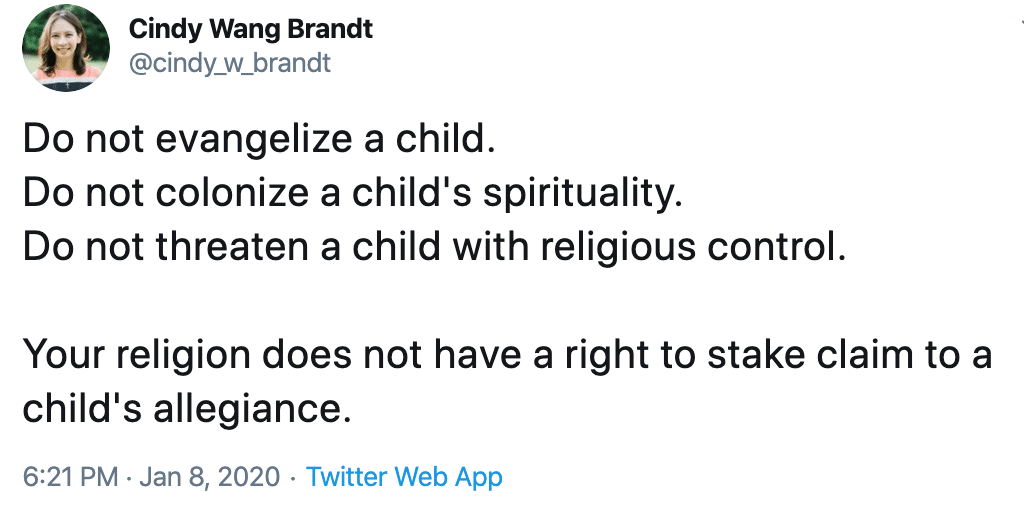
Are Christians extremists?

“I can believe in God without being a _________.”

How do you fill in that blank? Maybe you would use a word like zealot or fanatic? Or maybe a less dignified word: freak, weirdo, wacko, nut.

If you’re a Christian, does it mean you’re obligated to stand on street corners with posters and a bullhorn? Or is it okay to be just an ordinary Christian?

Ordinary life presents us with plenty of challenges, long before we need to go to any extremes. Before you consider standing on a street corner with a bullhorn, you have to consider more pressing matters—how to get along with a difficult friend or coworker, how to make ends meet in your budget, how to take care of your children or your aging parents.

I love this verse from a paraphrase of the Bible, because it recognizes those ordinary parts of our lives: “Take your everyday, ordinary life—your sleeping, eating, going-to-work, and walking-around life—and place it before God as an offering” (Romans 12:1).[note]From THE MESSAGE: The Bible in Contemporary Language.[/note]

These everyday, ordinary parts of our lives can demand plenty from us. I’ll give you a simple example. A friend of mine is a pastor in Tennessee. A woman in his congregation antagonized him from the time he arrived. Nothing he did ever seemed to be right. Every time he made a proposal for something new, she rejected it and rallied others to her side. She had even worked to have him fired. Their relationship was contentious at best, sometimes closer to hostile.

And then her kidneys began to fail.

In difficult times, a pastor should be one of the first people there alongside the person suffering. But how do you come alongside someone and offer this kind of support after the relationship has been so distressed? Should you be there when you know the person doesn’t believe you should be the pastor at all? You may not have the kindest feelings toward her. How do you offer sincere compassion and grace in a difficult time like this?

My friend’s dilemma was nothing extraordinary. It serves as just one simple example. These are the kinds of decisions we all face. How do we take the everyday, ordinary parts of our lives and respond in ways that are appropriate?

What I’ll suggest below is that monotheism—the belief that there is one true God—is more than a statement of belief. It’s a statement of devotion. And it impacts everything about our everyday, ordinary lives.

In the first of the Ten Commandments, God says, “You shall have no other gods before me” (Deuteronomy 5:7). What does that mean in practice—in our everyday, ordinary lives?

No God but One

Are Christians extremists? Can we believe in God without being zealots or fanatics or enthusiasts? Can we just be ordinary people, living ordinary lives, who believe in God?

I don’t think we can.

Any faith that takes seriously loving God with all––all of our hearts and souls and minds––leads to a single-minded devotion, the kind that will necessarily lead to extremism. In a world that has many loves—many gods that compete for some of our heart, some of our soul, some of our strength—those who instead devote all to God will appear extreme.

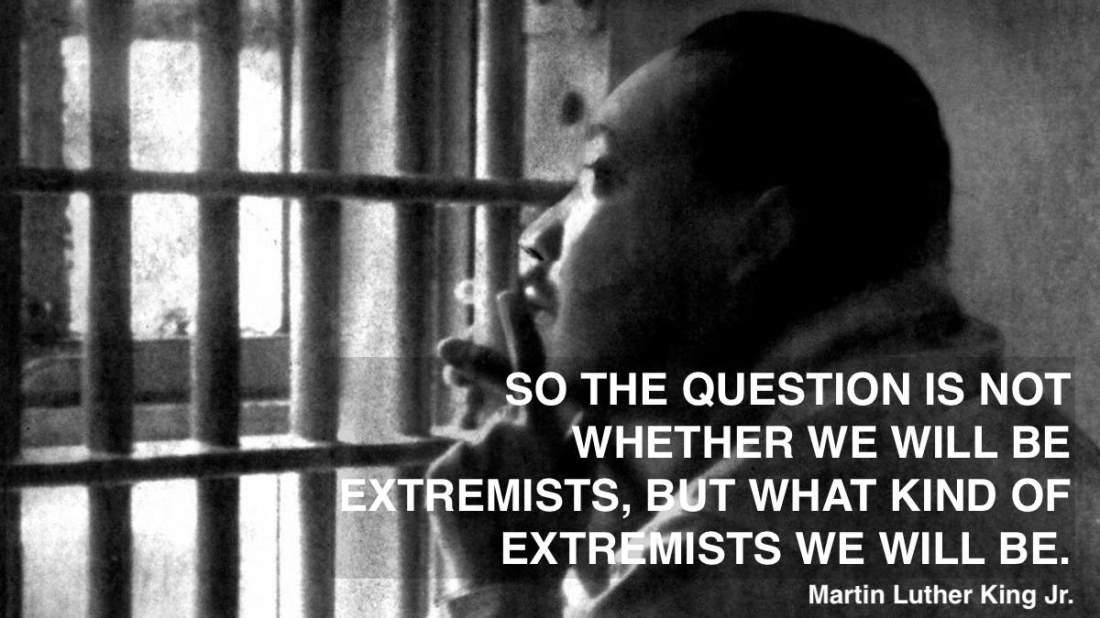
The word “extremist” is a dangerous word. I was wary of using it at first, knowing that much of our world’s violence and terror are blamed on “extremism.” Our remedy is often to avoid extremes, as if total devotion to anything may be the problem. Look at this great quote to the contrary from Martin Luther King Jr., in his “Letter from a Birmingham Jail.” It’s a long quote, but worth your time:

[T]hough I was initially disappointed at being categorized as an extremist, as I continued to think about the matter I gradually gained a measure of satisfaction from the label. Was not Jesus an extremist for love: “Love your enemies, bless them that curse you, do good to them that hate you, and pray for them which despitefully use you, and persecute you.” Was not Amos an extremist for justice: “Let justice roll down like waters and righteousness like an ever-flowing stream.” Was not Paul an extremist for the Christian gospel: “I bear in my body the marks of the Lord Jesus.” Was not Martin Luther an extremist: “Here I stand; I cannot do otherwise, so help me God.” And John Bunyan: “I will stay in jail to the end of my days before I make a butchery of my conscience.” And Abraham Lincoln: “This nation cannot survive half slave and half free.” And Thomas Jefferson: “We hold these truths to be self-evident, that all men are created equal…” So the question is not whether we will be extremists, but what kind of extremists we will be. Will we be extremists for hate or for love? Will we be extremists for the preservation of injustice or for the extension of justice? In that dramatic scene on Calvary’s hill three men were crucified. We must never forget that all three were crucified for the same crime—the crime of extremism. Two were extremists for immorality, and thus fell below their environment. The other, Jesus Christ, was an extremist for love, truth and goodness, and thereby rose above his environment.

The call to love God with all is a call to extremism. The problem with the extremism that has so damaged our world was not extremism itself, but its misplaced devotion. Can you justify violence, hatred, or murder because of your extreme devotion to God? Not if your god is this God, the God who is compassionate and gracious, slow to anger, abounding in love. Not if you call “Lord” the one who said, “Love your enemies, do good to those who hate you” (Luke 6:27). If you perpetrate violence or hatred because of your extremism, the problem isn’t your extremism, but your god.

Extremism: The key to a long and happy life?

But say you get your extreme devotion right. You devote yourself wholly to God—all your heart, all your soul, all your strength. Can we say that’s the key to a long and happy life? Maybe you’ve heard the popular saying: “God has a wonderful plan for your life!”

Note instead the serious consequences that may come with total devotion. Martin Luther King Jr. referenced seven people in that letter from a Birmingham jail. Jesus, Paul, and Abraham Lincoln were all killed. John Bunyan was imprisoned. Martin Luther was excommunicated from the church and his life seriously threatened. The details of Amos’ life are unknown, though one unauthenticated account says he was tortured and murdered. Only Jefferson escaped [relatively] unharmed after he penned the Declaration of Independence at great risk to his life.[note]He has also had many more questions raised about his character in recent years.[/note] And of course, King himself was assassinated five years after he wrote those words.

This shouldn’t be too surprising. Jesus warned his disciples about these things. After he told them that they were blessed for hungering and thirsting for righteousness, for being pure in heart and being peacemakers, he pronounced a more unusual blessing: “Blessed are you when people insult you, persecute you and falsely say all kinds of evil against you because of me” (Matthew 5:11). These are the likely consequences for anyone who would fully devote themselves to God: insults, persecution, and slander.

Now, let me follow that by saying something that may sound absurd. I still believe “God has a wonderful plan for your life!”

Extremism and the extraordinary

Martin Luther King Jr. called Jesus an extremist for love, truth, and goodness. This is the true calling of all who would follow Jesus. We who claim, “There is no God but one,” can do nothing less than devote all of our lives to this God and what he commands.

In this, our everyday, ordinary lives become something more. A great theologian named Dietrich Bonhoeffer said it this way: “What is characteristically Christian is that which steps away from the world, rises above the world, is extraordinary.”[note]In Discipleship, volume 4 of Fortress Press’s Dietrich Bonhoeffer Works series, p. 146.[/note]

The extremist nature of our devotion to God may even add new options to otherwise ordinary decisions. Remember the friend I mentioned at the beginning of this chapter—the pastor whose church member was experiencing kidney failure? She had antagonized him for years, now how should he care for her in a time of need?

His answer went beyond the ordinary. He gave her his left kidney.

I said above that I believe “God has a wonderful plan for your life!” That wonderful plan could cost you a kidney. It could cost you your wealth. It could cost you your dignity. And it could cost you your life. And yet we can call it wonderful, even if we might also call it difficult, or worse. It’s wonderful because Jesus says, “Whoever loses their life for my sake will find it” (Matthew 10:39). It’s wonderful because, in that extremist devotion to the way of God, we find true life. Our lives become rich and bold and empowered because we live and die to God alone.

———
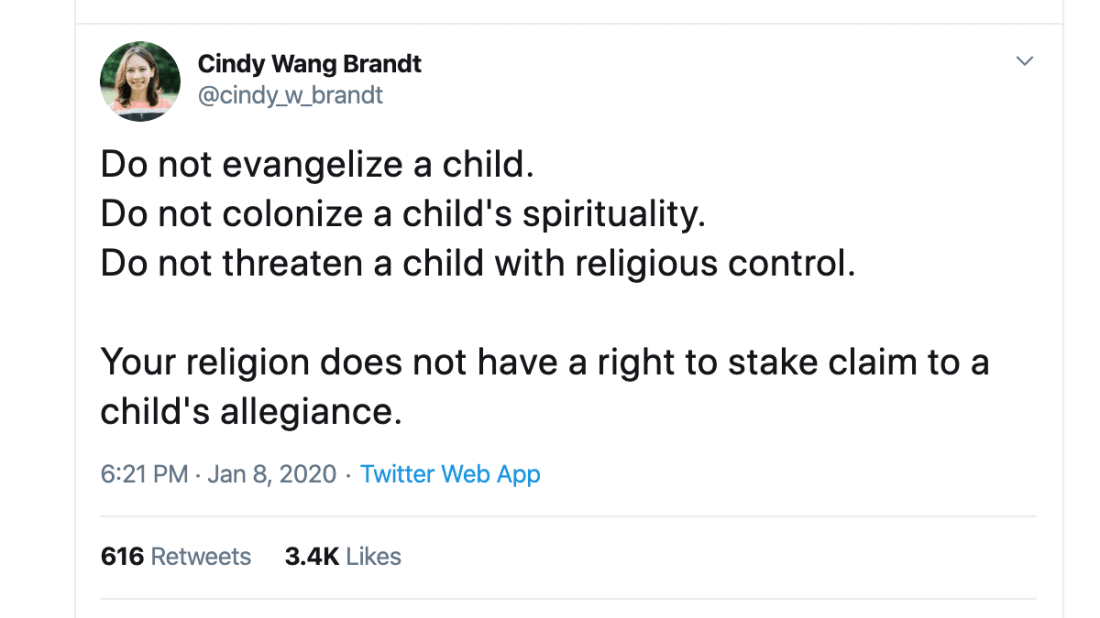
Should we evangelize children?

This tweet has received a lot of attention this week.

Should we evangelize children? Our own? Others?

The most recited words in all of history would disagree with Cindy Wang Brandt. You’ll find those words in Deuteronomy 6, in what’s known as the Shema. It begins with “Hear, O Israel: The LORD our God, the LORD is one.”[note]Deut 6:4[/note] Young boys would learn these words as soon as they could speak.[note]See Sukkah 42a of the Babylonian Talmud: “If he is able to speak, his father must teach him Torah and the reading of the Shema.”  “What [in this context] is meant by the Shema? The first verse.”[/note] Jews from ancient times to the present have recited this verse and those that follow twice a day, morning and evening.[note]The recited Shema includes three parts—Deuteronomy 6:4-9, Deuteronomy 11:13-21, and Numbers 15:37-41[/note] And these are the traditional final words of Jewish believers as they die. From earliest speech to final words: “Hear, O Israel: The LORD, our God, the LORD is one.”

Some of the greatest and most important implications for our faith come from this simple declaration. There is one God! Nothing that follows would make sense or have the same sense of urgency attached if there were more gods than one, or if the true God were not this particular God.

But if God is one—if this God is truly the God of all the earth—then what we’re about to consider is much more than a set of commands. It’s life according to reality. It’s life lived the only way we would choose to live it if we truly believed these words.

The charge that follows gives the most important statement about home life in Israel:

These commandments that I give you today are to be on your hearts. Impress them on your children. Talk about them when you sit at home and when you walk along the road, when you lie down and when you get up. Tie them as symbols on your hands and bind them on your foreheads. Write them on the doorframes of your houses and on your gates.

Deuteronomy 6:6-9

Do you hear the urgency in these instructions? If God alone is God, pass this faith down to the next generations! Teach it at home and on the road, as you’re going to bed and as you’re waking. These words, on hands and foreheads and doorframes and gates, serve as a witness not only to the children in the household but to everyone around. Pass this faith along!

Cindy Wang Brandt wouldn’t like this. And some parenting philosophies today would reject this idea, as well. Parents talk about raising their children to “decide for themselves” when it comes to faith. Parents don’t want to force their faith on their children. And when it comes to those outside our own families, we claim even less right. Who are we to tell others how to live? And so we choose not to meddle, to “live and let live” or “think and let think.” We may have chosen to follow the God of Christianity, but that was a personal decision, one we shouldn’t expect of others.

When we say things like this, we’re acknowledging something that’s a reality, regardless of our wishes: Others will make this choice for themselves. Our children will one day choose for themselves when it comes to their faith (and all else, as well). We can’t force these decisions. Not forever, anyway.

But let’s acknowledge something else, too: we pass down many loves. We pass down to our children our love for certain sports and sports teams. We pass down political stances and important traditions. We try to impress upon our children values like integrity and respect and gratitude, and we train them with certain life skills that we think are essential. Some parents require their children to know how to change a tire or jumpstart a battery before they can get their driver’s license. Others have insisted that their children learn to do laundry and cook before they move out of the house.

And we do the same with others besides our children. Have you ever convinced someone to watch a certain show or movie, or read a certain book, because it was so good? Because you believed that it would improve their lives—or give the two of you something good to share together?

If any of this applies, you could call yourself an evangelist. You’ve attempted to convert someone, to get them to believe a certain way or do a certain thing. Why do we do this? Because we believe in the cause. We believe enough in the sports team or the political stance or the book that we want others to share in it with us. Or we believe that life skills like jumpstarting a car or cooking are important enough that our children must have them to do well in life. So long as these are honest pursuits to improve someone’s life (or even more, our world), they’re good pursuits.

And if God alone is God, wouldn’t our greatest pursuit be to impress this faith on others? Sports teams, political views, traditions, good movies and books will all pass away. But if God alone is God, nothing is more important to pass down than this faith. If we say “God is one,” that statement carries a great urgency to share it.

To be sure, this doesn’t justify any tactic. It doesn’t justify force or threats. It doesn’t justify rude or self-righteous badgering. And it doesn’t justify intolerance for those who don’t conform, whether about faith or any of the other things here. (Have you met someone who can’t have a happy friendship with a fan of the “wrong” sports team? It’s miserable and silly.)

We cannot, we must not, treat anyone with less respect or dignity because they have different beliefs than we do. But this doesn’t mean we should treat them with indifference, as if faith in God would do anything less than radically transform their lives.

Inter-religious faith gatherings are becoming more common. In some of these, people who represent different religions come to share about their faith. Tim Tennent, a world Christianity scholar and now president of Asbury Theological Seminary, writes about his experiences at these gatherings. He describes people of various faiths who come with a whole-hearted belief in their faith, even a hope to convert him. We should expect nothing less from anyone who believes that they know God, the true and only God. Look at what he says about when these go wrong:

What is heart-breaking is when I arrive at an inter-religious dialogue event and meet these full-orbed Muslims and Hindus and Buddhists all beautifully representing their faith and the millions of followers who stand in these traditions, and then the Christian stands up and blathers on endless nonsense about how we are all really the same and how all religions lead to God and we are all really saying the same thing.

from “Two Kinds of Pluralism,” posted on February 19, 2015, at http://timothytennent.com/2015/02/19/two-kinds-of-pluralism/

Can you see the difference between tolerance and respect, on the one hand, and indifference and apathy on the other? We can respect others’ beliefs and opinions, but this is far from conceding that they’re unimportant. We aren’t all really saying the same thing.

Pass these down—at home and on the road, at dawn and at dusk! Impress them on your children! If we truly believe that God alone is God, we can do nothing less.


A different option than New Year’s Resolutions

Are you among the 60% of people who make New Year’s resolutions?

Are you among the 8% of those who actually keep them?

One recent study shows that January 12 is the day most people give up their resolutions. So soon …

I talked with a friend earlier this week about the value of making small, seasonal commitments. Because they have an end date (and in less than a year), they aren’t as daunting as those long or indefinite commitments we make. They also allow us to consider our needs for a shorter period of time.

I’ve begun to see great value in re-assessing my life and commitments seasonally. In the church, we have natural rhythms and seasons for this. You might be most familiar with it if you’ve ever made a commitment for the season of Lent.

So I developed a tool to help you consider some seasonal rhythms and commitments. It provides a structure for you to consider (1) your current life & spiritual state, (2) your spiritual growth, especially focused on what we call “means of grace,” (3) your personal life and physical health, and (4) your relationships. My goal was to give you something useful for personal examination about where you are, along with some prompts for commitments you might make in the upcoming season.

This Season and Next

In the life of the church, our next season is the shortest of all of them. It also may be the season of the year when your life rhythms are most disrupted. Christmas is a 12-day season beginning on the evening of Christmas Eve and going through January 5. (Hence the song.) I think it may be the perfect first season for you to consider using this tool. That’s specifically because it’s such a short and unusual season. This is not the time to make 20 new commitments. But because of some of the unique opportunities that will come over these twelve days, this could be a great time for you to consider how you approach them with care.

Different seasons in the church are suited for different priorities. During Lent, a season of fasting, you’re likely to give up something for the season. Christmas is a season of feasting! So some of your choices may be different. As you consider any commitments for these twelve days, you might especially focus on worship, the section titled “works of mercy,” generosity and gratitude. If you’ll spend several of these days with people you don’t see often, it would be a good time for you to consider any commitments related to relationships––or related to those things that distract from relationship.

For me, commitments I’m making for this season include some final family accounting so we can make year-end decisions about giving, extra focus on thanksgiving in daily prayer, a commitment about words and notes of gratitude, and a commitment to stay off social media for those 12 days (if you see a post from me, it will be pre-scheduled).

I’m also putting this out now because the next season is quite a bit longer. That will be Epiphany season[note]Or the season after Epiphany, if you prefer[/note] which runs from January 6 through February 25––7 weeks. This gives you some time to consider longer commitments you might make during that season. Epiphany is a season of worship, focused on the revelation of Christ to the world. It comes right before the Lenten season of fasting. As you think ahead, some areas that would be especially good for your focus during Epiphany (Jan 6 – Feb 25):

  • Worship – perhaps an increased commitment to participation in corporate worship
  • Searching the Scriptures – perhaps a Bible reading plan focused on the gospels over those 7 weeks
  • Evangelism – a commitment to having a conversation about faith with a friend, relative, or neighbor, or a commitment to invite them to worship with you
  • Sabbath & Simplicity – establishing a different rhythm of life and different priorities in this new year

Those are only a few possibilities and suggestions as you plan and pray about how you’ll approach the season.

The Tool

I’m including below the seasonal rhythms and commitments tool I’ve developed. A few notes about it:

1 – I’m intending this as a guide for you. Do not try to make a commitment at every prompt. They’ll be far too many, and you’ll be set up for failure. These are all provided as prompts so you can choose the areas that are most important. I highly recommend only making one to three commitments per section unless you have confidence you can take on more. Especially for the 12 days of Christmas, focus on a few things you’d like to be intentional with this year.

2 – To make the best use of this, I recommend setting aside 30-60 minutes and praying as you work your way through.

3 – For success, I highly recommend you consider sharing your commitments with someone else for their support and accountability.

4 – This begins by asking which season you’re preparing for. If you’re following a different timeline than the church’s calendar, you can use the “other” space to list your own dates.

5 – Once you complete the form, it’s set up to immediately send you an email with your responses in both email and PDF format. I’d love to hear your comments or feedback. I want this to be as helpful as possible for you.

The form is embedded below. If it doesn’t show up in your email or browser, you can also access it here.