The Church, simul justus et peccator

The United Methodist Church is in the middle of a theological crisis. Some will call this a crisis regarding human sexuality, others will say the crisis centers on justice or biblical authority or Christian orthodoxy.

Many have gone to John Wesley for help in resolving these crises, as we would expect. But I wonder if we could use some outside help in this instance. I’ll suggest here that Martin Luther may offer a different view of our impasse.

Simul justus et peccator

One of Luther’s most famous phrases is simul justus et peccator. With it, Luther claimed that a Christian is at once both righteous and a sinner. We are sinners, and we are saints. For the one who imagines himself only a saint, Luther’s claim instills humility. For the one who imagines himself only a sinner, Luther’s claim offers hope.

We hear a similar notion in Solzhenitsyn’s most famous quote:

“If only there were evil people somewhere insidiously committing evil deeds, and it were necessary only to separate them from the rest of us and destroy them. But the line dividing good and evil cuts through the heart of every human being.” [note]From The Gulag Archipelago, 1918-1956[/note]

Luther and Solzhenitsyn remind us that evil is not simply something out there. Look inside each of us and we will find it.

Luther emphasized this well in another of his famous phrases: “Sin boldly!”

What can he mean by “sin boldly”? Shall we go on sinning so that grace may increase? By no means![note]This is from Romans 6:1-2[/note] To understand, we should look at the context for that exhortation –– a letter to his friend Philip Melanchthon:

“If you are a preacher of mercy, do not preach an imaginary but the true mercy. If the mercy is true, you must therefore bear the true, not an imaginary sin. God does not save those who are only imaginary sinners. Be a sinner, and let your sins be strong [i.e. sin boldly], but let your trust in Christ be stronger, and rejoice in Christ who is the victor over sin, death, and the world […] Do you think such an exalted Lamb paid merely a small price with a meager sacrifice for our sins? Pray hard for you are quite a sinner.”[note]emphasis mine[/note]

Luther’s “sin boldly” makes more sense to me when I see it in this context. This isn’t to encourage a friend into sin––”Go do what you please! God will forgive you.” This is to make Luther’s friend acknowledge his true state as a sinner. Don’t treat your sinfulness as imaginary, as something insignificant, as a few minor mistakes. You’ve heard those kinds of “confessions”––”I’m sure I’ve done some things wrong”; “Mistakes were made”; “I’m only human.” Instead, “sin boldly” tells us to recognize our true nature: “You are quite a sinner!”

The one who lets his sins be strong (i.e. sins boldly) is the one who can cry out with the Apostle Paul, “What a wretched man I am! Who will rescue me from this body that is subject to death?” [note]Romans 7:24[/note] He is also the one who can then join Paul in the exclamation, “Thanks be to God, who delivers me through Jesus Christ our Lord!” [note]Romans 7:25[/note]

Luther calls every Christian to humility––to recognize our own sinfulness.
And Luther calls every Christian to wonder and gratitude––to recognize God’s undeserved gift of life and salvation through Jesus Christ our Lord.

Humility in conflict

How rarely we “sin boldly” in the church today! It seems we recognize others’ sinfulness quite easily but consider our sins much less significant––much closer to the imaginary variety. Michael Gerson named a similar phenomenon in American politics.

This is unsurprising in American politics. It should not be the norm for the Church.

Would a view of ourselves as simul justus et peccator give us the humility to engage each other with less hostility and more grace? Would Solzhenitsyn’s distinction about the line dividing good and evil slow us from tossing pejorative grenades across our supposed lines of division?

“If only there were evil people somewhere insidiously committing evil deeds,” Solzhenitsyn writes. But we have found those evil people! We accuse the other side of racism, bigotry, white nationalism, homophobia, fundamentalism, heartlessness, and injustice. Or we claim based on one issue that an entire group must have no interest in holiness, biblical authority, or following Jesus. These false lines we draw see only justus in ourselves, only peccator in the other.

I wonder if Luther’s simul justus et peccator might give us the humility to handle these conflicts differently. Might it prompt more repentance and less accusation? Might it prompt us to deal gently with those going astray, since we know ourselves to be sinners, too?

The church as simul justus et peccator

When Luther spoke of us as simul justus et peccator, he spoke of us as individual Christians. In each of our bodies, we are at once sinner and saint. I want to suggest that simul justus et peccator may have a broader application––not only to our bodies, but to our Body.

Is it fitting to say that the Church, the very Body of Christ, is at once a sinful and a holy Body? Is it right that we should call this Body “quite a sinner”?

This does not seem fitting of the true Church––the one that is truly Christ’s Body. Because in Christ is no sin. And no one who lives in him keeps on sinning.[note]1 John 3:5-6[/note] I believe this. It’s the great doctrine of Wesleyan holiness, which has transformed my life. In the true Church, the true Body of Christ, there is no sin.

Wesley describes it this way:

“If the Church, as to the very essence of it, is a body of believers, no man that is not a Christian believer can be a member of it. If this whole body be animated by one spirit, and endued with one faith, and one hope of their calling; then he who has not that spirit, and faith, and hope, is no member of this body. It follows, that not only no common swearer, no Sabbath-breaker, no drunkard, no whoremonger, no thief, no liar, none that lives in any outward sin, but none that is under the power of anger or pride, no lover of the world, in a word, none that is dead to God, can be a member of his Church.” [note]In Sermon 74, “Of the Church” [/note]

With Wesley I affirm that Christ’s invisible Church is holy, pure, and set apart from sinners.[note]Hebrews 7:26[/note] We are these because Christ is these and we are his Body.

But are any of our visible churches without thieves or liars? Are any without people under the power of anger or pride? No! The church remains full of sinners. As a Body, we are full of sin. So we confess each week, “We have failed to be an obedient church.”

The church, in all of its visible forms, is simul justus et peccator.

And the line dividing good and evil does not cut between one faction and another, between one congregation and another. It cuts through the heart of every body that calls itself church.

Orthodoxy

We need to make an important distinction about orthodoxy before we carry the analogy from Luther too far. When Luther spoke of people as simul justus et peccator, he was not referring to all people. This was a designation for confessing Christians.[note]I’m indebted to Dr. Steve O’Malley for this point.[/note] They had been baptized into the Church under the Apostles’ Creed as the common confession of faith. They confessed God as Father, Christ as Lord, the resurrection of the body, and the life everlasting. The sinners Luther referred to were made righteous by living by this faith. Righteousness is not our own, it comes only by faith.

I want to suggest that the visible church is a Body both sinful and righteous. But it is only righteous by faith in Christ. A church that does not confess and mean the historic creeds of the Church as the historic Church confessed and meant them is no church at all. At least, it is not a Christian church. All faith outside of these affirmations is, by definition, heterodox––or heresy. If this sounds like an exclusionary statement, that’s because it is. All real things have bounds,[note]I originally had “All things but God have bounds,” but even an omnipotent, omniscient, omnipresent God has definition. God is everywhere, but God is not everything, and everything is not God. (i.e. We are not pantheists.)[/note] and the bounds of Christian orthodoxy were constituted long ago in these universal confessions.

There are some who call themselves United Methodists who reject the Christian faith articulated by the Church’s early ecumenical councils. We have some among us[note]Please do not confuse my “some” to suggest that all, or even most, of any particular faction fit these descriptions[/note] who scoff at the notion of Christ’s real, historical, bodily resurrection, some who believe the Bible is a mere human work with no ultimate authority, and some who honestly have no interest in following the way of Jesus if it should lead them somewhere different than where they would like to go. What I’ve written above is not about those people. They are not those whom Luther referred to as simul justus et peccator. A Body that does not confess the Christ of faith is not the Body of Christ.

Debates about orthodoxy have become common in our current crisis. Should we extend it beyond our definition above? Some have called the “traditional” position on human sexuality the orthodox position. I reject that here. I think orthodoxy is best left to refer to conciliar orthodoxy. James K. A. Smith articulates this well: “The word [orthodox] is reserved to define and delineate those affirmations that are at the very heart of Christian faith—and God knows they are scandalous enough in a secular age. Perhaps we need to introduce another adjective––’traditional’––to describe these historic views and positions on matters of morality. ” [note]From this blog post, which is worth reading in full.[/note]

What do we do with a sinful Church?

And so we have a body––the very Body of Christ––at once righteous and sinful. We’re uncomfortable with the church as simul justus et peccator. And we should be. God has set in our hearts a different image of the Church––as a bride making herself ready for the wedding of the Lamb,[note]Revelation 19:7[/note] preparing as one to be beautifully dressed for her husband.[note]Revelation 21:2[/note]

Our disagreements about what we call sin are presenting themselves as a theological crisis in our church. Underneath them is another tension: What do we do with a sinful Church?

Who will rescue us from this body that is subject to death?


This post attempts to establish some foundations. In a post to follow, I’ll focus on another aspect of Luther’s theology––the theology of the cross––along with implications for the United Methodist Church and for those who might consider leaving.

Like it? Or just want to discuss it more? I’d be honored if you’d share it. Click here to share on Facebook. Click here to share on Twitter.
A sermon preparation worksheet

People occasionally ask how I prepare a sermon. I’m copying below the sermon preparation worksheet I use. I prepare a sermon over seven to ten 75-minute blocks. This is the standard template I follow. I don’t do everything listed every time (i.e. no way to do full translation, lectio divina and Inductive Bible Study detailed observations in one 75-minute block, and I certainly don’t use everything under the “Questions to guide interpretation”), but these provide good options as I go.

I use 75-minute blocks to get myself focused and in the text, and also to give myself a time limit. The work done in each of these blocks could easily consume 10 hours. But it can’t. Many other things to do. So I give myself 75 minutes and then need to press on.

A special offer for you. The worksheet below is how I prepare my sermons. I’ve also created a 12-YEAR PREACHING PLAN. That details what I’m preaching. The whole pastoral team at First UMC Lexington is following it together. In 2019, I finished a 3-year exploration of the Old Testament narrative from patriarchs to rebuilding the Temple after exile. In 2020, we began Year 1 of this plan, a “Year with Jesus.” Click the link below to receive it as a PDF.

[subscribe_to_download_form]

I may provide more commentary at some point. Happy to answer questions if you have them. For now, here’s the worksheet…

—————–

Sermon Prep Worksheet
(exegesis adapted from Fee & Stuart)

1 Block = 75 minutes

Block 1 (4 weeks out) –– Close reading of the text

Goal: deep familiarity with the text

Important note: When I do this block with others (which is much better than alone), they frequently ask by the end of it what I think I’ll preach about. 95% of the time, I have no idea! The goal of this block is not to identify what to preach about. You’ll see that I don’t press that question until block 4. It can be a distraction early on. Too much pressure that leads to tunnel vision. The goal right now needs to simply be deep familiarity with the text.

Resources: Greek or Hebrew lexicon, Metzger

Approach:

  • Read context around the text. Use an outline of the book to see the big picture and where this passage falls. Or read over the headings of the passages leading up to the text. I usually read any material immediately before and after the passage that seems useful for understanding the context (e.g. Where are we? What has just happened? What topics and themes have been prominent leading up to this passage?)
  • Read multiple translations and reflect. I usually read the passage in one translation then reflect on it for 5-10 minutes, noting any aspects that struck me as important, interesting, or confusing. It’s frequently in reading the third or fourth different translation that I start to recognize opportunities for Greek/Hebrew word study or for deeper socio-historical research. I put those in my notes for block 2.

    My standard translations: NIV, NRSV, NAB, TEV (Good News Bible). Those come from different translation traditions with different goals. Lots of variety among them. I occasionally go to the KJV, CEB, NLT, REB, or MESSAGE paraphrase as well, if I think any of them might offer something helpful.
  • Other occasional tools. I don’t use all of these each time. Not enough time. But I frequently identify one that would be useful and spend time on it.
    • Translate the text from Greek/Hebrew. (I favor the Greek and frequently work from the LXX when I’m in the Old Testament. OT quotations and allusions in the NT are more apparent from the LXX, so I think a canonical approach to the Bible can favor the LXX over the BHS for Old Testament usage.)

Block 2 (3 weeks out) — Lexical and socio-historical focus

Goal: socio-historical understanding / treasure hunt

Resources: dictionaries/encyclopedias

Approach:

  • Continue work from above, as needed.
  • Identify key terms and do lexical analysis. For words or phrases that seem especially important to the text, or perhaps have ambiguous meaning, I do a word study or spend more time analyzing the grammar. For words that are used more than once or twice throughout the Bible, my preferred way of understanding a word’s usage and meaning is to look through the various passages where it’s used. This frequently connects me with other important texts that relate to the passage in ways I may not have otherwise noted.
  • Ask questions about historical background and other contextual questions. If the location may have significance, or if the passage references a certain social custom (e.g. weddings), or some other socio-historical information could be relevant, I use Bible dictionaries and encyclopedias to learn more.
  • Find an interesting thread and start exploring it. I can’t track down every lexical or socio-historical piece of information from a passage. If I catch an interesting thread, I keep going with it. This block can be fun because it’s like a treasure hunt.

Block 3 (2 weeks out) –– Others’ work, canonical, theological & contemporary contexts 

Goal: test and refine my understanding of the text, gain well-rounded perspective, connect to contemporary relevance

Resources: commentaries, articles, dictionaries as needed, NT use of OT, pop culture references

Approach:

  • Read commentaries and other literature. How do these understand the text. Are there ways that they challenge, affirm, or add to what I’ve been seeing so far? There’s obviously not enough time to read all of the commentaries. There may not be even enough time to read one commentary’s full section on the passage. If I’ve had particular questions about one or two aspects of the text, I look to the commentaries for help on those questions.
  • Begin to examine canonical, theological and contemporary contexts. How does this text relate to other parts of the canon? Identify other relevant texts. How does it relate to the theological tradition? (I might look at the indices of some systematic theologies to see if they use this passage and where.) Is there a popular usage or understanding of this passage in contemporary culture? Does the exegesis challenge, affirm, or add to that understanding?

Block 4 (1 week out) — Themes, Focus & Function 

Goal: from broad exegetical understanding to narrower sermon focus

Approach:

  • Identify major themes from exegesis. What keeps coming up? I write these themes down and begin to make connections between them.
  • Develop one or more of these themes. How does it relate to other biblical, historical, topical, and cultural material? How does it relate to experience––mine and others’? See “Questions to guide interpretation” below for help.
  • Create focus and function statements.

    The focus statement: If I put the focal message of this sermon in a tweet (old Twitter length: 140 characters), what would it be?

    Function statement: If I named how people could respond to this sermon, what would it be? (again, tweet length)

    See “Questions to guide interpretation” below for important questions I have to ask of every focus and function statement.
  • With time: outline / story board / mind map. 

Block 5 (1 week out) — Outlining, Story boarding, Mind mapping, and/or Writing

Goal: structure and flavor

Approach:

  • Continue refining focus & function statements.
  • Outline, story board, mind map and/or begin writing. I’ve found that each of these approaches leads to a very different kind of sermon. A manuscript is especially careful about wording and nuance. A story board tends to produce a sermon with a more natural narrative arc. A mind map keeps one theme central. When I get stuck or especially when I begin to feel like my preaching is getting repetitive or stale, I switch formats and it tends to provide the change I need.
  • With time: write intro, conclusion.

Blocks 6-7 (week of) — Finish 

Goal: clarity of thought and organization; engaging, clear gospel proclamation

Approach:

  • Refine outline, storyboard or mind map, or finish manuscript.
  • To recognize flow – highlight:
    • where does it inform / educate? (black)
    • where does it engage / amuse? (blue)
    • where does it inspire / invite response? (purple)
    • Avoid too much black without a break.
  • With time: create slides, outline for preaching

Blocks 8-9 (Sat – Sun) — Rehearse & Refine 

Goal: present with clarity, fluidity and conviction

Approach:

  • 5 short blocks of rehearsal
  • Ideal (from manuscript): 
    • read 
    • work from outline, reference manuscript when needed
    • work from outline, no manuscript
    • no notes, reference outline when needed
    • no notes

Questions to guide Interpretation:

  1. For focus statement:
    1. Where is the person of Christ, the cross & resurrection essential to this sermon? (If Jesus was not crucified and raised, could I still preach this sermon, and would it still be good news?)
    2. What is the gift of God (grace) on offer?
  2. For function statement: How do we respond to the gift of God on offer?
  3. Where has this been true (or negative examples) in:
    1. the Bible?
    2. history?
    3. my life?
    4. others’ lives?
    5. media / culture?
  4. Topics:
    1. Doctrinal: What doctrine from Echo or a creed most relates to this?
    2. Liturgical: What from our baptismal covenant, confession & pardon, Great Thanksgiving, or Lord’s Prayer most relates? Or from other liturgies (Social Creed, marriage and funeral rites, songs, etc.)?
    3. Moral: Which of the capital vices or virtues, beatitudes, or fruits of the spirit relates here?
      1. Vices and opposing virtues: 
        • Vainglory – Humility 
        • Greed – Liberality (Generosity)
        • Lust – Chastity
        • Envy – Kindness (brotherly love)
        • Sloth – Diligence (persistence, perseverance)
        • Anger – Meekness (patience)
        • Gluttony – Temperance (abstinence)
      2. Beatitudes: 
        • Poor in spirit – full of genuine humility; recognize our sinfulness (against pride)
        • Mourn – serious; mourn over sinfulness (against sloth)
        • Meek – mild and gentle; even-tempered; gentle with sinners; yielding to God’s will; patient and content with ourselves and our circumstances (against wrath, impatience, discontent)
        • Hunger and thirst for righteousness – free from selfish intentions; seeking perfect holiness (against unholy desires)
        • Merciful – compassionate and tender-hearted; loving neighbors as ourselves (against indifference or cruelty to others)
        • Pure in heart – devoted to God; sanctified; holiness of desires / inward purity (against outward holiness only)
        • Peacemakers – active lovers of people; doing good to all people, as we have opportunity (against passive or inward religion)
        • Persecuted because of righteousness – enduring persecution, insults and slander for any of the above (against moral compromise)

Sermon Prep (topical — changes in first 4 blocks)

Block 1 (4 weeks out) –– Literature survey

  • Read any relevant articles, book segments, etc. on topic

Block 2 (3 weeks out) –– Literature survey

  • Continue reading, especially refine to key Scripture passage(s)

Block 3 (2 weeks out) –– Text & Interpretation

  • Translation, structure, observation, key terms, and historical background for key texts

Block 4 (1 week out) –– Text & Interpretation

  • Context work, create focus and function. With time: tasks, steps, intro and conclusion.

[subscribe_to_download_form]

Why we need more churches: How to NOT squander church resources (pt. II)

In the coming years, the church must find a way to maximize its resources. The United Methodist Church serves as an excellent experimental lab, with thousands of ongoing experiments running in different local churches and Annual Conferences. What can we learn from those experiments? I wrote part I of this series on pastoral tenure and transition. The next two parts will focus on church growth and church planting.

Two charts that should change how we think about church growth

I’m going to share two charts with you that should make us reconsider how we typically think about church growth.

These are based on my research of the United Methodist Church in Kentucky. This is obviously a limited data set. One denomination, one state.[note]Not even a full state. Just my conference. A handful of our counties are in another conference.[/note] Nevertheless, it gives us over 800 churches in 105 counties, so there’s a lot to work with here. I suspect that it would hold true if we went beyond my denomination and state.[note]Preliminary research on the North Carolina Conference of the UMC shows similar results.[/note]

An easy first question: Is there a relationship between the number of churches in a county and the percentage of that county’s population in worship?

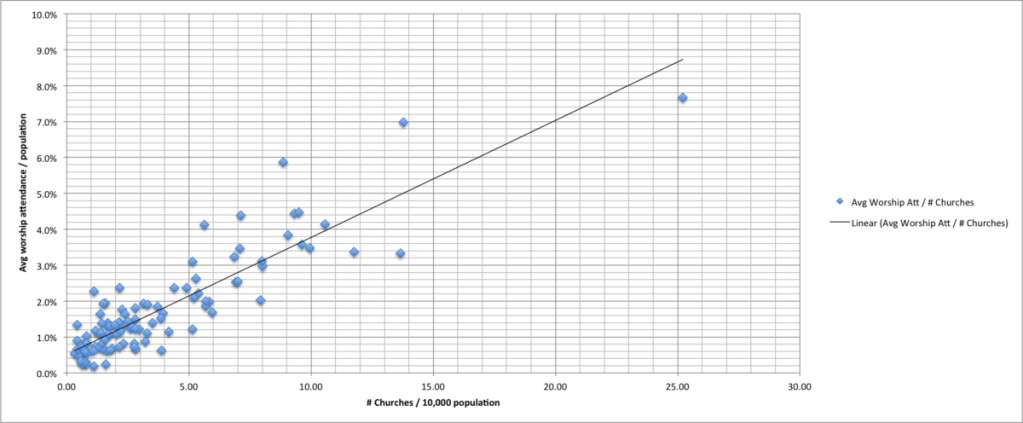
If you said yes, you were right. More churches = more people in worship. The chart below plots each county based on its number of UMC churches per capita and the average percentage of the population in worship attendance at UMC churches.
churches-and-attendanceLook at that beautiful direct relationship. More churches = more people in worship.

For people who like math and statistics, the correlation here is 0.884.

If you’re unfamiliar with correlations, they show you how closely related two variables are.

A 1 signifies a perfect positive relationship. Things with high positive correlations: ice cream sales vs. the outdoor temperature, your waist size vs. the amount of junk food you eat.

A -1 signifies a perfect negative relationship. Things with high negative correlations: hot chocolate sales vs. the outdoor temperature, your waist size vs. the amount you exercise.

A 0 signifies no relationship. Things with a near-0 correlation: the temperature outside vs. the amount of money in your bank account.

So a 0.884 correlation suggests a strong relationship between these two things.[note]There’s an important reminder in statistics: correlation does not imply causation. The number of people who drowned by falling into a swimming-pool correlates with the number of films Nicolas Cage appeared in during the year. Nevertheless, I think we have reason to believe that some causation is happening here. A few people might argue that the number of people in worship is causing the number of churches in that county. I don’t think that argument would find much support.[/note] I took this data to a team of MBA students at UK to be sure I hadn’t mishandled my data or misunderstood my results. They came back to me amazed that the data showed such a strong one-variable relationship.[note]For statistical analysis nerds, there’s much more here to discuss re: regression analyses. A regression analysis using county size and churches per capita shows a p-value of 4.4*10^-37 for churches per capita. A regression analysis using county size and average church size shows a p-value of .97 for average church size. I’m happy to continue the conversation and get your help and input for any next steps of study. Email me.[/note]

Let’s ask a next question. Is there a relationship between the size of churches in a county and the percentage of the population in worship?

This seems as intuitive as the first question. Bigger churches should equal more people in worship.

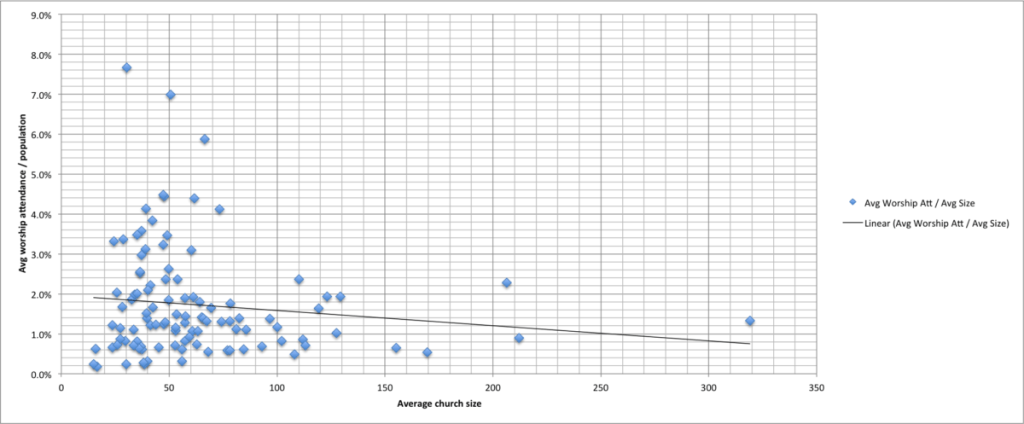
If you said yes… you were wrong. Bigger churches = nothing as far as total reach. The chart below plots each county based on the average size of its UMC churches and the percentage of the population in worship attendance.

size-and-attendanceNo relationship. The correlation is -0.12. This doesn’t change significantly even if we separate our counties by size. Even among our large counties––where churches are likely to grow larger––the number of churches per capita relates to how many people we’re reaching, the average size of the churches in that county does not.
More churches, more people

Tell me the number of UMC churches in your county, and I can tell you with decent accuracy what percentage of the county you’re reaching. Tell me the average size of UMC churches in your county, and I can tell you… nothing.

More churches = more people. Bigger churches = no difference.

In the data points above, you might see that the UMC has nearly 8% of one county in worship each Sunday. That’s Cumberland County. That county doesn’t have a single church with more than 100 people in attendance. But it has 17 of them![note]Some people will argue that Cumberland County is an outlier. Except that it’s not. Remove it, and the correlation doesn’t change. It is not an exception to the rule. It’s an extreme data point that proves the rule.[/note] For comparisons’ sake, that’s four more UMC churches than Fayette County has, even though Fayette is 46x larger.

If the Church really believes in reaching more people, it should be locked-in focused on starting more churches. Instead, we seem much more focused on growing churches. We celebrate church growth more than anything. Which people do we put in the spotlight? The ones who grow big churches! “The next speaker grew his[note]Let’s face it, it’s almost always “his.” I don’t celebrate that.[/note] church to ___ thousand in just ___ years!” The not-so-subtle suggestion: we all want to be like that guy and grow massive churches. Or at least grow larger than we are. Because we’ve all been convinced, if not consciously then subconsciously, that bigger churches are better.

We reveal that disposition when we refer to the church down the street as competition instead of as an ally. We reveal it when we say [insert your city name] has enough churches already, or when we advocate for church mergers. (“Do we really need one more church down the street? Why not combine into one bigger church?”)

About those mergers

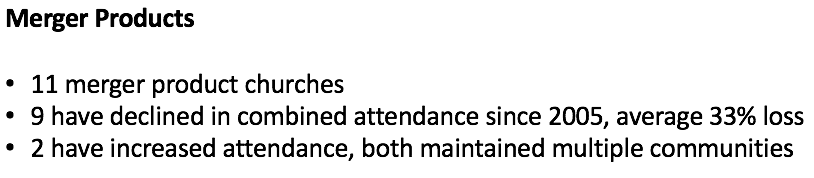
When we look at our merger products, we see more evidence that our bigger is better thinking is flawed. Analysis of Kentucky’s merger product churches over the past decade shows them as the single worst-performing category of churches we found. We had eleven merger product churches. Nine declined in their combined attendance and averaged a 33% loss. Five of them were among our top 20 attendance decreases across the conference during this period. (A category of churches that makes up only 1.4% of the Conference represented 25% of our churches with worst worship attendance losses.)

Two of those merger products actually grew. Those two exceptions are telling. One maintained separate geographic locations. The other maintained worship services in different languages. Neither merger included getting all the people under one roof.

Why we prefer bigger, why we need more

Bigger affords more. Specifically, it affords pastors a bigger pulpit, paycheck, parsonage and pension. (I’ve heard about the 4 P’s more than a few times. So long as they’re prized, our decisions will be based more on pastor preferences than kingdom impact.) So there’s a baked-in incentive for pastors to favor bigger rather than more. If you send people out to start something new, it means that your pulpit will stay smaller. And probably the paycheck and pension, since people will take their money with them. One church of 400 can pay a pastor much more than five churches of 100 can each pay their pastor. But we reach more people the second way.

Bigger affords more, but bigger doesn’t reach more. More reaches more. How can we flip the script in the church to start celebrating more churches more than we celebrate bigger churches?

This post deals with our why. Why plant churches? Because we reach more people. The why isn’t enough, though. How do we plant churches effectively? Next week’s post [now available] will suggest that we already know… but often ignore it. To be sure you don’t miss it, JOIN my e-mail update list.