
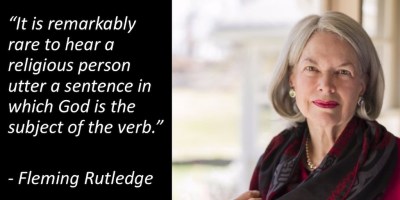
“When I have taught homiletics (preaching),” writes Fleming Rutledge, “I have always put a lot of emphasis on subjects and verbs. It’s remarkable how infrequently many of today’s preachers make God the subject of active verbs. Usually it’s the human being who is given the verbs.” [note]If you have not read everything Fleming Rutledge has ever written, your life is incomplete.[/note]
In a longer paper, Rutledge discusses our love for the “triumph of the human spirit” story. She’s worth quoting at length:
“Our addiction to our own supposed powers leads us perpetually to sentimentalize and romanticize human possibility rather than acknowledge our desperate predicament. This tendency, in turn, subtly or not so subtly encourages the making of sentences which have human capacity as their subject and God as their object. Thus we have the current enthusiasm for ‘spiritual journeys,’ with the human religious search as the controlling metaphor.”
Because of Fleming Rutledge, I’ve begun to pay more attention to my grammar––especially in preaching and church leadership, but also in everyday life. How often is God the subject of my verbs?
When God is the subject
I’ve also begun to pay more attention to the subjects and verbs in the Bible. My general finding: When God is the subject of the verbs, things tend to go well. When people become the subjects of the verbs, things often go awry. Which can lead back to God being the subject of some rather unpleasant verbs…
A warning in the book of Deuteronomy illustrates well. As the people move into the promised land, they risk convincing themselves that they did it all. I’ve highlighted several key subjects so we can see the movement:
When you have eaten and are satisfied, praise the LORD your God for the good land he has given you. Be careful that you do not forget the LORD your God, failing to observe his commands, his laws and his decrees that I am giving you this day. Otherwise, when you eat and are satisfied, when you build fine houses and settle down, and when your herds and flocks grow large and your silver and gold increase and all you have is multiplied, then your heart will become proud and you will forget the LORD your God, who brought you out of Egypt, out of the land of slavery. He led you through the vast and dreadful wilderness, that thirsty and waterless land, with its venomous snakes and scorpions. He brought you water out of hard rock. He gave you manna to eat in the wilderness, something your ancestors had never known, to humble and test you so that in the end it might go well with you. You may say to yourself, “My power and the strength of my hands have produced this wealth for me.” But remember the LORD your God, for it is he who gives you the ability to produce wealth, and so confirms his covenant, which he swore to your ancestors, as it is today.[note]Deut 8:10-18[/note]
The Bible story is not a “triumph of the human spirit” story. It’s a triumph of God story. God is the main character. The main plotline is about God creating, God rescuing, God redeeming, God restoring, God with us.
People are the supporting cast. Our story, apart from God, highlights the weakness of the human spirit and the evil inclinations of the human heart. Only because of God’s active role in this narrative can we celebrate triumphant and good people.
“Why have you not built me a house of cedar?”
This week the lectionary brings us to 2 Samuel 7 where David considers building a temple for Yahweh.
Is it an act of genuine piety? David sees the contradiction between his royal palace and the place of the ark of God––literally “in the midst of curtains.” He wants to give Yahweh a more fitting dwelling place.
Or is it about self-serving legitimation? A grand temple validates the king. It’s a mark of his success. (Does this have similarities to church building programs?) In some ways, it makes the god a patron of the king.
Walter Brueggemann calls temple building “undoubtedly a mixed act of genuine piety and self-serving legitimation.” [note]In his outstanding Interpretation commentary.[/note] Isn’t this how it is with so many of our decisions, especially as Christians and church leaders? Advancement and self-preservation––of both individuals and institutions––can have motives that are at once noble and self-serving. To the extent that it may be difficult to discern which is which.
Whether David’s motives are pure or impure (or more likely, an indivisible mix of the two), Yahweh changes the subjects of the verbs. Look at these subjects:
“This is what Yahweh says: ‘Are you the one to build me a house to dwell in?’ “
Subject: David.
Object: House (temple).
Recipient: Yahweh
And then the reversal:
“I have not dwelt in a house from the day I brought the Israelites up out of Egypt to this day. I have been moving from place to place with a tent as my dwelling. Wherever I have moved with all the Israelites, did I ever say to any of their rulers whom I commanded to shepherd my people Israel, ‘Why have you not built me a house of cedar?‘ “
From here through verse 16, Yahweh is the subject of 23 active verbs, as I count them.
He’s the subject of past-tense verbs: “I took you from the pasture.”
He’s the subject of future-tense verbs: “I will make your name great.”
He’s the subject of the great promise that extends far beyond David’s small vision of a temple: “Yahweh declares to you that Yahweh himself will establish a house for you.”
Subject: Yahweh.
Object: House (dynasty).
Recipient: David.
The Bible story is also not a story of people doing good things for God. It’s the story of God continually sustaining his sometimes anxious, sometimes self-serving, sometimes faithful people by giving them far more than they have envisioned. Ultimately, God has given us his Son, the offspring of David, whose kingdom never ends.
Regarding human plans that didn’t begin with God, he asks, “When did I ask you to do this for me?”
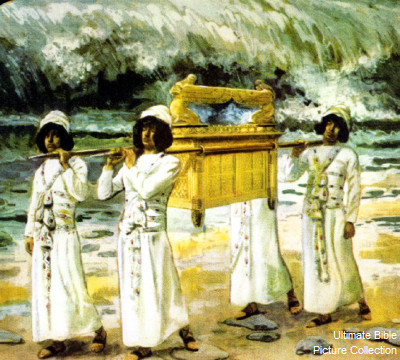
God does tell his people to do things for him. Principally, he tells us to trust and obey. Outside of trust and obedience, Yahweh is the subject of most of the good verbs in the Bible. The difference between Noah building an ark and the people building a tower at Babel––one is an act of human trust and obedience, the other an act of human will.
The lectionary and the UMC
A favorite phrase of United Methodist leaders today is “non-anxious presence.” In a time of anxiety, our Bishops are urging us to “project a non-anxious presence.”
This amidst much (legitimate) concern about the state of the United Methodist Church. It’s difficult to speak of “death tsunamis” and potential schism with a non-anxious presence.
I don’t expect we’ll become non-anxious through reading the right leadership book or mustering up enough confidence. I don’t expect the newly released report of the Commission on a Way Forward to reduce anxieties. From the beginning, many have viewed the task of the Commission as impossible––so far as the task is to maintain the unity of the UMC.
I expect the only legitimate way to cultivate (not just project) a non-anxious presence is to make God the subject of more of our verbs. I want to resolve as a leader in the church to spend less time prognosticating and more time asking what faithfulness to God means in my life and the life of my congregation today. I want to resolve as a leader in the church to spend less time wringing my hands about the future and more time in prayer, in gratitude for what God has done, and in sure and certain hope that God will sustain his church.
Does this mean that God will sustain the United Methodist Church in unity? We don’t have that promise. Nor can we fixate on making it happen ourselves. In our efforts to save our denomination, perhaps we have romanticized human possibility rather than acknowledging our desperate predicament. Perhaps we have made ourselves the subjects of too many of our verbs.**
Perhaps, like David, our determination to do something for God (with all the mixed motives that surely entails) has veiled our eyes to the larger designs of God. Perhaps we’ve sought to preserve and build an institution at the expense of celebrating the greater promise of God––his Son, Immanuel, God with us, as the one whose kingdom will last forever. If that kingdom is our end, we have no need for anxiety.
Fleming Rutledge writes, “The biblical story has God as its unfailing subject. God is not for us to find; God has found us, and keeps on finding us, and will chase us down even in Sheol (Psalm 139:8).” I don’t know the future of the United Methodist Church as a denomination. But I believe wherever it is we end up––each of our churches and members and clergy––God will be there already, with us, seeking us out, chasing us down… even in Sheol.
Like it? Or just want to discuss it more? I’d be honored if you’d share it –– use the social media links at left. Or send me an email for follow-up discussion. Or if you haven’t already, click here to subscribe for more. Thank you!
** To be clear: I don’t mean to negate good and faithful work done by many of our leaders, and particularly the Commission on a Way Forward. I trust many of them are asking questions that acknowledge our desperate predicament and God’s action as our only true hope. And I’m thankful for them. I write this more as admonition for myself and others like me than for those who already have God as the subject of their verbs.
 teddy ray