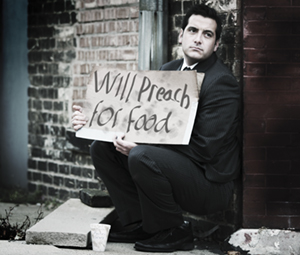
 Many people promote a common half-truth about pastors’ salaries, and it needs to end.
I just heard it again last week. “Hey, I only make $50,000.” Well, that was true. Technically.
What it neglected was the $20,000 housing allowance this pastor receives. And the $4,000 utilities allowance.
The truth about pastoral compensation
Pastors’ compensation packages are arranged differently than most. Whereas almost everyone else in America is responsible for paying for their own housing and utilities, these expenses are usually covered for pastors. We usually receive either a parsonage (a house provided by the church) or a housing allowance that covers the cost of our mortgage, along with any furnishings, maintenance, and renovation. And then the church pays for our utilities. This will often include the cost for lawn care, and probably some other things I’m forgetting.
One other benefit: Housing and utilities allowance are exempt from federal income tax. And pastors still get to claim a deduction for the mortgage interest they pay. It’s a double dip, and I have no idea why the IRS allows it, but they do.
Those in parsonages will tell you that they get a bum deal sometimes. They get a house that’s far from ideal and poorly maintained. This is a reality for many, and a genuine concern. Church – if you provide a parsonage for your pastor that you would never consider living in, you need to do something. Then again, you’d be surprised at the quality of some other parsonages. I’ve seen them valued up to $600,000 (in an area where median is $158k).
In all, here’s what this means: The pastor I reference above who only makes $50,000 actually receives $74,000. And $24,000 of that isn’t subject to income tax. Which makes his relative compensation – when compared with people in other professions – roughly $88,000.**
Yes, the IRS allows this – although I expect that to be challenged sometime in the next few decades. But let’s stop telling half-truths about pastors’ salaries.
Pastors, please don’t tell people, “I [only] make $XX,XXX,” and leave out that all costs associated with your housing are taken care of on the side. The people you’re talking to have to use their salaries to pay for their rent/mortgage, their utilities, their home maintenance, their lawn care, their cable bill…
As I read over this, I know it could be taken in a bitter or antagonistic tone. That’s not my intention. I receive a housing allowance and utilities allowance, too. I’m just imploring us to be more honest when we talk and think about our compensation. The lowest compensation package for a United Methodist elder in Kentucky (where median household income is $42,000) is just shy of $60,000. As compensation goes, none of us have anything to complain about.
Thinking theologically about pastoral compensation
My greater hope is that we would stop thinking about pastoral compensation in the business-world pragmatic sense and start thinking theologically about compensation in the church. See this earlier piece: “Pastors’ Salaries and Church Buildings.”
The pragmatists will say we can’t do it or we’ll lose our most talented people. There are a number of problems with that, which I might try to address another time.
For now, I would venture this with the pragmatists in my Methodist tradition. When we look at the relative compensation of our pastors and the numerical growth of Methodism, I bet you’ll find the greatest growth in the times and places where relative compensation was the lowest. And I bet there’s a pretty surprising negative correlation (i.e. one number goes up while the other goes down) between those two numbers over the last 200 years. I’d love to run some numbers on this, but I feel pretty confident about it based on what I’ve seen.
—————–
** Some more details, for those who are really interested…
Because the pastor I reference was a UMC pastor, he has a pretty nice health insurance package, for which his church pays nearly $13,000 annually. They’re also required to make an annual $11,000 pension contribution on his behalf, regardless of whether he contributes anything. Ignoring any other expense allowances or continuing ed, this is a $98,000 pay package. I point all this out just so we know the reality for this person who claimed to make “only $50,000.”
One other unusual thing that comes into play for pastors: we file as “self-employed.” Odd, isn’t it? This means the church doesn’t make FICA/SECA payments on our behalf. If the pastor in this example pays SECA taxes, this is a loss of $5,661. Adjust that comparable compensation number back down to $82,339.
But the final unusual piece: pastors can opt-out of Social Security. That’s a great economic boon to them! It’s also highly questionable, as far as I’m concerned. Anyone who opts out has to sign a statement that states,
I certify that I am conscientiously opposed to, or because of my religious principles I am opposed to, the acceptance (for services I perform as a minister, member of religious order not under a vow of poverty, or a Christian Science practitioner) of any public insurance that makes payments in the event of death, disability, old age, or retirement; or that, makes payments toward the cost of, or provides services for, medical care. (Public insurance includes insurance systems established by the Social Security Act.)
“Conscientiously opposed to […] the acceptance of any public insurance.” Hmmm… I see far more opt-outs out of economic convenience than out of troubled conscience.


 I was recently talking with my good friend Eddie, part of the leadership team at a mega-church, and I asked, “What’s a blind spot smaller churches seem to have – from the vantage point of mega-church world?”


