The Lectionary and the UMC: Avoiding Uzzah

[When you’re done, see my newest post: “The Lectionary and the UMC: The subjects of our verbs.”]

Throughout the history of God’s people, religious renewals have followed a similar pattern. You’ll be unsurprised to know these renewals didn’t begin with a change to policy or structure or a 55-45 vote. Here’s how William J. Abraham describes the Lutheran and Wesleyan renewals, among others:

“They took to immersion in the scriptures, to study of the tradition, to intentional participation in the sacramental life of the church, to prayer, and to extended conversation with their friends.” [note]In his brilliant Waking from Doctrinal Amnesia, p. 91[/note]

As the United Methodist Church faces a time of crisis, I’m convinced that renewal will not come through a vote at our General Conference or the next great policy proposal (not that these are entirely insignificant). It will come the way renewal comes, when we immerse ourselves in the scriptures and prayer and the church’s tradition and sacraments––and when we have extended conversation with each other concerning these practices and shaped by them.

To be sure, we can’t undertake these practices for the sake of proving ourselves correct. We do it to seek a word from God. Or perhaps better, to stop making ourselves the subjects of all our verbs and instead to say, “Speak, Lord, for your servants are listening.”

Whether you are United Methodist or not, might we ask how God speaks to us––not just as individuals, but as communities of people, even denominations––through his scriptures? What if we immersed ourselves in the scriptures according to our own lectionary? Does God have a word we can hear together here?

Avoiding Uzzah

The Old Testament lectionary passage for this week (2 Samuel 6:1-5, 12b-19) is as remarkable for what it leaves out as for what it contains. The passage narrates the arrival of the ark of God in Jerusalem. It leaves out Uzzah’s sudden death.

Verses 6-7, missing from our prescribed lectionary reading:

“When they came to the threshing floor of Nakon, Uzzah reached out and took hold of the ark of God, because the oxen stumbled. Yahweh’s anger burned against Uzzah because of his irreverent act; therefore God struck him down, and he died there beside the ark of God.”

The lectionary frequently leaves out portions of passages. Sometimes that’s for the sake of brevity, other times for the sake of focus on one particular aspect of the passage. In this case, though, I suspect it’s to avoid having to deal with what happened to Uzzah. This makes sense to me. I’d probably prefer to avoid it. But an honest immersion in the scriptures doesn’t let us off that easily.

Why are we uncomfortable with the Uzzah passage? It seems like the wrong answer to a common question: “Would a loving God really do that?” How could a loving and compassionate God strike someone down? And for this?

Richard Dawkins loves texts like this. He uses them as basis for a central claim in The God Delusion: “The God of the Old Testament is arguably the most unpleasant character in all fiction: jealous and proud of it; a petty, unjust, unforgiving control-freak…” [note]p. 51. That sentence keeps going for quite a while longer.[/note] Uzzah tries to steady the ark on the cart and God strikes him dead. Uzzah’s (ultimate) punishment does not seem to fit his (very minor) crime.

Uzzah’s demise traces back to Numbers 4:15: “After Aaron and his sons have finished covering the holy furnishings and all the holy articles, and when the camp is ready to move, only then are the Kohathites to come and do the carrying. But they must not touch the holy things or they will die. The Kohathites are to carry those things that are in the tent of meeting.”

The ark of God––the throne of God on earth among the Israelites––was intended to be carried like this.
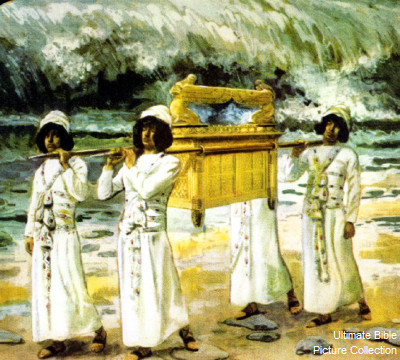
Picture courtesy of bibleencyclopedia.com

Does that look familiar?

Looks kind of like this.
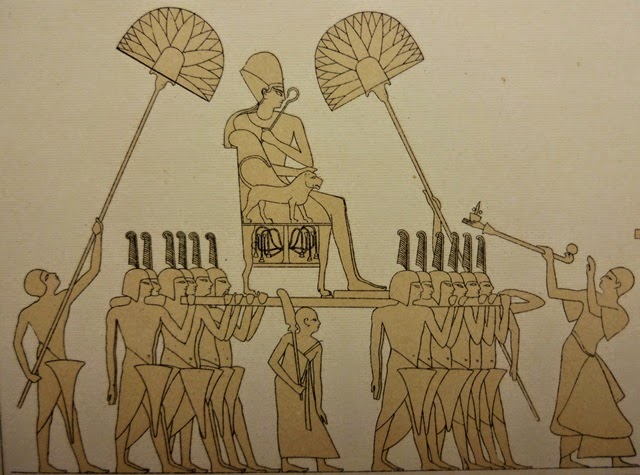
Picture courtesy of paranormalromantics.blogspot.com

A royal procession for a King.

Instead, the Israelites chose to move the ark of Yahweh as if it were luggage, loaded onto an oxcart.
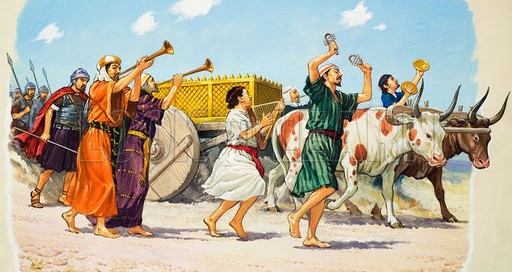
Courtesy of http://www.sgeorgiastreet.church

Uzzah’s decision to reach out and touch the ark, disregarding God’s command and God’s holiness, was far from the first act of irreverence on the part of the Israelites. But it was the action that resulted in Yahweh’s wrath finally breaking out.

When we ask whether a loving and compassionate God would strike Uzzah dead, our hearts want to say no. But God did strike Uzzah dead, and while our lectionary can avoid it, we cannot.

Essential but not Sufficient

God’s compassion is an essential part of understanding the nature of God. But God’s compassion alone is not sufficient for understanding God. We make a great mistake when we confuse essential for sufficient.

Along with recognizing God’s compassion, we must recognize what the Israelites here ignored: God’s holiness. They had been told to fear Yahweh, to walk in obedience to him and observe his commands and decrees. This, too, was an essential part of their understanding and knowing God. Uzzah’s death was a result of their lack of fear and obedience.

When we avoid Uzzah to focus on a God of compassion, we don’t get a better God, we get a false god––one of our own making.

We could also do the opposite––to fixate on the God who strikes Uzzah dead. This is how Richard Dawkins would prefer it. But that overlooks the God who mercifully returns to be Israel’s God––visible in the ark’s procession to Jerusalem––even after their repeated rejections and rebellions. If we did this, we would likewise be worshiping a god of our own making, one who desires sacrifice, not mercy.

The Lectionary and the UMC

There are two common watchwords right now in the UMC: compassion and orthodoxy. Both are essential to the Christian faith. Neither is sufficient.

Compassion tells us to listen to those on the margins, the minorities, the least of these. Orthodoxy tells us to listen to those who’ve gone before us. Who should we listen to? Both!

Compassion tells us we should give special attention to care for the marginalized and oppressed, whatever the cost. Orthodoxy tells us we should give special attention to reverent obedience to God’s word and the church’s historic teaching, whatever the cost. Which should we tend to? Both!

Compassion tells us we should be wary of injustice. Orthodoxy tells us we should be wary of heresy. Which should we be wary of? Both!

Our problems come when we take either of these not just as essential, but as a sufficient rule for our faith and life, and thereby nullify the other.

If I find myself regularly citing those on the margins, I may need to spend extra time listening to those who’ve gone before us (and not just those who say what I want to hear). If I find myself regularly citing those who’ve gone before us, I may need to spend extra time listening to those on the margins (and not just those who say what I want to hear).

Our church cannot avoid Uzzah. God is a holy God. His eyes are too pure to look on evil; he cannot tolerate wrongdoing.[note]From Hab 1:13[/note] Neither can our church fixate on Uzzah. His death shows us only part of God’s nature. Yahweh is still a compassionate and gracious God, slow to anger, abounding in love.[note]Found throughout the OT. See, e.g. Ps 103:8; Jonah 4:2[/note]

Like it? Or just want to discuss it more? I’d be honored if you’d share it –– use the social media links at left. Or send me an email for follow-up discussion. Or if you haven’t already, click here to subscribe for more. Thank you!

[When you’re done, see my newest post: “The Lectionary and the UMC: The subjects of our verbs.”]
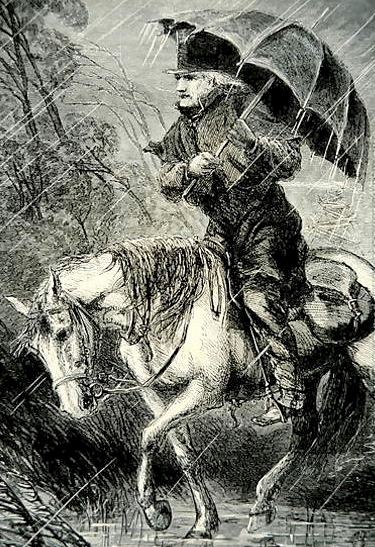
A vote in favor of Methodist itineracy, or When the circuit rider dismounted…

Many advocates for itineracy in the United Methodist Church have contended that itineracy is at the heart of Methodism and a vital part of our ministry.

I’ve advocated in many places for the importance of the local pastor. Some have taken my advocacy as a disregard for itineracy. On the contrary, I would argue that itinerant ministry played a vitally important role in the history of Methodism and could continue to play that role now.

In 21st century Methodism, the ideal of itineracy has not been tried and found wanting. It has been found difficult; and left untried.[note]with apologies to G.K. Chesterton[/note]

Real Itineracy and the Dismounting of the Circuit Rider

Long ago, our circuit riders dismounted. We now operate with stationed pastors who get shuffled around from time to time. This may be a continued acknowledgment of episcopal authority––the Bishop decides when and where someone goes. It has little to do with itineracy as the early Methodists understood it. If anything, our current practice of “itineracy” is likely to have an effect opposite that of real itineracy as the early Methodists practiced it.

Look at this description from Frederick Norwood’s The Story of American Methodism:

“What they meant by itineracy was that plan of appointments by which ministers were kept moving twice-over. In the first place, each man had his appointment for a strictly limited time [at first quarterly, then annually with an absolute 2-year limit, then 3- and 4-year limits in the later 19th century]. In the second place, every preacher kept on the move on his circuit, and this was true even of ministers appointed to city stations, for they had several outpoints […] In this way, some preachers were appointed to circuits in which they preached perhaps four times (once each quarter) in each of many preaching points, and then went off to the annual conference for appointment to a different circuit. Four powerful sermons, ringing the changes from conviction of sin all the way to perfect love, would take care of an entire year’s preaching!”[note]p. 137[/note]

Itinerant preachers moved twice-over. (1) Their appointments to circuits had strict limits. Those who stayed at the same appointment for a second year were criticized for staying too long. (2) Even within those circuits, they were constantly moving. They might preach somewhere four times in a year!

Were these itinerant ministers the ones conducting weddings and funerals for all of their people?

No!

Were they the ones convening weekly leadership meetings, hiring staff, visiting the sick? In other words, were they the “pastor in charge”?

No!

Would they have even known most of their people’s names?

I wonder.

The itinerant minister functioned much more like an evangelist. “Four powerful sermons, ringing the changes from conviction of sin all the way to perfect love…” The itinerant minister provided little to no pastoral care, little church management, rare “vision-casting” leadership, if at all––and the “vision” would usually be a vision of the kingdom of God, not a committee-created 2020 “vision” for the church.

The Congenial Combination in Early Methodism

So what about all the rest? Who would conduct weddings and funerals? Who would meet with the leaders of a congregation and visit their sick? Who were the “pastors in charge”? The located leaders. These were the often overlooked backbone of the early Methodist movement. The traveling evangelists could bring their four powerful sermons, then move on. A local church would not rise and fall on that kind of occasional leadership. Instead, the ongoing leadership of a congregation came from people who were not under threat of being moved at the next annual conference.

The traveling preacher and the local pastor made for a great team. The one serving an apostolic role––constantly on the move and proclaiming the gospel––the other a priestly role––living among the people and shepherding them. “Only when the circuit rider dismounted and settled in the community where the local preacher lived did the problem arise […] of what his role should be,” explains Norwood, “especially in a community accustomed to a congenial combination of the two.”

Today’s Methodism has lost that congenial combination. We have no traveling preachers. We have lost what was best and most important about that role––its evangelistic nature and focus.

We have only local pastors. Yet we warn local pastors and their congregations that we’re likely to uproot them and move them to a different congregation from time to time. With that, we have lost what was best and most important about that role, too––its constancy with the people.

Why did we abandon the true itinerant ministry? Mainly because we found it difficult. Even in American Methodism’s earliest days, the bishops lamented that “an embarrassingly large number of traveling preachers located.” [note]Norwood, 135[/note] The pilgrim life is hard. It’s best cut out for the young and the single. (It was when circuit riders married that they tended to locate.) How many of our “itinerant” ministers today would truly be able and willing to travel like those early Methodist preachers? The car is much easier on the body than a horse. Still, we would likely lose most. Perhaps we would replace them, though, with those truly called to a ministry of itinerant evangelism.

And how many more great pastoral leaders for the church might we gain if we did away with the threat to move them to a different town and congregation? Likely many. Though what we call “itineracy” today is hardly circuit riding, its constant threat of displacement is still difficult both for those with families and for those whose vision of ministry includes a long journey with a particular community.

The Unnatural New Creation of Modern Methodism: The Ad Interim Pastor

Our circuit riders dismounted long ago. When they did, we abolished both the itinerant ministry and the located pastoral ministry. Instead we settled for a new, unnatural and biblically unprecedented form: the ad interim pastor, where the interim may be one year or twenty––hold your breath at each annual conference cycle. It is now the ad interim pastor who conducts most weddings and funerals, convenes most leadership meetings, hires most staff, and sometimes visits in the hospitals, too. Many in the UMC will contend that we should train laity to do some of these things––at least the visitation. To what degree will depend on which ad interim pastor is serving a congregation at the moment. That wasn’t a question in early Methodism. When the circuit riders dismounted, the lines between these roles blurred.

What if we tried itineracy again? What if we tried having located pastors in charge again? Even one of these moves could reap great rewards. The two together could be a piece of returning to the roots of the Methodist movement.


If you found this interesting or helpful, I’d love the chance to share more. Click here to subscribe.

HOW we need to plant churches: How to NOT squander church resources (pt. III)

In the coming years, the church must find a way to maximize its resources. The United Methodist Church serves as an excellent experimental lab, with thousands of ongoing experiments running in different local churches and Annual Conferences. What can we learn from those experiments? In the last part of this series, I detailed why we need to focus on church planting. This part will focus on the how.

Church Planting

Over the past 200 years, Methodists planted over 800 self-sustaining churches in the state of Kentucky. Those churches have been places of care for their members, mission outposts in their communities, and contributors to a mission far beyond their own.

How can we continue to create places like these for future generations?

I’ve read numerous studies on church planting and conducted some of my own research over the past few years. The most slap-you-in-the-face clear findings: (1) more churches reach more people [see previous post]; (2) initiatives sponsored by local churches usually succeed; the rest usually fail; (3) disproportionate outside funding harms long-term sustainability.

Local Initiatives

One of the best quantitative studies I’ve found analyzes the Christian Reformed Church’s planting success. It compares local initiatives to denominational initiatives. Of the 43 locally sponsored initiatives, 31 were successful, a 72% success rate. Of the 36 other initiatives, 2 were successful, a 94% failure rate!

The author of the study, David Snapper, discusses advances in church growth research and training for church planters. Many people expected good training in church growth techniques would lead to success. However, the denominational-initiative pastors––the 94% failure rate pastors––had received heavy training in church growth techniques. Snapper concludes, “[G]ood technique cannot, by itself, overcome the enormous difficulties imposed by isolation, lack of support, diminished name-recognition, and similar realities of many NCDs.”

Of course, this study was conducted on congregations organized between 1987 and 1994.[note]See “Unfulfilled Expectations of Church Planting” by David Snapper in the Calvin Theological Journal 31 (1996): 464:86.[/note] A lot has changed since the 90’s. Is this data still relevant? Results from recent Kentucky church plants suggest that it is.

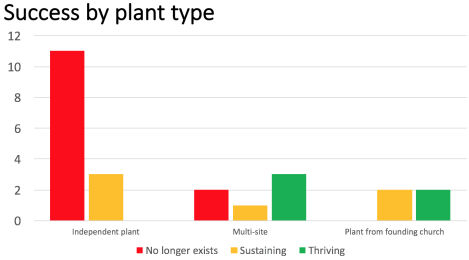
I wish our team in Kentucky had come across Snapper’s research study and heeded its warnings fourteen years ago. A study of UMC church planting in Kentucky from 2004-2018 showed similar results. We looked at all plants that had received denominational funding in the past 14 years and have since gone off funding. We categorized them as no longer existent, sustaining,[note]exists, but is not paying denominational apportionments, a sign of continuing financial challenges[/note] and thriving.[note]financially self-sustaining + paying apportionments[/note]

Out of fourteen attempts at independent plants, eleven no longer exist and three are sustaining. None were categorized as thriving. That makes for a 21% somewhat-success rate.

Out of ten attempts at local-initiative plants––multi-sites or plants from a founding church––two no longer exist, three are sustaining, and five are thriving. That makes for an 80% success rate for at least sustaining, 50% success rate for thriving. The two that no longer exist represent one idea that received limited funding and never actually began and one congregation that left the UMC denomination (so they do still exist, just not in the UMC).[note]I’m not including other kinds of plants that were a part of the larger study––multi-language plants (new language, same location), church restarts, and church-within-a-church. Our sample size was too small and results too inconclusive to be of much help. The early results from all of those did not look good.[/note]

Every piece of our findings confirms what that earlier study of the Reformed Christian Church demonstrated: Initiatives sponsored by local churches are likely to succeed, the rest are likely to fail.

As with frequent moving of pastors, the independent plant model of church planting seems to defy basic biology. A church plant is much more likely to succeed as an organic outgrowth from an existing church than as an isolated strategic initiative. God can create ex nihilo. The rest of us will do better with the strong base of support a local church provides.

Disproportionate Funding

Another question we asked about church plants over the past 14 years: How did the amount of denominational funding they received impact their long-term success?

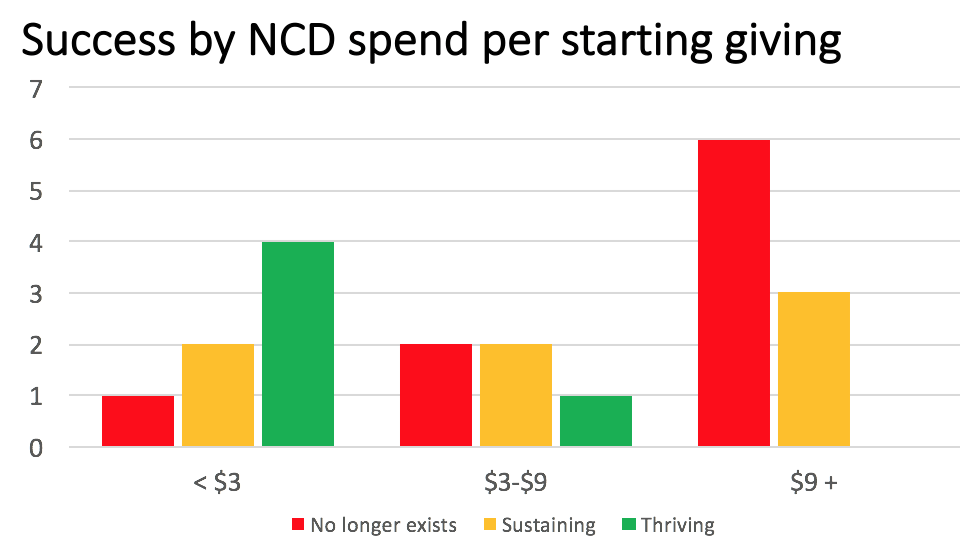
Specifically, we asked, “For every dollar given by church members during a new church’s first year, how many dollars of denominational support did they receive?” Many of us expected an easy answer: the more financial support, the better. That was wrong.

We categorized them into churches that received <$3 in total from the denomination for every dollar contributed by members in the first year (e.g. If a new church’s giving was $50,000 in its first year, the total denominational support was $150,000 or less), churches that received $3 – $9 for every dollar contributed by members, and those that received over $9. Look at the success rates:

The more disproportionate the denominational support, the less likely a new church was to succeed.

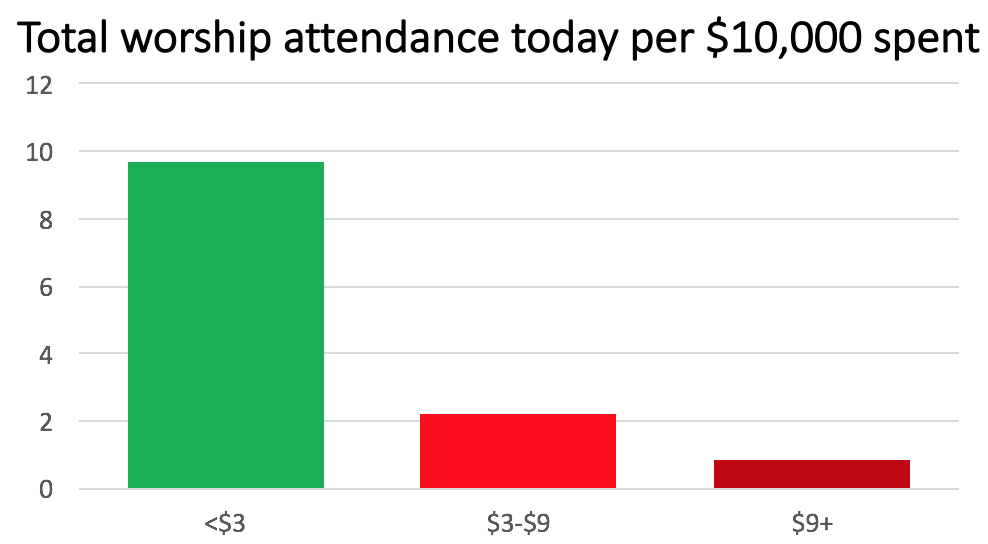
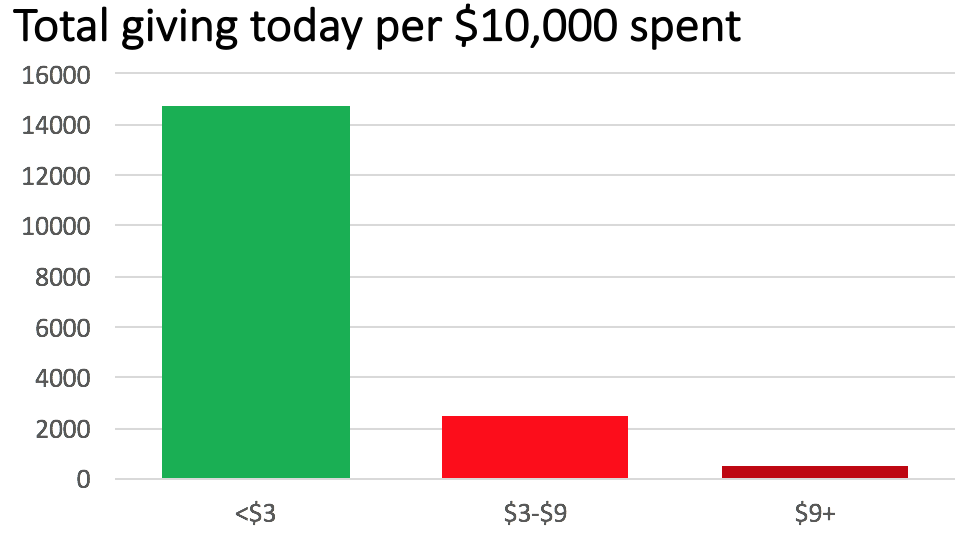
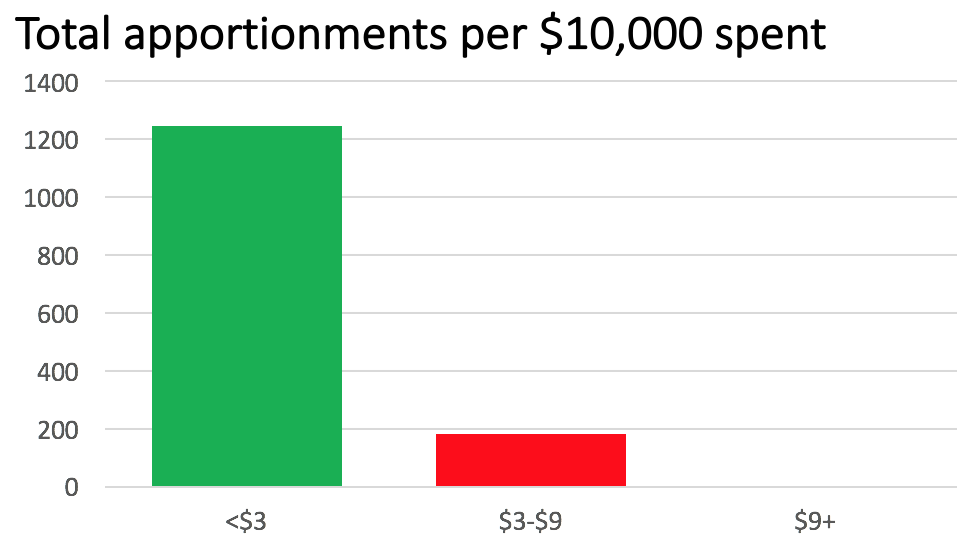
Even more revealing is a look at attendance, giving, and contributions back to the denomination (“apportionments” in the UMC) for each of these categories. We asked, “For every $10,000 our denomination invested, what is the average worship attendance––or annual giving, or annual apportionments paid––today?”

To help make sense of this chart –– The churches that received a total of <$3 from the denomination for every dollar of first-year giving are averaging nearly ten people in worship per $10,000 invested by the denomination. If the UMC invested $100,000 in one of these churches, attendance today is likely around 100 today. By comparison, if the UMC invested $100,000 in a more disproportionate way –– if it was in the middle category, that church is likely to have 20 in worship today.

I think what we’re seeing here is that with more disproportionate denominational investment, new churches become dependent on that funding. They are unable to mature into churches that can become self-sustaining.

This runs against much of the logic used in new church development circles. If a church has more internal funding, we support them less, supposing that they have enough already. If a church is struggling financially, we often rush to their aid with more denominational funding, trying to prop them up. Those efforts to prop up will probably be wasted money, keeping a new congregation dependent on the denomination, when it would be better to allow them to either rise to the challenge or close.

Putting it all together

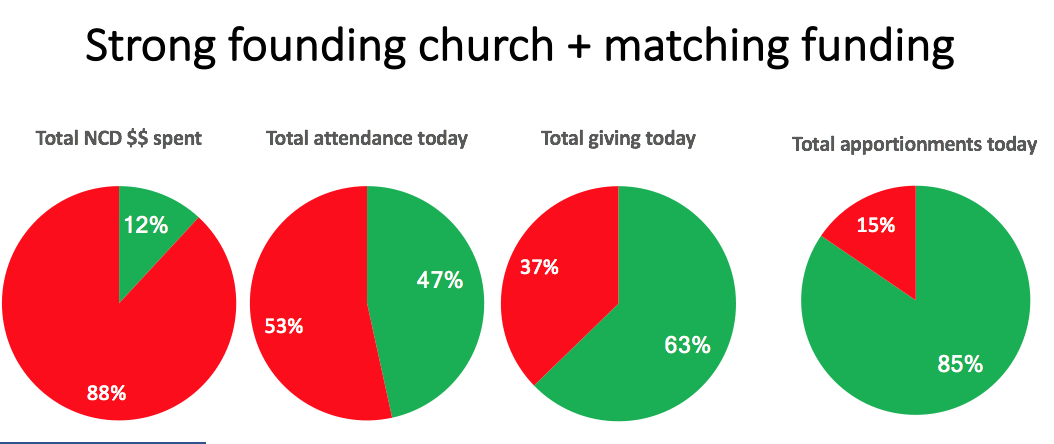
What if we asked only two questions for supporting new faith communities: (1) Is it an initiative coming out of a strong founding church? (2) Can we support it with proportionate denominational funding? In this case, I’ve identified proportionate as matching funding from the denomination that would put a church in that <$3 category above.

In the past 14 years, 12% of Kentucky investments in new church planting have fit those two categories. Look at how those investments have done:


I think we have enough evidence to make a change. We should re-focus our church planting resources. Can a good idea + a charismatic leader + massive denominational funding lead to a successful church plant? Of course! But it will be the rare exception to the rule. We’ve spent millions on parachutes for charismatic leaders with good ideas, and we have little to show for it.[note]This should actually provide some reassurance to any of those discouraged leaders. If you tried to start a church without the strong backing of a local church and were unsuccessful, we shouldn’t first assume it’s a reflection on your leadership. The odds were stacked against you.[/note]

Denominations need to keep a focus on church planting, but their role needs to be about inspiring and incentivizing local churches to plant new churches. Denominations should invest in those new plants as partners, not as their primary benefactors. We need to get out of the business of investing in ideas––even ones with exciting, well-crafted plans. We need to run from any notions of centrally-planned initiatives. If we continue investing in initiatives that aren’t based out of a local church or where denominational funding makes up most of a new church’s budget, we need to ask whether we’re squandering our resources.

I don’t want you to miss the next post, and neither do you. To be sure you don’t miss it, JOIN my e-mail update list.