Why we need more churches: How to NOT squander church resources (pt. II)

In the coming years, the church must find a way to maximize its resources. The United Methodist Church serves as an excellent experimental lab, with thousands of ongoing experiments running in different local churches and Annual Conferences. What can we learn from those experiments? I wrote part I of this series on pastoral tenure and transition. The next two parts will focus on church growth and church planting.

Two charts that should change how we think about church growth

I’m going to share two charts with you that should make us reconsider how we typically think about church growth.

These are based on my research of the United Methodist Church in Kentucky. This is obviously a limited data set. One denomination, one state.[note]Not even a full state. Just my conference. A handful of our counties are in another conference.[/note] Nevertheless, it gives us over 800 churches in 105 counties, so there’s a lot to work with here. I suspect that it would hold true if we went beyond my denomination and state.[note]Preliminary research on the North Carolina Conference of the UMC shows similar results.[/note]

An easy first question: Is there a relationship between the number of churches in a county and the percentage of that county’s population in worship?

If you said yes, you were right. More churches = more people in worship. The chart below plots each county based on its number of UMC churches per capita and the average percentage of the population in worship attendance at UMC churches.
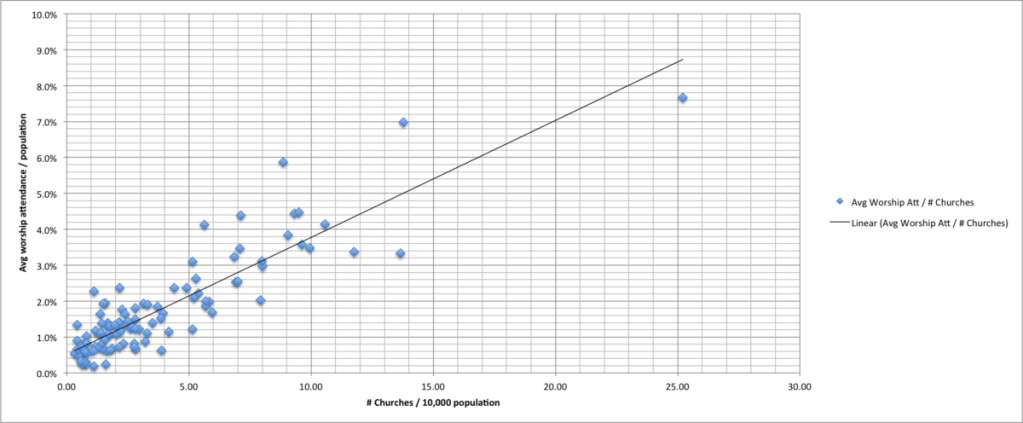
churches-and-attendanceLook at that beautiful direct relationship. More churches = more people in worship.

For people who like math and statistics, the correlation here is 0.884.

If you’re unfamiliar with correlations, they show you how closely related two variables are.

A 1 signifies a perfect positive relationship. Things with high positive correlations: ice cream sales vs. the outdoor temperature, your waist size vs. the amount of junk food you eat.

A -1 signifies a perfect negative relationship. Things with high negative correlations: hot chocolate sales vs. the outdoor temperature, your waist size vs. the amount you exercise.

A 0 signifies no relationship. Things with a near-0 correlation: the temperature outside vs. the amount of money in your bank account.

So a 0.884 correlation suggests a strong relationship between these two things.[note]There’s an important reminder in statistics: correlation does not imply causation. The number of people who drowned by falling into a swimming-pool correlates with the number of films Nicolas Cage appeared in during the year. Nevertheless, I think we have reason to believe that some causation is happening here. A few people might argue that the number of people in worship is causing the number of churches in that county. I don’t think that argument would find much support.[/note] I took this data to a team of MBA students at UK to be sure I hadn’t mishandled my data or misunderstood my results. They came back to me amazed that the data showed such a strong one-variable relationship.[note]For statistical analysis nerds, there’s much more here to discuss re: regression analyses. A regression analysis using county size and churches per capita shows a p-value of 4.4*10^-37 for churches per capita. A regression analysis using county size and average church size shows a p-value of .97 for average church size. I’m happy to continue the conversation and get your help and input for any next steps of study. Email me.[/note]

Let’s ask a next question. Is there a relationship between the size of churches in a county and the percentage of the population in worship?

This seems as intuitive as the first question. Bigger churches should equal more people in worship.

If you said yes… you were wrong. Bigger churches = nothing as far as total reach. The chart below plots each county based on the average size of its UMC churches and the percentage of the population in worship attendance.
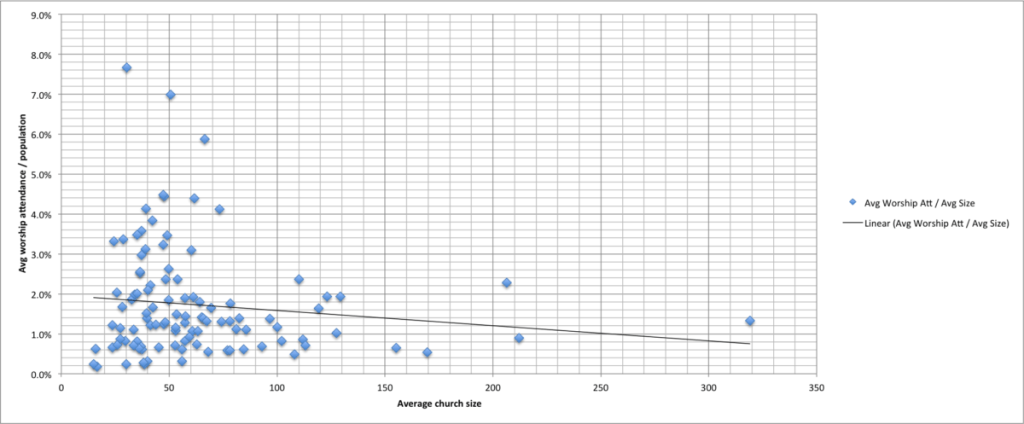
size-and-attendanceNo relationship. The correlation is -0.12. This doesn’t change significantly even if we separate our counties by size. Even among our large counties––where churches are likely to grow larger––the number of churches per capita relates to how many people we’re reaching, the average size of the churches in that county does not.

More churches, more people

Tell me the number of UMC churches in your county, and I can tell you with decent accuracy what percentage of the county you’re reaching. Tell me the average size of UMC churches in your county, and I can tell you… nothing.

More churches = more people. Bigger churches = no difference.

In the data points above, you might see that the UMC has nearly 8% of one county in worship each Sunday. That’s Cumberland County. That county doesn’t have a single church with more than 100 people in attendance. But it has 17 of them![note]Some people will argue that Cumberland County is an outlier. Except that it’s not. Remove it, and the correlation doesn’t change. It is not an exception to the rule. It’s an extreme data point that proves the rule.[/note] For comparisons’ sake, that’s four more UMC churches than Fayette County has, even though Fayette is 46x larger.

If the Church really believes in reaching more people, it should be locked-in focused on starting more churches. Instead, we seem much more focused on growing churches. We celebrate church growth more than anything. Which people do we put in the spotlight? The ones who grow big churches! “The next speaker grew his[note]Let’s face it, it’s almost always “his.” I don’t celebrate that.[/note] church to ___ thousand in just ___ years!” The not-so-subtle suggestion: we all want to be like that guy and grow massive churches. Or at least grow larger than we are. Because we’ve all been convinced, if not consciously then subconsciously, that bigger churches are better.

We reveal that disposition when we refer to the church down the street as competition instead of as an ally. We reveal it when we say [insert your city name] has enough churches already, or when we advocate for church mergers. (“Do we really need one more church down the street? Why not combine into one bigger church?”)

About those mergers
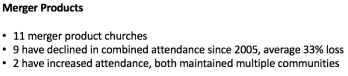
When we look at our merger products, we see more evidence that our bigger is better thinking is flawed. Analysis of Kentucky’s merger product churches over the past decade shows them as the single worst-performing category of churches we found. We had eleven merger product churches. Nine declined in their combined attendance and averaged a 33% loss. Five of them were among our top 20 attendance decreases across the conference during this period. (A category of churches that makes up only 1.4% of the Conference represented 25% of our churches with worst worship attendance losses.)

Two of those merger products actually grew. Those two exceptions are telling. One maintained separate geographic locations. The other maintained worship services in different languages. Neither merger included getting all the people under one roof.

Why we prefer bigger, why we need more

Bigger affords more. Specifically, it affords pastors a bigger pulpit, paycheck, parsonage and pension. (I’ve heard about the 4 P’s more than a few times. So long as they’re prized, our decisions will be based more on pastor preferences than kingdom impact.) So there’s a baked-in incentive for pastors to favor bigger rather than more. If you send people out to start something new, it means that your pulpit will stay smaller. And probably the paycheck and pension, since people will take their money with them. One church of 400 can pay a pastor much more than five churches of 100 can each pay their pastor. But we reach more people the second way.

Bigger affords more, but bigger doesn’t reach more. More reaches more. How can we flip the script in the church to start celebrating more churches more than we celebrate bigger churches?

This post deals with our why. Why plant churches? Because we reach more people. The why isn’t enough, though. How do we plant churches effectively? Next week’s post [now available] will suggest that we already know… but often ignore it. To be sure you don’t miss it, JOIN my e-mail update list.


Theology and Sex: Do we write a Three Views book or a new creed?

Earlier this week, Tim Tennent posted an excellent article to distinguish perspectives and positions in theology. If you haven’t already read it, you should go do that. You might notice my comment at the bottom of the post. I build on that below.

Here I’m going to: (1) summarize how Tennent defines perspectives and positions and draw some logical conclusions for the church, (2) note how these categories should alter what I wrote last week on the UMC Divide, (3) ask whether human sexuality is a theological perspective or position, and (4) make a note on the crisis of authority in the post-Reformation Church.

A Summary of Perspectives and Positions according to Tennent

Theological perspectives allow for a “generous orthodoxy” (my words). We have different views about these matters, but we’re not calling anyone a heretic or unChristian for disagreeing.[1] Want to see all the sides of one of these debates? Zondervan has made a whole series for it––31 volumes. You can get Four Views on HellFive Views on the Church and PoliticsTwo Views on Women in Ministryor even Four Views on God and Canaanite Genocide.

While we celebrate that “generous orthodoxy” regarding perspectives, we allow no such variance for our positions. These are the core doctrines of the faith, “matters where the church has historically spoken with a single voice,” according to Tennent. You hopefully won’t find Two Views on Whether the Son was Created or Three Views on Christ’s Nature: Human, Divine, or Both? That’s because these matters are settled in the church. The early church convened councils, wrote creeds, and excommunicated people over them.

If someone teaches a belief contrary to a Christian position, there is no room for “generous orthodoxy.” We’re dealing with heterodoxy or heresy. The proper response isn’t to write a Three Views book, it’s to correct or excommunicate the heretic.

Perspectives, Positions, Sex, and the UMC Divide

Given the current controversy in the American church and especially the United Methodist Church, the elephant in the room throughout Tennent’s article is our theology of human sexuality. Which category does it belong to––perspective or position? Though the article doesn’t mention human sexuality directly, readers surely glanced in the elephant’s direction while they read this line in a paragraph on core doctrines: “We are told that we are ‘on the wrong side of history’ and we should ‘get with the times.'”[2]

Whether we treat this as a matter of perspective or position will change every aspect of how we handle this controversy. A few people took issue with the comparisons in my last post between United Methodists who flout our stance on baptism and those who flout our stance on same-sex marriage. To use Tennent’s definitions, I believe they were arguing that one is a perspective (generous orthodoxy!), the other a position (heresy!) That misses the point, as I was comparing the two regarding fidelity, not doctrine. If covenant matters, then all of the covenant matters.[3]

Though the categories of perspective and position don’t change that part of my post, they do draw two other parts into question.

1 – I listed several areas where a United Methodist church and clergyperson would be expected to keep covenant. That list is a medley of the two categories. It includes perspectives like women in ministry, itineracy, and baptism practices.[4] It also includes United Methodist doctrine, which in itself is part perspective (e.g. Wesleyan soteriology) and part position (e.g. the bodily resurrection).

Underneath that list, I said, “These questions do not ask for full agreement, only obedience.” That was a statement too broad for a medley of perspectives and positions. You don’t have to fully agree on itineracy, just obey. But on the eternal divinity of Christ, you must agree.

The denominational perspectives require obedience for the sake of fidelity.
The positions require agreement for the sake of orthodoxy.

The other item I included in that list was same-sex marriage. Is it a perspective that requires obedience or a position that requires agreement? This brings another part of my post into question.

2 – I said that I believe the church needs dissenters who will keep dissenting. I included those with different views on same-sex marriage as needed dissenters. If this is a perspective, then we should welcome appropriate debate on the issue. If it’s a position, then as Tennent says, it is “not a point of discussion;” debate and disagreement about same-sex marriage should be tolerated no more than Arianism.

I treated our debate over same-sex marriage as a matter of perspective, not as a matter of position. (Or at least, not as a matter so settled as to close the door on discussion.)

Is our theology of human sexuality perspective or position?

If we say this is a perspective, we can keep full communion, even while differing on this matter of theology.[5] But we’ll have to answer why the church’s consistent historical position on sexuality has come back up for debate. If the church has always taught sex as unitive (uniting two into one flesh) and procreative––prohibiting it whenever it didn’t have these two meanings––what permits us to question these now? Could historical teaching on Christ’s humanity or eternal divinity also come back into play?

If we call this a position, we’ll say the church has historically spoken with a single voice. This is not a point of discussion. We cannot keep full communion with those who disagree. They’re not orthodox Christians. But if we rely on tradition here, we’ll have to answer how the situation is different from as recent as the 15th century, when women’s ordination and the confessional view of baptism looked much closer to prohibited positions than permissible perspectives. Moreover, we’ll need to answer whether Protestant churches have truly held to the historical position of the church––that sex must have a unitive and procreative meaning. The Roman Catholic Church would surely argue that our perspective on contraception is a violation of the church’s historical position on sexuality.

I don’t conclude here with an answer. Tennent’s post has given me helpful categories to name my confusion. I’m a traditionalist on human sexuality. From Scripture and the church’s tradition, I’m convinced that sex is properly unitive and procreative. But I’m unsure whether I can call this a perspective or a position. The difference is glaring. Do we write a Two Views book with each other (it’s already out there), or do we say this is no point of discussion and correct or excommunicate the heretic?

The Crisis of Church Authority

Most of the church’s major theological crises were settled when there was a definable church. Then, as now, they did not have one side arguing from the Bible and another denying the Bible. Instead, they had two sides arguing their position from the Bible. They were able to convene ecumenical councils as one body, identify orthodox belief and heresy, and write creeds that specified Christian belief.

A theological crisis like this over human sexuality reveals the trouble with church authority after the Reformation. A denomination can convene a council, but that council speaks for the denomination, not for the Church universal. A council speaking for a denomination is, by definition, clarifying a perspective, not a position. Without an ecumenical council, where do we go to confirm and clarify positions in question?

I write about theology, ministry and the UMC, usually about twice a week. Click here to subscribe by email.

I don’t have comments here any more. If you’d like to discuss it with friends, share it with them and discuss. If you’d like to discuss it with me, send me an email. I’d love to hear from you.

[1] Well, most of us aren’t, anyway.
[2] When I run a Google search for “wrong side of history” and “church,” six of the first seven articles are about human sexuality.
[3] For a better direct comparison between doctrinal points, see my discussion of our treatment of human sexuality in relation to same-sex marriage.
[4] That we would include baptism as a perspective is especially interesting, and almost all of us would. Tennent supports this by saying that both views of baptism have theological arguments to support them and that historically, “the church has not found common ground on every aspect of baptism.” We can certainly say this today, but could 15th century theologians have said the same? Or would they have called baptism (or at least infant baptism) a matter “where the church has historically spoken with a single voice”––a position?
[5] This point especially comes into focus as the UMC and The Episcopal Church discuss full communion.

How the UMC Divides

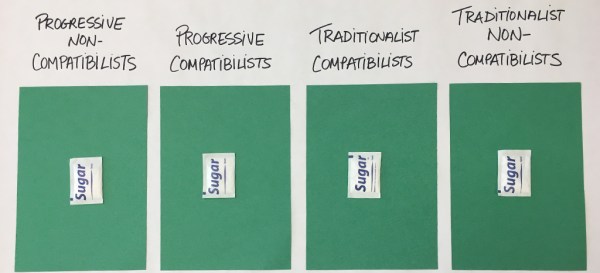
Most people now think some sort of divide in the UMC is inevitable. Tom Berlin shared this helpful illustration about our differences––attributed to Tom Lambrecht. It shows two groups who are “non-compatible” with the other’s stance on same-sex marriage. Their positions are so opposed that they cannot find any covenant both sides would agree to and keep.

from http://revtomberlin.com/church-vitality/#sthash.6KAWMFae.7RLszL8M.dpbs

Chris Ritter improved on that illustration in a recent post to show the relative size of each group.

from https://peopleneedjesus.net/2017/05/08/why-are-traditionalist-compatiblists-so-hard-to-find/

First, let’s ask whether Ritter and Berlin are right––these groups can’t all remain united. I think they are. Mainly because I’ve interacted with non-compatibilists on both sides. I know the pastors and church members who will leave any Church communion that endorses same-sex marriage, on paper or in practice, nearby or afar (i.e. what happens in California affects Kentucky). And I know the pastors and church members who will leave any communion that prevents them from endorsing same-sex marriage.

Unless I’m wrong about this, our Commission on a Way Forward will not find a way to keep us all united. Some divide must occur.

The question: where and how do we draw the lines?

The illustration above helps us see our current crisis. However, I think it leads us to the wrong conclusions when we start talking about drawing lines. We assume that if we’re headed toward inevitable schism, the line must cut according to these divisions––we’re going to divide over same-sex marriage.

I want to suggest a different way of looking at our current situation, not according to same-sex marriage (alone) but according to covenant.

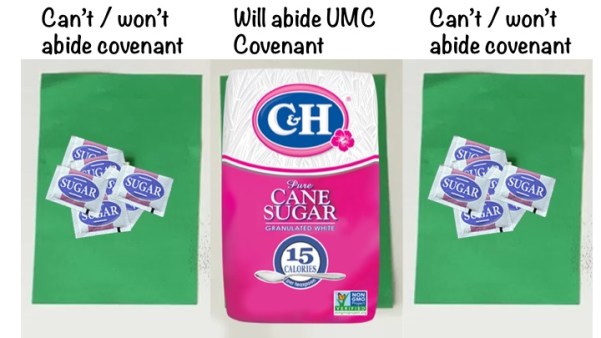
“Covenant” in the UMC may sound like a shibboleth for conservative / traditionalist right now. Especially given the name and emphasis of the Wesleyan Covenant Association (WCA). But note that there are sugar packets on both sides here.

This is where some “conservative / traditionalist” repentance is in order. I offer this as someone who tends to identify more closely with the UMC’s “conservative” crowd. I hosted Bill Arnold’s guest post about the initial WCA meeting. I teach and affirm the UMC’s current positions on human sexuality. So I offer this critique of the UMC’s more conservative wing from the inside:

  1. Traditionalists have gotten serious about human sexuality far too late, and still leave some question about whether we’re concerned about human sexuality or only gay sex.[1] Many of our churches have allowed unmarried, sexually active heterosexuals to become members, leaders and staff members while denying the same to sexually active homosexuals, or in some cases, even celibate homosexuals![2] This reveals an incomplete and incoherent (or merely homophobic) theology of human sexuality. We must develop and practice a more robust theology of human sexuality.
  2. We have gotten serious about covenant far too late, and in an incomplete way. Some progressives have asked me why covenant-keeping has become so important to conservatives now, when they’ve never seen outrage about our several churches and pastors who practice re-baptism, “remembrance of baptism” by full immersion, or infant dedications with believer’s baptism. All of these are flagrant violations of our covenant.[3] If we’re going to get upset about flagrant covenant-breaking, it has to be about all flagrant covenant-breaking.
  3. We have suggested that traditionalists “believe the Bible” and progressives don’t. That’s unfair. I’ve been on the other side of that argument with Calvinists, believer’s baptism folks, and people who won’t ordain women. (“You let women preach? Oh, my church follows the Bible…”) We have to engage in more serious conversations about exegesis, not straw man take-downs.
  4. Some of us have withheld our apportionments as a sign of protest. That’s not the way to protest.

Our tendency is to acknowledge our “small” faults, but then to point out how much more the other side is at fault. I’ve never had a conflict move toward resolution by trying to point out that the other person was 80% of the problem. I don’t know the percentages here, but there’s enough blame to go around. No need to identify who’s more at fault.

Getting serious about covenant

With all of that, I want to suggest that it’s time for us all to repent, forgive, and get serious about our UMC covenant––all of it.

We need to offer full forgiveness to all who have broken that covenant in the past.

We need to ask which churches and pastors will find it impossible to abide our covenant going forward.

We need to offer them a gracious, graceful exit. This is not far different from what Bill Arnold and David Watson were proposing a few years ago (the A&W plan, as it was called). If you must leave, take your property and your pension with you. Some of our general boards and agencies may even find a way to continue to work in partnership with you, should you choose.

The major difference between this suggestion and the A&W plan: it’s not just about same-sex marriage. It’s about the whole covenant. Can you abide, or can you not?

Some of the most likely areas we’ll need to discuss:

      • Baptism practices. Will you need to break covenant to re-baptize someone, to perform an infant dedication, or to recommend believers’ baptism?[4]
      • United Methodist doctrine. Contrary to popular opinion, we have a clear set of doctrinal beliefs. Can you affirm and teach Trinitarian faith? The historical, bodily resurrection of Christ? Free grace on offer to all people (i.e. you’re not a Calvinist)? The Bible as the true rule and guide for faith and practice?[5]
      • Women in ministry. Can you support full clergy rights for women?[6]
      • Same-sex marriage. Will you need to break covenant to perform or live in a same-sex marriage?
      • Itineracy. If you vow to go wherever the Bishop may send you, can you keep that vow?
      • General Conference. Above all, you’re agreeing to live and minister according to the decisions of our General Conference.

These questions do not ask for full agreement, only obedience.

I have friends who believe we should re-think baptism, others who believe we should re-think same-sex marriage. But they’re willing to live within our current UMC covenant. I believe we need to re-think ordination and itineracy. But I’m willing to live within our current covenant.

We need dissenters who will keep dissenting, just as we needed them in the past to advocate women’s ordination until we changed our position. I’m not convinced by the alternative positions on baptism or same-sex marriage. I don’t expect ever to be. But people have historically helped the church re-think important positions by their advocacy.

If we divide (and we almost surely will), I hope we do it based on covenant, not the single issue of same-sex marriage. I hope we give a graceful exit to those who simply can’t abide the covenant. I hope we retain many people who continue to disagree and advocate for change. And I hope we then begin to take our covenant seriously––all of it.

I write about theology, ministry and the UMC, usually about twice a week. Click here to subscribe by email.

I don’t have comments here any more. If you’d like to discuss it with friends, share it with them and discuss. If you’d like to discuss it with me, send me an email. I’d love to hear from you.

[1] Some people have noted that traditionalists aren’t only now trying to maintain biblical faithfulness regarding human sexuality. They talk about an effort in the 60s and 70s to maintain faithfulness regarding premarital sex, adultery, and divorce. “We capitulated to cultural pressures” on those issues, writes one person. That’s a better historical perspective, not that traditionalists are only now getting serious about sexual ethics, but that we’ve capitulated on the rest in many places, making a firm stance against same-sex marriages appear merely homophobic, since it’s no longer paired with a firm stance on the rest.

[2] To be clear, I’m not suggesting that it would be unfaithful to our UMC covenant to admit people as members to the church, even while they’re doing something that we would call wilful sin. (I don’t advocate membership in those cases, but that’s another post for another day…) All I mean to suggest here is that if we’re willing to admit anyone “living in sin” as members, we need to be ready to admit anyone “living in sin.” No way can we exclude a gay or lesbian couple while admitting others.

[3] Several people have asked me if all of these are truly “flagrant violations of covenant.” I admit that I may have gone too far here. Re-baptism is a clear flagrant violation (including by willful ignorance or by any suggestion that the first one didn’t count).

Remembrance by immersion and infant dedication are more gray area. This article from Discipleship Ministries and the sources it cites are probably most helpful regarding infant dedication. If not 100% inappropriate, it’s at least a significant deviation from our sacramental theology (baptism as an act of God; dedication as a human action). For remembrance, This Holy Mystery states, “water may be used symbolically in ways that cannot be interpreted as baptism.” That makes it hard for me to see immersion qualifying. Usually a smaller amount of water is used and it’s not administered by another person. If it looks like a duck, swims like a duck… Many of these “remembrances” seem to me a clever way of getting around our baptismal theology. But this, too, is not black and white.

[4] Why the heavy emphasis on baptism? “That’s not what’s causing our divisions,” some say. But if we say that infidelity to covenant is causing our divisions, then this is a prominent area of covenant infidelity in some areas, and it must be resolved. (Also, some value our sacramental theology as much as our theology of sexuality. We have not come lightly to our positions on the sacraments.)

[5] Several people have suggested that the primary cause of our divide is theological. First, I don’t believe we have one divide, but many. Theology is certainly a cause of division, though I’d caution us not to think of that divide in simplistic “left” and “right” categories. We have many people across the spectrum (and with varying beliefs about same-sex marriage) who can say the full Nicene Creed and mean it. And we have people across the spectrum who cannot. If we attempt to solve our divisions by means of sifting out the heterodox (something that fidelity to covenant does), we will not be chopping off a “liberal” or “conservative” wing or resolving our controversy over same-sex marriage.

[6] For any who think this addition unnecessary, here’s a comment to me from a United Methodist woman: “[O]ne of the things I was worried about before the WCA was that the conservative voices in the UMC particularly here in KY would begin to question women clergy (among other things). Let’s be honest many many [of our] UMCs do not totally support women clergy and in fact if we shine a light bright enough, we find several UMC pastors and maybe even DSs that do not as well. I have also seen and been privy to conversations surrounding Communion as a Sacrament, One Baptism and Calvinistic language among lay persons in leadership and clergy whose primary background is in another denomination. Seriously, we have many Bapti-Methodist churches in [our state] and the SEJ that ignore important aspects of our doctrine and polity as egregiously as those progressive whom they criticize. As I have heard and seen WCA emerge, I’ve been pleased to see that Orthodoxy, Wesleyan theology, and abiding by the BOD in all regards is the focus.” For the record: I don’t know of any DSs who don’t support women clergy, but I found this woman’s testimony helpful for anyone who believes we’re past these concerns.