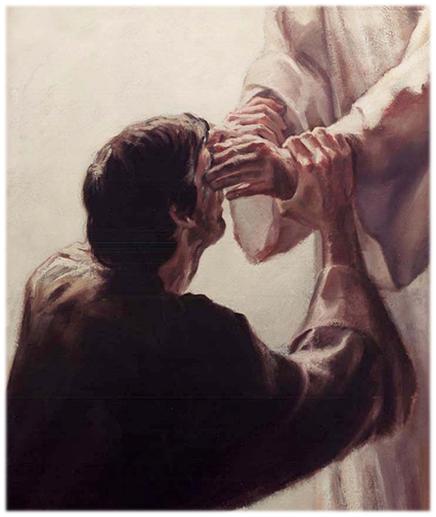
In John’s gospel, Jesus and his disciples see a man blind from birth, and the disciples ask, “Rabbi, who sinned, this man or his parents, that he was born blind?”[1. John 9:2, NIV]
Of all the questions the disciples ask Jesus, this is the one we’re least likely to ask today. We know that every physical malady doesn’t result from a spiritual problem. That’s a good thing. Can you imagine having a physical disability in a world that assumes it’s a result of sin?
In our modern world, we rarely attribute physical illness to spiritual causes. But many people still see mental disorders in these terms. The reaction to depression or an eating disorder can be close to the disciples’ question: “Who sinned?” People struggling with these issues will commonly feel ashamed. They’ll blame and cast judgment on themselves, as if they have done something wrong. And others’ comments to them might only reinforce that.
In my previous article on mental health and personality, I had that perspective in mind. I was reacting against a sort of pre-modern approach to mental health that disregards the physical things happening in someone’s mind and body. Several of your responses confirmed that you’ve heard this approach to mental health or had it yourself, and it caused ample pain and hardship.
But I committed a common modern era in my attempt to fight a pre-modern mentality. I ignored the spiritual battle entirely. I placed a glass ceiling over our world, denying God any role.
I made reference to God as healer in my previous post. I mentioned a prayer for healing if my son breaks his leg. But that comment was as glib as I’m sure it sounded. Do I really believe God may miraculously heal that leg? Only just barely. I call Jesus the Great Physician with my lips, but when it comes to physical maladies, I place much more trust in the physician down the road. God,I do believe; help me overcome my unbelief!
So allow me to offer this corrective: the spiritual battle is constant. When we’re weakened in one area, that battle surely intensifies. What better time for our adversary to tell us lies than when we’re too physically, mentally or emotionally weak to refute them? We need extra spiritual protection and provision during those times.
Furthermore, even the physical battle is God’s. He can and does heal. Do we believe it?
To be clear, I’m not retracting anything I said in the previous post. Please seek professional help if you might have a mental health problem. Please don’t attribute a character problem to yourself or others if the real issue is mental health, and don’t assume that you just don’t have enough faith.
But that previous post was terribly incomplete. I should have urged you to seek a spiritual solution while you seek a physical remedy. I should have told you that pastoral counseling and care may be a crucial complement to psychological treatment. I should have encouraged more discernment about where you seek help. Some psychologists operate under a philosophy that stands in direct contradiction to Christian faith and values. Consider asking your pastor for a good reference.
I’ll close by sharing some beautiful words from a reader who captures all the sides of this with a theological depth that I lacked:
I think mental health is one of those tensions between living in the “already, but not yet.” We want to live in a world where all is right. Yet, until Christ comes, we won’t. So, even in matters of mental health, we continue pursuing redemption and restoration, knowing that it is certainly possible in the here and now, but also knowing that we may have to continue living with remnants until Christ returns in final victory. […]
I would like to see a study on the effectiveness of spiritual disciplines in eliminating undesired behavior or restoring functioning and reducing mood disturbances. My personal experience tells me that they’d be effective.
Special thanks to Julia, who graciously showed me the problem with my original post.
** Note: I’m not a trained mental health professional. I felt compelled to write this because of what I’ve seen from a pastoral perspective. I write only from that perspective. Mental health professionals, if you see anything here that you believe should be said differently, please let me know.
Over the years, I’ve talked to several people who suffer from things like depression, excessive anxiety, or eating disorders. For many, those struggles have been a challenge to their faith, or a barrier to faith in the first place. For others, faith has been the only thing that seemed to carry them through the most difficult times.
In many cases, Christians have unintentionally made things worse for the people going through these things. We’ve too often rushed to judgment, given poor advice, or reeled off mantras about God being all we need and never giving us more than we can handle.
I’d like to share some brief words of encouragement for you who suffer with any issues similar to these. I’d also like to give a few suggestions to others about how we can respond well to anyone going through one of these issues.
To those who struggle
If you’re having trouble carrying on with everyday life because of intense and sustained emotions or because of an anxiety or fear that seems paralyzing, you may be dealing with a mental disorder. These moods might result from something like major depressive disorder (aka, clinical depression), bipolar disorder, or an anxiety disorder.
Of course, other causes could exist, too. You may be depressed because you’ve just gone through a stressful life event, or a medication or physical health problem has thrown you into a depression. Something as simple as a lack of sleep could be impacting your mood and mental abilities. If any of these are the case, you may not be dealing with a mental disorder, but your mental health still isn’t good.
If you’re showing signs of an eating disorder––not eating, barely eating, binge eating, vomiting or laxative abuse, or other things that suggest intense and unnatural emotions about food––you also may be dealing with a mental disorder.
Many of us recoil at the suggestion that we could have a mental health problem. It’s a blow to our pride different from most others. It feels more personal. It can make us feel like something is wrong and abnormal about us. But mental disorders are more common than most of us realize. In 2000, the World Health Organization estimated that 48.6% of Americans will experience a mental disorder in their lifetime.[1. See this PDF for the full research paper: http://www.ncbi.nlm.nih.gov/pmc/articles/PMC2560724/pdf/10885160.pdf%5D
Personality = disposition + mental health + character
This is important for us to consider here for two reasons.
First, if you have a mental disorder, it does not say something about your character. I’m worried that well-meaning people do harm when they misunderstand this. They expect you to snap out of it, change your attitude, or exercise more self-control. Their words suggest that something is wrong with your character, that you simply need to do better. The person who may provide the most critique is yourself, with heaps of shame and self-blame. Christians may be especially hard on you because they tell you that a Christian should be joyful, not depressed; reliant on God, not anxious; self-controlled about how you eat and not preoccupied with your appearance. They’re treating a health problem as a character problem, and it’s not fair.
I say that because I’ve seen several Christians treat people this way. I’ve also seen several Christians offer generous amounts of grace and concern and care for people struggling with these things. I hope that’s what you’ve experienced.
Second, if you have any problem with your mental health, it’s affecting your personality. It’s distorting your wonderful, God-given disposition, and it needs to be addressed.
If something like a physical health problem, a lack of sleep, or a stressful event has affected your mental health, perhaps an easy remedy exists. Maybe you need to go to bed an hour earlier for a week. Or maybe you just need to make it through a bad illness. But if the quick and easy remedies aren’t working or aren’t identifiable, I hope you’ll consider the advice below.
I would urge you to seek help from a mental health professional. Find a way to have an appointment with a psychiatrist, a clinical psychologist, or a clinical social worker.
I’ve seen several people reject these options. In the Christian world, I’ve heard people suggest that God can take care of these things––no need to get “treatment.” I agree with them. God can take care of these things. I’m sure of it. I also believe God can heal a broken leg. If my son breaks his leg, I’ll pray for a miraculous healing, but I’ll also be quick to the hospital.
While few people deny that they have a broken leg or refuse to seek treatment for it, I’ve encountered a number of people who deny their mental health problems or refuse treatment. Some of the saddest conversations I had as a pastor were the second, third, and fourth times I told someone I thought they needed to seek psychiatric or psychological help but they dismissed it––often acting astonished that I would suggest such a thing.
If more than one person has suggested that you may have a mental health problem, I urge you to take that seriously. Set up at least one appointment. Maybe that appointment will confirm for you that the others were wrong. Maybe it will be the beginning of getting the help you need. The people asking you to seek help have nothing to gain by sharing with you what they believe is a hard truth.
What are you seeking with treatment? We hope and pray for a cure––for the problem to be expunged. That’s often realistic, but we should also recognize that some of these issues may be like a chronic illness. They may always be with you. If so, the goal is to find a way to manage them, to live in health, even though you may live with the specter of illness hanging over you.
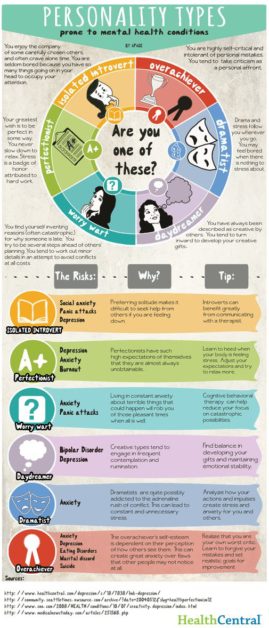
One other note about disposition and mental health: certain dispositions may be more prone to various mental health conditions. See at right the interesting infographic from HealthCentral.
A summary word to you –– can a good Christian be depressed? Or excessively anxious? Or have an eating disorder? Absolutely! These conditions may be no more a reflection of your character than if you had a broken leg or the flu or arthritis. But just as you would want to seek treatment for those issues––to seek a cure or a way to manage them well––you need to seek help for your mental health, as well. Without it, a mental disorder may be terribly distorting the beautiful disposition God has given you.
Three quick suggestions for all of us
If someone you know may be struggling with a mental disorder:
1 – Be careful and slow to make judgments about that person’s character. To treat them as if they need to shape up, have a change of mind, or make better choices is unfair and has more potential to make things worse than better.
To assume that the person just needs to accept God’s grace in changing/healing them isn’t entirely false. God may do that. But are you willing to say the same to someone with a broken bone or a chronic illness?
2 – It would be kind to try to help the person recognize their problem and get help. You walk a fine line when you do this. It won’t be helpful to go around telling people they have mental health conditions when they don’t. And that sort of suggestion will need to come with an abundance of tact and grace. Before you have a conversation like this, you should do some of your own research, consider what you should and shouldn’t say, and pray. When you talk to the person, you’ll need to give some appropriate disclaimers: “I’m not an expert in these things, and I might be wrong about this… but I care enough about you to share what I’m seeing and to ask you to consider a first appointment.” If you know that money could be an issue, you might offer to help cover any cost, or come with information about some low-cost options.
Pastors, this applies to us, too. Unless we’re trained mental health professionals, some of these issues cross a line beyond what pastoral counseling can and should handle. When we sense that line is being crossed, we need to refer.
3 – If you’re going to talk about someone’s potential problem, talk to the person, a mental health professional (to help you better assess things and properly approach them), or one of very few select people who may be better to talk to them. By very few, I mean perhaps the person’s spouse, other member of their nuclear family, or their pastor. If you don’t think the person is (a) willing, and (b) in a more suitable position than you to have this conversation, they don’t qualify here.
If you’re talking to anyone else about it––trying to “see if other people are seeing the same thing,” or “so they know how to pray”––knock it off! You’re not helping; you’re gossiping. Whatever is needed right now, it’s not that.
All of this only scratches the surface, but I hope it helps. I can only treat these things in general terms here. For any specific issue you’re considering, contact a professional near you or your pastor. Or I’d welcome an e-mail.
I’ve talked with several people who were turned off to Christianity because Christians seem fake to them. In the cases I’m considering, they think our faith tells them to change their personality. To them, there’s a particular personality type that Christianity prescribes, and they don’t think it fits them.
What most of these people seem to be looking at is a “shiny happy people” sort of Christianity. They see a classic Christian personality type—the meek and mild lover of puppies and rainbows who’s just outgoing enough to welcome new visitors at church services—and it seems fake to them, inauthentic about life with an insincere smile as cover.
Maybe you’ve seen a different sort of personality type expectation. Perhaps the gregarious, fun-loving, charismatic type. Or the introspective, solemn type who spends most of her time fasting, praying, or reading Scripture.
Other people––those who have struggled with issues like clinical depression or anxiety or eating disorders––have been told that there’s no place for those things in the life of a Christian. Christians have too much cause for joy to be depressed, too much hope to be anxious, too much self-control and self-esteem to be bulimic. They must not have real faith if they’re still dealing with these issues. Whatever part of their personality is causing these issues needs to change.
As a pastor, I’ve seen “personality” misused a lot––as the cause for conflicts, the reason to deny people certain roles, even the reason to tell some people they’re not suited for ordination. In most of these situations, attributing things to personality isn’t helpful. Sometimes it’s too broad; other times it’s the wrong category entirely.
Does God want to change your personality? Yes… and no.
What constitutes your personality?
I’m going to define personality here with three components.[1. The field of personality theory has seen plenty of research. I’m trying to offer a simple structure here to examine the issues I’m seeing most often. If you’ve studied a lot of psychology or psychiatry, I’d welcome your input.]
Personality = Disposition + Character + Mental health
Each of these components plays an important role, but the roles they play are different. In the times when we’ve done the most damage to ourselves and others, we’ve misunderstood these components or failed to differentiate between them.
Over the next few posts, I’m going to define what I mean by disposition, character, and mental health, suggest how we should understand each of them in light of our faith, and show the problems we cause when we misunderstand their roles.
Your Disposition
In the beginning, God created mankind in his own image, in the image of God he created them. No doubt, the effects of sin have seriously distorted that image of God. We’ll get more into that in the next two posts. But even after sin entered the world, God tells Noah that mankind has been made in the image of God (Genesis 9:6). Sin has distorted, not erased, the image of God in us.
At its root, your personality includes several inherent, God-given qualities—qualities that reflect the image of God in you. This is what I’m referring to as your disposition.
Maybe you’re naturally wired to take care of people or serve as the loyal guardian of an institution. You’re dependable, dutiful, and hard-working.
Or maybe you’re a natural creative type—spontaneous and inventive. You get restless when tasks are mundane and when life gets too routine.
Perhaps you’re more of a thinker—an analyst and planner whose head is often in the clouds.
Or you’re best described as an idealist. You’re naturally enthusiastic. You long for meaningful, authentic relationships.[2. These are broad descriptions of the four temperaments defined by David Keirsey. I’ve found them generally helpful. See more at http://www.keirsey.com/]
At least one of these probably sounds like you. A lot of us would aspire to be defined by all of these descriptions, but it’s doubtful that all four fit any of us equally. Of course, there’s much more to say about your disposition. These are just some generalizations.
The point: you have a natural disposition of some sort. Your environment has shaped that some, but there’s a lot that was inborn. Spend some time watching a room full of toddlers—even siblings who have grown up in the same home environment—and you’ll see a wealth of different dispositions already on display.
In this model, what I’m calling your disposition serves as the foundation of your personality. Those other two components—character and mental health—serve to amplify or distort. But regardless of good character or bad, mental health or mental disorder, you still have that same underlying disposition.
How to understand dispositions and our faith
Does God want to change your disposition? No![3. To qualify this just a bit: God can change your disposition. And perhaps this has even happened in the past. But I think it’s the rare exception to the rule.]
If dispositions reflect God-given qualities, then we embrace and celebrate them in all their diverse forms.
I love the way Paul uses the human body as a metaphor for the church in Scripture. Is the whole body an ear? Or an eye? Or a hand? Of course not! None of us can represent the whole. We’re each only a part, and those parts look different.
We see this even in creation. God creates mankind in his image, not an individual. “In the image of God he created them; male and female he created them” (Genesis 1:27). From the beginning, we see that none of us alone can fully reflect the image of God. We make a mistake when we try to squeeze everyone into our same mold of “Christian disposition.” In the process, we tell them that some of those God-given personality traits need to change.
Consider the apostle Paul. He was bold and assertive, feisty and determined. Some people might have described him as headstrong. Meek and mild aren’t the first words we think of with Paul. And he appears to have been wired this way before his conversion, too. Paul’s conversion didn’t change his disposition; it changed his allegiance and his character.
Problems when we misunderstand disposition
We must understand that disposition and character are different. With his bold and assertive disposition, I can imagine Paul was called arrogant a time or two. But you can be naturally assertive without being arrogant.
Other dispositions have had similar problems. The quiet thinker can be deemed standoffish and unkind, the gregarious socialite deemed frivolous and superficial.
Sadly, our world is often quick to look at people’s dispositions and pass character judgments. This is sometimes caused by jealousy, other times by ignorance. Regardless, Christians should strive to do better. We should embrace each quirky disposition as it is, celebrate their differences, and be slow to attribute character flaws to people who may just have different dispositions.
We also should be careful with ourselves––careful not to use our dispositions to excuse things that need to change. Just as the assertive person can be falsely accused of arrogance, the arrogant person can excuse himself too easily by saying it’s just disposition. I’ve heard anger excused this way often: “I just have a short fuse. I was born that way.”
We should recognize, too, that our different dispositions may lend themselves to certain character issues, even perhaps certain mental health problems. More on these in upcoming posts.
For now, take this with you: God doesn’t want to change your disposition. He created you with it, and he loves it. If we’ll allow it, some of the beauty of God’s people––the body of Christ––is all of the great diversity found within.
Did you enjoy this? Click here to receive new posts in your inbox.

 In John’s gospel, Jesus and his disciples see a man blind from birth, and the disciples ask, “Rabbi, who sinned, this man or his parents, that he was born blind?”[1. John 9:2, NIV]