
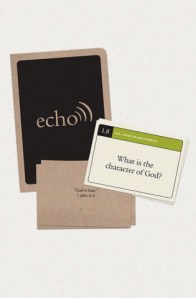
 Last year, we preached through the Echo catechism over the course of 31 weeks in my faith community. That may sound like a long series for some, but we broke it down into six shorter series, the way that the catechism is broken down.
I got more pastoral opportunities out of this sermon series than I have ever had. And that should be no surprise. It was theological bread and butter every week. If we only had 31 weeks to lay out the most important elements of Christian faith, what would we choose? That means no messing around! It also means a deliberate walk through systematic theology in the order that it was classically presented.
Take a look and see what you think. If you’re interested, I’d be happy to talk more.
If you had 31 weeks to lay out the most important points of the Christian faith, what would you preach? Any changes you would make to this list?
Who is God?
1 – God is spirit.
2 – The attributes of God: omnipresence, wisdom, omnipotence, eternity.
3 – The nature of God — God is holy. God is love.
4 – There is no God but one.
5 – The triunity of God – our most distinctive and fundamental doctrine.
Creation and Sin
1 – God as Creator and sustainer of all things that exist.
2 – Created in the image of God (pt. I): righteous and holy.
3 – In the image of God (pt. II): rulers over every living creature.
4 – What is sin?
5 – Original Sin
Salvation
1 – Incarnation – God’s love and Christ’s humiliation
2 – Christ the King – exaltation and intercession on our behalf
3 – Repentance
4 – Salvation by Faith
5 – Justification
6 – Regeneration
7 – Adoption & Assurance
8 – Sanctification
9 – Alertness & Falling from Grace
The Church & Means of Grace
1 – What we mean when we say “Church”
2 – The office and work of ministry
3 – Baptism
4 – The Lord’s Supper
5 – The Word of God
6 – Prayer
The Law of God
1 – “Love the Lord”
2 – “Love your neighbor”
3 – Law & Grace
Death, Judgment & Eternity
1 – Death
2 – Judgment
3 – Eternity
Some more resources and articles on the catechism:
Why the United Methodist Church Needs a Catechism (on Asbury Seedbed)
Do Catechisms Create Parrots?
How Sunday School created a theologically illiterate American Church
Why we’re teaching our kids a catechism
 Discipleship is often treated today as an end in itself. And to a certain extent, I’ll agree with that. When we worship, pray, study Scripture, fast, do works of mercy and works of piety, etc., these activities are the point. They’re means of God’s grace and ways we honor God, so we do them.
 teddy ray