The Pastor Salary Fallacy

preach for food

preach for foodMany people promote a common half-truth about pastors’ salaries, and it needs to end.

I just heard it again last week. “Hey, I only make $50,000.” Well, that was true. Technically.

What it neglected was the $20,000 housing allowance this pastor receives. And the $4,000 utilities allowance.

The truth about pastoral compensation

Pastors’ compensation packages are arranged differently than most. Whereas almost everyone else in America is responsible for paying for their own housing and utilities, these expenses are usually covered for pastors. We usually receive either a parsonage (a house provided by the church) or a housing allowance that covers the cost of our mortgage, along with any furnishings, maintenance, and renovation. And then the church pays for our utilities. This will often include the cost for lawn care, and probably some other things I’m forgetting.

One other benefit: Housing and utilities allowance are exempt from federal income tax. And pastors still get to claim a deduction for the mortgage interest they pay. It’s a double dip, and I have no idea why the IRS allows it, but they do.

Those in parsonages will tell you that they get a bum deal sometimes. They get a house that’s far from ideal and poorly maintained. This is a reality for many, and a genuine concern. Church – if you provide a parsonage for your pastor that you would never consider living in, you need to do something. Then again, you’d be surprised at the quality of some other parsonages. I’ve seen them valued up to $600,000 (in an area where median is $158k).

In all, here’s what this means: The pastor I reference above who only makes $50,000 actually receives $74,000. And $24,000 of that isn’t subject to income tax. Which makes his relative compensation – when compared with people in other professions – roughly $88,000.**

Yes, the IRS allows this – although I expect that to be challenged sometime in the next few decades. But let’s stop telling half-truths about pastors’ salaries.

Pastors, please don’t tell people, “I [only] make $XX,XXX,” and leave out that all costs associated with your housing are taken care of on the side. The people you’re talking to have to use their salaries to pay for their rent/mortgage, their utilities, their home maintenance, their lawn care, their cable bill…

As I read over this, I know it could be taken in a bitter or antagonistic tone. That’s not my intention. I receive a housing allowance and utilities allowance, too. I’m just imploring us to be more honest when we talk and think about our compensation. The lowest compensation package for a United Methodist elder in Kentucky (where median household income is $42,000) is just shy of $60,000. As compensation goes, none of us have anything to complain about.

Thinking theologically about pastoral compensation

My greater hope is that we would stop thinking about pastoral compensation in the business-world pragmatic sense and start thinking theologically about compensation in the church. See this earlier piece: “Pastors’ Salaries and Church Buildings.”

The pragmatists will say we can’t do it or we’ll lose our most talented people. There are a number of problems with that, which I might try to address another time.

For now, I would venture this with the pragmatists in my Methodist tradition. When we look at the relative compensation of our pastors and the numerical growth of Methodism, I bet you’ll find the greatest growth in the times and places where relative compensation was the lowest. And I bet there’s a pretty surprising negative correlation (i.e. one number goes up while the other goes down) between those two numbers over the last 200 years. I’d love to run some numbers on this, but I feel pretty confident about it based on what I’ve seen.

—————–

** Some more details, for those who are really interested…

Because the pastor I reference was a UMC pastor, he has a pretty nice health insurance package, for which his church pays nearly $13,000 annually. They’re also required to make an annual $11,000 pension contribution on his behalf, regardless of whether he contributes anything. Ignoring any other expense allowances or continuing ed, this is a $98,000 pay package. I point all this out just so we know the reality for this person who claimed to make “only $50,000.”

One other unusual thing that comes into play for pastors: we file as “self-employed.” Odd, isn’t it? This means the church doesn’t make FICA/SECA payments on our behalf. If the pastor in this example pays SECA taxes, this is a loss of $5,661. Adjust that comparable compensation number back down to $82,339.

But the final unusual piece: pastors can opt-out of Social Security. That’s a great economic boon to them! It’s also highly questionable, as far as I’m concerned. Anyone who opts out has to sign a statement that states,

I certify that I am conscientiously opposed to, or because of my religious principles I am opposed to, the acceptance (for services I perform as a minister, member of religious order not under a vow of poverty, or a Christian Science practitioner) of any public insurance that makes payments in the event of death, disability, old age, or retirement; or that, makes payments toward the cost of, or provides services for, medical care. (Public insurance includes insurance systems established by the Social Security Act.)

“Conscientiously opposed to […] the acceptance of any public insurance.” Hmmm… I see far more opt-outs out of economic convenience than out of troubled conscience.
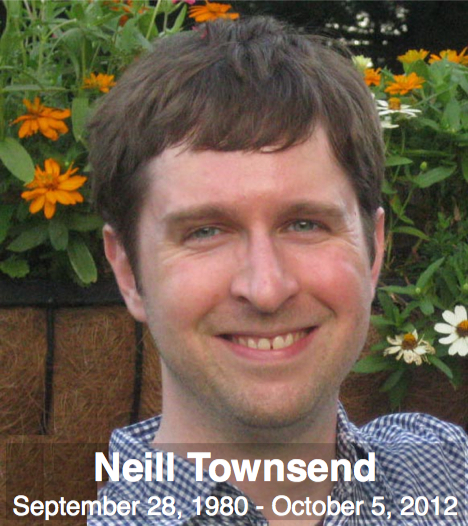
Neill Townsend – 1980-2012

neill townsend

neill townsendToday I had the honor and the dismay to preside at the funeral of Neill Townsend, an old friend. For those who knew Neill but were unable to attend the ceremony, I’m posting my sermon below, in his memory. You can also find Neill’s obituary and leave a note in his guest book here.

Neill Townsend Funeral Sermon – October 12, 2012

I met Neill when we were in preschool. He had those big glasses and that big smile. We went on to 1st and 2nd grade together, where I remember Neill already being heads and shoulders above the rest of us when it came to anything athletic. He was funny and made friends easily. And he was really smart. I can still remember him explaining to me in front of the class why I should know 7 + 5 can’t be 13.  We ended up at separate schools for a few years after 2nd grade.

I didn’t see Neill again until we were in 6th grade. The big glasses were gone, but not much else had changed. He still had that big smile, was starting for the basketball team, the quarterback for the football team, and the star of the academic team. Yes — quarterback for the football team, star of the academic team. And seemingly friends with everyone.

Again, we ended up at different schools after middle school, and I didn’t see Neill for a few years. We actually ended up re-connecting not long after his terrible car accident in high school. That was a hard time, obviously, but also one where I was impressed with how Neill carried himself through it. I still remember him at Aldersgate Camp just about a year after the accident, sharing one night about the incredible change in his life because of the people who had surrounded him and the renewed hope God had given him.

And even in that tough time, Neill still had some bravado. We went on a first date double-date together – on Valentine’s of all days! – and Neill insisted that we take roses. He walked up to the door, put the rose in his back pocket to make it a surprise, and then stepped inside where the door closed and chopped off the head of the rose! He ended up pulling out an empty stem. And yet he came back to the car smiling and shaking his head, and he dated the girl for another year. From big to small, Neill rolled with some of those punches a lot better than most of us do.

At root, it was still the same Neill. Still an excellent athlete, still incredibly smart, still a special knack for making people laugh and smile, still a loyal friend.

I hadn’t been in touch with Neill since high school, but it wasn’t surprising to hear the more recent stories as I talked with Lee, Jane, and Scott this week:

  • Stories about a workplace that saw him come in and quietly do his job, and before they knew it, he seemed to have his hands in everything. They’ve been talking about how many people they’ll need to hire to replace him now.
  • Stories about Neill asking his mom to put him on speaker phone so he can talk to the dog
  • Stories about friends that Neill had reached out to and been a steady presence in difficult times

I think Scott said it best the other day. A number of different people have been calling, writing, visiting, and sharing about Neill. Scott said some of the stories were new, but none of it was news. He said, “We just keep getting confirmation that everyone knew the Neill we knew. The same Neill we’ve known all his life.”

And though we all knew the same Neill, it’s also amazing how many different sides there seemed to be:

  • The athlete and the avid reader.
  • The person who could so easily make a crowd laugh and the person who went out of his way to give special attention to friends going through tough times.
  • The passionate sports fan and the passionate advocate for justice, all the way from Appalachia to international war crimes victims

We gather this morning to thank God for blessing us with Neill in all of his wonderful diversity.

At the same time, as much as there is to celebrate about Neill’s life, we can’t believe we’re here.

Several of us have had the same thoughts this morning as we came here. We’ve had the same thoughts throughout this week. “It just doesn’t seem real. Doesn’t seem believable that we would be preparing for Neill’s funeral.”

In the reading from John, we just heard Jesus say, “Let not your hearts be troubled,” and, “Peace I leave with you.” Now I doubt most of us could honestly say our hearts haven’t been troubled this week. It would be difficult to say we have had a real peace throughout. And that’s okay. In the Bible, we even find Jesus weeping at the tomb of his friend Lazarus.

But I’m comforted to know that even in the face of a terrible loss like this, the words of Jesus are still, “Let not your hearts be troubled… Because I live, you also will live.” This is the hope I know and rely on in times like this.

In Jesus Christ, we see the promise of life, even where the world may see only death. In Jesus, we see that God sent his only Son to walk this earth and to endure even death, so when we come to times like this, we know that God is not a distant God, unable to understand or empathize with our pain.

And in Jesus, we see a triumph over the grave and over the forces of evil. When Jesus said, “Because I live, you also will live,” he told us that death does not have the last word. And when he died and rose again, he proved that word true. This is why he says, “I am the resurrection and the life. The one who believes in me will live, even though they die; and whoever lives by believing in me will never die.”

We sang “Great is Thy Faithfulness” earlier. We heard Jesus say, “You trust God, trust also in me.” We believe that God’s compassions do not fail, that God gives strength for today and bright hope for tomorrow, that He is a faithful God.

If you come here today with deep pain, the best thing I know to do is point you to the God who says, “Comfort, comfort, my people.” If you come with sorrow and distress, I pray you find hope in Christ who says, “My peace I leave with you.” Though we mourn now and have every reason to, I trust a God who says that in time he will turn our mourning into gladness; he will give us comfort and joy instead of sorrow.

With that hope, we come now and entrust Neill to God, who can be trusted.

The most important thing in our faith…

John Meunier captures the heart of Methodism well in a recent post: “How is your heart today?”

[You should really go read the whole thing. Actually, you should just go ahead and subscribe to him. He’s on the money pretty much all of the time.]

I’ll quote his whole ending, which is particularly good:

We confuse ourselves for generic American evangelicals because we use much of the same language. But the Methodist accent often falls on different notes than the Baptist or Calvinist or non-denominational versions of the faith. Justification or “being saved” or “born again” is but the first dawning of Christianity in the soul of a person. It is important, but only as a starting point. If it is not the beginning of a new life and growing holiness of heart and life, then it loses its value. We can unmake ourselves and be unborn. The old self that dies in Christ is a vampire. It will rise again if we allow it.

For many Christians, the key question is something like “When were you saved?” For the Methodist, the key question is always “How is it with your heart?” Our “once saved, always saved” brothers and sisters often speak as if the most important thing in our faith is something that happened in the past. Methodists believe the most important thing in our faith is what we are doing today, right now.

So, I ask myself and ask you: “Do you feel the love of God in your heart?”

Did you catch that? “Methodists believe the most important thing in our faith is what we are doing today, right now.” This is about a life-long journey. The starting point (i.e. conversion) is important, but we miss the whole point if we think that’s all there is to it.

C.S. Lewis made a similar point in the conclusion to the last book in his Chronicles of Narnia series:

All their life in this world and all their adventures had only been the cover and the title page: now at last they were beginning Chapter One of the Great Story which no one on earth has read: which goes on for ever: in which every chapter is better than the one before.

Though he was attempting a [suitable] comparison between this life and the after-life, I think a similar comparison can be made between conversion and ongoing Christian life.

Note: I was gone for a good while. Sorry about that. Other life demands got the best of me. Then I tried to get back in the saddle with last week’s “What if I don’t believe the Bible?” Then new unforeseen things this week. Hopefully back more regularly next week!