
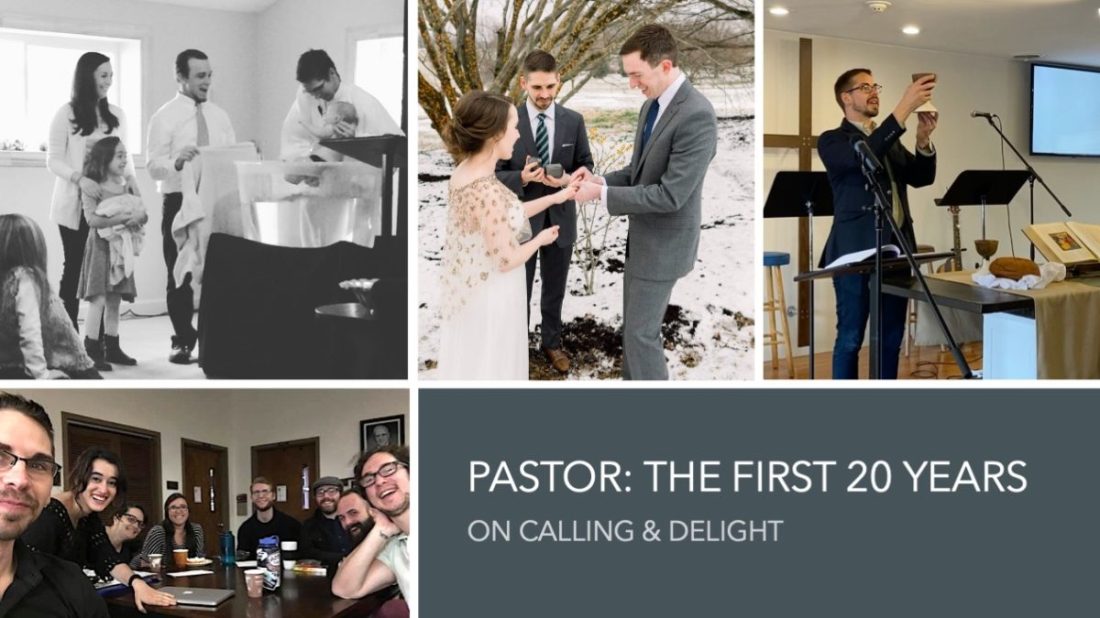
This June, I won’t be receiving reappointment to my church. It will mark the end of twenty years in pastoral ministry. I just shared the news with our church this morning. I wrote the narrative and reflection below as a way of understanding and clarifying some of the process for myself as I prepared to share with others.
A little more than a year ago, I had a restlessness I’ve never had before. I was hardly sleeping. I was more emotional than I’d ever been. Emily (my wife) saw me cry more in the first few months of 2020 than in the first twenty years of our relationship. I sat with Todd (my boss/pastor/15-years ministry partner) in a coffee shop and was barely able to hold myself together as we talked about the future. Things were actually going well. I was enjoying life and ministry as much as ever. It was an odd time to be over-emotional, especially as someone who’s rarely emotional at all. Yet I had a nagging sense that something was off.
At that point, our family was planning to go to Spain for the next year. We had already arranged for me to come back to my position at the church on the other end of that time. But part of my restlessness was a feeling that I wouldn’t or shouldn’t actually be coming back at the other end.
That was not an exciting thought to me. I’ve loved the work of ministry and particularly the church and community where I’ve gotten to lead. I’ve told people often that I didn’t expect to leave until they carried me out. So the strong emotions weren’t because of dissatisfaction about what I was doing. They were more about grief that I felt like it might be coming to an end.
That all came before the pandemic. The pandemic obviously changed our plans for Spain, but it also brought some relief––or at least distraction––from any notion that I wouldn’t continue in ministry. But sometime near the end of summer, the questions about what I was doing returned, and they only grew from there.
I’ve talked and written quite a bit about calling. I’ve done that in part to try to understand it myself. The idea of calling to a particular place or task or role is, in some ways, still a mystery to me. I said for years that I wasn’t sure I was “called” to ministry, only that the work I was doing seemed good and right, and so long as others would let me do it, I’d take it as a path God had made available.
When we came back from a sabbatical year in Spain in 2014, I thought for a moment that I wasn’t going to come back to pastoral ministry. In fact, I rather actively tried not to. That was the last time I had the kind of restlessness I experienced over this past year. Then, it was a nagging sense that I was making the wrong decision if I didn’t come back to this. Now, it has been a sense that I would be making the wrong decision if I stayed.
Maybe this is all so mysterious to me because I tend to make decisions based on reason and spreadsheets, not on feelings and senses. And yet, while most of my daily life decisions are rational and pragmatic, the biggest decisions haven’t been. Our sabbatical year, coming back into ministry in 2014, leaving it now in 2021, none of those have been rational, spreadsheet, pros and cons decisions. They all came with a sense that I needed to choose a certain direction, that to do anything else would be to choose the wrong way.
Some people speak freely and often about God’s leading as they make decisions. Though I certainly believe God leads, directs, and calls, I’m hesitant to label particular decisions this way. It has a tendency to shut down any other conversation. Once you’ve played the “God card,” no one has permission to question your decision. I don’t want to play that card in that way. And yet, God’s leading is the best way I can describe the process behind some of these big decisions. God hasn’t spoken any of these plans in a voice from the heavens, and I can’t with certainty call it something as strong as the clear will of God. But for lack of any better understanding, I’ve taken these decisions as following the leading of God. I hope that’s what it is.
The final few steps in this direction came through the fall and winter. If you read this blog regularly, you might have noticed that I began writing reflections on my first twenty years in ministry last fall. Part of my motivation was to take some extra time to reflect on calling and ministry and just how good this work is. Ministry during pandemic has been … mostly miserable. But a lot of things have been miserable during this time, and the pandemic will end. As I started to ask questions again about the future, I wanted to be sure I was doing that while reflecting on calling and the goodness of ministry, not to be misled by the temporary frustrations of pandemic-era ministry.
A fast was the last major step. At the start of 2020, I had invited several people to participate in a 10-day fast during the UMC General Conference. When the pandemic canceled the conference, I canceled the fast. In December, I decided to observe that fast as a time for prayer and discernment about the future. That time and some important conversations in the first weeks of 2021 gave me final confirmation that it was time to make a change.
The decision to leave comes with a lot of grief. Pastoral ministry has been so good. I’ve gotten to spend a lot of time with people celebrating their most important moments, grieving with them in the hardest times, and offering a word of support or direction or prayer in the times when they needed it most. I’ve gotten to spend a lot of time studying Scripture in preparation for preaching and teaching. And I’ve gotten to spend a lot of time giving other people opportunities to lead and watching them grow. What a gift to have called this my job for twenty years. Already I have some hope that maybe that sense of calling back to this work will return one day. But for now, I get the sense that it’s not my work to do anymore. At least not in this way.
What’s Next?
I’ve heard many people advise never to leave one thing until you’re drawn to the next. I think I needed something nearly the opposite. I had never given much attention to what I would do if it weren’t pastoral ministry. I never expected to do anything else as my primary focus, except perhaps to teach theology and be a pastor on the side. The sense of calling away from ministry allowed me to recognize new interests that had been growing over the past several years, ones I hadn’t even been able to recognize as such until I had some release from continuing in my current role.
I’ve had increasing chances in recent years to interact with other people working in public service across the city and state. The work they’re doing has been compelling to me. I’ve become fascinated with the law and the way it creates an ecosystem for us all to live within. I’ve seen how it can make it easier or more difficult for local businesses to start and grow, how it affects people’s ability to get and keep housing and jobs, and how it can help or hinder children from having the resources they need to thrive. By this summer, I was reading full majority and dissenting opinions that came out from the Supreme Court. Sometime around then, I began saying, “If I were ten years younger, I think I might go to law school.”
In November, as Emily and I drove back from a trip for my 40th birthday, I sat in the passenger seat taking career assessments on my phone. I had at least arrived at the point that I knew I needed to start thinking about what I would do if I weren’t in ministry much longer. Someone had said that people considering a midlife career shift should take one of these assessments, since they probably hadn’t taken one since college and were likely different people by now. Every assessment I took ranked multiple legal careers in the top ten. Again: “If I were ten years younger, I think I’d go to law school.” At some point, Emily notified me that I was not ten years younger, and I wasn’t going to be. But it might not be too late.
In December and January, I set a goal of talking to one person each day in the legal field. They ranged from private practice to government to public interest to academics. Those conversations confirmed even more my interest in the law and particularly work in government law.
I ended up applying to a small handful of law schools at the very end of January. I also met with Todd, my boss and ministry partner nearly from the start, to tell him I thought I should finish my time in ministry this June. Some jobs I think you can do while you wait to move on to something else, but I don’t believe ministry is one of those. Once you know it’s not your long-term future, it seems best to start working toward an exit. Regardless of whether any of the school applications worked out, I knew we needed to name an ending date in the church. We talked to church leadership and began preparing for transition.
About two weeks ago, I received an acceptance call from Yale. From the beginning, Yale was the dream, but I had never let myself believe it could be reality. Even a few weeks after the acceptance call, we’re still somewhat in disbelief.
In that acceptance call, the Dean said, “I know you didn’t say it in your application, but I got a sense that this involved a deep religious discernment process. I have a colleague who says, ‘The law shouldn’t just be a job, it should be a calling.’ I got a sense from reading your application that this was about calling.” Those may have been the most affirming and hopeful words I’ve heard in this process. Though I still can’t quite get a full grasp on the mystery that is calling, I believe in it. And it gives me hope that the future isn’t just our own making, but God’s guiding.
I formally accepted the Yale offer on Thursday. Our family has begun packing. There will be a lot of grief as we go. Nearly all of our lives are wrapped up in Kentucky, and a lot of my identity and greatest joys are wrapped up in ministry here at Offerings and First UMC. But we go with trust that something good is ahead, too.
Diversity Statement
Part of the law school application is a diversity statement. It’s an opportunity to provide a 1-page statement of any way you may bring diverse perspectives or backgrounds to your class and legal work. I wrote about my time in ministry. Here it is.
The first funeral I presided over was for a childhood friend. He had been hit by a truck cycling to work. His distraught mom remembered that I’d gone into ministry and called to ask if I would do the funeral. I never told her it was my first. Though I was scared and didn’t know what I was doing, as I sat with a grieving family to prepare a funeral, I was overwhelmed at the honor of being invited into their home and lives right then. It’s a rare privilege to be with people during some of their greatest times of confusion or heartache or fear. I still marvel that I get to be with so many people during those times.
Many people go into ministry because they love people and empathize well with them. I didn’t. When I started, the people close to me would have characterized me as highly rational, hardly emotional. My wife didn’t see me cry until we had been married five years. That wasn’t because I hid the emotion; I was just never overcome by it. When I started in ministry, I would have happily avoided those times sitting with families as they grieved or the times in pastoral counseling talking about the intimate parts of people’s lives, but I couldn’t. And as much as I was supposed to be helping others, those moments changed me. I saw the common pattern of shame from men who lowered their voices to a whisper in my office to tell me they were addicted to pornography. I counseled highly successful people who still sought their parents’ approval and felt like frauds. I wept with a young, new father whose wife had just died of cancer. The opportunities I’ve had to be part of others’ lives have changed me for the better, and I’m profoundly grateful for them.
I expect to see legal work differently because of my ministry work. My company was sued twice last year. Both felt like predatory lawsuits—people who knew they could force a settlement. In each case, my partners and I were afraid and confused as we sat with lawyers who calmly guided us. I recognized in those moments several similarities to the conversations I’ve been having for the past twenty years.
When I first considered going into law, I was worried I was too late. From what I’ve seen, applicants in their 30s are rare, those in their 40s almost non-existent. Though I come late, I believe these years have been invaluable preparation for me. I’ve spent nearly two decades meeting with people as they shared some of the most difficult and intimate parts of their lives. I hope that will help me bring to my class and my work a particular awareness of how people feel and behave in some of the hardest times.
———




 teddy ray