The analysis of the earthly city is cautionary, pressing Christians to recognize that cultural systems are often fundamentally dis-ordered, in need of both resistance and reordering by Christian labor in all streams of culture.
You’ll find here another angle at what I’ve been suggesting about Christians and politics. It will give you a small introduction to Augustine’s City of God, one of my Top 10 Christian Classics. If you see anything that seems to contradict what I’ve been saying, there’s a misunderstanding or miscommunication somewhere, because I wholly agree with Smith.
My recent post on capitalism has brought several questions about how Jesus would handle the political world today. I’m not sure I can identify the political world that Jesus would envision.
The libertarians say, “Surely Jesus would want everyone to make charitable decisions on their own. And more people will have more purchasing power to do more good and help more people in a more free market.”
The statists say, “Surely Jesus would want the needy cared for. And the individual wealthy clearly aren’t doing it on their own. Look at all the poor still among us and the enormous wealth inequality.”
I hear people of all different political stripes say that Jesus would agree with them politically. And they all have a decent case. But I’m not sure if Jesus would take a stand for any of our existing parties or systems.
I see a very political Jesus in Scripture in one sense, but also a very apolitical Jesus. To the secular world, his primary message seems to be “repent.” Stop oppressing people and take care of them. And also: your only real hope will be found in communion with God, not by your own strivings. We could get into skirmishes over the best economic and political systems, but I don’t think any of our secular models really work. In a fallen world, they all break down when it comes to caring for the most needy. [see “Christians, Capitalism, and Ayn Rand” for a brief take on why these all break down]
I think Jesus’ more political statements are for believers. And his call to them is to live out a different economy than our world’s, not to go advocate for a better system within the world.
To clarify my earlier suggestion: I’m suggesting that Christians give their energy to living out a Christian economy in a secular world. I think that’s our better contribution than trying to make secular world political decisions. I don’t think we need to waste much of our time affirming one economic system or another or choosing one party affiliation or another. I think we can provide a third way.
That’s not living in a bubble. It’s just engaging in a very different way. Not stepping into the back-and-forth political fray – which seems to be mostly about power – but instead creating an alternate economy.
I don’t know whether Jesus would be an advocate for big government or small government. What I do know is that among believers, “Anyone who has two shirts should share with the one who has none, and anyone who has food should do the same.” We’re not doing that yet. I think much more fruit will come from that than engaging in the secular arguments, where I’m starting to believe both sides are wrong.
Oddly, a lot of these thoughts came for me when I started reading Rand’s Atlas Shrugged and other capitalist economics. The more I read, the more I realized that these people really think our society’s great hope is unfettered capitalism, and it was all based on assumptions I disagreed with — about the point of life (some form of material prosperity and happiness), the point of society (more middle-class people with purchasing power), and the state of humanity (generally good, just needing more freedom).
I got so frustrated with those assumptions that it made me start questioning the whole system. I realized that I had wanted to make Jesus a capitalist just as much as others had wanted to make him a socialist or Republican or Democrat. And what we consistently see in Scripture is that when people ask Jesus “A or B?” he typically says something to suggest, “wrong question” or “have you considered C?”
I wonder if my questions – “Republican or Democrat?” “Capitalism or Socialism?” “Big government or Small government?” – were the wrong questions all these years. I wonder whether Jesus’ challenge back to me would be: “How come you have two shirts and your neighbor has none?” Woe be it to me if I say, “Because the wrong person got elected!”
I’ll keep my commentary brief and related to the previous post…
The video shows the health and social problems that rise with economic inequality. If we assume that we can’t fix the broader inequality, perhaps Christians and churches could look to those problem areas as primary places to get involved. How can we contribute something positive in areas of imprisonment, teenage births, obesity, mental illness and addiction…?
The video is nearly 17 minutes long. It’s worth it. Find some time and watch.
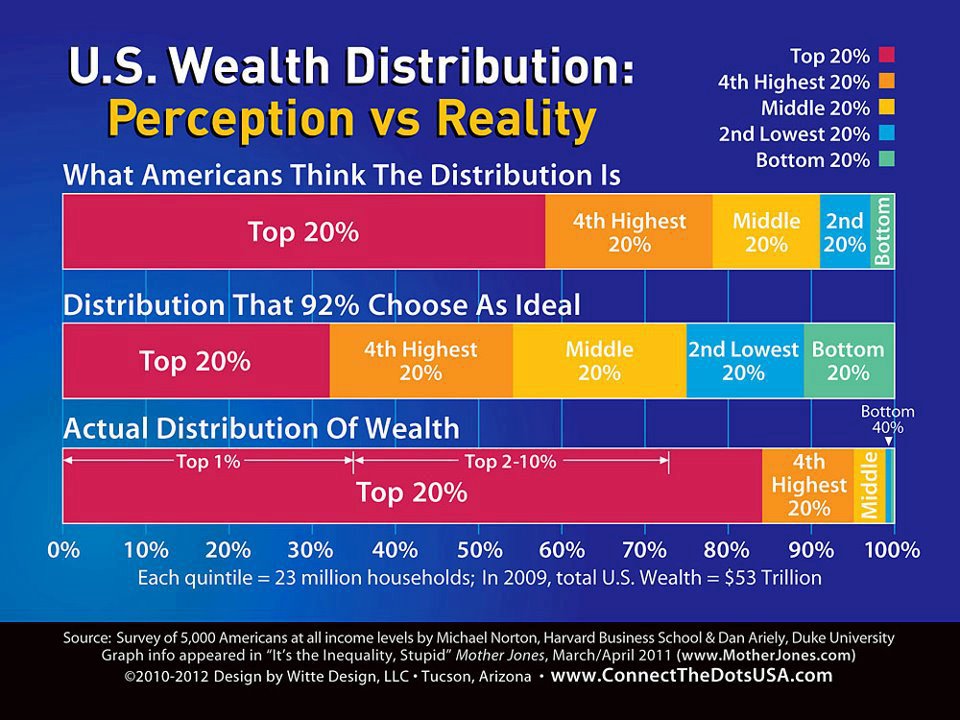
The infographic below is enlightening. It shows a marked gap between our perception and reality regarding wealth distribution. Credit to James K. A. Smith (@james_ka_smith), whose symposium I mentioned in the last post, for sharing the graphic.
This isn’t really a theological post. The last one was. This is just to stimulate some further thoughts in light of that one. What do you think?



 teddy ray
