
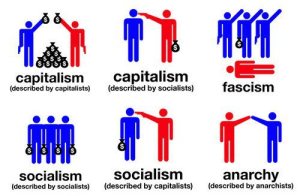
 If you pay any attention to politics, you’ve been deluged with economic talk for the past, oh, four years. We’ve seen the rise of the Tea Party, Occupy Wall Street, the return of Gordon Gekko, and polarized political views about how to fix a slumping economy. And that barely scratched the surface of what you’ll get in the next three months.
In the midst of it all, I’ve spent a lot of time wondering what is an appropriate Christian stance and response.
Capitalism and Christian Economics
Let’s look first at the ardent capitalists. Ayn Rand’s fame has soared in the past few years. People like Edward Conard are writing about how growing income inequality is a sign that our economy is working (see this long but interesting interview with him).
So far as the goal is to increase the number of middle-class people and to increase their purchasing power, I agree with nearly everything the capitalists say. I’m concerned, though, that they seriously underestimate how much people will lie, cheat, steal, and oppress because of their love of money. Rand and Conard clearly don’t believe that the love of money is the root of all evil. Actually, they might say that the love of money is the root of all human ingenuity.
Rand summed up her whole belief system for us: “My philosophy, in essence, is the concept of man as a heroic being, with his own happiness as the moral purpose of his life, with productive achievement as his noblest activity, and reason as his only absolute.”
The problem: a Christian worldview disagrees with every bit of this. Christ is the hero, who saves depraved humanity from our sinfulness. Holiness, not some secular understanding of happiness, is the moral purpose of life. Service to God is our noblest activity. And reason often fails and deceives.
I can’t get over the feeling that Rand’s (IMHO) bad theology and anthropology led her to develop a bad economic model. She built her model on the assumption that humanity is essentially good and that an individual’s own happiness is the point of life.
Christian theology and anthropology tell me that humanity is corrupt – that without regulation, people will mistreat others to satiate their own greed. Christian theology tells me that greed is at the root of all kinds of evil. Christian theology says Gordon Gekko is wrong – greed is terribly harmful to individuals and society.
I’m not a Socialist
So now you’re thinking I must be a socialist. Or at least a Democrat. I’m not. I’m not going to belabor the point here, but lest all the conservatives begin assuming I’m just another flaming liberal, I’ll admit that I don’t remember the last time I voted for a Democrat.
Governments are run by depraved people, and they’re equally likely to lie, cheat, steal, and oppress. We’ve seen that when we give government more power, they don’t use it all to fight for the little guy. They use a lot of it to pick their own special interests and protect their own power. In a fallen world, socialism is just as flawed as capitalism.
Regardless if your system is capitalist or socialist, it concentrates a lot of power in the hands of the few. That power will rarely be used in the interest of the person without power, status, or wealth. Whether they be at the top of a government bureaucracy or a big business, people love money and power and will fight for more of it.
Chilling for the capitalists is the suggestion that because of that concentration of power, capitalism will lead to socialism.
In the end, I struggle to know what to believe about politics. I think the capitalists’ philosophy only works if humanity is inherently good – or if the goal is creating more middle-class people, often at the expense of the poorest. If humanity were inherently good, socialism would work just fine for those purposes, too.
A Christian Economic View
As economics go, I think Christians should seek to embody an economic culture that reflects new creation — not counting our possessions as our own, selling property and sharing as anyone has need, having no needy persons among us. That’s very different from the goal of creating more middle-class people with more purchasing power, or from forcibly taking from those with more to give to those with less. No policy can accomplish it.
Are Christians today more focused on fixing the secular economy than living out a Christian economy? In a secular world, greed and extravagance will always prevent a new creation economy, regardless of legislation. Someone will always be scammed, oppressed, left on the outside.
Regardless of where we find ourselves in the world — capitalist, socialist, distributist – I wish Christians would give their energy to taking care of the people who got left out of the system. Our culture has been so immersed in the Tea Party-Occupy world of pragmatic, secular economics that I’m worried Christians are forgetting that our economics start from a different place.
If you have the time to read it, the brilliant theologian Jamie Smith participated in a symposium with a Christian economist that is a great depiction of the problem that economists and theologians are having even trying to have a discussion. I think we’re starting with such different sets of “givens” and assumptions that it’s hard to even understand each other in a conversation. Smith’s opening article is great. If you read the whole thing, you’ll see just how much they’re talking directly past each other because of different starting points.
You should also read…
- Jesus and Politics – a further take on the relationship between Christianity and politics
- Economic Inequality and Societies – a follow-up post with thought-provoking video and infographic
- The Church as Alternate Economy – how I believe the Church is called to embody an alternate economy


 for a starter or Alexander Schmemann’s
  for some real depth (affiliate links). Those will both be great references for the preaching series suggested below.
 teddy ray