Priorities for organizing a weekly schedule [Pastoral Letters]

In July, I’ll be returning from a sabbatical year to be the lead pastor of the Offerings Community at First UMC in Lexington. I’m sharing some pastoral letters with them in advance of that return. Though some notes here are specific to that congregation, the letters are a broad attempt to share a pastoral theology.
Credit for original photo to www.planetofsuccess.com/blog/
Credit for original photo to http://www.planetofsuccess.com/blog/


In two years’ time, the lead pastor position in Offerings has moved from 1/4-time to 3/4-time. I’m thrilled about this and what it can mean for our community.

I’ve thought and prayed a lot about how we need to use this position most faithfully. What does our community need most from the lead pastor? And what are the best contributions I can make?

How we spend our time says a lot about our values, so I’m sharing this as a way of showing you my values. I also think it’s important for you to know what I’m doing with the time you’ve given me.

Though no single week will look exactly like this, here’s a general sketch of how I plan to spend my time:

1 – Preaching and Writing
In my first letter, I said the gospel is the primary thing that motivates everything I do in ministry. I think preaching and writing are our best broad opportunities to proclaim the gospel.

Several people have told me they think one of the greatest strengths of Offerings is faithful preaching. We need to continue that. I want to invest the time to do it well.

I love that we have a preaching team. It gives us a chance to hear a number of voices and perspectives. So my “preaching and writing” time will also include working with our other preachers––helping each other refine and improve our preaching.

I’ve also discovered what a great pastoral opportunity writing is. It affords a reach beyond what Sunday morning allows. It can focus on issues that wouldn’t be appropriate preaching topics, allows people to read in their own time, and can be passed on to other people.

In all, I plan to spend about 15 hours per week on preaching and writing. My best preaching requires about 15 hours of preparation—roughly what I’ve seen other preachers recommend. When I prepare less, it’s noticeable. For the weeks I’m not preaching, I’ll devote the extra time to writing and to working with our other preachers.

2 – Pastoral Visitation
Pastoral visitation is my best opportunity for deep connections. In that first letter, I also told you that I believe in you. Visiting with people is one of my best chances to invest in all of you.

I’m planning to meet individually with all of our leaders several times per year in addition to leadership team meetings. I also hope to visit each of you—as an individual or a family—once per year, preferably in your home. This category also includes visiting new guests, pastoral counseling, door-to-door visits in our neighborhood, and special need visits (people in the hospital, new babies, etc.)

Investments in these relationships are the best extension of myself—the best way to encourage and equip our leaders, and the best ways to make sure people are receiving good pastoral care and to encourage them to take next steps in discipleship. In all, I hope to spend about ten hours per week in various forms of visitation with people and leadership teams.

3 – Administration 
Again, in that first letter, I said I believed in the church—and specifically in First UMC. Because of that, I’ll make a priority for First UMC administrative, staff, and pastoral meetings. It’s important for Offerings to be well-represented in those meetings and well-connected to the larger church. And it’s important for us to make a good contribution to the big church’s direction.

We also have plenty of administrative needs for Offerings. I’ve loved being able to count on a weekly email this past year and plan to continue those, along with any other things we need to do to ensure good communication. Faithfulness in small things—quick responses to calls and emails and taking care of any paperwork—help keep everything moving smoothly. I want to take care of those well.

As we explore moving into a new location, the details associated with that will take a lot of extra attention to administrative details. In all, I expect our administrative needs to require about ten hours on most weeks, and probably more than that at first.

4 – Connecting with area leaders (especially other church and nonprofit leaders), reading and research  
I plan to keep regular calendar space for meeting with area leaders. That’s an important investment in our community’s relationships to other churches and agencies. I also plan to set aside regular time for reading and research (you can always see what I’m reading on the right sidebar of my blog).

These are the extremely important but not at all urgent. No one will require them of me or immediately notice whether they’re happening or not. It’s a lot like exercise. If I skimp on it for a few weeks or months, people probably won’t notice a difference. But the results in a few years’ time will be drastically different.

For my effectiveness as a preacher, leader, and pastor, there will be major dividends or major holes in the years to come based on whether I’m diligent about these things. I think it’s crucial that I carve out and protect regular time for them.

I hope to spend about six hours per week on this networking and continuing education. I also know, though, that these will be the first things to go when administrative and pastoral demands require more time. Because of that, I’ll be diligent about carving out and protecting regular time for these on my calendar and only back off them when another need is exceptionally important and urgent.

Modeling with my schedule
We’ve talked a lot in Offerings about our pastors’ lives reflecting our values. I think it’s important for me to do that with my schedule. Two specific ways that I’m trying to model important values with my schedule:

1 – I try to limit myself to 45 hours each week except for in rare emergencies—emergency to be read as the kind of thing that happens once or twice a year, not every other week. At my family’s current stage, I don’t think I can stay healthy (physically, spiritually, and emotionally) and take care of my family if I exceed that time.

There are always more things to be done. I would love to devote 30 hours per week to each item listed above. I want to do my best to name the most important things and always take care of them, but some things will inevitably go un-done. I’ll ask for your grace and help in those things.

I’ve seen a lot of people—pastors and other professionals—disregard health and family because there’s always more to do at work. I don’t want you to be one of those people, and I want to model a healthier way with my schedule.

2 – I don’t count my Sunday morning time or my time in a catechesis group, or things like personal devotional time, as “work time.” Those are things I expect all of us to do outside our jobs. I count them as something I do because I’m a Christian and part of the community, not because I’m on payroll.

I hope this helps. I think it’s important for you to know what I’m doing with the time you give me. And thank you for giving me the time to do these things!

Did you enjoy this? Don’t miss the next post. Sign up to receive free updates.
How the Church Grows (pt. II) [Pastoral Letters]

In July, I’ll be returning from a sabbatical year to be the lead pastor of the Offerings Community at First UMC in Lexington, KY. I’m sharing some pastoral letters with them in advance of that return. Though some notes here are specific to that congregation, the letters are a broad attempt to share a pastoral theology.

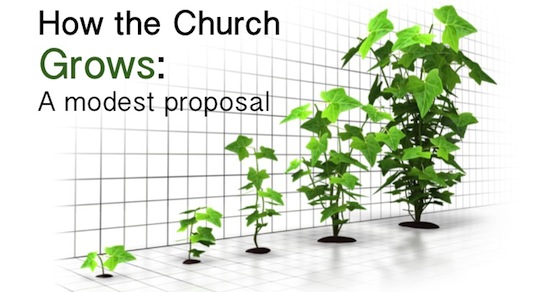
how the church grows

Last week, I shared part I of “How the church grows” (see it here). Here’s the second part…

Service

Our service is an essential part of the church’s growth. I mentioned staff positions last week, but no matter how much money we have, we never plan to “hire” most of the work we have to do as a church. We’re a body, and we all have a part to play in this.

We grow when you serve within the church—when you change diapers in the nursery or greet people at the doors or show up with meals after someone has been sick. On any given Sunday morning, the number of people we rely on to serve is amazing. This past Sunday, nearly one-third of the people in attendance were formally listed as serving somewhere. And a lot of the rest of you were serving in some unofficial capacity.

This isn’t just about keeping the machine running. This is about caring for people well, doing the small things that create an environment for relationships to grow, for people to worship without distraction, for people to hear a word from God.

We grow when you serve outside the church, too—when you show up at Room in the Inn to share a meal and fellowship, when you fly to Haiti to help in an orphanage, when you go across the street to mow an elderly neighbor’s lawn.

Maybe it’s less obvious how those things affect our growth, but I think they’re crucial to it. These are the things that remind us we’re a sent people.

I believe God calls out to the world, calling people to come into the church. But God also calls into the church, calling us to go out to the world.

The story of a lot of declining American churches is about churches that got self-absorbed and forgot their calling to go out into the world. If we ever forget that calling, we’re bound to shrink away. And no one else will much notice or care.

So I urge all of us to serve. Specifically, if we can, to find two ways to serve—something in the church, and something out in the world. How can you take some of the time and talents and energy and passion God has given you, and put it to use within our community? And where can you do the same out in the world?

Witness

For a lot of us, this one is the hardest. I would guess it’s the one least practiced. But we must do it! The church grows when we share the good news—when we’re bold and passionate enough to point to Christ and tell people that he’s King, and that he’s changing our lives.

Our lives are a witness themselves. Our lives reveal God’s work in us when faith sustains us through hard times, or when faith leads us to make hard decisions, or when the love of Christ shows through us.

Our witness at least includes having lives that reveal Christ as our Lord. But I think it needs to mean more, too. It needs to mean a clear invitation.

Maybe that’s an invitation into the church community—I hope someone who takes you up on that invitation will encounter God in our midst.

Maybe that’s an invitation to believe the gospel. I met someone recently who shares a simple version of the gospel and invites people to believe several times a day. And usually at least one person responds each day. Do all of those people remain in the faith? I don’t know. But none of them would if they were never invited in the first place.

As we consider moving to a new location, we have to keep this in mind. “If you build it, they will come” made for a great movie, but in real life it’s usually untrue. A new worship space won’t automatically bring new people. The vast majority of people who come will come because we invited them.

From our time in Spain, I learned a couple of things about invitation:

I learned that more people are interested than I thought. People I had become friends with were very open to an invitation into the church. Some people I was worried about hassling came back later and told me how much they appreciated the invitation.

I also learned to keep inviting. No one responded to the first invitation. No one. It was the second or third or fourth invitation that they responded to.

Let me urge us all to be considering our witness. Who are you inviting into the life of faith? Who are you inviting into the church? Can you make a list of 5-30 people you can pray for and commit to giving some sort of invitation (better, several invitations) in the next few months?

Regular, Scheduled, Disciplined… and Spontaneous

If you haven’t recognized them yet, these are the vows we all take when we join a United Methodist congregation—to support the church with our prayers, presence, gifts, service, and witness. If each of us who took those vows would be diligent about them, I think we would experience an incredible revival.

I’ve learned in my own life that good intentions don’t usually get me far. When I resolve to start spontaneously doing things that I don’t normally do, it doesn’t last long. The things I do most regularly are the things I also do spontaneously—eat, check Facebook, imagine creating awkward social situations…

For things I’m not already doing naturally, I need them to be regular, scheduled, and disciplined. If I do them like that long enough, over time I find them happening spontaneously, too.

For any of these that you don’t already find yourself doing on a consistent basis, how can you find a regular, scheduled, disciplined way to do them?

Can you name a certain time to pray each day? When you do, please pray for our church and our community.

Can you commit to making worship attendance a priority and ask about joining a catechesis group?

Can you take a look at your giving and commit to something regular?

Can you identify one place in the church and one in the world where you will serve on a scheduled, consistent basis?

Can you make a list of people whom you’ll commit to telling about your faith or inviting to worship?

When we do these things regularly, I think we’ll also start finding ourselves doing them more spontaneously.

All by the grace of God

And please remember my first note on prayer. None of this happens by our own strength. It happens by the grace of God and the work of the Holy Spirit. It happens in ways that will shock and amaze us. Our role is secondary, but that doesn’t make it unimportant. God invites us to be co-workers in his service. What an invitation!

Why Seeing Black and White is Needed (maybe more needed than Bill Arnold thinks) [pt. II]

Two weeks ago, I interviewed Bill Arnold about his new book, Seeing Black and White in a Gray World: The Need for Theological Reasoning in the Church’s Debate Over SexualityGo to that interview to see more summary of the book and Dr. Arnold’s thoughts about it.

Last week, I shared Part I of this review, with four things I love about Seeing Black and White.

This part concludes my review.

seeing black whiteI said in Part I of this review that I had one disagreement with Dr. Arnold and that he had changed my thinking about one aspect of the sexuality debate in a way that I don’t think he intended.

Is the biblical debate really settled?

My disagreement with Arnold is about the state of the biblical debate. I’ll summarize his presentation first, then explain my disagreement.

Citing Christopher Seitz, Arnold says that we “have seen three separate and distinct phases in the church’s understanding of Scripture [on the issue of homosexuality]” in the past forty years.

He describes phase one as a time for reevaluating biblical passages on same-sex practices. Perhaps these passages had been misunderstood and misread. Maybe they didn’t condemn ordinary same-sex practices. Maybe these were addressing particular problems in particular cultures.

He describes phase two as a time when people realized the phase one arguments didn’t work. They accepted that “[t]he Bible really is consistently negative toward same-sex practices.” Instead, people in this phase pointed to things like the Jerusalem Council of Acts 15 as a model. If those church leaders could agree to accept Gentiles as converts without requiring circumcision, why couldn’t we make a similar move now regarding same-sex practices?

Finally, Arnold describes phase three––our current reality––as a time when people see the Bible as irrelevant on this issue. It isn’t able to take into account the newer development of “monogamous faithful homosexuality.” In this phase, supporters of same-sex intimacy simply regard the Bible as “a book of religious development, from one Testament to the next” [quoting Seitz]. But we’ve gotten past those points of development in our “enlightened modern times.”

Because of this, Seeing Black and White approaches the discussion about homosexuality as if the biblical debate is already settled. Arnold confirmed as much in our interview: “the church isn’t listening to the scriptural evidence anyway.” As a result, he focuses on showing why we should heed the scriptural evidence. He largely assumes that we already have agreement about what the scriptural evidence shows––an unqualified condemnation of homosexual practice.

From the discussions I’m hearing, I’m not sure this is an accurate read of the current climate. I see a lot of discussions that Arnold would call “phase one.”

I see a lot of people suggesting that the few mentions of homosexuality in the Bible were about particular problems in those cultures. Several people have asked me if Paul’s references to homosexuality weren’t just as culturally specific as his references to women wearing head-coverings in worship.

I wouldn’t give the book to anyone having those conversations and asking those questions. I think it starts by assuming answers to questions they’re still asking.

To be fair, Arnold doesn’t neglect this discussion entirely. He has an excellent example, showing Old Testament and New Testament writers at a roundtable discussing ethics. While many topics show progress and “deeper formulations” in the movement from earlier to later writings, the discussion of same-sex practices has a flatline consensus around the table. For my friends who aren’t yet convinced about the biblical position, they’ll need to see a lot more like that discussion.

For what it’s worth, I agree with Arnold’s position that the Bible is consistently negative toward same-sex practices. I just don’t agree with him that everyone else is convinced of that.

As he said in the interview, there are already some great resources that deal with this. Arnold cites Richard Hays’s excellent essay on Homosexuality in The Moral Vision of the New Testament along with Robert Gagnon’s The Bible and Homosexual Practice and Richard Davidson’s Flame of Yahweh. His roundtable example recalls William Webb’s argument in Slaves, Women & Homosexuals.

It may be too much to ask one little book to rehash all those arguments and advance the discussion. Just know that Arnold’s work can’t stand on its own. It stands on the conclusions already made in these resources.

For anyone who doesn’t come to the book already agreeing that “the Scripture clearly condemns same-sex practices,” I think it would be better to start with one of the resources linked above. If those convince you, then move on to Seeing Black and White.

How Seeing Black and White changed my mind in a different way than intended

In our interview, I shared this quote from the book: “[I]t can be argued that the church failed to influence culture in the 1960s, losing its voice and failing to condemn nonmarital sexual practices of all kinds.”

That quote has continued to ring in my head. The United Methodist Church’s statement on human sexuality says, “sexual relations are affirmed only with the covenant of monogamous, heterosexual marriage.”

Dr. Arnold has convinced me that conservative leaders in the UMC have no right to a voice on homosexuality until they demonstrate a consistent voice on heterosexual sex. Among our leaders, ministry candidates, and ordained clergy, I suspect that most violations of our standards for human sexuality are heterosexual, not homosexual. Are we taking these as seriously?

If your church’s standards for membership, leadership, or employment treat homosexual and heterosexual indiscretions differently, you’re not taking a stand for holiness, you’re discriminating.

Until your Board of Ordained Ministry will just as quickly ask and remove someone from candidacy for having sex with his girlfriend as for having sex with his boyfriend, you have no justification for your position. This is to address only our beliefs on human sexuality. Perhaps we could go further, but we must go at least this far.

Maybe I’m wrong about this and we’re already taking seriously all issues of sexuality. But I’ve seen enough to believe that we have a double standard that turns a blind eye to many heterosexual indiscretions while railing against any hint of homosexual practice. This is indefensible.

If this is true, I think we’re fighting the wrong fight. We need to get back to a serious stance on heterosexual sexuality first, or we need to give up the whole sexuality debate at once. To fight for a hard-line stance on homosexual practice after we’ve given up that stance on heterosexual sex is hypocritical. We have no right to be taken seriously so long as we’re double-minded on this.

Perhaps Dr. Arnold would agree with all of this. If so, I would have loved to see more ink spilled on our “heterosexual problem.” But this may be again asking one small book to do more than it should have to do.

I’d love to hear your thoughts and questions. Though I’ve listed two issues here that I would have liked to read more about, as Part I of this review showed, I eagerly recommend this book to most people. Check it out at the Seedbed publisher website.

Did you enjoy this? Don’t miss the next post. Sign up to receive free updates.