 I met Wesley Sanders in 2010. He was just out of college and preparing to start seminary at Candler School of Theology.
Wesley is unusual. Already in 2010 he had sharper theological insight than most seminary graduates and a more thorough understanding of the United Methodist Church than I will ever have. (He said he had watched every second of the last UMC General Conference on his computer—like it was an edge-of-your-seat movie. I told you he was unusual.)
So I wasn’t shocked to hear that just out of seminary, Wesley was already influencing major decisions in the North Georgia Conference where he serves. Last year, he urged his conference to alter its budget—rejecting several proposed raises—and they accepted his proposal by a wide margin. This year, the conference is again proposing raises, and Wesley has again urged voting members to reject them. This time he sent a written letter to members of the annual conference and plans to speak again when they discuss the budget.
Because I’ve written about clergy compensation (see the “Related Posts” below), I’ve received several messages about it from people in the North Georgia Conference. I think this is important. North Georgia is the largest conference by membership in the UMC and one of the wealthiest. If they begin to change their attitudes toward clergy compensation, they could lead the way for many other conferences.
So I asked Wesley if he would share more. Here’s an interview I just did with him (Note: It’s long. I didn’t want to cut it short for those of you who are interested…)
Last year, you were all of a few months out of seminary, and you decided to speak up against raises for your conference’s Cabinet (who happen to be, in many ways, your boss[es]). This year, it seems you’ve gone a step further, writing a letter in advance to urge people to vote against raises. That doesn’t seem like the clearest path to ordination and career advancement. Can you say some more about why you’re doing this?
Quite frankly, I am doing this because I think our current practices as a denomination, as they relate to clergy compensation, are far too influenced by American capitalism. This is not unique to the United Methodist Church by any means, and we do better than some others—the nature of itinerancy actually helps to keep our highest-paid clergy in our largest churches at a much lower salary than the pastors of the largest churches of more congregational denominations.
But in my opinion, when we talk about clergy compensation we are not influenced enough by Scripture or the Wesleyan tradition, both of which recognize the real danger that wealth can present. You’ve written extensively on this, so I won’t rehash the arguments you’ve made, but I think this subject has been ignored for far too long in our denomination and in American Christianity as a whole. So, even if I don’t succeed and the raises pass, I hope that by speaking about this, it can begin conversations among clergy and laity alike about how we most faithfully use the resources God gives us.
The raises will have little actual impact on me. I did the math; it will cost my congregation about $45 more in apportionments next year if the raises pass. But the danger of not having a theological conversation about clergy compensation is much bigger than the actual financial impact.
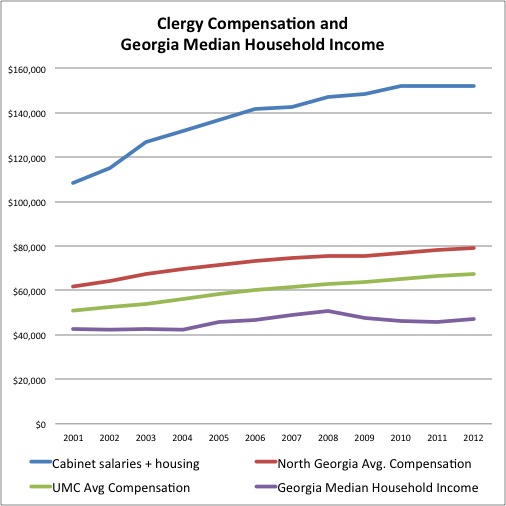
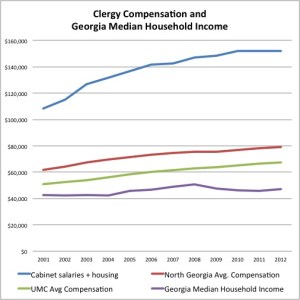 Both our denominational average compensation and our conference average compensation went up consistently even in the depths of the recession, while our laity suffered job losses and US household income declined significantly, as did income in Georgia. At the local church and conference level, we cut staff positions, turned away clergy candidates because there were not enough appointments, and reduced spending on missions, all the while full-time clergy continued to see pay increases (not universally, of course, but the average compensation level continued to rise). It’s not just about the cabinet—it’s about the whole nature of compensation of clergy. In some ways, I worry that we’ve made itinerancy primarily about salary sheets and tenure rather than about matching the right gifts to the right ministry setting.[1. Notes on the chart:
1. The DAC and CAC are lagging indicators – for example, the 2012 DAC is the average for 2010 compensation data. Thus, in this chart, DAC and CAC numbers are adjusted accordingly, so in other documents that reference the 2012 DAC, for example, this chart places that number alongside 2010 data.
2. DAC and CAC also include housing (either cash compensation for a housing allowance, or a 25% factor for clergy living in parsonages). The cabinet figures factor in a steady increase in housing allowance––from $19,000 in 2001 to $37,749 today]
As far as career and ordination, last year I raised an objection at conference that we shouldn’t obligate ourselves to a series of proposed raises because we hadn’t paid our denominational apportionments in full for many years; I’ve got the same concern this year––that we shouldn’t be giving out raises while we aren’t meeting our obligations. As you mentioned, the proposed raises didn’t pass last year, and after my speech on the floor of conference, several people told me that they like what I’m saying, but I should have waited until I was ordained to say it (I had been commissioned as a provisional elder less than 24 hours earlier). I didn’t take that advice lightly, given who some of those people were, but I concluded that I could not wait until I had a lifetime job guarantee to begin speaking about issues that I am convinced the church must address.
I’ve seen a bit of what our Cabinet in the Kentucky Conference has to do. It seems like a tough job. A thankless job, in many ways. Do you not think these people are due a raise?
Let me be clear: this isn’t really about the cabinet or a sense that they are undeserving of honor or a fair salary for doing such a challenging job. Having been only on the side of receiving appointments and knowing how stressful that process is, I can’t imagine the weight of being on the other side and having to assign clergy to all 930+ churches we have here in North Georgia. I’ve seen superintendents have to take the brunt of some very unchristian behavior from both laity and clergy when something was wrong, and I’ve rarely heard of a case where someone calls the DS just to say how happy they are with the pastor and how glad they are that their apportionments went up; it’s a tough job to try to be both the pastor and supervisor to all the clergy under one’s care. These are just a few of the things that make it an unbelievably challenging task they have, and I don’t envy them one bit.
However, I believe the package offered right now is generous. Assuming their spouse does not work, the current package puts the members of the cabinet in the top 5% of income-earning households in our state when you include the housing benefit (and I think you have to, since all other household income in the state includes the portion of the income used to pay for housing). It’s already a well-compensated position, and I can’t help but think that we need to realign our financial priorities.
For example, I received a fundraising solicitation just a few days ago, describing the need for bicycles and Bibles for UMC pastors serving in the villages of Africa, and I found myself wondering whether our priorities are straight when, on the one hand we have clergy who don’t have the very basic tools for ministry, while here we have clergy who have turned down an appointment to the cabinet because the compensation package was too low. I think it’s hard to reconcile that with the call of the Gospel.
I’ve had a lot of friends tell me they could be making more in the business world. Maybe their feeling is best captured in a tweet I saw a few weeks ago: “Pursuing a call should not require one to resign oneself to a less than competitive salary. #umc” What do you say to that? Are you advocating for “less than competitive” salaries?
I suppose in a sense I am advocating for less than competitive salaries, if you assume that we as clergy are simply one profession competing against others for the best people for a given job. In that sense, we very well may lose out on some very talented, gifted people who could probably do some fantastic things for the kingdom of God, but feel their talents are better used in an environment where they can earn a salary directly commensurate with what the free market would set for their experience and education. There’s a valid argument to be made for that, and it was made very well by Dan Pallotta who gave a TED talk on the issue of nonprofit compensation last year. And if we were a secular nonprofit, I am wholly convinced that high compensation levels would be appropriate and perhaps even necessary.
From a secular point of view, salary and benefits are the primary way you attract good talent, and we might lose some good talent by paying less than the business world might pay for comparable jobs (setting aside for a moment the question of whether that assumption is even true when you consider our housing, pension, disability, and health benefits which are often unstated when people complain about clergy salaries). But, of course, our theology of ordination and calling doesn’t say we want the most talented people for ministry. We want people called by God for the life and work of ministry, trusting that by God’s grace and through the outpouring of the Holy Spirit, they will be empowered with the gifts and the grace of God needed for the task.
We pay clergy not so they can become wealthy and experience the dream of upper middle class American life. We pay them so that they can be free to devote their whole time to the work of ministry.
And, frankly, we pay full-time ordained clergy well. Even minimum salary clergy in most conferences make around the median household income in the US when you factor in the value of housing. We won’t become wealthy, but if we use our resources wisely, it is plenty to live off of and plenty to retire off of. I am grateful to serve in a denomination that has minimum salary standards, a defined benefit pension, disability benefits, and healthcare, and I am grateful for all that the church has given me to do my ministry.
If you got to make the rules, what would you do? What’s the right answer here for clergy compensation?
That’s an interesting question, and I have two answers.
If I were starting a denomination from scratch, I think I would have a standardized pay scale for all clergy based on education and perhaps number of children, with an adjustment for higher cost of living areas, paid centrally by the annual conference (of course apportionments would be much higher, but churches wouldn’t have localized clergy salaries, so the new cost would theoretically be the same). This would really free us to do itinerancy more freely, and recognizes the cost of education and the additional cost of raising children––it brings us back to what I think should be the fundamental idea of clergy compensation, that we are providing for the needs of our brothers and sisters who are leading the church.
There are, of course, a lot of practical problems with this idea that make it almost impossible to implement, and I’ll name just two. The first problem is that the Judicial Council has consistently ruled (Decisions 213 and 461, in particular) that the charge conference has sole authority to set clergy salaries, and any attempt at standardization from the annual conference is dead in the water from that perspective. The second is that central deployment coupled with centralized salaries begins to weaken our argument to the IRS that for income tax purposes, the local church is the employer of clergy rather than the annual conference. That has some huge tax implications that would make our clergy and annual conferences subject to certain mandates under the Affordable Care Act and other laws, and that could end up increasing the cost of regulatory compliance substantially. Those are just a few of the reasons I can’t ever see something like that coming to fruition.
So, I support something like Holly Boardman’s proposal that came to General Conference in 2012 and is likely to return in 2016 (assuming we talk about anything besides human sexuality at GC2016!). Rev. Boardman’s proposal, based on 1 Timothy 5:17, would have assessed an apportionment on any local church that paid its clergy more than double the minimum salary standard of their conference: a dollar-for-dollar surcharge for any amount above minimum salary. So, for example, in my annual conference the minimum salary for full connection elders is currently $34,000 (plus housing and benefits). So, if you paid the pastor $70,000, your church would have a $2,000 apportionment surcharge in addition to the regular assessed apportionments. That surcharge would have to go to equitable compensation funds, which could then help to support ministry either within your annual conference or to support central conference clergy.
I like that idea because it facilitates the sharing of resources with others. I might modify it so that it doesn’t just support equitable compensation funds, because I’ve sometimes seen equitable compensation used as a way to simply bolster ineffective clergy or dying churches, and I don’t think that’s the best use of church money, either, particularly if you are taking it away from a vibrant ministry. But I think something that disincentivizes unfettered growth of salary packages would go a long way toward making sure we are using church resources in the way that most honors God.
You’re not even 30 years old yet, and you have no children to support. I’m sure some people have called you young, naïve, and idealistic. What do you say to them about that?
They might be right! This is an ideal, and I have no illusions that I am going to fundamentally change the system. I may very well be naïve and idealistic, but I think a little idealism is sometimes a necessary check to a system driven by pragmatism.
But to answer a few possible objections: although I don’t have children, I do have a wife who is in graduate school for neuroscience and has several chronic health problems which last year cost us about 20% of our household income in doctor’s visits, prescription costs, hospital stays, etc. So, my cost to support a two-person household is higher than the typical two-person young adult household. That doesn’t probably approximate the cost of raising a few children, but there are a lot of pressures on my finances that some other young adults may not face. All that to say, I am not totally naïve as to how expensive life can be.
I have also become very aware of how easy it is to let your lifestyle rise with your income. Last year, I went from being a part-time local pastor to a full-time provisional elder, an increase in annual pre-tax income of almost $30,000 when including my housing allowance (though I am now in a parsonage). I thought the substantial increase in income would make life a lot easier financially, (and it did!) but I managed to let my lifestyle rise with the increase in income in many ways, even with our medical expenses tempering it to some degree. I’m the first to admit that I have a long way to go before I have begun to live up to the gospel’s ideal for money. Every time I read John Wesley’s sermon “On the Use of Money,” I am convicted, especially when he lays out his fourfold test for whether a particular expenditure is appropriate––I can think of a few expenditures just this week that fail that test miserably. This realization, that despite my best efforts my lifestyle rose with my income, has forced me to more carefully budget and to rethink my relationship with money. Thinking about this issue on a personal level has made me see how easy it is for me to let my life be ruled by money and how easy it is to waste money.
So, I am sympathetic to the concern that a pastor who is making $200,000 a year plus housing has planned his/her life around that kind of income, and so to reduce it to $118,000 plus housing by asking him/her to become a superintendent would require a substantial lifestyle change, and that is not easy. But, I also know it is possible because many of our laity have faced those kinds of circumstances, whether through layoffs or through a decline in their business income. It requires us to rethink our relationship with money, and it requires us to change our priorities. It also requires us to take much more seriously the question we are asked at ordination, “Are you in debt so as to embarrass you in your work?” I wonder what would happen if all of us as clergy had to ask ourselves that question a little more often.
You started with a concern that we’re too influenced by American capitalism and that wealth presents some real dangers. What do you say to the successful business person in your congregation who comes to you and says, “So you think I make too much money?”
Let me begin this response by saying that I love capitalism, probably more than a lot of my United Methodist colleagues and friends. I disagree with a lot of the assumptions that underlie our section in the Social Principles about the Economic Community. I think capitalism really is the best economic system there is so far, and although it isn’t perfect by any means, I really believe it can generate the most financial security for the most people in the long run compared to other economic systems.
And so, to the successful businessmen or women in my congregation, I would tell them that as long as they are not ruled by their money and are earning it through honest work, (not exploiting their workers, not engaging in some inherently sinful trade, etc.) and giving away enough so that it actually hurts (which probably means more than a tithe!), I have no problem with them making lots of money. I once again return to John Wesley’s “On the Use of Money” as a guide; probably he or she, like me, could stand to re-evaluate how much they spend on certain things, but I think gaining all one can through honest capitalism is not inherently bad.
But there is a big distinction between a business person making money through his/her trade and the use of church revenue. Once someone gives money to the church, it is, as John Wesley described it, “sacred to God and the poor.” Although all money should be seen as God’s, money given to the church has a very particular function, and that is to do the work of the Kingdom of God and to take care of the needs of our brothers and sisters. Part of this should be caring for the needs of pastors and their families who devote their whole lives to ministry. Ben Witherington makes a good case in his book Jesus and Money that Paul never intended tentmaking ministry to be a required norm for church leaders, and so I see nothing wrong with salaried clergy in principle. But when we begin to go far beyond caring for the needs of our brothers and sisters to a money-driven ecclesiology, we’ve got a problem in my opinion.
——————-





 teddy ray