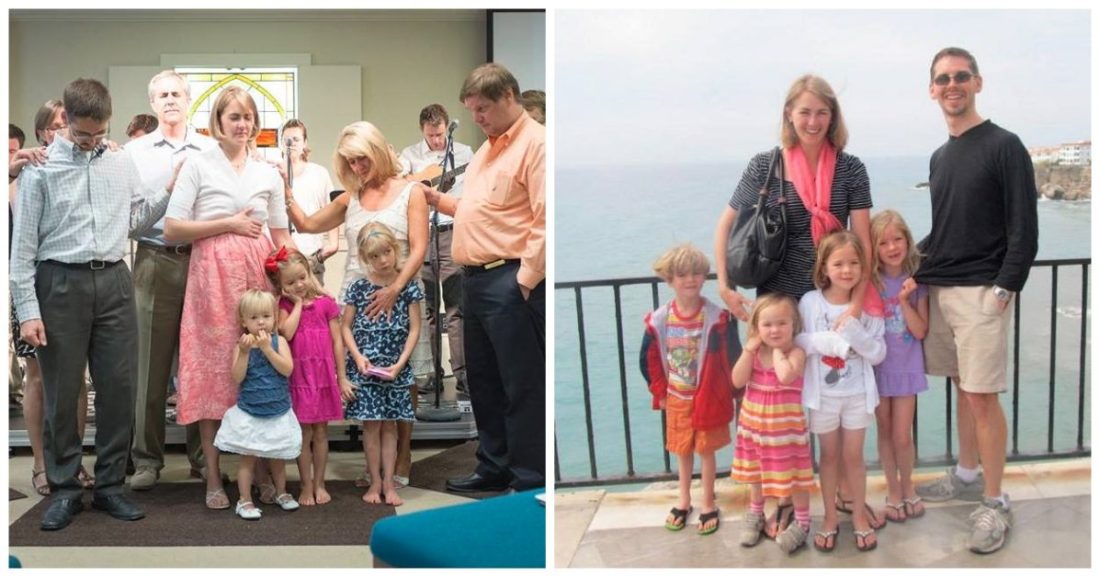
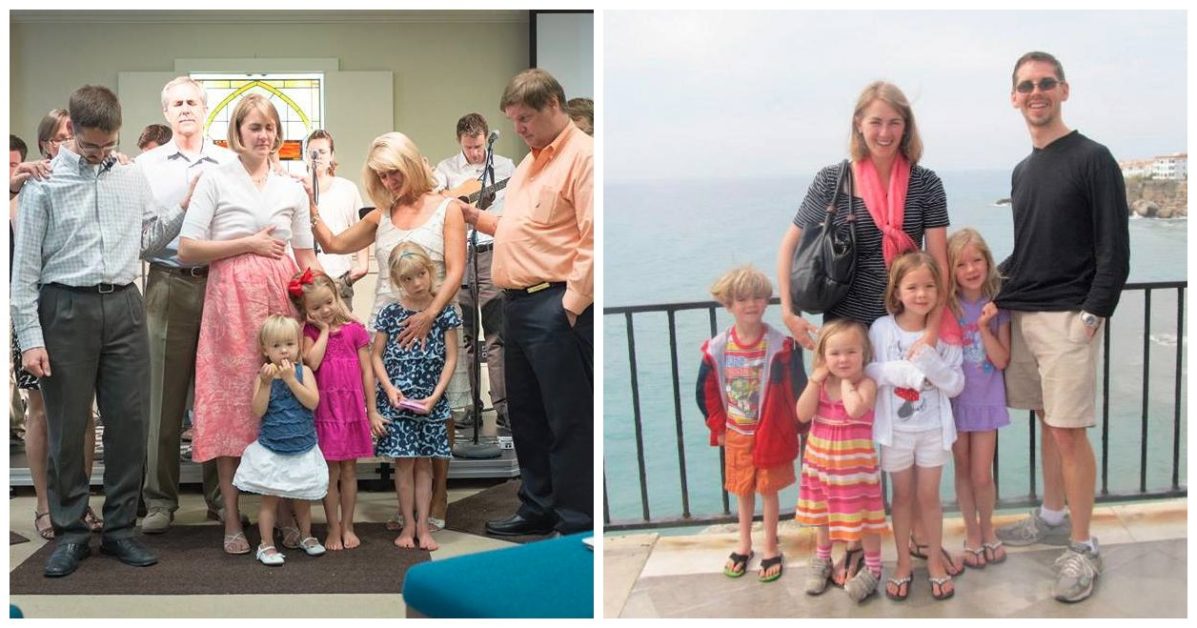
Left: Our family being commissioned by the Offerings Community before coming to Spain. Right: 10 months later in Spain.
In July, I’ll be returning from a sabbatical year to be the lead pastor of the Offerings Community at First UMC in Lexington, KY. I’m sharing some pastoral letters with them in advance of that return. I wanted to share them with you. Though some notes here are specific to that congregation, the letters are a broad attempt to share a pastoral theology.
Three beliefs motivate everything I do in ministry…
The Gospel
I believe God’s grace is our only hope. I believe God so loved the world that he gave his one and only Son––Jesus Christ, God in the flesh––that whoever believes in him shall not perish but have eternal life.[1. John 3:16] I believe Christ has died, Christ is risen, and Christ will come again.
I believe in the gospel because it’s “the power of God that brings salvation to everyone who believes.”[1. Romans 1:16] By the grace of God, we’re forgiven for our past sins, given power over present sin, healed from our brokenness, and collectively made into the body of Christ in the world.
I believe all this because I’ve experienced it. God’s grace has transformed my life. Despite my own insecurities, I have a great assurance of God’s love. Despite my own past sins, I have a great assurance of God’s forgiveness. Despite my own doubts, I’ve seen God answer prayers.
I believe all this because I’ve seen it in so many of you. One of the greatest privileges of pastoral ministry is the front-seat I’ve had to the transformation in some of your lives. I’ve seen some of you receive forgiveness and know it was real after you had thought you’d never get past the guilt of something in your past. I’ve seen some of you freed from sins you thought would keep you enslaved the rest of your lives. And I’ve seen some of you become great ministers––hands and feet of Christ to others––when before you could barely keep yourselves together. What a privilege to see the gospel at work in you!
The apostle Paul wrote, “If Christ has not been raised, our preaching is useless and so is your faith.”[1. 1 Corinthians 15:14] I agree with him. If the good news about Christ’s death and resurrection isn’t true, and if the grace God offers through Christ isn’t transforming us, we’re all wasting our time.
The Church
I hear a lot of people today criticize the church. They call it irrelevant and unnecessary. They say they can be “spiritual” without “institutional religion.” They say they can be “Christian” without having to “go to church.”
First, full disclosure: I’ve seen a lot of ugly things about this institution we call the church. I can’t disagree with a lot of the criticisms I’ve heard. Yet I believe in the church.
I believe in the church because the Bible tells us “Christ loved the church and gave himself up for her.”[1. Ephesians 5:25] I believe in the church because it’s called the body of Christ––“the fullness of him who fills everything in every way.”[1. Ephesians 1:23] How humbling that such a flawed and wayward community would still be the community that Christ loved and gave himself up for, the community that would be called the very body of Christ!
Despite our many problems and all the ways we fall short, I believe God still uses the church. I believe the church is still God’s primary means of offering his grace in the world––the fullness of Christ in the world.
Specifically, I believe in First UMC of Lexington. I love our emphasis on making disciples “across the street and around the world.” I love the way we’re trying to start new worshiping communities in new places so that we can reach new people. I believe in First UMC because I’ve experienced what this church can do. This is my home church, and for over 30 years, they’ve surrounded me with a community of love and forgiveness, supported and encouraged me, and helped me grow into the person I am today. Is First UMC perfect? Far from it! But I believe God loves this church and is using us to proclaim and live the gospel. In our failings, I trust that God is at work to transform us into a church that looks more like her Savior.
Even more specifically, I believe in this Offerings Community. I love our emphasis on spreading scriptural holiness, our focus on making disciples who become pastors and apostles, our desire to start more communities in the future. I believe in this little community because you’ve surrounded me and my family with a community of love and forgiveness. We know God’s love better because of you. Is the Offerings Community perfect? Far from it! But I believe God loves this community and is using it in powerful ways. In our failings, I trust that God is at work to transform us into a community that’s the body of Christ for our world.
You
I believe each of you is an essential member of the body of Christ. I believe God has given each of you special gifts––gifts that we need to minister to each other and to our world. I believe in you.
At a time when so much of ministry is “professionalized”––left to the church staff––I love the way this community values shared ministry. If you’ve been around for long, you’ve already seen the priceless contribution that so many people bring to this community. And I think we’re still only scratching the surface.
I believe great things are ahead for us, and that God will use you to do those things. Some of you have a great gift of faith, and we’ll be sustained by your prayers. Some of you have the gift of evangelism, and we’ll share the gospel with new people because of you. Some of you have a special gift for generosity, and your giving will sustain our budget. Some of you have special gifts for spiritual encouragement, and you’ll be pastors to others. Some of you don’t even realize that you have those gifts yet, but you will.
What’s the hope for our world? The gospel.
How is our world most likely to see and hear and receive the gospel? Through the church and through you.
Those beliefs motivate everything about ministry for me.
Bill Arnold, Professor of Old Testament Interpretation at Asbury Theological Seminary
What should the church teach and practice regarding homosexuality? Our debates have been escalating for decades and have reached a fever pitch. Several denominations have already split because of their disagreements. The United Methodist Church is threatening to be next.
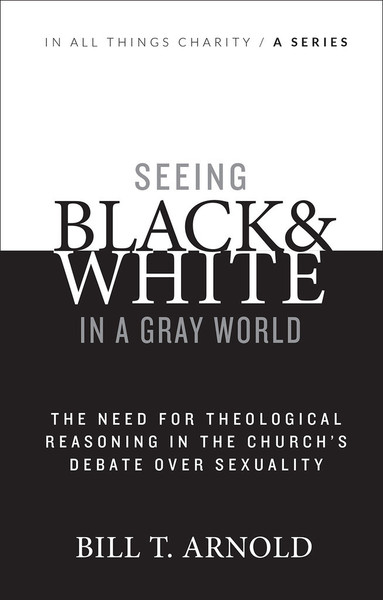
Among other things, the book serves as an extended response to Adam Hamilton’s 2008 book, Seeing Gray in a World of Black and White: Thoughts on Religion, Morality, and Politics. Hamilton’s view has been championed as the “middle way,” the agree-to-disagree view, the gray area between polarized black-and-white camps. Arnold argues that no such middle way is possible in this case (or in many of the other cases Hamilton discusses).
I’ll share my review of the book next week (NOW AVAILABLE HERE). But for now, Dr. Arnold has allowed me the privilege to interview him about his book, the church’s debate about homosexuality, and the future of the United Methodist Church.
Thanks for your time, Dr. Arnold.
On the surface, this is an unusual book. It’s a book-length review of something that came out six years ago. It’s an Old Testament professor writing about modern theology and ethics. So why did you think this book was needed in the first place? Why choose Adam Hamilton’s book as your “conversation partner”? And why is an Old Testament professor writing this kind of book at all?
While the book engages Adam’s, I prefer to see it as a collegial discussion over coffee. We happen to disagree. As I explain in the Preface, I only read his book in 2012, on my way to General Conference in Tampa. But I also hope my readers will see the book as more than an extended review. In reality, the first two chapters attempt to critique and deconstruct what Adam has proposed. Then in chapters 3-6, I reconstruct a different way of looking at the debate in the church over human sexuality. These are chapters in which I hope to offer something original and genuinely helpful to the church, rather than merely interacting with Adam’s proposals.
I chose Adam as a “conversation partner” frankly because he is so influential in our church. Most of what he has accomplished is laudable. I celebrate the way God has used him in his ministry, and continues to use him. But I also believe that because of his success, our church has not thought critically enough about his proposals related to same-sex practices.
And, Yes, I’m an Old Testament teacher. One reviewer said it was odd that an OT scholar/professor should engage in dialogue with a pastoral theologian, and another friend has privately scolded me for coming down out of the “ivory tower” to address “real life” problems I don’t understand. I find this whole thing interesting. We academics get slammed for being “ivory tower” and not writing or speaking about things people care about. Then when we do, we get slammed for writing or speaking about things people care about. I admit in the book that I stepped significantly out of my comfort zone to write this book. I often imagine what it would have been like to stay in my world of Hebrew exegesis and the book of Deuteronomy. Safer, to be sure. But the story I tell in the preface about my experience at General Conference 2012 emboldened me to step into the public arena, to clear my throat, to express my views. I think of my interaction with Adam as a mutual engagement of ideas, an exchange of differing opinions, and the power and value of that engagement lies in the ideas and truths expressed, regardless of the source.
Have you talked directly with Adam Hamilton about the disagreements you list in the book—either before or since its writing? How have those conversations gone?
Yes. I had met him a few times, but we had never talked about these issues. As I say, I was not fully aware of his views until I read his book in April 2012. And to answer your question more fully, I need to explain the process I went through to write the book. I had the ideas, basic outline, and general plan for the book on the airplane back from Tampa. I wrote the first chapter that fall, but then I placed the book aside. I frankly didn’t want to continue it. Gradually, during the Spring Semester, 2013, I felt convicted that I should return to the manuscript and keep writing. So during the summer, I placed aside several other writing projects, which I still consider to be my primary calling, in order to write this book for the church. All along the way, I argued with myself (or with God) about whether or not I was really going to publish this.
Once I came to realize that yes, indeed, I was really going to offer this for publication, then I contacted Adam. I explained to him what I was planning, and we engaged in an email discussion. I wish it could have been more substantive and in person. But this was the best we could do. You asked how the conversations have gone. I suppose they have gone as you might expect. We are simply not going to agree on this issue, even if we are together on many other issues. We’re always collegial and gentlemanly, if that’s what you mean. In some ways, I hope we can model how Christians can disagree, and do it in a Christian manner.
Your approach surprised me. I expected a biblical studies person to do a deep-dive into some of the biblical passages on homosexuality. Instead, your book taught me a lot about logical fallacies (I counted 29 uses of the word fallacy), theological method, and myths in the contemporary ethical debate. Why’d you choose this approach?
I suppose it’s about the needs I perceived in the church. We have several extensive treatments of the biblical data related to same-sex practices. I especially benefitted from Richard Hays, Robert Gagnon, William Webb, Richard M. Davidson, and others. I also took the opportunity to engage the counter arguments represented in the works of Sylvia Keesmaat and Luke Timothy Johnson, although my critiques of their work will not appear until this fall in another publication. The point is, I didn’t need to rehash all that work. Besides, the church isn’t listening to the scriptural evidence anyway. I spent quite a lot of time on hermeneutical method and explaining why scripture is important. But in general, the church needs to be reminded today, in my opinion, about “theological reasoning” as I say in the subtitle.
You say, “We don’t need a newly reformed Christianity. We need instead a Methodism that is renewed and empowered to continue the social work of spreading scriptural holiness across the land, as the early Methodists did.” Could you say more? What’s the difference between “reformed” and “renewed”? And what does the UMC lack for the kind of renewal and empowerment you mention?
That quote comes from a larger critique of Adam’s approach, which proposes a new generation of Christians of the middle-way should combine parts of both extremes (Falwell or Spong) into a new Christianity. He believes this reformed Christianity will be created by people who see more gray than black-&-white. This call for a new reformation borrows a theme from the Emerging Church, which I think is trendy and already waning in influence. I think this call for a new reformation is overreaching, and what we really need is renewal of what we have in Wesleyan theology. A fresh proclamation of our theology is what the world needs. I really believe that. But we’re distracted and torn apart by conflict. We need renewal and empowerment, not new answers to controversial debates.
You argue that there is no middle way on the issue of same-sex practices. It’s a fork in the road. Either we approve them, or we don’t. But some people will say we don’t have to force everyone down the same path. We don’t require all of our pastors to remain in lock-step on our beliefs about creation, or our stance on tobacco use, for instance. So why enforce conformity on this issue?
Our statement on sexuality emphasizes the sacred worth of all persons, and is clear that we do not condemn individuals for experiencing same-sex attraction. The pressure on our church today is on the specific questions of ordination and the nature of Christian marriage. And how these relate to same-sex practices presents the church with the single most important social issue of our day.
The pressure to address the question would not be as great for congregationalist denominations. They have mechanisms for letting each congregation decide. But Methodism defines itself as connectional, and sees this as one of the most important ways we participate in the one, catholic, universal church. Of course, we don’t all agree on every issue. But as a connectional church, our Social Principles offer the world our best theological thinking on every aspect of life in the modern world. How can this not include official statements embraced by the connection on human sexuality?
You had a great section at the end of the book, debunking myths in the current debate. This quote stood out to me:
“The church’s teaching about sex is not the problem, and liberation from that teaching has not provided healthy freedom. On the contrary, it can be argued that the church failed to influence culture in the 1960s, losing its voice and failing to condemn nonmarital sexual practices of all kinds.”
You suggest that the church lost its voice on sexual issues fifty years ago. Might it be hard for people to respect a stance on same-sex intimacy from a church that has, as you say, “failed to condemn nonmarital sexual practices of all kinds”? Have we lost the right to speak on sexuality? Or are we starting in the wrong place by making same-sex practices our focus?
Yes, in one sense we are starting in the wrong place. We’re here because North American culture is driving the UMC quickly toward becoming another example of “cultural Christianity” rather than biblical Christianity.
That quote is part of a discussion of the “myth of liberation” in the current debate. My point is that the church lost the battle during the sexual revolution of the 1960s, in which “liberation” was a central theme. And once the church lost its influence in the culture, we simply grew quiet on sexual promiscuity generally, whether we’re talking about multiple marriages without just cause for divorce or premarital cohabitation. The church has grown silent on those topics and is now unfortunately fixated on same-sex practices. But you’re right, the church exists to teach the world and offer the world a higher way, a more excellent ethic that is ultimately satisfying to God and more fulfilling as human beings in this created order. The church extends grace and care to persons experiencing same-sex attraction. It’s vitally important that the church find new and creative ways to do that. But we also offer everyone in the church, no matter our sexual experiences or preferences, a way of holy living that ultimately fits our souls for communion with God.
Two of the most prominent violations of the UMC stance on same-sex marriages involve UM pastors who officiated the weddings of their gay sons. I’m sure situations like that would cause someone to do a lot of soul-searching. If you’ll indulge a hypothetical—a gay son comes to you and says, “Dad, I’m getting married. I hope you’ll be at the wedding. I’d really like you to officiate it.” What do you say?
Great question. As I say in the preface to the book, I had long talks with two of my three sons about this topic while I was writing the book. (Our youngest son was on deployment with the Marine Corps in Afghanistan at the time.) They were helpful chats because they don’t all agree with everything I’ve said here. But this is something that never came up. I think and hope my first impulse would be to assure him how much I love him, and how much I will never allow anything to break our relationship. I think my sons know me well enough, have gone through enough with me to know, I would probably grab him and hug him first, and then start talking about it. Of course the next part of my answer is hypothetical, so I can only say this is what I hope I would do. But I hope I would say I would attend the ceremony, and express my unhesitating love for my son, but that I could not perform the ceremony. I think any of my sons would understand this. A wedding ceremony is God’s stamp of approval, acknowledging that God honors and blesses, and approves of love between two people, and finally, that God approves the sexualization of that relationship. When I perform wedding ceremonies, I’m an instrument of God’s grace to approve and bless that union. I would hope my son would love and respect me enough to understand my position, and welcome my presence in attendance at the ceremony, but accept my decision not to perform the ceremony. That would be incredibly difficult and painful. I don’t want to minimize the pain others have gone through in making this decision. But just as they say it’s a question of pastoral integrity that leads them to perform same-sex wedding ceremonies, I respond that indeed, it’s integrity that drives me to say I simply cannot perform them. I think my sons would understand that.
A lot of different proposals are coming out right now regarding the impasse in the UMC. Another group just recently issued a press release through Good News Magazine that essentially said it’s time to acknowledge our differences and work toward an amicable split. If you had to propose or endorse a way forward for the UMC, what would you say right now? To get more realistic, what do you think is most likely for our future?
Well, those are two different questions. Because I’m basically a pessimist, I need to say I don’t have much hope for keeping us together. But I’m also not part of those groups calling for a split or amicable separation. I prefer staying together as a denomination, but finding ways to hold bishops and annual conferences accountable to the “sacred trust,” as the Book of Discipline says, that binds us together. We’re in this mess because some have chosen deliberately to break faith with the connection, which they consider biblical disobedience. I consider it schismatic.
I also don’t favor proposals circulating just now that favor allowing the local congregation to decide the question of marriage/civil unions, and annual conferences’ Boards of Ordained Ministries to decide the question of ordination. I don’t support those proposals for two main reasons. First, on the authority of the local church to decide the question of marriage/unions, I believe this would make us congregationalists. Our connectionalism is one of the hallmarks of Methodism, which also locates us squarely in the one, catholic, universal Church. The idea of turning to local congregations to settle this important and sensitive issue reconfigures Methodism significantly. Second, on the ordination question, I cannot image the confusion and chaos created at the conference level. I make no claim to be an expert on the appointment system. But this strikes me as “everyone doing what is right in their own eyes” chaos (you might have expected an Old Testament allusion).
And just for fun… You’ve been a delegate to the past two General Conferences. You were the second person nominated in the Kentucky Conference last time, and the person who was nominated before you is now a bishop. If nominated for the episcopacy, will you run? If elected, will you serve?


 teddy ray