Rob Bell vs. Tim Tennent

rob bellI haven’t read Rob Bell’s newest book, What We Talk About When We Talk About God, and I honestly don’t expect to anytime soon. Too many others on the stack that I need to get to.

The book is currently ranked #10 in Christian Theology on Amazon, though (behind 3 books on heaven, 5 books on apologetics, and an end-of-the-world book — oh my…), so I can assume a number of people are reading it or will be soon.

I did read Tim Tennent’s unflattering review of the book. Tennent has me worried that Rob has gone even further down a path I’ve feared for years he might be heading down — toward a New Age spiritualism with plenty of grace but very little cost. Toward a faith that seems to rely on or embrace the great, ancient Christian faith no more than it would any other religion or spirituality.

I wrote not long ago about what a profound, positive influence Bell has had on me. I defended him early on (and I believe rightly, at that time) against attacks from people who just seemed angry and narrow-sighted. I later squirmed when I heard him explain some difficult Old Testament passages as perhaps things that people just thought were a revelation from God, but really used to justify their own actions. And when I read Love Wins, I found myself frustrated because a lot of the argument just wasn’t well-conceived.

But I stuck with Rob, because I still was convinced this was someone intently pursuing orthodox Christian faith. Bell has always embraced a pretty wide orthodoxy, and I do, too, so I wasn’t concerned that he come down exactly where I did everywhere. I just wanted to know he was taking me down the paths he had taken in that pursuit.

My problem is that the things I’ve seen recently from Bell are making me wonder whether he’s really still taking me and others down that path, or whether he has veered off the path that pursues the heart of the ancient Christian faith — the path pursuing orthodox belief and life. Has he veered to pursue a more bland version of spirituality that gives precedence to an inward “stillness” over the ancient faith?

I haven’t read the book, but I would guess some of you have. Can you help me? Is Tennent right? Is this the path Rob is more consistently taking here?

It will be pretty upsetting to me if the person who helped me see much more depth, richness, and nuance in the Christian faith ends up offering a “less nuanced, more simplistic, more pluralistic expression of Christianity,” as Tennent suggests he’s doing.


The book link is an affiliate link. Feel free to buy wherever you choose.

Secret option C in the worship wars, or Worship as flawless performance or communal offering?

worship
Oh my…

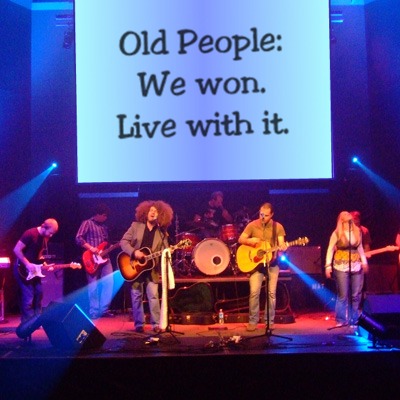
One church uses an organ and a choir. Another uses a rock band.

Some churches that had previously used only organ and choir start letting drums and guitars creep in. Perhaps it’s for a song here, a song there. Or we call it “blended,” where a choir leads songs written by Bach, followed by a praise band leading songs written by Chris Tomlin.

Other churches start saying they need to “expand their menu” and offer both. So they start a “contemporary” service.

Still other churches stake their claim with one form and demonize the other, either as “bar music” or “antiquated.”

But what if both options in the worship wars have led us in the same, wrong direction?

I’ve written before about why the worship wars have caused us to focus on style in worship rather than content. Here I’d like to show how they’re about more than just style.

Taken to an unhealthy extreme, the “contemporary” church can strive to put its nearest version of a concert band on stage. Likewise, the “traditional” church may look for the best, classically-trained vocalists and musicians. Both may even hire professional musicians simply for the sake of bolstering the quality of the music performance on Sunday mornings.

And so the question a lot of people are answering in their worship preferences is how they’d prefer to spend a good night out: at a U2 concert or the opera or philharmonic.

When this is our central focus in our worship “offerings,” we equate worship with a performance for people to come and consume. And as the worship wars have worn on, we’ve found “traditional” churches adding more anthems and “contemporary” churches trying to get their bands to sound more and more like the ones on the radio.

All of this conceives of worship in a totally different way than it has been conceived for the better parts of the church’s history.

What is worship? In the best parts of our history, I think we see worship as a gathering of the people of God, coming into the presence of God to offer our praise and thanksgiving, our confession and prayers. It’s a gathering of the people to hear from God and respond. For the Church’s first 1500 years, it was unquestionably a time of coming to the Table to encounter the crucified and resurrected Christ. And it was a time to be sent into the world, bearing the name of our Lord and living by his power and example.

What have the worship wars suggested that worship is? Often, these tell us that worship is a performance. Rather than the people coming to humbly offer themselves in worship, they come to hear a well-rehearsed choir sing to them. Or they hear a rock band sing songs they know from the radio. A friend observed that there’s a difference between worship songs and performance songs. And when our really good bands perform great songs like they’re done on the radio, it makes it pretty hard for a lot of people to sing.

Many will say that this exaggerates everything too much. And they’re probably right. The whole worship service comprises more than that anthem or that rock song. But these are what we’ve leaned harder and harder into the past couple of decades. The traditional churches amplified their “traditional” music by focusing on more choir performance pieces. The contemporary churches amplified their “contemporary” presentation by making it look more like a concert. Both types might do this by relying on professional singers and musicians. If those were the things these churches most amplified in the last few decades, it’s because they saw these — the performance aspects — as the most important piece of what they “offered” in worship.

And so, the problem at root: Churches began conceptualizing worship as what they — the religious service providers — offered the congregation — the religious service consumers. That’s a far cry from worship that we, the people of God, offer up to God.

For some similar thoughts on worship, see “Encounter or Entertainment?”

A tension we need to wrestle with in our worship planning: do we err on the side of flawless performance, offered to the congregation, or communal worship, offered to God?

A few years ago in my community, worship was a two-man show. As the pastor and preacher, I handled any speaking elements. Our worship pastor coordinated a band that handled the musical elements.

In the past several years, we’ve moved (repented?) from that form and become a dozens-of-men-women-and-children show. But it’s not a show; the point is that we’re all participating. There has been a small sacrifice in doing that. The more people you include — especially non-staff people who can’t dedicate the same amount of time to rehearsal/preparation, the more likely it is that something won’t go just right. The worship service may not be flawless. There may be an awkward transition here and there, something not said as well, or as powerfully, as we had hoped. (But then, I make no claims to having led worship anywhere close to flawlessly before.)

For the small sacrifice of including more people, though, I think our worship has become much more authentic. It has become much more fully an offering of what our community has to give of ourselves before God. It doesn’t attempt to limit it to only our most excellent performers. Furthermore, we’ve seen a lot of these new leaders lead various elements of our worship better – with more thought and focus – than was done before.

This doesn’t mean we don’t use some sort of discernment in asking people to lead. For the sake of the person and the community, we try not to put people in places where we haven’t seen that they’re gifted to lead. But as a Body of Christ, we believe everyone has been gifted for something, and we believe it’s neglect of the Body if we don’t make use of those gifts. We might be able to put on a better show if we simply identified the one or two most-skilled people to lead us in each aspect of our worship, but it would be a better show, not better worship.

If the worship wars asked us to focus on which performance style we prefer and formed in us a consciousness of worship as performance, perhaps secret option C is to quit asking questions about performance and start asking questions about what we, as a fully body, can do when we come to worship God. What if we focus more on offering ourselves – all of us – to God in worship and focus less on offering a flawless worship performance to the people?

Some other articles you should read:

Why we chose a church with bad music – (shaungroves.com)
Desperately seeking worship pastors – (Jonathan Powers on Seedbed.com)
What kind of worship service do you have?” (teddyray.com)
Encounter or Entertainment? (teddyray.com)

Your church has a communication problem

communication

Follow-up now available: Some help for your church’s communication problem

If your church is like most American churches, you have a communication problem. If you surveyed active church members across the nation, I’d guess that the vast majority would list “communication” as one of their church’s greatest failings, or say that their church isn’t “transparent” enough.

My church has a communication problem. If you’re a church leader and hear that complaint/lament regularly, I can empathize with you. If you’re a member of my church, I apologize to you. We have a communication problem. I know it. I wish we didn’t. You can go somewhere else, but unless they’re not doing anything, or are a mega-church (I’ll explain that below), they probably have a communication problem, too.

I usually try to suggest solutions where there are problems, but I’m afraid my goal here is a bit less optimistic. I think the best I can do is provide more understanding of why this is such a frequent problem. And then I’ll offer some suggestions to the frustrated, under-communicated-with church member and the frustrated, regularly-blamed-for-under-communicating church-leader.

A Diagnosis – Confused Constituencies

Here’s my hypothesis: the church’s (and other social organizations’) constituencies fall into a very different category than the standard organization’s constituencies. Because of that, we have a very difficult time communicating with them the way they think they want to be communicated with.

The Church as a Family

Many complaints about “transparency” come when we frame the church in familial terms. If your church is a 15-person house church, that might be pretty legitimate. But let’s face it, in larger churches, the family analogy just doesn’t hold all the way through.

A family doesn’t have full-time employees.

I don’t know any families (in this case, ones comprising more than 15 people who don’t all live together), with a single, large combined budget.

transparent family is one that all knows each other rather well, whereas in all but very small churches, the people don’t even all know each other’s names.

And so, when we hear complaints like, “We have a right to know all the details about [insert difficult situation/decision]. We’re a family!” it doesn’t really work. Whenever there’s a complaint about communication not working like a family’s would, we should ask whether the situation is a typical family situation. Families don’t hire and fire people. Families don’t have professional communication departments to inform them of events in the family. They call or e-mail or visit each other. If that sort of organic, non-professional communication isn’t happening in your church, it’s probably a good sign that we’re not truly dealing with a family situation.

Which takes us into the realm of the organization…

The Church as Organization

Most organizations have three primary constituents: employees, customers, and owners. There’s a relatively clear and distinct strategy for communication with each group.

Which constituency would we associate active church members with?

Customers

Some would want to consider church members like customers. But that’s not usually the reality. The decision-making expectations are different. So is the expectation for how much information is available.

If your favorite restaurant changes the menu, decides to open a second location, or decides to close on a particular day, you don’t expect to be consulted. Good businesses will let their customers know about decisions like that — usually through their marketing departments. Some might even get customer input through surveys. But the customer doesn’t typically expect to be brought into the decision-making process. Nor do customers expect to receive regular information about that business’s budgeting, staffing, or property decisions. Customers don’t expect “transparency” about all of those areas.

Church members usually expect to be brought into the decision-making process much earlier than a typical customer would. And they expect to receive more information than customers do. They’re not customers.

This is where some mega-churches may get an exception. Their size and centralized leadership structure make it clear that they’re religious service providers to their members, who are religious service consumers. Nearly all decisions are made by the staff, with only the biggest decisions going to some sort of “board” (compare to “owners”), and then communicated to the members by a marketing/communications department. Andy Stanley’s North Point Church in Atlanta is a great example of this employee-driven model.

So there’s actually a solution in this: make a more clear divide between employees, owners (i.e. church board), and customers (i.e. members). It’s much easier to communicate if the “church board” expects only to be brought in on the biggest decisions (think in terms of the most crucial 3-5 decisions of the year), the employees are fully charged with operations, and the members expect to be communicated with like customers.

Of course, I’m not advocating this. I don’t like it. But it would make communication easier.

Owners

In a small company, there are usually just a few owners. How do they get their information? Mostly through one-on-one communication with their managers. That doesn’t work unless only a handful of church members want to be treated this way.

If we look at this more like a large organization, though, we have two options:

      1. We treat members like shareholders. That probably looks like a quarterly update and annual meeting. I don’t know many who would be satisfied with that. They want to know more and know it earlier.
      2. We treat the board like owners and the rest like customers. Now we’re back to what I laid out above.

Employees

The place I see the most complaints comes when active members would probably like to be communicated with like employees. And this makes some sense in any church that relies heavily on volunteers for ministry and committee work. Those volunteers are like employees — they’re the ones making it happen — they just don’t get paid for it.

But there’s another difference: most of those volunteers have day jobs. That means they don’t spend the majority of their week immersed in the details of the church, like the actual church employees do.

If they were actual employees of the church, it wouldn’t be unusual for them to meet weekly – perhaps even daily when a crucial decision needs to be made. If they were actual employees, it wouldn’t be unusual for them to exchange rounds of e-mails every week. That’s highly unusual for volunteers, though. And it should be. Most of them have day jobs!

But the problem is that in most people’s day jobs, the other people who are needed to make a decision are also at their day jobs. And so the decision turn-around can be reasonably fast. Employees are unsurprised by multiple inter-organizational e-mails per day.

I receive 20-30 church e-mails per day and send as many. And I attend no less than 5 or 6 church meetings each week. And I spend a considerable amount of time in the office, learning about things just because I was present when they happened or because of inter-office conversation. So I know a lot about what’s happening in the church. Even with that, I occasionally learn things late and get caught by surprise. By comparison, a daily e-mail and weekly meeting is far too much for most church members (and I don’t blame them), and it still wouldn’t be enough to get them fully up to speed.

So I would argue that we can’t communicate with church members like customers. They’re more than customers. They want more information, want it earlier, and often want to be part of the decision.

We can’t communicate with church members like owners. There are far too many of them to give them the personal communication a small group of owners gets, and they want far more than what typical shareholders get.

We can’t communicate with church members like employees. They can’t handle dozens of e-mails per day and multiple meetings per week. They can’t handle the volume of information typical employees receive, nor can we produce that volume for our members without stopping a lot of the other things we’re doing.

And so our problem: churches and their members (and other social organizations) are confused about what kind of constituents their members are. The volume of information desired is often something just short of what employees receive, but that’s too much volume for the church to produce and for most people to truly be able to handle.

The Church as Pastoral, Strategic, and Social Organization

A final problem relatively unique to the church in its communication is that it serves as a pastoral, strategic, and social organization. Here’s what I mean…

As a social organization, the members of the church have relationships with each other. They talk regularly. It’s not uncommon for them to receive more church information (and occasionally misinformation) through casual conversation than through actual church communications.

So for instance, several church members notice that a family hasn’t been around for a while. They know that family had been upset by something that happened in the youth ministry a while back and now assume that’s why they left. They don’t understand why the pastor never did anything. What they don’t know is that the pastor met with that couple several times in a counseling situation, and the reason they left had to do with marital problems totally unrelated to the youth ministry problem.

But the pastor can’t say that. (S)He can’t announce it in the church newsletter each time a person leaves for reasons (s)he may fully understand, yet the church doesn’t know. Most people would generally disapprove of any sort of public announcement of their leaving when it’s not because of a move, and it would usually be inappropriate.

And yet, because of that lack of information, our social networks fill in the blanks with whatever we can most easily fit into them. There’s a legitimate lack of communication here. But it’s an appropriate one.

The church as strategic organization has another communication challenge. As a strategic organization, any significant decisions need to pass through a process. But as a social organization, a large number of people are emotionally invested in those decisions. If people learn about something in its earliest stages of the decision-making process, it may produce undue speculation, rumor, and consternation over something that will never come to fruition. If they’re not let in at those earliest stages, they’re likely to be hurt and offended for not knowing sooner.

Managing emotions and strategic decisions in a social organization makes communication particularly difficult. We’re not just dealing with formal lines of decision-making, we’re dealing with all the social and emotional aspects of this peculiar organization.

Your church has a communication problem. And it’s not as easily fixed as you might think.

Suggestions for better communication and better communication expectations

I’ve laid out many of the problems we’re dealing with in some detail. And as I said at top, I’m worried that I don’t have a great solution. I think so long as we continue operating churches as large, professional organizations, there will always be a gap between communication expectations and realities.

But I do think we can do better. I’ve realized several of my own failings in church communications, sought advice, and am trying to do better. In my following post, I’ll try to offer some resources and suggestions for the frustrated, regularly-blamed-for-under-communicating church leader. I’ll also offer some suggestions for the frustrated, under-communicated-with church member.