Liberal and Conservative theologizing — a caricature using song lyrics

mirrorIn my last post, I introduced language about theological liberalism and conservatism, and I got the sense that I needed to give more definition.

Some notes about what I mean by “liberal” and “conservative”

Most people conflate the theological divide with political ideologies, but they’re almost entirely separate ideas. You can be politically liberal and theologically conservative, and vice versa (although I expect the majority are actually conservative in both or liberal in both, for reasons I won’t get into here…)

So the way that I’m using “liberal” and “conservative” isn’t intended to address politics. In fact, even within the Church, I gather that there are different definitions. I’m using these the way I primarily see and experience them in Protestant-world.

Regarding conservatives, I’m really referring to fundamentalist theology here. I’m dealing with any sense of the Bible being inerrant as typically understood, which is often listed as a core tenet of conservatism.

Here’s a simple attempt to present these different theological methods.

Disclaimer 1: This is, admittedly, quite caricatured and limited. I do this to highlight starkly and basically the differences in these methods. If you want all the nuance behind these, I’d suggest Nancey Murphy’s Beyond Liberalism and Fundamentalism (affiliate link) as a good start.

Disclaimer 2: I’m using a song lyric, which is not Scripture. So all analogies can’t hold. But enough can to paint a starting picture.

Let’s imagine we found the lyrics of the brilliant Fleetwood Mac song “Landslide” in the Bible:

I took my love and I took it down
I climbed a mountain and I turned around

And I saw my reflection in the snow covered hills
‘Till the landslide brought me down

Oh, mirror in the sky
What is love?
Can the child within my heart rise above?
Can I sail thru the changing ocean tides?
Can I handle the seasons of my life?

How would liberals and conservatives each read this?

The conservative reading

The conservatives would say that the writer must have climbed a mountain, then turned around. And just as she saw her reflection in the snow covered hills, a landslide – probably caused by God – brought her down. Now, since mountain climbing didn’t work out, she should consider sailing, but that could prove an obstacle, too.

The conservative might begin to conjecture about why God brought this avalanche at just such a time. God must have wanted to put her in a better place. Or perhaps climbing the mountain in the first place – or gazing in the snow for too long – was a sin, and the landslide was punishment.

Prove to the conservative that the singer has never actually climbed a mountain or encountered a landslide, and their faith will be seriously shaken.

The liberal reading

The liberal reads this and knows that it’s unlikely for someone to survive a landslide on a mountain. They begin to reconstruct the real history of this account: the author was probably so focused on looking at her own reflection in the snow that she slipped and tumbled. To her, it felt like a landslide. But we know better.

Indeed, much modern psychology shows that when someone becomes obsessive about a love interest, she can lose all sense of reality. This can cause both the dizzied state that caused the author to fall, and the irrational state that caused her to blame her fall on a “landslide.” The song reveals the experience of all humanity and confirms our modern psychological findings.

Problems

It’s not too difficult to see the problems in both of these caricatures. Oddly, both remain focused on what was actually happening in the historical account. One accepts the historical account as inerrantly true. The other seeks to reconstruct the “true history” and the real, universally applicable human experience. One presupposes that God was active in the historical account, and acting literally as presented. The other presupposes that God’s direct involvement isn’t really necessary.

You could say that simple attention to genre would help solve these problems. And you’d be at least mostly correct. Do you see how our inattention to different genres in Scripture has caused problems? And especially how it causes problems to ignore all of the Bible as first a theological document rooted in history? But genre confusion isn’t the only problem here.

You see, at heart, both of these expect that language is descriptive — either to describe objective historical reality or to describe subjective human experience. But what if neither is really the case? Many would say that the Enlightenment – with all of its science and rationalism – convinced us to start thinking about theology and reading Scripture in a different way than we should. The assumption of modern thought forced people into two camps — relying either on the Bible or human experience as their ultimate foundation. Anything that contradicted that foundation would need to be explained away or outright refuted.

But what if there are other options? Some lead down similarly bad roads. But I think others help us think about God and read Scripture in a much more helpful way. More on that later…

To get more, you should JOIN my e-mail update list.

You are not alone…

different[Edit: I’ve changed “pragmatists” to “utilitarians” throughout. I think that better captures what I’m trying to describe there.]

I’m running into a growing group of Christians – especially pastors – who are trying to figure out where they fit. They find themselves in an awkward and unusual place in the Christian world.

Most Evangelicals (not to even mention the fundamentalists) are going to think they’re far too liberal because they’ll put up with the likes of Rob Bell and may not have a problem accepting theories of macroevolution.

Most “liberals” find them far too conservative because they actually believe that Christ rose and that the Bible has more than just moral or literary authority. And if these people hold that the practice of homosexuality is incompatible with Christian teaching, the liberals might as well write them off as full-blown fundamentalists.

Among the ministry utilitarians — who may fall anywhere on the “liberal” to “conservative” theological spectrum, or may just not care — these people are going to have an even harder time because they put theological integrity before results, something the utilitarians often can’t even comprehend. The utilitarians have focused so long on how to grow the church and get results that talking to them in nuanced theological terms is like Alton Brown explaining the science of making a perfect hamburger to a McDonald’s manager.

Are you one of these people — searching for where you fit? Does the below describe you?

You may find yourself at an evangelical Bible study where you’re clearly the “liberal” in the room who doesn’t take the Bible seriously enough (see, e.g., “What if I don’t believe the Bible?“), and then find yourself at a mainline Bible study where you’re clearly the “conservative” in the room who keeps wanting to talk about what God was intending to say through a particular passage. [I’m referencing theological liberals here. John Meunier and Roger Olson have both captured well why I’m not a liberal. You should read both of those.]

And then, in ministry circles that are more focused on “church growth,” you just seem like a nuisance because you keep pressing theological considerations at the expense of utility. (See, for instance, any of my attempts to talk about the church’s use of money, which are attempting to ask how our theology should influence our use of money, but are consistently refuted in utilitarian terms.)

Is this you? You don’t fit the “conservative” mold conservatively enough? You don’t fit the “liberal” mold liberally enough. And yet, you also wouldn’t say you’re a “moderate.” It seems a difference of category, not just degree.

You find yourself wanting to be more theologically faithful in the way you do ministry, even if the results might suffer. And you have a gut feeling that in the long-run, the results will be better. That we’re stifling the much greater growth that could take place if we would truly live according to the calling of Christ, even when it’s unpopular or ignores what Jim Collins would say we should do.

If this is you, you’re not alone. I talk to so many who think they’re nearly alone in this. Everywhere they look, they’re surrounded by people who just don’t “get” them. Indeed, all of our denominations seem overrun with utilitarians and conservatives, or utilitarians and liberals, or somehow in the case of the UMC, all three at once! And so wherever you are, it means you’re likely in the minority if you don’t fit nicely into one of these groups. But you’re not alone! There are others. Many others!

Perhaps you’re speaking up and making it known how out of place (out of line?) you are. Perhaps you’re staying quiet because you know it won’t go well if you speak up.

Is this you? I’d love to hear more about your experience, your thoughts, your stories, where you’re finding like-minded people, where you’re finding hope that this odd form of Christianity you represent can spread and grow.

How are you navigating situations where you know your position won’t be received well? Where your job might be at risk if you act on your beliefs? Tell us more in the comments. And if necessary, feel free to tell us anonymously.

See my follow-up: Liberal and Conservative theologizing — a caricature using song lyrics

And for more like-minded conversation, you should JOIN my e-mail update list.
Opening our eyes to a world of possibilities

making manifestIn the beginning, God created the heavens and the earth.

God is the Creator of all things.

What do humans “create”? In a sense, nothing. All of our work is derivative. “Derivative work” is frowned upon pretty heavily in the art world. Quit imitating someone else and do something original! Contribute something new to the mix!

But in relation to God, it’s all derivative. At the root, the very act of creating is an imitation of our Creator. And it’s good.

When we create good things, we honor a God who placed humanity in a “good” garden and tells them to work it and take care of it. From the beginning, the story of God and humanity has been that God is the ultimate Creator, but then he entrusts his creation to us and tells us to keep working, keep producing, keep adding our own sweat and energy to the mix.

So while God finished all the work he had been doing in creation on that sixth day, he didn’t tell the man and woman to leave it alone because it was all perfect. He called them to keep working on it.

When we take the good things God has given, when we stop and notice the things in front of us, and then continue to work and create and produce, we imitate the Creator in a way that he seems to have intended from the beginning.

You may have experienced a certain connection with God in your own creating. You’ve felt a little more alive – like you were doing what you’ve been made to do – discovering a few of the endless possibilities in this world we’ve been given, and making a contribution.

The world is full of possibilities. Once we start creating, we start seeing more of them. The greatest artists and inventors in history haven’t run out of things to create — hitting their crowning achievement, then running out of ideas. They’ve run out of time. Because the possibilities are endless, and the more we create, the more we see down that endless stream of possibility.

We need yours. What is it you have to create? Will it be written word, visual art, video? A new small business or a charitable organization? Actual food from the ground or fruit from the tree? The possibilities are endless…

Whatever it is we contribute, it seems that the first steps are to know our Creator and his creation. And the more clearly we see each of these, the more clearly we see ourselves and those next possibilities for creation. Derivative creations, yes, but there’s no shame in imitating the Creator of all things.

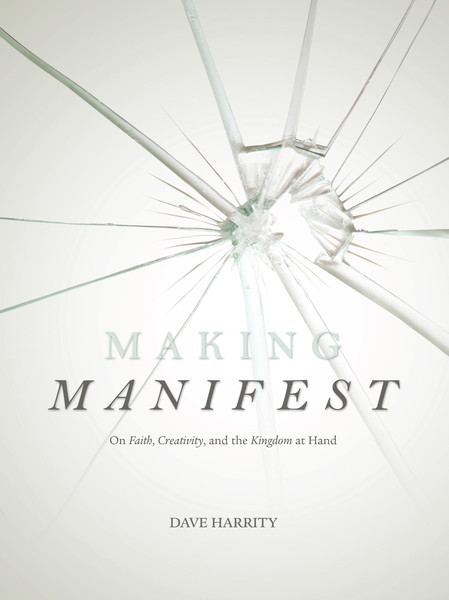
Want a place to start? You really must check out Making Manifest, just out by Dave Harrity.

And watch this excellent video trailer: