The People Don’t Perish Without a Vision Statement

no vision
no vision
Yes, the reference is wrong. It should be Prov. 29:18

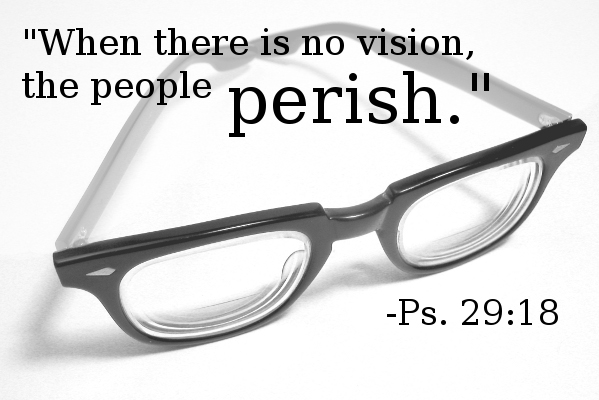
You’ve probably heard the line before: “Where there is no vision, the people perish.”

You’re most likely to have heard it in some sort of church planning meeting. Or in a ramp-up for the unveiling of a new, great church plan. There’s likely a capital campaign at hand, too.

“Why does our church need a vision statement? Because without it, the people perish. So says Proverbs 29:18.”

I’ve heard this proverb quoted dozens of times to prove that the church needs to be involved in strategic planning, mission statements, vision statements, core values, etc. And it’s always quoted in the old King James Version. Even hip, Message-Bible-using contemporary pastors resort to the KJV for Proverbs 29:18.

Why? Because here’s how the NIV reads: “Where there is no revelation, people cast off restraint.” Or try Today’s English Version: “A nation without God’s guidance is a nation without order.”

What the Proverb is About

This is a proverb about receiving guidance from God.

This is about a people’s desperate need to hear from God.

It’s about the ways that people go off and do whatever they feel like doing if they don’t heed God’s instruction.

What the Proverb is NOT About

This is not about crafting “our vision.”

Google “church vision statement” and you’ll see all kinds of advice about making big plans, dreaming big dreams, and inspiring your people. These may frequently include the types of buildings and land a church will own, the types of programs they will offer, and the types of people they will attract.

Yes, most good leaders and churches will surely at some point mention that the vision is “inspired by God.” But does the process really always reflect that? Are we more frequently asking what our plans, hopes, and dreams are, or asking for a revelation from God?

A godly vision

My point here isn’t to tell you to drop all the strategic planning. I think it has its place. We do need to know what we’re aiming at.

Actually, I think the bigger problem is that churches today are having to create vision and mission statements. Do we really not know what we have been put here to do?

Somehow, it seems that churches got sucked in by the visioneering of the ’80s. We’ve all been taught that if we don’t have a mission statement that every member has memorized and a vision statement that has captured the congregation’s imagination, we clearly have no idea what we’re doing. Let’s just remember that the Church survived (and at many times thrived) for nearly 2000 years without these things. The great business strategies introduced a few decades ago probably aren’t what the American Church is looking for to end its decline.

Is it possible that all of our visioneering is actually preventing us from more clearly hearing from God? Is it possible that we’re missing something bigger because we’re so set on our vision of becoming a mega-church, or our strategic action plan to build a gym?

A disclaimer before the comments:do think strategic planning has its place. I have no great fondness for formal mission statements. The church (and even businesses) found some way to survive all the way to the 1980’s without these now-imperative statements. But I don’t think they’re inherently bad. I’m just wondering if we’ve given strategic planning too much prominence. If we’ve made this more about (wo)man-centered vision than a revelation from God. Is that why we insist on going back to that comfortable KJV version of Prov 29:18 to make a point that the proverb isn’t making?

What do you think? Share something in the comments.

Trust, Money, and the Guaranteed Appointment

guaranteed

guaranteedThe United Methodist Church’s Judicial Council just nullified a decision at GC2012 to do away with guaranteed appointment. I’m not going to get into all of the legislative technicalities here. Let’s look at the bigger picture.

The guaranteed appointment issue is about trust – on all sides. Those worried that a Bishop won’t continue a worthy person’s appointment are ultimately saying they don’t trust our Bishops. They believe they need protection from Bishops who might make an ill-informed, prejudiced, or punitive decision.

Some will say this is about a check and balance. The Board of Ordained Ministry determines who will serve; the Bishop determines where they will serve.

Either way, United Methodists commonly hold up the importance of submission in our system. Elders submit to the Bishop’s authority and submit to go where they are sent. Are we saying elders are willing to submit to the Bishop regarding where they go, but not whether they go anywhere or not? This seems backward from the New Testament appointment of elders, which appears to be a submission regarding whether one served as an elder, not where.

If people are willing to submit to where, but not whether they are appointed, I wonder if this is really about a guaranteed income (with benefits), not a guaranteed appointment. We don’t just guarantee appointments to elders. We guarantee them appointments to full-time jobs, where they must be provided a minimum salary, housing, health insurance, and a pension. And as more and more churches face budget crunches in the coming years, there will be concern about whether we can provide all of those guaranteed incomes.

[Major edit: Wesley Sanders notes in the comments that GC2012 passed a petition to allow appointment of elders for less than full-time, and the Judicial Council didn’t nullify that petition. See it here. This is a big deal. It moves everything I’ve said below from hypothetical to realistic. We have effectively done away with guaranteed full-time appointment. In my mind, this is more important than doing away with guaranteed appointment.]

Some will say, “No, I’m concerned about having a place to serve as a pastor, not the income.” That’s a great attitude. I hope it’s true. And what if that’s how we approached guaranteed appointment? What if we stopped guaranteeing a full-time income and benefits to our elders? Guarantee that they’ll have a place to serve, but it might be a part-time position.

Why have we mandated that ordained elders receive a full-time income from the church? Some will claim that ministry requires full-time attention, and that needs to be protected. But then they’ll need to explain all of the part-time local pastor appointments throughout our connection.

Get rid of the guaranteed full-time paid position, and I think many of our other problems go away. I hear concerns over whether to ordain people who don’t speak English fluently. “They can be great in a Hispanic (or Korean, or French-speaking Congolese…) congregation, but we only have four of those in our Conference. What if we have more ordained Spanish-speakers than positions?” That’s only an issue if it’s about a guaranteed full-time income.

But if you thought there was a lot of consternation over removing guaranteed appointments, just wait until you see what happens when guaranteed full-time incomes are threatened. Due to our current financial situation and the further budgetary strains coming, it’s an issue we’ll have to broach sooner or later.

See more United Methodist posts on my UMC posts page.

“Your organizational structures are killing you”

decision making

decision makingI was recently talking with my good friend Eddie, part of the leadership team at a mega-church, and I asked, “What’s a blind spot smaller churches seem to have – from the vantage point of mega-church world?”

Eddie didn’t even hesitate. “Your organizational structures are killing you,” he said.

Me: “What does that mean? How can we organize differently?”

Eddie: “Last year, we had the idea to start a multi-site location one Tuesday. It was the first time we had ever talked about it. Six weeks later, on Easter Sunday, we opened the site. How many committees would your church have had to go through to do that? How many people would have had to approve it? How long would it have taken you?”

At Eddie’s mega-church, there’s a weekly Tuesday meeting of their 6 or 7 primary leaders. He says everything could change on any given Tuesday.

Now we’re not all trying to become mega-churches. That’s not what I’m advocating here. And maybe we would say there are good reasons to move a bit more slowly. But is there a chance your organizational structures are a serious problem? How long does it take to make a relatively major decision? How many meetings have to be called?

How long to make even a minor decision? Are there less-than-earth-shattering things that likely can’t be accomplished in three months’ time because there are too many steps in the decision-making process to get there by then?

[For an example of how the UMC is struggling with this at an Annual Conference level, not to even mention the General Conference level, see here.]

How come a 3,000-member church is able to turn more quickly than churches much smaller? This seems to defeat the whole notion/excuse that “It takes an aircraft carrier a long time to turn around.”

And is there a risk that church politics start to play a bigger role when people know how easy it is to throw a wrench into the middle of plans and grind everything to a halt – or at least slow it enough that it’s likely to die?

Invite some friends to join the conversation –
share this on Facebook.
Thanks!

For anyone in church leadership, you should take the time to read the article “Leadership and Church Dynamics,” by Tim Keller. Thanks to Chad Brooks for pointing it out to me. Find the link here (requires free registration) or download the PDF directly here.